
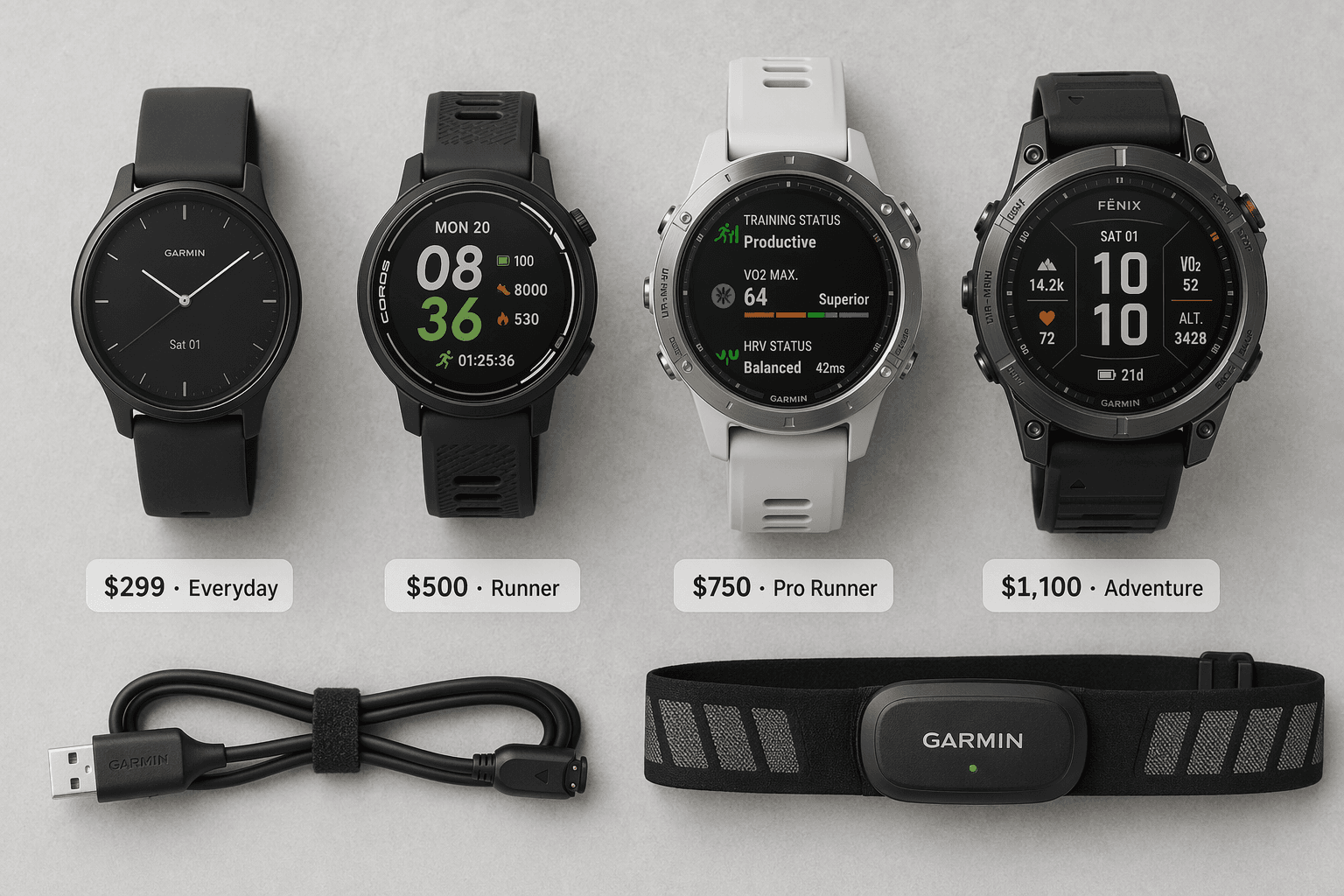
The sticker price on a Garmin fitness tracker is the number the company wants you to see first. But it’s rarely the number you end up paying. I keep seeing this pattern: someone buys a Forerunner 970 — $750, multi-band GPS, 15-day battery, all the training metrics a serious runner could want — and then discovers they need a separate $170 chest strap to get the advanced running metrics the watch was marketed for. And now there’s a subscription: Connect+, at $70 a year. Over three years, that $750 watch becomes $1,130 — before you replace a band or a cable.
The $170 Strap You Didn't Know You Needed
If you’re a casual walker or a daily step-counter, the watch’s built-in optical heart rate sensor is fine. But if you buy a Forerunner 970 because you want the deep running data, the watch alone won’t give it to you. Garmin’s HRM 600 chest strap is required for Step Speed Loss, Running Economy, and Running Tolerance — the three metrics that are the main selling point for the 970’s advanced running features. Without the strap, you’re paying for a trophy you can’t touch. The $170 strap is not optional if you want the headline numbers. Garmin’s product page lists the watch at $750 and separately sells the strap. They’re not hiding it. But they’re also not bundling it, and the marketing copy leads with the metrics, not the accessory.
A Vivoactive 6 owner at $300 doesn’t need the strap. For them, the hidden cost is zero. That’s the key nuance: the strap is conditional, but if you buy a 970, the condition is nearly always met.
Connect+: $70 a Year for One Useful Screen?
Garmin’s free Connect app has long been one of the best reasons to own a Garmin. No subscription. Full data. That changed in 2025 with the launch of Connect+, a paid tier that costs $6.99 a month or $69.99 a year. For that, you get features like Live Activities, Active Intelligence, and some deeper performance analysis.
WIRED’s reviewer tested Connect+ for five months and came away with a clear verdict:
“It’s probably not worth it.”
The only genuinely useful feature they found was Live Activities. Active Intelligence, the main selling point, delivered insights they described as “pretty rudimentary” — even after months of use, it still lacked specific exercise recommendations. Paying $70 a year for one useful screen seems thin. That’s one reviewer’s opinion, but it matches what I see in the forums: most users skip it.
What bothers me more than the current value — or lack of it — is what it signals. Garmin now has a dedicated team building paywalled features. That is a clear sign that the free tier may shrink over time. The company already sells other subscriptions on top of Connect+: Outdoor Maps+, inReach plans. The trend is toward a multi-subscription future.
For comparison, Whoop’s subscription model costs $149–$359 per year depending on tier, and the device is free. Oura charges $72 per year. Garmin’s $70 is cheaper than both, but you’re also paying for the hardware upfront. The total ownership picture changes when you stack them.
Other Costs That Add Up Fast
Beyond the strap and subscription, there are smaller recurring expenses that most buyers don’t think about at checkout:
- Replacement bands: Garmin’s proprietary quick-release bands cost $30–$60. If you wear daily, you’ll likely replace one in 18–24 months.
- Charging cable: If you lose or damage the proprietary cable, a new one runs $20–$40.
- Fenix 8 Pro satellite subscription: For the rugged $1,100 Fenix 8 Pro, you can enable inReach satellite messaging. Plans start at $8 a month for basic SOS and go up to $50 a month for unlimited texting with photos. That’s a separate bill, on top of Connect+.
These costs are not universal. A Vivoactive 6 user will spend maybe $30 on a band over three years. A Fenix 8 Pro adventurer could drop $1,200 extra on satellite plans alone. The point is: do not assume the sticker is the cap.
The 3-Year Total: Three Scenarios
Let’s put it all together. Over three years, your actual spend depends entirely on which Garmin you pick and how deep you go into the ecosystem.
| Scenario | Device | Accessories | Subscriptions | 3-Year Total |
|---|---|---|---|---|
| Casual (no advanced metrics) | Vivoactive 6 ($299) | None | None | $299 |
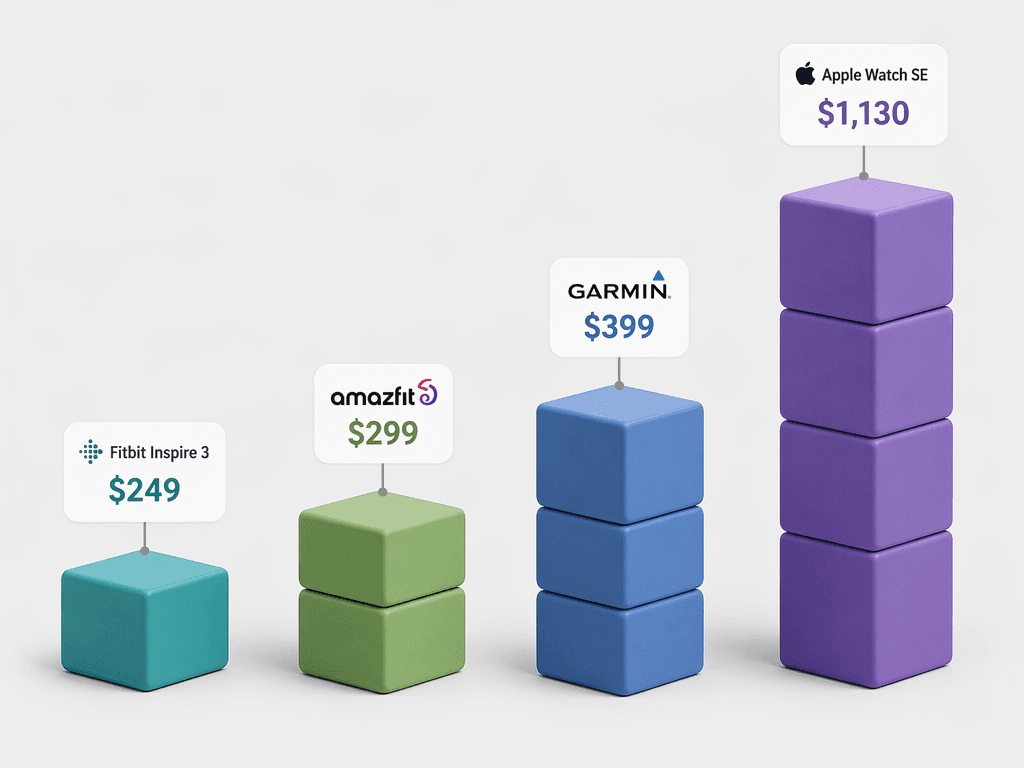
| Runner (needs running metrics) | Forerunner 970 ($750) | HRM 600 ($170) | Connect+ 3 yr ($210) | $1,130 |
| Adventurer (satellite messaging) | Fenix 8 Pro ($1,100) | None | Basic inReach 3 yr ($288) | $1,388 |
Now compare to the alternatives:
| Ecosystem | Device Price | Subscription Cost (3 yr) | 3-Year Total |
|---|---|---|---|
| Apple Watch SE 3 | $249 | $0 (no sub needed) | $249 |
| Fitbit Charge 6 + Premium | $160 | $240 ($80/yr) | $400 |
| Whoop 5.0 | $0 (free) | $447–$1,077 ($149–$359/yr) | $447–$1,077 |
| Oura Ring 4 | $300 | $216 ($72/yr) | $216–$516 |
The starkest line: a Vivoactive 6 costs $299 total; a fully loaded Forerunner 970 costs over four times that. The Forerunner 970 with strap and subscription isn’t even the peak — that belongs to the Fenix 8 Pro with satellite.
For a broader look at how Garmin’s ecosystem compares to Whoop and Oura, see our ecosystem comparison guide. And if you’re still deciding which tracker to start with, our best tracker for home gym workouts guide covers more options in the same price range.
Who Should Buy a Garmin?
If you are a serious runner who will use the advanced metrics — Step Speed Loss, Running Economy, Running Tolerance — the Forerunner 970 with the HRM 600 and Connect+ is a fantastic system. The data depth is unmatched. Budget $1,130 over three years, and you get what you pay for.
If you are a budget-conscious home fitness buyer who just wants heart rate, steps, and sleep tracking, don’t buy a premium Garmin. A Vivoactive 6 at $299 is fine, but an Apple Watch SE at $249 (iPhone required) or a Fitbit Charge 6 with Premium at $400 gives you comparable core tracking without the ecosystem creep.
My real concern is the trend. Garmin has a dedicated team building paywalled features. The free tier has already lost some features to Connect+. If you buy a premium Garmin today and keep it for three years, the total cost could climb higher if more features move behind the paywall. The math favors the competition for anyone who doesn’t need Garmin’s unique running metrics.
Comments
Join the discussion with an anonymous comment.