
The least useful way to compare women’s health features is the one most spec sheets use: cycle tracking: yes. That checkbox can mean a calendar where you enter period dates, a prediction model that estimates fertile windows, a temperature-based ovulation estimate, a pregnancy mode with blood glucose logging, or a symptom log that still works when periods become irregular or stop. Those are not small differences. They change who the device is useful for.
If you are searching for the best fitness tracker watch for women specifically because of women’s health tracking, the answer is not one watch for every life stage. Garmin has the broadest support for pregnancy and non-textbook cycle tracking. Apple Watch Series 11 is the clearest watch choice when ovulation estimation from wrist temperature is the priority. Oura Ring 4 is one of the strongest fertility-tracking options because of its Natural Cycles integration, but it is a ring, not a watch, so it breaks the form-factor promise in the search term. Fitbit is useful for basic period and fertile-window logging, but it does not compete with Garmin on pregnancy support or with Apple and Oura on temperature-based ovulation workflows.
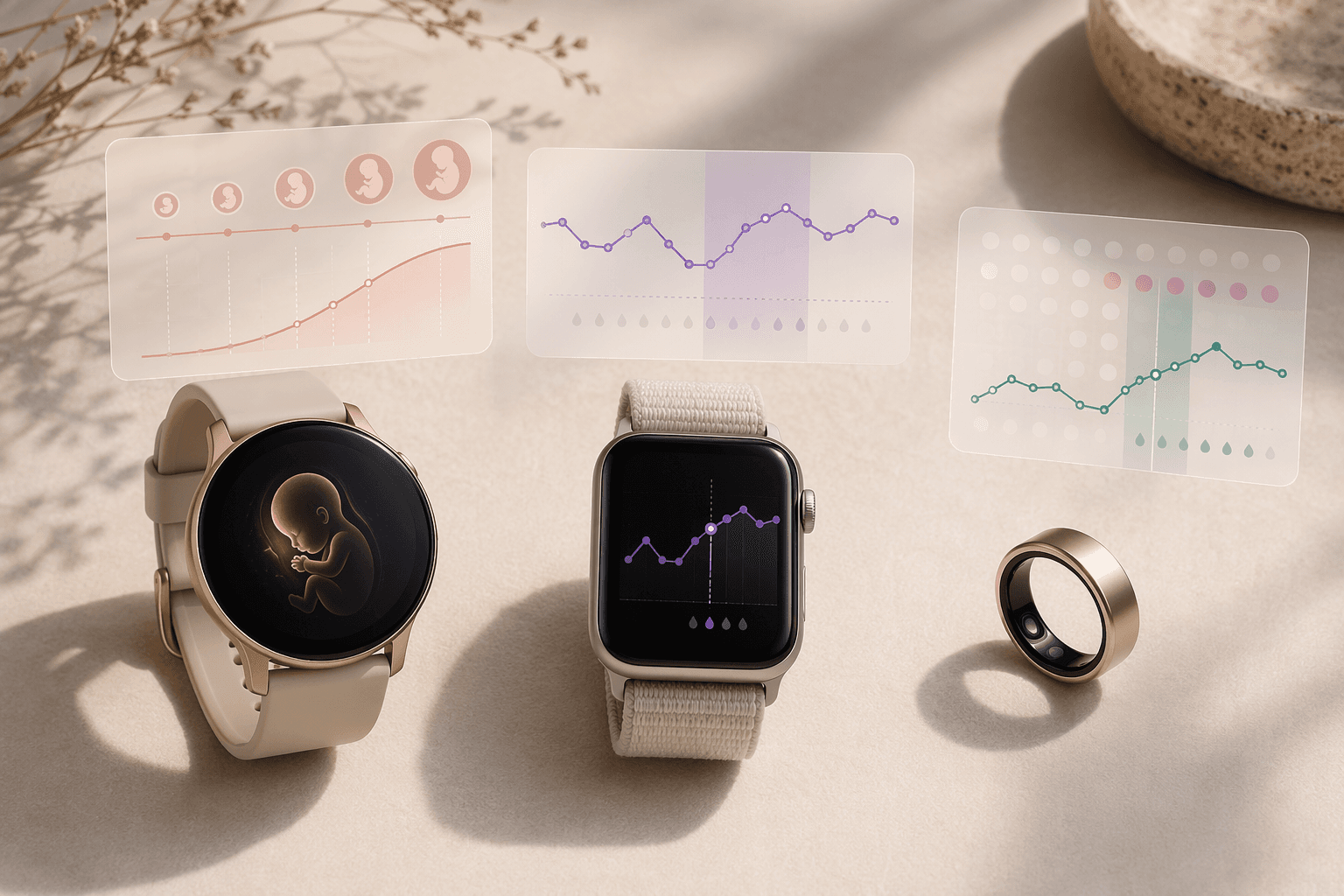
What “Women’s Health Tracking” Actually Means
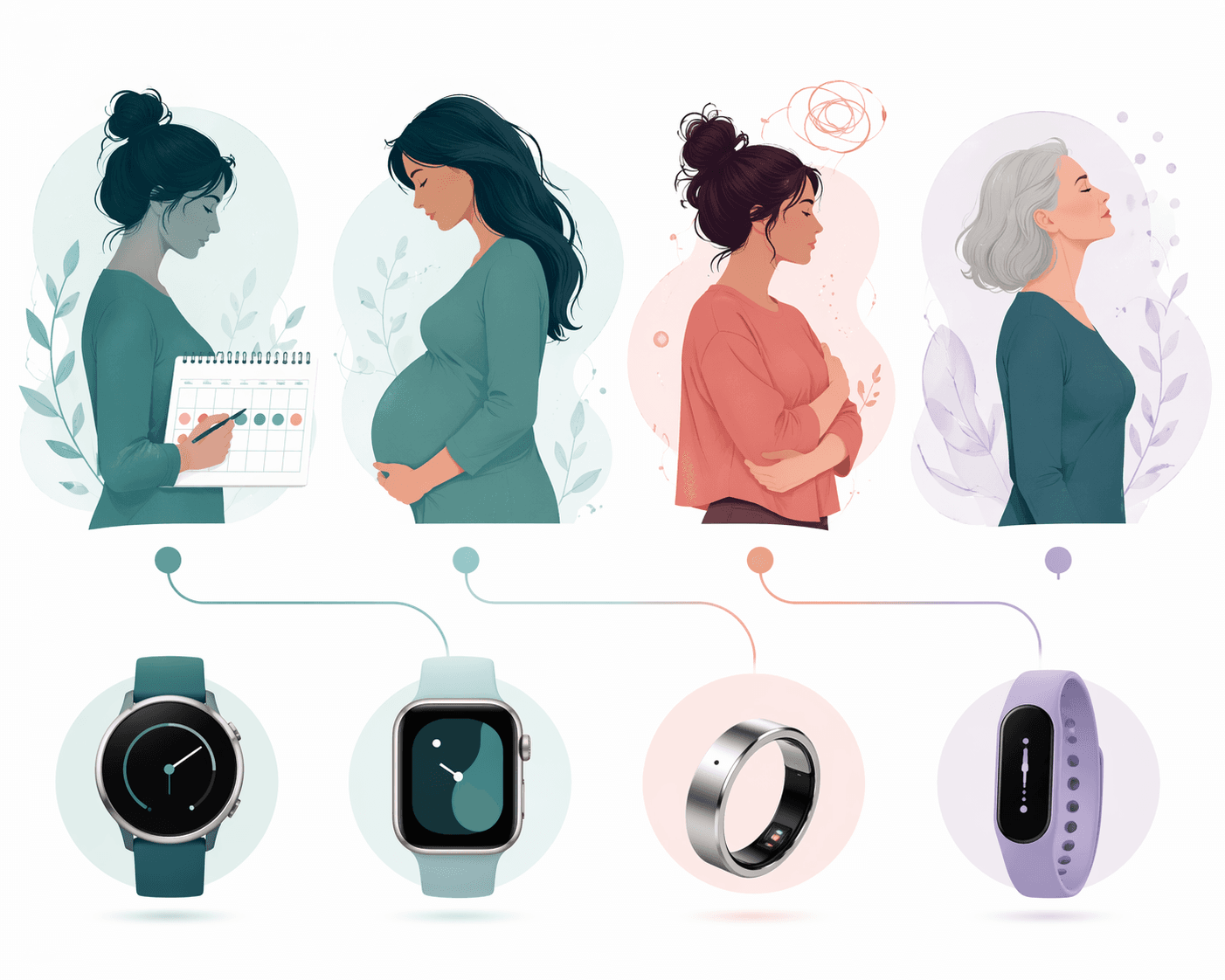
A device that lets you log a period is not doing the same job as a device that estimates ovulation, and neither is doing the same job as a pregnancy tracker. The practical question is what the tracker does when the user’s body is under more interpretive pressure: trying to conceive, pregnant, postpartum, dealing with PCOS, entering perimenopause, or watching symptoms that do not follow a neat 28-day model.
| Feature depth | What it usually includes | Why it matters |
|---|---|---|
| Period logging | Manual period dates, symptoms, and predicted next period | Useful for general awareness, but mostly depends on user entry |
| Fertile-window prediction | Estimated fertile days based on logged cycle patterns | Helpful for planning, but not the same as detecting ovulation |
| Temperature-based ovulation estimation | Wrist or body temperature trends used to estimate likely ovulation after the fact | More meaningful for fertility tracking, but still not a diagnostic medical test |
| Pregnancy support | Gestational age estimates, pregnancy-specific guidance, and related health logs | Much more useful once the question shifts from predicting periods to monitoring pregnancy routines |
| Irregular cycle and menopause support | Symptom logging when periods are absent, irregular, or no longer the central signal | Critical for PCOS, postpartum, perimenopause, and menopause users |
That distinction is where Garmin immediately separates itself. Tom’s Guide reports that Garmin’s pregnancy tracking includes gestational age estimates, prenatal nutrition and exercise guidance, and blood glucose entry for gestational diabetes management, and frames it as a feature Apple would need to copy to compete on women’s health depth. [1]
Garmin’s own women’s health documentation also matters because it does not stop at standard periods. Garmin documents pregnancy tracking, support for logging symptoms when periods are irregular or absent, and menopause symptom tracking. [2] That “absent period” detail sounds small until you think about postpartum tracking, PCOS, or perimenopause. A calendar that only behaves well when bleeding is regular can make the exact users who need tracking most feel like exceptions.
Garmin Is Strongest for Pregnancy and Broader Life-Stage Support
Garmin’s advantage is not that it has prettier women’s health branding. It is that its feature set keeps working after the simple period-prediction use case ends. Pregnancy tracking changes the center of the product from “when is my next period?” to “what stage of pregnancy am I in, what should I log, and what health routines need attention?” The blood glucose entry option is especially notable because gestational diabetes management is a concrete pregnancy scenario, not a vague wellness mood.
The same breadth helps outside pregnancy. Garmin’s documentation says users can track cycle-related symptoms even when periods are absent, and it includes menopause symptom tracking. [2] That makes Garmin the most convincing choice here for someone whose main concern is not a single fertile-window estimate but ongoing body-pattern logging across pregnancy, postpartum changes, irregular cycles, perimenopause, or menopause.
There is also a limited real-world note worth keeping in proportion. DC Rainmaker’s Garmin Lily 2 review includes user reporting that period predictions were within 1 day for irregular cycles. [3] That is not broad clinical validation, and it should not be treated like one. It is still useful as a reminder that prediction accuracy is experienced personally and longitudinally: a tracker either helps you notice your pattern over months, or it becomes another notification you learn to ignore.
Apple Watch Series 11 Is the Watch Pick for Ovulation Estimation
Apple’s clearest advantage is narrower and more specific: wrist-temperature-based ovulation estimation on Apple Watch Series 11. That is meaningfully different from manually logging a period date or seeing a predicted fertile window. It uses temperature trends to estimate likely ovulation, which makes it more relevant for users trying to understand ovulatory patterns than a basic cycle calendar.
The limitation is evidence depth. As of Q2 2026, the newer generation of temperature-based ovulation features still has limited long-term independent reliability data in the materials available here. That does not make the feature useless; it means it should be read as a consumer wellness and fertility-awareness aid, not as a standalone medical answer. For someone trying to conceive, Apple Watch Series 11 is the most straightforward recommendation if the requirement is specifically a watch with ovulation estimation.
Oura Ring 4 May Be Better for Fertility, If You Can Give Up the Watch
Oura Ring 4 needs an asterisk every time it appears in this conversation: it is not a fitness tracker watch. For a buyer who wants a screen on the wrist, notifications, workout controls, and watch-style daily utility, that is a real trade-off. But for fertility tracking, Oura’s Natural Cycles integration is too relevant to ignore.
Natural Cycles is an FDA-cleared birth control app, and Oura Ring 4’s integration with Natural Cycles connects overnight temperature data to a fertility workflow rather than leaving the user to interpret temperature patterns alone. Reported ovulation detection accuracy for this combined approach is 85–95%. [4] That is the strongest fertility-tracking case in this comparison, but it belongs to a ring-plus-app setup, not a standalone watch feature.
That distinction matters because “best” changes with the job. If the job is fertility tracking and you are comfortable wearing a ring, Oura Ring 4 deserves serious consideration. If the job is choosing a watch that also handles workouts, phone integration, and daily display interactions, Apple keeps the cleaner fit.
Where Fitbit Fits
Fitbit is easiest to place because its women’s health features are more limited in the supplied materials. It can log period dates and fertile windows, which can be enough for someone who wants light cycle awareness alongside steps, sleep, and everyday fitness tracking. But it lacks the pregnancy depth Garmin offers and the temperature-based ovulation support that makes Apple and Oura more compelling for fertility-focused users.
That does not make Fitbit a bad tracker. It makes it the wrong device to buy if women’s health tracking is the deciding feature rather than a nice extra. A basic log can still be useful, especially if you already like Fitbit’s app and want a simple record to bring to a clinician or compare against symptoms. It just should not be mistaken for deeper reproductive-health support.
Choose by the Life Stage You Are Actually In
For pregnancy, Garmin is the strongest pick because it gives pregnancy its own tracking context instead of treating it as a pause in normal cycle prediction. Gestational age estimates, prenatal nutrition and exercise guidance, and blood glucose entry give it practical depth that the other major wearable brands in this comparison do not match in the supplied research. [1]
For trying to conceive, split the recommendation by form factor. If you want a watch, Apple Watch Series 11 is the clearest option because of wrist-temperature ovulation estimation. If you are willing to wear a ring, Oura Ring 4 with Natural Cycles is the stronger fertility workflow. Those are different answers because they solve the problem differently: Apple keeps fertility estimation inside a watch, while Oura leans into a dedicated temperature-plus-app system.
For PCOS, postpartum changes, irregular cycles, perimenopause, or menopause, Garmin again has the better shape. The ability to log symptoms when periods are absent and the inclusion of menopause symptom tracking are more useful than a prediction model that assumes regular bleeding. [2] If recovery, HRV, and metabolic changes are becoming as important as cycle data, the more focused guide to the best fitness tracker watch for women over 35 is the better next read.
For general cycle awareness, Fitbit can be enough if your expectations are modest. If you want the broader buying context beyond reproductive health features, start with Choosing a Fitness Tracker as a Woman. If your main concern is how much confidence to place in these signals, the accuracy-focused guide to heart rate, sleep, and cycle tracking is the more relevant follow-up.
There is no single best fitness tracker watch for women’s health across every life stage. Garmin is the best fit for pregnancy and broader women’s health support. Apple Watch Series 11 is the watch to choose for ovulation estimation. Oura Ring 4 is the strongest fertility-tracking option if you accept a ring instead of a watch. Fitbit is best understood as basic cycle logging, not deep women’s health tracking.
References
- Which fitness trackers are the best for tracking women's health?, Tom's Guide
- Women's Health, Garmin
- Garmin Lily 2 In-Depth Review, DC Rainmaker, January 2024
- Oura Ring 4 and Natural Cycles ovulation detection reporting, jointcorp
Comments
Join the discussion with an anonymous comment.