
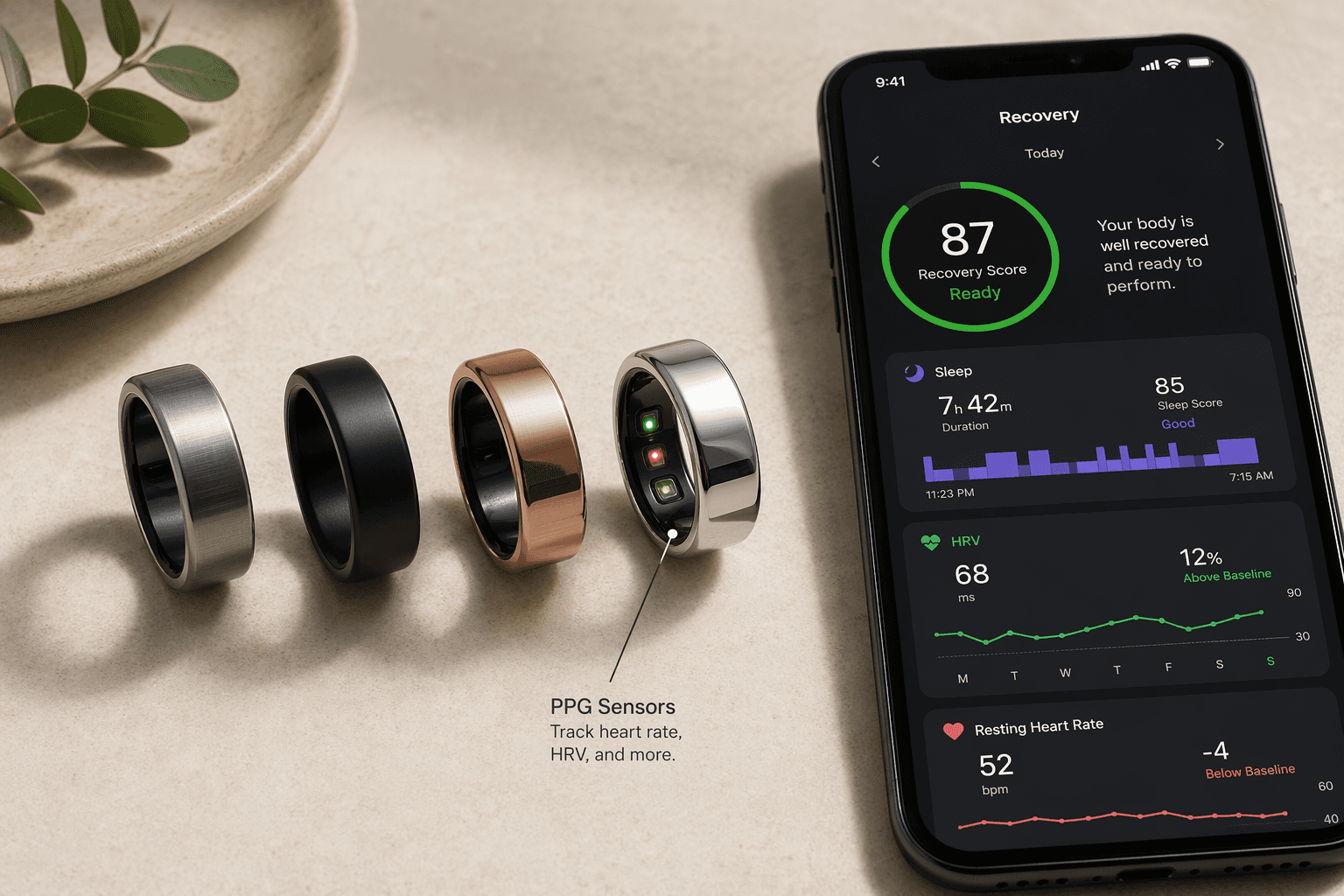
Why Your Finger Beats Your Wrist for Recovery Data
The case for a smart ring starts with anatomy. Finger arteries sit closer to the surface than wrist arteries, which means a ring can capture a tighter pulse signal with fewer dropouts during sleep. For overnight heart rate and HRV measurement — the raw material of any recovery score — that cleaner signal is a real advantage. I’ve tested multiple rings, and the difference in signal consistency is noticeable.
The Gadgeteer sums it up: “Finger arteries sit closer to the surface than wrist arteries, giving smart rings a tighter pulse signal and fewer dropouts during sleep for overnight HRV and heart rate measurement.” A ring worn all night doesn’t twist or move as much as a watch band, so the data is more consistent. That consistency matters because a single bad night of tracking can throw off a whole week’s recovery trend.
None of this means wrist wearables are useless — they are fine for daytime activity. But if your primary goal is recovery tracking, the form factor itself gives rings a structural edge. The question is which ring turns that raw signal into something useful without locking you into a subscription or a charging schedule that guarantees you will miss a night.
The Two Numbers That Matter: Battery Life and Two-Year Cost
Let me cut through the feature lists. When you evaluate a ring for recovery, two numbers matter more than any other: how many consecutive nights can it track without needing a charge, and how much will it cost you over two years. Every other spec is secondary.
| Ring | Price | Subscription | Tested Battery (PCMag) | Two-Year Cost | Recovery Algorithm Depth |
|---|---|---|---|---|---|
| Oura Ring 4 | $349 | $5.99/mo | 7.25 days | $492.76 | Proprietary Readiness Score (7 contributors) |
| RingConn Gen 2 | $299 | None | 10.5 days | $299 | HRV + sleep trends, no composite score |
| Ultrahuman Ring AIR | $349 | None | 4–6 days (manufacturer) | $349 | Movement Index + sleep metrics |
| Samsung Galaxy Ring | $399 | None | 6.5 days | $399 | Basic sleep/HRV, Samsung Health integration |
RingConn wins both categories. Its 10.5-day tested battery means you practically never have to charge during sleep. Its $299 two-year cost is the lowest. Oura costs nearly $200 more and requires a reminder to charge every week. Ultrahuman and Samsung fall in the middle on both metrics.
Oura Ring 4: The Algorithm You Pay For
Oura's Readiness Score is the most comprehensive recovery algorithm in a ring today. It aggregates seven contributors: Sleep, Sleep Balance, Previous Day Activity, Activity Balance, Resting Heart Rate, HRV Balance, Body Temperature, and Recovery Index. Each contributor is scored and weighted into a single 0–100 number: 85 or higher means optimal, 70–84 is good, under 70 suggests you need recovery.
That depth comes with two costs. First, the subscription: $5.99/month adds up to $492.76 over two years — nearly $200 more than any subscription-free ring. Second, the algorithm is a black box. Sports cardiologist Dr. Eamon Duffy told Health.com: “Recovery scores are motivational, not diagnostic.” You are paying for a black box that tells you how ready you are. That can still be useful — trends over time are meaningful — but do not expect the score to tell you why you are at 67 instead of 82, or exactly what to do about it.
Where Oura excels is sleep-stage analysis. It tracks light, deep, and REM sleep with greater granularity than any other ring. If you will actually adjust your bedtime based on a sleep balance number, the subscription might be worth it. If you just want to know whether you recovered well, the extra algorithm depth may not justify the recurring fee.
- Readiness Score range: 85+ optimal, 70–84 good, <70 needs recovery (Oura blog).
- Seven contributors include HRV Balance, Sleep Balance, and Recovery Index (Oura blog).
- Two-year cost: $492.76 (Wareable, PCMag).
RingConn Gen 2: The Uninterrupted Overnight Tracker
RingConn Gen 2 addresses what I consider the biggest practical barrier to consistent recovery data: charging gaps. If you take your ring off to charge during the night — and with a 5–7 day battery, most rings eventually need that — you lose a night’s worth of HRV and sleep data. One missed charge can corrupt a week’s trend.
RingConn’s tested battery life is 10.5 days (PCMag), and the manufacturer claims 10–12 days. In real-world terms, that means you can charge it during a morning shower every week and a half and never interrupt a night of tracking. That is a concrete operational advantage.
The ring costs $299 with no subscription. Over two years, you pay exactly $299 — $193.76 less than Oura. The trade-off is algorithm depth: RingConn does not have a composite readiness score. It tracks HRV, heart rate, and sleep metrics, and leaves the interpretation to you. I prefer that: raw numbers are more honest than a black-box score.
RingConn’s own blog explains that “HRV reflects the state of the Autonomic Nervous System: high HRV indicates relaxation and recovery, low HRV indicates stress or fatigue” and that “a ‘good’ HRV score is intensely personal and depends on age, genetics, and fitness level; trend analysis against personal baseline is the correct interpretation method.” That is solid advice. Just know it’s from company marketing — take the mechanics, not the hype.
Ultrahuman Ring AIR: Subscription-Free, But Availability Risk
Ultrahuman offers a compelling value proposition: $349, no subscription, and a set of insights that include sleep tracking, HRV, and a Movement Index. The ring is lightweight and comfortable, and the app avoids the gamification that some users find distracting.
But there is a catch. Wareable reports that the Ultrahuman Ring AIR faces a US import ban due to patent disputes with Oura, with no resolution date. If you are outside the US, this may not matter. For US readers, availability is uncertain, and warranty support could be complicated.
Battery life is also weaker: 4–6 days per charge, meaning you will have to charge more often, which increases the risk of missing a night. If you can buy it and you accept the charging frequency, Ultrahuman is a solid choice. I cannot confidently recommend it to US buyers at this time.
What Rings Still Can’t Tell You
Every recovery score from a ring — Oura’s, RingConn’s trends, Ultrahuman’s Movement Index — comes with the same fundamental limitation: it is proprietary, not diagnostic. Dr. Duffy’s point bears repeating: “Recovery scores are motivational, not diagnostic.” The formulas are undisclosed. A score of 72 on one ring is not equivalent to a 72 on another.
What this means in practice is that you should watch trends, not single numbers. If your HRV baseline is gradually dropping over two weeks, that is a meaningful signal — regardless of whether the readiness score says 74 or 81. Factors like dehydration, alcohol, and late meals will also drag down scores. The ring can tell you that something is off, but it cannot tell you what specifically caused it.
That is okay. The ring’s job is to surface the data; your job is to act on it. If you wake up with a low readiness score, the practical response is: prioritize sleep that night, reduce training load, hydrate, skip the evening drink. The ring is a sensor, not a coach.
Which Ring Should You Buy?
There is no universal best smart ring for recovery. The right choice depends on your priorities. Here’s how I see it:
- If you want the most sophisticated readiness algorithm and are willing to pay $5.99/month for it, and you care about sleep-stage breakdown and will act on the daily score — choose Oura Ring 4.
- If you want uninterrupted overnight tracking without subscription costs, prefer to see raw HRV and sleep data and interpret it yourself, and want the lowest total cost over two years — choose RingConn Gen 2.
- If you are outside the US, want no subscription, and are okay with charging every 4–6 days — consider Ultrahuman Ring AIR.
- If you are a Samsung phone user and want a basic ring for sleep tracking without extra fees — the Galaxy Ring works, but its recovery depth is shallower.
For the majority of home fitness enthusiasts — people who train consistently, want to track recovery without thought, and do not want an ongoing fee — the RingConn Gen 2 is the strongest recommendation. Its battery life alone removes the most common source of data gaps, and its price makes it an easy buy. Oura is better only if you specifically need the algorithmic depth and are willing to pay for it. Ultrahuman is a solid option if you can get it, but the availability risk is real.
None of these rings will diagnose an illness or tell you exactly what to do. They will give you clean, consistent data about your sleep and recovery. That is enough — if you use it.
Comments
Join the discussion with an anonymous comment.