The useful way to shop for cable machine alternatives for a home gym is not to ask which gadget “replaces” a cable station. That question usually leads to disappointment. A full cable machine gives you smooth constant tension, adjustable angles, heavy pulldowns, pushdowns, rows, curls, flys, face pulls, and a tidy loading path in one fixed place. It also commonly asks for $1,000–$4,500+ and roughly a 5×5 ft footprint plus 3–4 ft of working clearance, before dealing with ceiling height, wall studs, bolting, plates, or delivery logistics.[1]
If you are in an apartment, renting, lifting in a bedroom corner, or trying not to spend rack-money on one machine, the better question is smaller: which cable function do you actually use? Lat pulldowns are a different problem from cable flys. Triceps pushdowns are a different problem from heavy seated rows. “Constant tension” is a different problem from “I need something that fits in a drawer.”
Start With the Cable Function, Not the Product
A small-space setup works when each piece earns its floor space. For cable-style training, these are the functions worth preserving:
- Constant or near-constant tension through the rep.
- Multi-angle isolation for flys, lateral raises, curls, extensions, face pulls, and rear-delt work.
- Vertical pulling and pushdown patterns, especially lat pulldowns and triceps pushdowns.
- Horizontal rows without needing another large machine.
- Progressive loading that is not a guessing game.
- Storage that does not make the room feel permanently occupied by gym equipment.
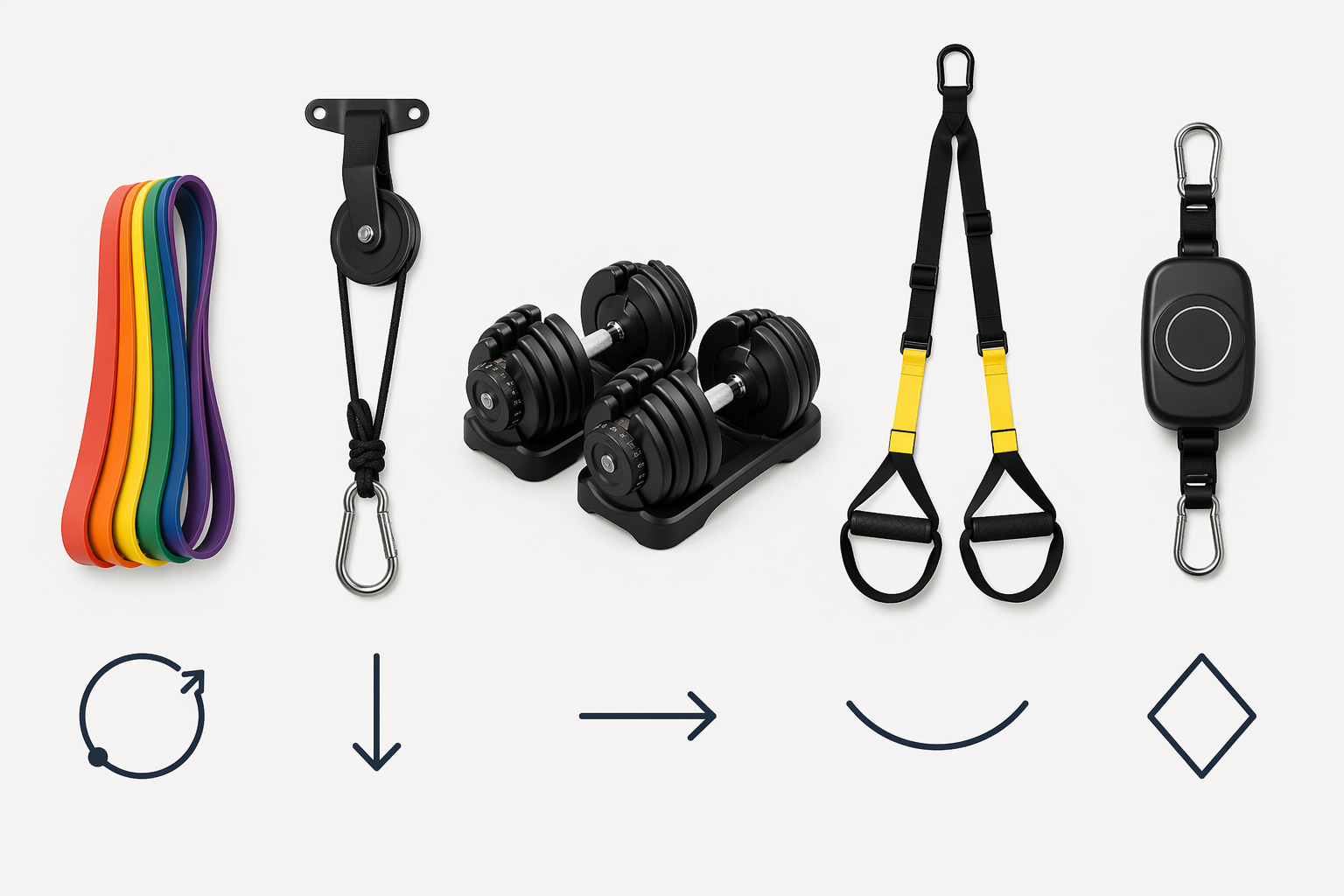
Once you separate those jobs, the answer gets less dramatic and more useful. Bands, a pulley, dumbbells, and a suspension trainer do not turn into a commercial functional trainer. But together, they can cover most of the cable exercises people actually program at home, while costing and storing like a small kit instead of a machine.
| Alternative | Best cable functions it covers | Where it falls short | Typical cost and space |
|---|---|---|---|
| Resistance bands | Pushdowns, curls, face pulls, lateral raises, fly variations, warmups, high-rep isolation | Variable tension; weakest at the least-stretched point, which can be exactly where some exercises need meaningful loading | $10–$60; shoebox storage[2] |
| DIY or rack-mounted pulley | Lat pulldowns, triceps pushdowns, rows, curls, straight-arm pulldowns | Needs a safe anchor, enough height, plates or loading pin, and setup time | About $25 for a DIY version; commercial simple pulley systems cost more[3] |
| Adjustable dumbbells | Rows, presses, curls, raises, fly-like free-weight work, heavy unilateral training | No cable path and no constant tension; gravity decides the resistance direction | $150–$500; compact but still needs lifting space |
| Suspension trainer | Rows, bodyweight fly-like patterns, rear-delt work, core-heavy pulling and pressing | Bodyweight loading is awkward to quantify; not a true cable resistance path | $100–$250; hangs on a door, beam, rack, or anchor |
| Portable digital cable unit | Compact adjustable resistance, app-controlled cable-style work, travel-friendly training | Can become expensive fast; often depends on mounts, apps, batteries, and ecosystem choices | Roughly $200–$2,199 depending on model and resistance limit[5][6] |
| Budget cable tower or half-rack pulley | Closest feel to a real home cable setup for pulldowns, rows, pushdowns, and isolation | Starts becoming a machine again; may need plates, bolting, and dedicated footprint | $419.99–$929.99 examples cited in mid-2026 pricing[5] |
Prices here are mid-2026 reference points, not promises. Street pricing, bundles, shipping, and used-market deals can change the math quickly.
Resistance Bands: The Cheapest Answer, With One Important Catch
Bands are the obvious first stop because they solve the two ugliest parts of cable ownership: price and storage. A set can cost $10–$60 and fit in a shoebox.[2] For renters and small apartments, that is not a minor advantage. It is the reason bands often get bought before anything else.
They also do real work. Band pushdowns, curls, pull-aparts, face pulls, straight-arm pulldowns, lateral raises, and fly variations can be productive when the anchor is placed well and the set is taken seriously. REP Fitness describes bands as linear variable resistance: the more the band stretches, the more resistance it provides, while citing published research on elastic resistance training.[2]
That same property is the catch. A cable stack does not care much where you are in the rep; the selected load is still pulling through the cable path. A band can feel brutally hard near lockout and almost empty near the bottom if it is not stretched enough. For some exercises, that bottom position is also the lengthened part of the target muscle. REP Fitness flags this caveat while referencing research identifying the lengthened phase as especially relevant for hypertrophy stimulus.[2]
That does not make bands fake training. It means they are best used where their resistance curve makes sense or can be managed. A band triceps pushdown can be excellent because tension climbs as the elbow extends. A band face pull or pull-apart can be brutally effective because the hardest part often matches the squeezed position. A band fly from a poor anchor, where the chest is barely loaded in the stretched position, is less convincing as a one-to-one cable fly replacement.
The practical fix is not complicated: pre-stretch the band before the first rep, step farther away from the anchor, use a lighter band with more initial stretch instead of a thick band that goes slack, or pair bands with dumbbells when the exercise needs more load in the lengthened position. If you are building from nothing, bands are still the first thing to buy. Just do not let their convenience trick you into pretending their resistance feels like a weight stack.
Pulley Systems: The Closest Low-Cost Substitute for Pulldowns and Pushdowns
If the cable exercises you miss are lat pulldowns, triceps pushdowns, straight-arm pulldowns, cable curls, and rows, a pulley system is usually the first serious upgrade. It is not as polished as a tower, but the movement path is familiar: handle, cable, pulley, load. That matters more than people admit when they are trying to keep cable work in a small home gym.
Garage Gym Reviews outlines a basic DIY pulley setup using coated cable, a swivel pulley block, and carabiners for about $25, with common uses including lat pulldowns, rows, triceps pushdowns, and curls.[3] That is an absurdly good function-per-dollar ratio if you already have a safe overhead point. The hidden cost is not money; it is anchoring and setup discipline.
A pulley is only as trustworthy as what it hangs from. A pull-up bar in a stable rack is different from a questionable doorway attachment. A rack crossmember is different from an unverified ceiling hook. A heavy loading pin swinging under a narrow base is different from a guided selectorized stack. The cheap version can be useful, but it is not a place to improvise beyond the rating of the parts or the anchor.
Commercial simple pulley systems reduce some of that guesswork. The Spud Inc Super Econo Tricep/Lat Pulley System is listed at $139.99, uses a 1:1 pulley ratio, has a stated 550-lb capacity, and requires a 6–7 ft rack height.[4] Those details are not trivia. A 1:1 ratio means the loaded weight corresponds directly to the resistance at the handle before friction. The rack-height requirement decides whether pulldowns feel like pulldowns or like awkward half-kneeling compromises.
The best pulley buyers are honest about where the pulley will live. If you already have a rack, a pull-up bar, and plates, the value is hard to beat. If you have none of those, the “cheap pulley” may drag you into buying a rack, plates, collars, a loading pin, handles, mats, and storage. At that point, it may still be worth it, but it is no longer a $25 decision.
What a Pulley Handles Better Than Bands
- Lat pulldowns: A high pulley with enough clearance gives a cleaner vertical pull than most band setups.
- Triceps pushdowns: A loaded cable gives more predictable resistance than a band that ramps up hard near lockout.
- Cable curls: The line of pull stays more consistent, especially with a low pulley.
- Rows: A low pulley can approximate seated cable rows if the anchor, body position, and loading pin are stable.
Dumbbells Still Belong in the Stack
Dumbbells are not cable machine alternatives in the clean mechanical sense. They do not provide constant tension through a cable path. Gravity pulls down, not sideways or diagonally because your program says it should. A dumbbell fly is not the same loading experience as a cable fly, and a dumbbell lateral raise loses tension where a cable can keep pulling.
They stay in the conversation because they solve another problem: load. Adjustable dumbbells in the $150–$500 range can cover presses, rows, curls, split squats, Romanian deadlifts, lateral raises, rear-delt raises, and unilateral work without needing an anchor or wall permission. For a small home gym, that reliability matters.
The smarter pairing is dumbbells plus bands or dumbbells plus a pulley, not dumbbells instead of cables. Use dumbbells where gravity works in your favor: rows, presses, curls, skull crushers, loaded carries, lunges, and hinges. Use bands or a pulley where the cable path is the whole point: pushdowns, face pulls, pulldowns, straight-arm pulldowns, and standing isolation from odd angles.
If you are still comparing equipment archetypes rather than individual pieces, the broader home gym equipment systems comparison is a better next stop than another list of attachments.
Suspension Trainers Are Useful, Just Not Cable Machines
A suspension trainer earns its place in small-space training because it hangs, folds, travels, and turns body angle into resistance. At roughly $100–$250, it can add inverted rows, assisted single-arm rows, fallouts, body saws, push-up variations, rear-delt patterns, and fly-like movements without plates or a machine.
The tradeoff is precision. With a cable, you can select a load and repeat it. With a suspension trainer, resistance changes with foot position, body angle, friction, strap length, and how honestly you keep your torso rigid. That is fine for rows and core-heavy accessories. It is less satisfying if you want a repeatable 12-rep cable fly progression that moves up by small increments.
A suspension trainer is best treated as the bodyweight angle tool in the kit. It fills gaps around rows, scapular control, trunk work, and joint-friendly pressing. It should not be asked to behave like a selectorized cable column.
When an Alternative Starts Becoming a Cable Machine Again
There is a point where the search for a cable alternative circles back to a cable machine, only smaller, smarter, or less permanent. That is not a failure. It just means the function you care about is specific enough that bands and a loose pulley no longer solve it cleanly.
Portable digital cable units sit in this middle zone. BarBend lists the MAXPRO SC at $999, under 10 lbs, with up to 300 lbs of digital resistance, Bluetooth app features, and a 6.77 sq ft footprint.[5] The Beyond Power Voltra I is listed at $2,199 with app-controlled resistance up to 200 lbs.[5] Tousains describes the Hivegym Power Pump at about $200, with 66 lbs of resistance and a 15 cm diameter.[6]
Those devices are appealing when storage is the main constraint and money is less tight. They can give you adjustable resistance without a plate stack, and some can mount to racks or anchors in ways that feel much closer to cable training than bands. The compromises shift toward app dependence, battery charging, mounting accessories, resistance limits, and whether the device’s software and hardware ecosystem still feels useful after the novelty wears off.
Budget cable towers and rack-pulley hybrids are the other direction. BarBend identifies the Bells of Steel Plate Loaded Cable Tower 2.0 at $419.99, while noting that it requires your own plates and bolting down.[5] The Major Fitness F22 is listed at $929.99 as a half rack with a pull-up bar and plate-loaded pulley system, with 400 lbs per side.[5] These are not drawer-friendly alternatives. They are ways to get closer to the real thing without buying a premium functional trainer.
This is where the decision needs to be brutally practical. If you cannot bolt anything down, do not buy a tower that expects bolting. If you do not own plates, add plates to the price. If the unit needs a rack upright, count the rack. If the app is required for normal use, treat the app as part of the equipment, not a bonus.
Readers leaning toward this category should also compare it against a dedicated smart setup rather than pretending it is still the same purchase as bands. The smart home gym buying guide is more useful once app-controlled resistance becomes a serious option.
Best Combinations by Constraint
Most people do not need one perfect substitute. They need a combination that covers the cable exercises they actually miss without swallowing the room.
| Your main constraint | Best starting setup | Why it makes sense |
|---|---|---|
| Lowest possible cost | Resistance bands plus a door-safe or rack-safe anchor | Covers pushdowns, curls, face pulls, pull-aparts, light flys, and warmups for very little money. |
| Cable-style pulldowns and pushdowns | Pulley system plus plates or a loading pin | Gets closest to the feel of a cable for vertical pulling and arm isolation. |
| Apartment storage | Bands, adjustable dumbbells, and a suspension trainer | Everything can be stored without dedicating a permanent 5×5 ft zone. |
| Upper-body accessory work | Bands plus dumbbells plus optional pulley | Covers rows, raises, curls, extensions, rear delts, and pressing without overbuilding the gym. |
| Cable feel with less permanent equipment | Portable digital cable unit | Useful when budget allows and app-controlled resistance is acceptable. |
| Closest budget machine experience | Plate-loaded cable tower or half-rack pulley | Makes sense when floor space, plates, and installation requirements are manageable. |
For truly small rooms, the cleanest first kit is usually bands, adjustable dumbbells, and a suspension trainer. Add a pulley only when you know where it will mount safely. Add a tower only when you are ready to give it permanent space. If the room itself is the limiting factor, the compact home gym equipment categories guide can help sort what belongs in the room before comparing more cable attachments.
Exercise Substitutions That Actually Clarify the Choice
Long substitution lists can make every option look equal. They are not equal. The useful substitutions are the ones that reveal which tool you need.
| Cable exercise you want | Best low-space substitute | What to watch |
|---|---|---|
| Lat pulldown | High pulley system; band pulldown if cost is the only priority | Pulley height and seat/body position decide whether it feels like a real pulldown. |
| Triceps pushdown | Pulley system or pre-stretched band | Bands get hardest near lockout; pulleys feel more predictable. |
| Cable row | Low pulley row, suspension row, or dumbbell row | Pulley is closest; dumbbells load heavily but change the resistance direction. |
| Cable fly | Bands from a good anchor, suspension fly, or dumbbell fly | None perfectly match a dual adjustable cable setup; pay attention to tension in the stretched position. |
| Face pull | Band face pull or pulley face pull | Both can work well if the anchor is around upper-chest to face height. |
| Cable curl | Low pulley curl, band curl, or dumbbell curl | Pulley gives the cleanest cable-like line; dumbbells are easiest to load. |
For upper-body work specifically, the best answer may be different from the best whole-gym answer. A lifter who mostly wants pushdowns, face pulls, and lateral raises can get far with bands and dumbbells. A lifter who misses heavy pulldowns should look harder at pulleys or compact towers. The upper body workout equipment comparison is the more direct comparison if your cable-machine search is really about shoulders, arms, chest, and back accessories.
The Practical Buying Rule
Buy the cheapest setup that solves the cable function you actually use. If the function is compact isolation, start with bands. If it is pulldowns and pushdowns, add a safe pulley. If it is general strength work, dumbbells probably matter more than another attachment. If it is rows, core-heavy pulling, and travel-friendly training, a suspension trainer earns its hook. If you need smoother loading, cleaner angles, and repeatable resistance badly enough, then look at portable digital cables or a budget tower with open eyes about price, mounting, plates, and space.
A cable machine is still better at being a cable machine. That does not make it the right first purchase for a constrained home gym. Build the small kit first, train with it long enough to find the real bottleneck, and upgrade only when bands, a pulley, dumbbells, and a suspension trainer are no longer the thing holding your training back.
References
- Home Gym Space Guide, GXMMat, 2025.
- Resistance Bands vs Cable Machines, REP Fitness.
- DIY Cable Machine, Garage Gym Reviews, 2023.
- Super Econo Tricep and Lat Pulley System, Spud Inc.
- Best Cable Machines, BarBend, 2026.
- Cable Machine Alternatives Guide, Tousains.
Comments
Join the discussion with an anonymous comment.