
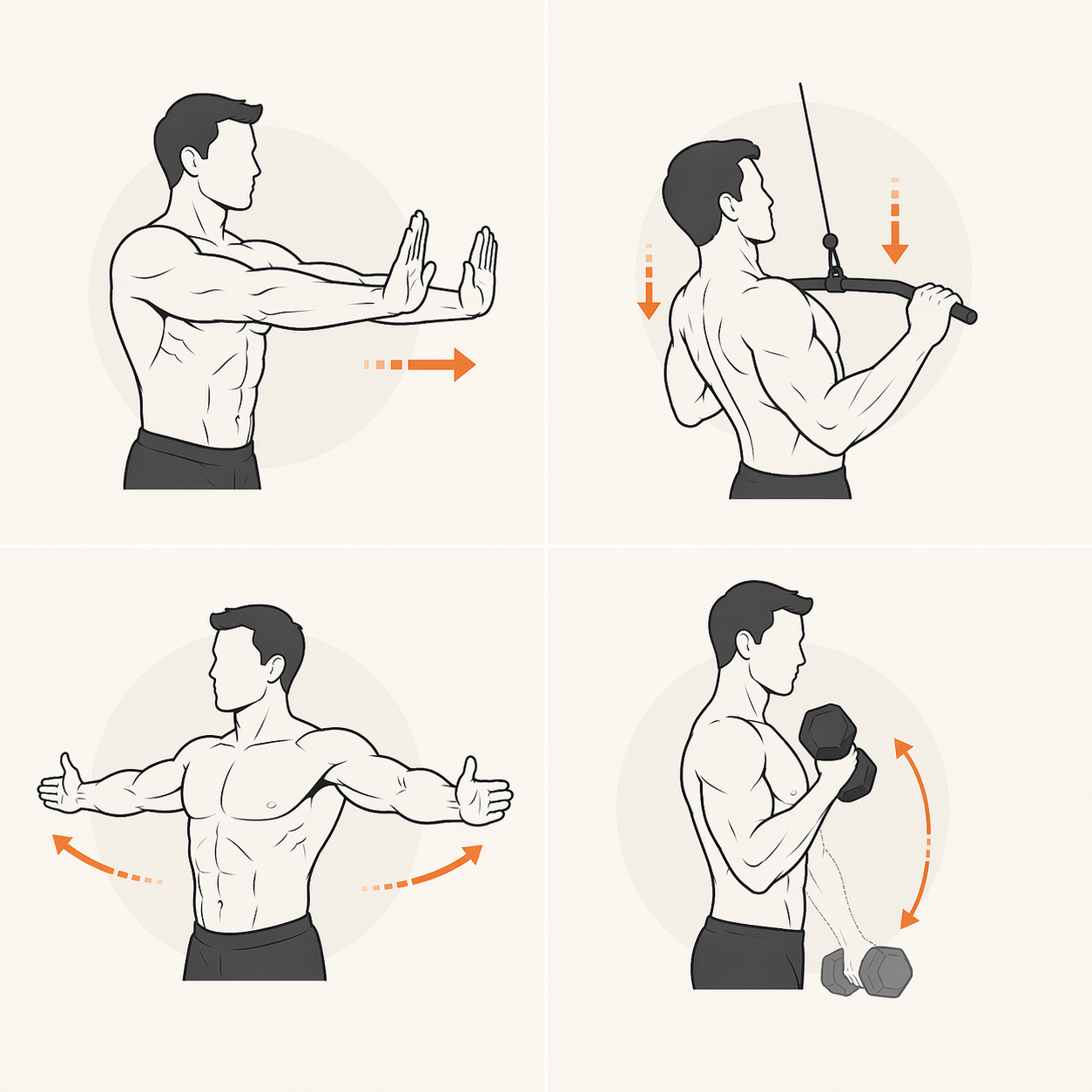
Buying upper body workout equipment gets messy because “upper body” is not one training need. A setup that feels great for dumbbell presses can still leave you without a decent vertical pull. A cable station that makes lateral raises feel smooth may cost more floor space than a renter wants to surrender. Bands can live in a closet and still train a lot of muscle, but they do not feel like a loaded dumbbell in the bottom of a press.
Before comparing models, compare the movements you need the equipment to handle: pressing, pulling, fly or lateral raise work, and curl or extension work. Those four demands expose the compromises quickly.
Start With the Movements, Not the Machine
A useful home setup does not need to copy a commercial gym. It needs to cover enough of the movement menu that you can train consistently without constantly working around the gear.
- Pressing: chest presses, shoulder presses, push-up variations, and incline or flat pressing patterns.
- Pulling: rows, pulldowns, pull-ups, face pulls, and rear-delt work.
- Fly and lateral work: chest flyes, cable crossovers, lateral raises, rear-delt flyes, and other movements where the resistance path matters.
- Curl and extension work: biceps curls, hammer curls, triceps pushdowns, skull crushers, and overhead extensions.
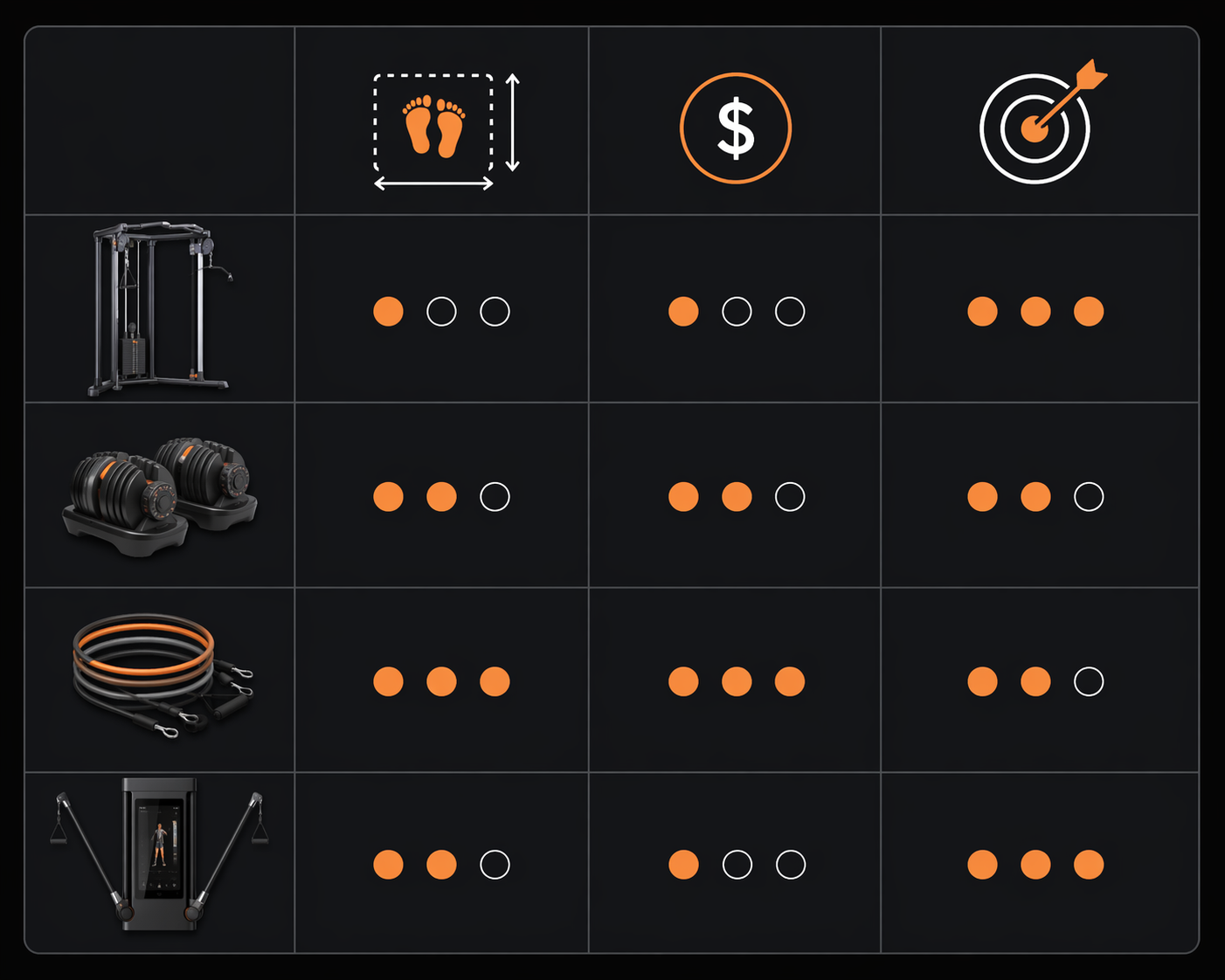
The awkward part is that no single equipment category handles all four equally well. Adjustable dumbbells are hard to beat for visible loading on presses and curls. Cables make flyes, lateral raises, pulldowns, and pushdowns feel less improvised. Bands are the cheapest way to get useful resistance into a tiny room. Smart gyms can replace several pieces at once, but the clean wall-mounted look comes with installation and monthly billing.
| Equipment type | Footprint | Cost profile | Best upper-body fit |
|---|---|---|---|
| Cable machine or functional trainer | Usually needs dedicated floor or wall space | Budget cable towers can start under premium all-in-one systems; full stations cost more | Flyes, lateral raises, rows, pulldowns, pushdowns, and upper-body variety |
| Adjustable dumbbells | Very compact compared with fixed dumbbell sets | Higher upfront cost than bands, strong value for progressive loading | Presses, curls, extensions, rows, and simple strength progression |
| Resistance bands | Smallest storage burden | Lowest entry cost | Travel, quiet training, warm-ups, beginner strength work, and accessory movements |
| Smart gym | Wall-mounted or compact station, but installation matters | Highest upfront cost plus recurring subscription | Guided training, cable-style movements, reduced clutter, and decision-light workouts |
Cable Machines Are Where Upper-Body Variety Starts to Feel Less Compromised
Cable machines earn their space when you care about the parts of upper-body training that dumbbells and bands can make clunky: flyes, lateral raises, pushdowns, face pulls, and pulldown-style work. The advantage is not magic. It is the ability to set a resistance path and keep tension through parts of the movement where a dumbbell may feel awkward or where gravity stops helping.
That matters most for movements that do not behave like a straightforward press or row. A dumbbell lateral raise is hardest where the arm is farthest from the body. A cable lateral raise can keep the target muscle working through a longer part of the range. A triceps pushdown is much easier to set up on a cable than with a loose band that has to be anchored somewhere reliable.
The Bowflex Xtreme 2 SE shows why this category gets tempting for an upper-body-focused room: 210 pounds of standard resistance, upgradeable to 410 pounds, a 63-inch by 49-inch footprint, more than 70 exercise variations, and a listed price of $1,499 in the cited Garage Gym Reviews guide.[1] Those numbers do not make it the universal answer, but they explain the appeal. It concentrates a lot of cable-style options into a footprint that many spare rooms can actually plan around.
There is also a cheaper cable doorway into the category. The Bells of Steel Cable Tower is listed from $435 with 210 to 250 pounds of resistance, depending on configuration.[1] That kind of starting price changes the conversation for someone who assumed cable training only meant a large functional trainer or a luxury smart gym.
The catch is that cable gear asks for a real place in the home. A tower, trainer, or Bowflex-style station may be more compact than a rack-and-plate setup, but it is still furniture-sized fitness equipment. If the room also needs to be an office, guest room, or storage zone, measure the working space around the machine, not just the listed footprint.
Adjustable Dumbbells Make Progressive Overload Obvious
If your upper-body plan is built around pressing, rowing, curls, and extensions, adjustable dumbbells are the cleanest kind of boring. You pick them up, load heavier when you can, and see the progression without decoding a resistance curve or paying for a screen to tell you what changed.
The NÜOBELL example is useful because the trade-off is concrete: one pair adjusts from 5 to 80 pounds and replaces 16 fixed dumbbell sets, with the cited guide listing the pair at $595.[1] For a beginner or intermediate lifter training at home, that is a lot of pressing and arm-work runway in a small physical package.
Dumbbells are especially strong when the goal is simple progressive overload. Add weight to a floor press, incline press, one-arm row, curl, or overhead extension, and the training log tells a clear story. That clarity matters for people who lose momentum when equipment feels vague.
They do have holes. Dumbbells do not give you a true lat pulldown. Chest flyes can be done, but the tension profile is not as friendly as a cable. Lateral raises work, though small jumps in load can feel larger than they look on paper. And unless you add a bench, pressing options stay limited.
This is where a small add-on can matter more than another expensive gadget. A doorway pull-up bar can give a dumbbell setup the vertical pulling pattern it otherwise misses, assuming the doorway and user are appropriate for that style of equipment. For many homes, that single addition is the difference between “presses and curls in a corner” and something closer to balanced upper-body training.
Bands Are Not a Toy, but They Are Not a Loophole Around Loading Either
Resistance bands deserve their popularity. They are quiet, easy to store, easy to travel with, and forgiving in apartments where dropping weights is not an option. A band kit can turn a closet shelf into a training station, which is not a small thing for renters or anyone sharing a living space.
The research case for bands is real but should be stated carefully. A 2019 meta-analysis in SAGE Open Medicine found that elastic resistance training produced strength gains comparable to conventional resistance training across the studies it reviewed.[2] That supports bands as a legitimate training tool, not just a warm-up accessory.
It does not prove that every band setup is equal to every free-weight setup for every lifter. Advanced strength training depends heavily on load, progression, exercise setup, and whether the resistance is high enough where the lifter needs it. Bands can be excellent for rows, pushdowns, curls, pull-aparts, assisted pull-ups, and travel workouts. For a heavy press or a very strong row, setup quality starts to matter much more.
This is where band-bar systems like X3 Bar sit in an interesting middle lane. They are still band-based, but the bar and platform try to make loading feel less improvised than handles and door anchors. The listed X3 Bar example reaches up to 300 pounds of resistance, or 600 pounds with an elite band, at $549, while avoiding plate-slamming noise. That makes it more serious than a bargain band kit, but also moves it out of the “cheap entry point” category.
For someone starting under a tight budget, bands are still the easiest yes. For someone chasing visible, repeatable overload for upper-body strength, bands may need to become one tool in the setup rather than the whole setup.
Smart Gyms Trade Clutter for Cost and Dependence
A good smart gym solves a real home-gym problem: it can combine guided workouts, digital resistance, exercise selection, progress tracking, and cable-style movement into a cleaner footprint than a pile of separate equipment. For someone who trains better when the workout is already built, that is not a gimmick. Removing decision fatigue can be the thing that gets the sessions done.
The price has to be part of the first sentence, though, not a footnote. Tonal 2 is listed at $4,295 with a $59 monthly subscription and 250 pounds of digital resistance.[1] That makes it a different purchase category from bands, dumbbells, or even many cable towers.
The fair comparison is not only hardware versus hardware. A smart gym may replace adjustable dumbbells, a cable tower, a workout app, and some amount of coaching structure. If those replacements are actually valuable to the buyer, the monthly fee may be acceptable. If the buyer already knows how to train and mainly wants load, the subscription can feel like paying rent on equipment they already bought.
Installation is the other practical filter. Wall-mounted systems need the right wall, enough clearance, and a living situation where mounting equipment is allowed. That can be fine in a house and a nonstarter in a rental. The cleanest-looking option on a product page can become the most complicated option once the room, lease, and monthly bill enter the picture.
Which Category Fits Your Situation?
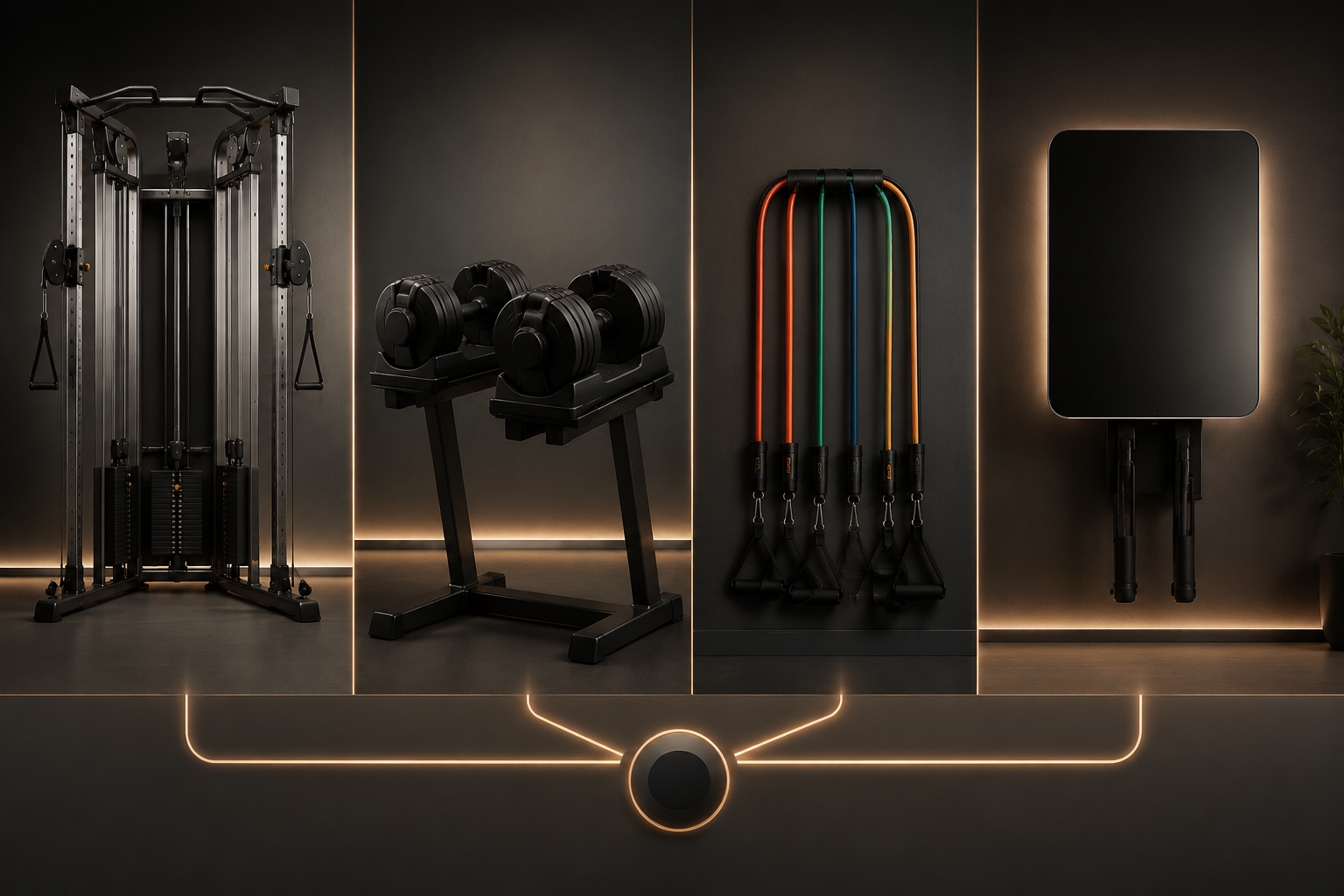
The right category usually reveals itself faster when you stop asking which equipment is best and start asking what kind of compromise you can live with after the new-equipment excitement wears off.
Small-Space Beginner
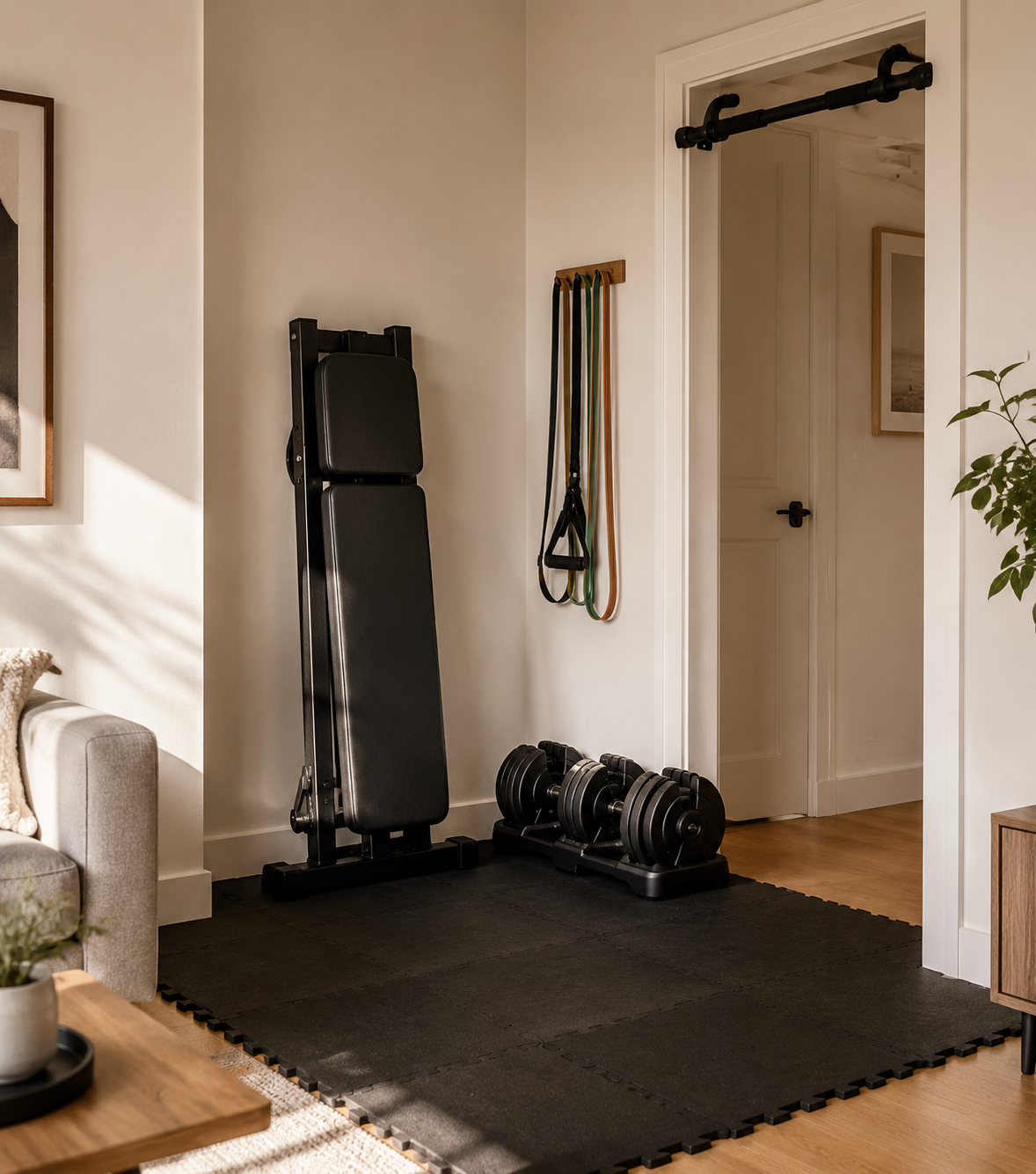
Start with bands, a doorway pull-up option if your space allows it, and possibly an adjustable bench before buying anything large. The goal is not to build the final gym immediately. It is to learn which movements you repeat, which anchors and angles your room can support, and whether you need more load or more exercise variety next. If the room itself is the limiting factor, a broader guide to compact home gym equipment categories can help before you compare models.
Budget Strength Builder
Adjustable dumbbells should get the first serious look. They make progression easy to see, they support the pressing and arm work most upper-body buyers care about, and they do not require a permanent installation. Add a pull-up bar or band anchor strategy if pulling is underrepresented. A full upper-body setup can be built under $500 with bands, a doorway pull-up bar, and an adjustable bench, but heavier adjustable dumbbells can push the budget higher.
Upper-Body Variety Seeker
Look hardest at a cable tower, functional trainer, or Bowflex-style station. This is the buyer who gets annoyed when every workout becomes presses, rows, and curls because the equipment cannot make flyes, lateral raises, pulldowns, and pushdowns feel natural. Cable equipment is not automatically compact, but it can deliver more upper-body exercise variety per square foot than a scattered collection of benches, bands, and specialty handles.
Tech-Forward Guided-Training Buyer
A smart gym makes sense if coaching, tracking, and reduced clutter are part of the value, not just decorations around resistance training. The buyer has to be comfortable with wall installation, software dependence, and a subscription that continues after the hardware purchase. If the smart-gym question is really about whether the living situation can support it, a dedicated smart home gym buying guide is the better next comparison.
Premium All-in-One Buyer
Compare cable-based stations and smart gyms side by side. Both can reduce clutter compared with piecing together multiple items, but they solve the problem differently. A cable station keeps the training more hardware-centered. A smart gym adds instruction and tracking, then charges accordingly. The better choice depends on whether the buyer wants a machine that stays mostly the same for years or a guided system that keeps shaping the workout.
The Category to Compare Next
If pressing strength and arm progression are the priority, compare adjustable dumbbells first. If flyes, lateral raises, pulldowns, and pushdowns keep showing up in your ideal workout, compare cable machines or functional trainers. If the room and budget are tight, start with bands and add a vertical-pull option before assuming you need a large machine. If guidance and a clean wall-mounted setup are worth the subscription, compare smart gyms with the full ownership cost in view.
For a wider equipment decision beyond upper body, use a general home gym equipment framework or a first-purchase guide like which home gym equipment should you buy first. If the hard constraint is apartment space, narrow the field with small-space home exercise equipment before getting pulled into model rankings.
References
- Best Home Gyms, Garage Gym Reviews, garagerymreviews.com/best-home-gyms
- Effects of training with elastic resistance versus conventional resistance on muscular strength: A systematic review and meta-analysis, SAGE Open Medicine, 2019, https://journals.sagepub.com/doi/10.1177/2050312119831116
Comments
Join the discussion with an anonymous comment.