
If you just started Ozempic, Wegovy, Mounjaro, Zepbound, or another GLP-1 medication and exercise suddenly feels harder than it “should,” the starting point is not a full fitness plan. It is ten quiet minutes you can repeat tomorrow.
That may sound too small, especially if you have seen the standard advice to work toward 150 minutes of weekly activity. But the first weeks on a GLP-1 are not standard beginner weeks. Appetite can drop before your exercise habits improve. Nausea may cluster around injection days. Fatigue can make a normal beginner workout feel oddly expensive. A useful exercise routine while on weight loss medication has to account for that instead of pretending motivation solves it.
The reason to start small is not because exercise matters less. It is because preserving capacity matters early. A 2024 ACSM’s Health & Fitness Journal article available through PubMed Central reported that, without strength training, people using GLP-1 medications may lose 25% to 40% of total weight loss as lean mass, measured with DXA in the underlying studies.[1] That is the part of the scale story that deserves more attention than it usually gets.
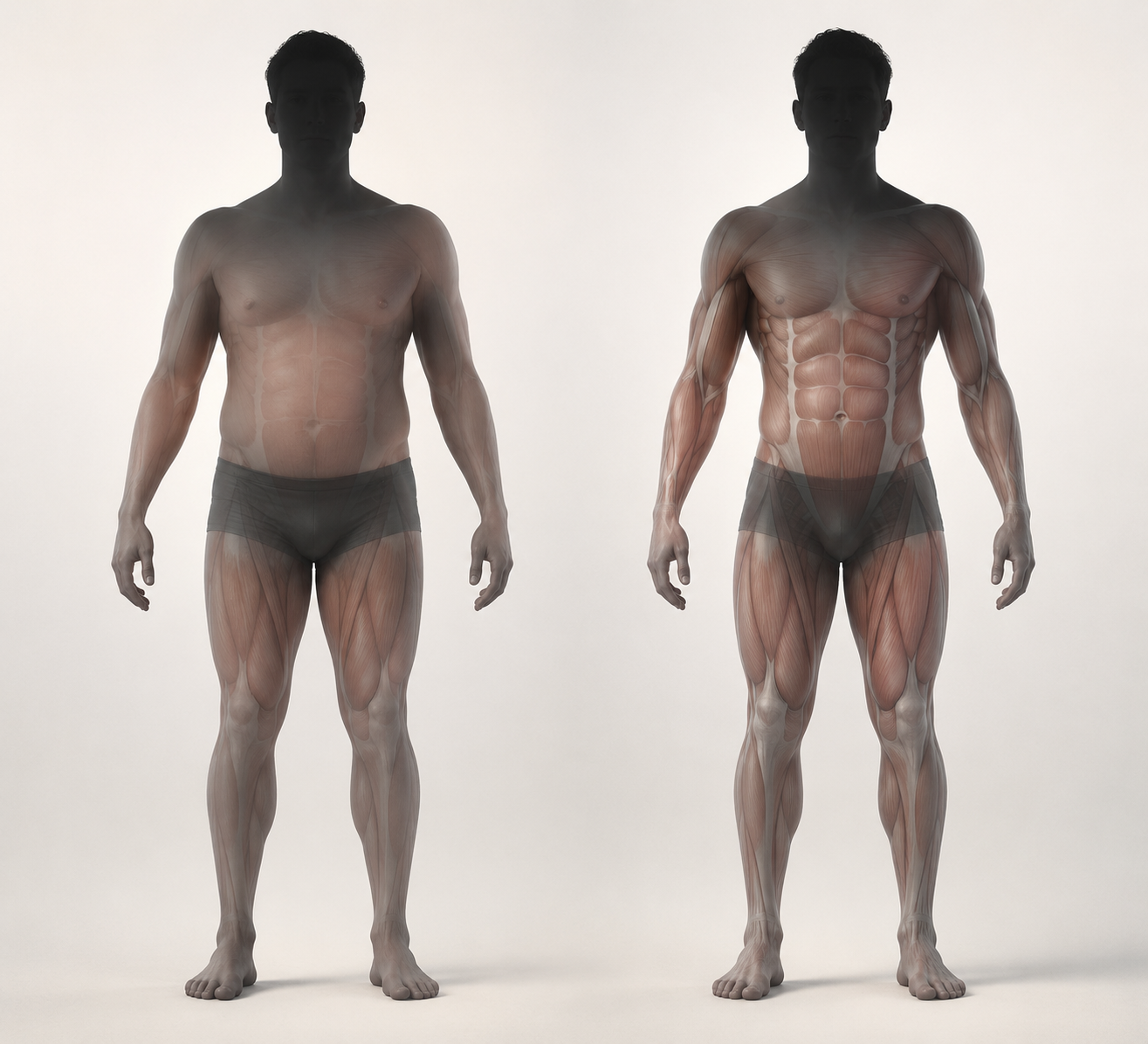
Lean mass is not just a gym aesthetic concern. It is tied to the ordinary things people notice first: getting up from the floor, carrying groceries, climbing stairs, catching balance, and feeling like the body is becoming more dependable rather than less. That is why this eight-week plan puts bodyweight strength at the center and treats cardio as support, not as punishment for eating or as a race toward a calorie target.
Before the Plan: Why Movement May Drop After the Medication Starts
It is tempting to assume that as weight comes down, activity naturally rises. Early objective data suggest that may not happen automatically. A National Institutes of Health study presented at ENDO 2026 and covered by Healthline used Fitbit data and found that after starting GLP-1 medications, average daily steps dropped from 5,047 to 4,487, an 11% decrease, while moderate-to-vigorous activity fell from 28 to 22 minutes per day, a 21% decrease.[2]
That study should be treated as preliminary because it was presented at a conference rather than published as peer-reviewed evidence. Still, the direction is worth taking seriously. If appetite is lower, energy intake is lower, and nausea is unpredictable, a person may move less unless movement is deliberately built into the day.
Clinical guidance is also more modest than social media fitness advice. Cleveland Clinic recommends beginning with as little as 10 to 15 minutes of light activity per day while using GLP-1 medications.[3] Mass General gives similar starting advice, emphasizing a gradual build during treatment rather than jumping straight into a full weekly exercise target.[4]
So the first job is not to prove you can tolerate a hard workout. The first job is to keep activity from sliding downward while you learn how your body responds to the medication.
The 8-Week Home Routine at a Glance
This plan assumes you are sedentary or minimally active, exercising at home, and still learning your side-effect pattern. It does not require a gym. A chair, a wall, a counter, and floor space are enough. If you have dizziness, chest pain, fainting, severe nausea, dehydration symptoms, or medical restrictions, pause the plan and contact your prescribing clinician or care team.
| Weeks | Main Goal | Weekly Structure | What Counts as Success |
|---|---|---|---|
| Weeks 1-2 | Find your tolerance | 10-15 minutes of light activity daily; 1 very short bodyweight strength session | You finish feeling steadier, not wiped out |
| Weeks 3-4 | Repeat the pattern | 10-15 minutes of light activity daily; 1 bodyweight strength session; optional mobility on tired days | You know which days after injection need lighter movement |
| Weeks 5-6 | Add a second strength exposure | 2 bodyweight strength sessions; 2 easy cardio sessions; light movement on other days | You recover within a day and do not dread the next session |
| Weeks 7-8 | Build consistency without rushing | 2 strength sessions; 2 low-pressure cardio sessions; optional short walks or mobility | The routine feels repeatable during a normal medication week |
Place lighter movement in the 24 to 48 hours after your injection if that is when nausea or fatigue tends to peak. Put strength work in the part of the week when food, fluids, and energy are easiest. If your medication schedule or side effects differ, let your care team help you adjust the timing.
Month 1: Start Smaller Than Your Pride Wants
Month 1 is the “do not scare yourself off” phase. It is not a test of fitness character. It is a calibration period for nausea, fatigue, appetite, hydration, balance, and recovery. If the plan feels almost too easy on a good day, that is acceptable. The first month should leave room for the not-good days.
Daily light activity: 10 to 15 minutes
Choose one option per day. Keep the effort conversational. You should be able to breathe through your nose or speak in full sentences.
- Walk indoors, outside, or in place for 10 to 15 minutes.
- Do a gentle mobility circuit: neck turns, shoulder rolls, standing hip circles, ankle circles, and easy marching.
- Use a low step or staircase for slow step-ups, but stop before your legs feel shaky.
- Break the time into two short blocks if one continuous session feels queasy.
Short sessions are not filler. They are the bridge between “I am too tired to exercise” and “I have a movement habit I can keep during titration.” If you need more reassurance that brief workouts can be legitimate starting points, this guide to 20-minute home workouts for beginners is a good next read after you finish setting up the first month.
One strength session per week
Do this once per week on a day when nausea is low and you have been able to eat and drink. Stop with energy left. The point is to send a clear “keep this tissue useful” signal to your muscles without turning the session into a recovery problem.
| Exercise | How to Do It | Starting Dose |
|---|---|---|
| Chair sit-to-stand | Sit on a sturdy chair, stand up, then sit with control | 1-2 sets of 5-8 reps |
| Wall push-up | Hands on wall, body straight, bend elbows, press away | 1-2 sets of 5-8 reps |
| Counter-supported hip hinge | Hands on counter, soften knees, push hips back, stand tall | 1-2 sets of 6-8 reps |
| Supported calf raise | Hold a counter or chair, rise onto toes, lower slowly | 1-2 sets of 6-10 reps |
| Dead bug arms-only or heel taps | Lie on your back and move slowly without holding your breath | 1 set of 4-6 reps per side |
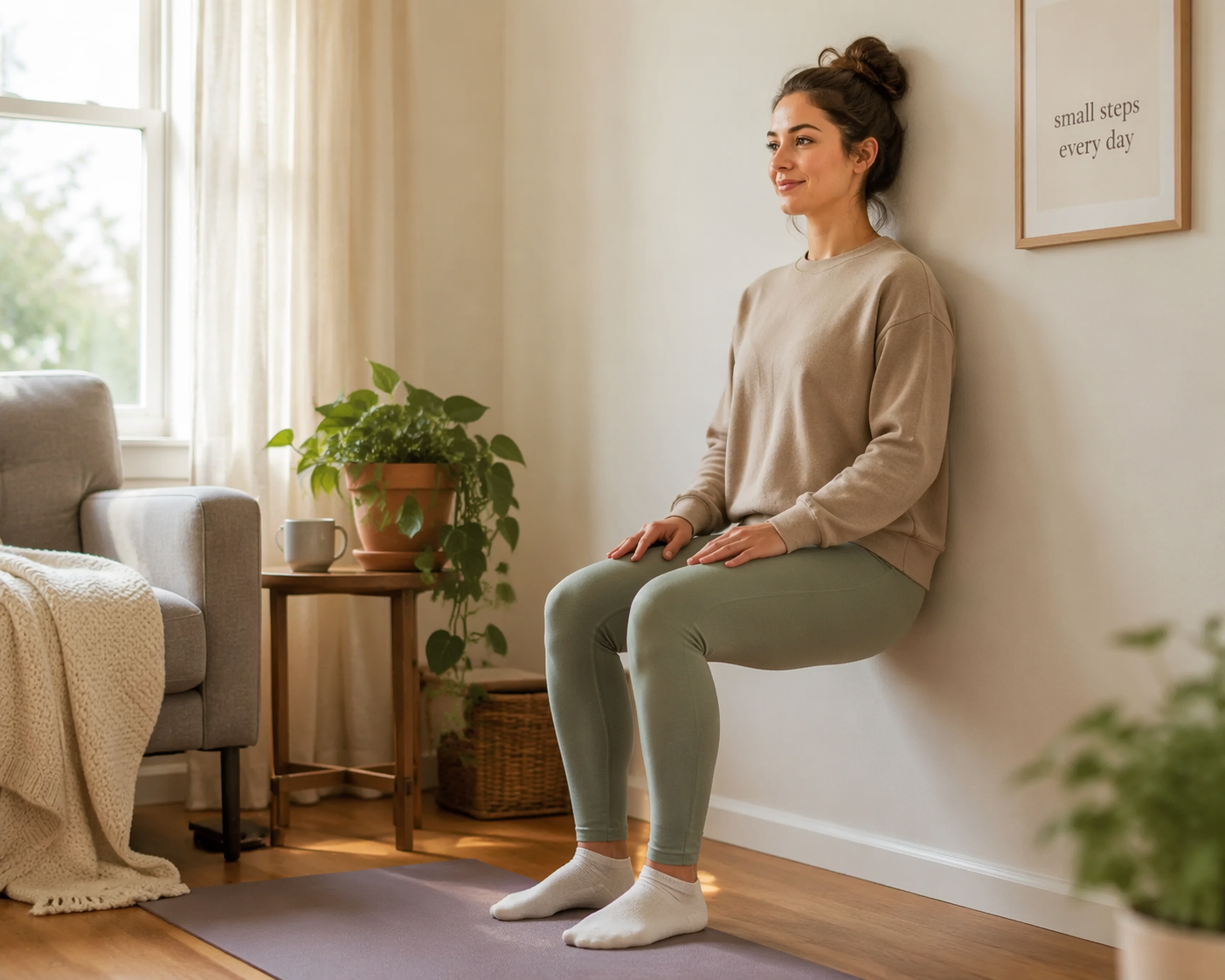
Rest as much as needed between exercises. If the room feels warm, your stomach feels unsettled, or you notice lightheadedness, sit down and end the session. You are not failing the workout by stopping early; you are collecting useful information.
Bodyweight training is enough for this stage because the limiting factor is not equipment. It is tolerance and repeatability. If you want the longer explanation for why bodyweight exercises can still challenge muscle, save the science of bodyweight training for later, when the routine itself is no longer new.
What to do in the 24 to 48 hours after injection
If your symptoms tend to peak after your shot, those days are for low-demand movement. Walk slowly. Do mobility. Do a few sit-to-stands if they feel good. Skip floor exercises if getting down and up feels unpleasant. The goal is circulation, joint motion, and confidence, not training effect.
A useful Month 1 rule: after a session, you should be able to eat something, drink fluids, and go about the rest of your day. If exercise makes you nauseated enough that you avoid food afterward, the dose of exercise was too high for that day.
Month 1 progression rules
- Add time before intensity: move from 10 minutes toward 15 minutes before walking faster.
- Add reps only when the current reps feel steady and controlled.
- Keep at least two reps “in reserve” on every strength exercise.
- Repeat the same workout for several weeks instead of constantly changing exercises.
- If symptoms flare after a dose increase, return to the easiest version for that week.
The person who succeeds in Month 1 is not the person who finds the hardest beginner workout online. It is the person who learns, without drama, which movements feel safe, which days are rough, and which small routine can survive a normal medication week.
Fuel Enough to Make Exercise Safe
Exercise on a GLP-1 can go badly when the workout is not extreme but the body is underfed. Appetite suppression can make protein and pre-workout food easy to miss. Mass General recommends that people taking GLP-1 agonists aim for 1 to 1.2 grams of protein per kilogram of body weight, while CNN’s 2025 reporting also cited that same 1 to 1.2 g/kg range in the context of strength training and muscle preservation.[4][5]
That number is not a command to calculate your diet alone, especially if you have kidney disease, diabetes medication changes, gastrointestinal side effects, a history of disordered eating, or other medical concerns. Ask your prescribing clinician, dietitian, or care team what protein range is appropriate for you.
For the workout itself, the practical question is simpler: have you had enough fluid and enough easy-to-tolerate food that movement will not make you feel worse? CNN cited expert advice that liquid options such as smoothies or protein shakes may be easier to tolerate 1 to 2 hours before exercise when appetite is low or nausea is present.[5]
- If you feel empty, shaky, or lightheaded, delay the workout and try fluids and a tolerable snack.
- If solid food is unappealing, ask your care team whether a smoothie, shake, yogurt, or other liquid option fits your plan.
- If nausea increases during exercise, stop early instead of trying to “push through.”
- If you repeatedly cannot eat enough around workouts, bring that pattern to the clinician managing your medication.
Month 2: Add Structure Only After You Have Data on Yourself
By Weeks 5 through 8, the plan can become more recognizable as an exercise routine. It still should not become a punishment routine. You are adding frequency, not trying to compress years of inactivity into a month.
A reasonable Month 2 week has two strength sessions, two easy cardio sessions, and lighter movement on the remaining days. If Month 1 was interrupted by dose changes, illness, dehydration, or strong side effects, repeat Month 1 instead of advancing. Repeating is often the safer progression.
| Day Type | Session | Effort |
|---|---|---|
| Strength Day A | Chair sit-to-stand, wall push-up, hip hinge, calf raise, dead bug variation | Easy to moderate |
| Cardio Day 1 | 10-20 minute walk or low step routine | Conversational |
| Light Day | Mobility, short walk, or gentle marching | Very easy |
| Strength Day B | Repeat Strength Day A or use slightly harder variations | Easy to moderate |
| Cardio Day 2 | 10-20 minute walk, indoor walk, or easy cycling if available | Conversational |
| Post-injection or Symptom Day | Light mobility, slow walking, or rest | Symptom-guided |
How to make the strength work harder without making it messier
Progress one variable at a time. Do not add reps, sets, harder variations, and shorter rests in the same week. Most beginners on GLP-1s do better with boring progress that the stomach and nervous system barely notice.
| Exercise | Month 1 Version | Month 2 Progression |
|---|---|---|
| Sit-to-stand | Hands assist as needed | Less hand support or slower lowering |
| Wall push-up | Hands high on wall | Hands slightly lower on wall or counter |
| Hip hinge | Counter-supported | Lighter hand support, still slow and controlled |
| Calf raise | Two hands supported | One hand supported or slower lowering |
| Core | Arms-only dead bug | Heel taps or shorter dead bug range |
If you want a more complete bodyweight sequence after this point, the 4-week no-equipment home workout plan is a better next step after Month 1 than on day one.
Cardio stays low-pressure
Month 2 cardio is not interval training. It is planned activity that keeps your daily movement from disappearing. Walk outside if that feels good. Walk around the house if weather, joints, privacy, or embarrassment make outside walks unrealistic. Use a stationary bike if you already own one. Keep the effort low enough that you could stop and restart without needing a recovery nap.
The ACSM survey data discussed in the 2024 GLP-1 exercise article reported that only 34% of GLP-1 patients achieved at least 150 minutes per week of physical activity, and patients self-reported feeling “disconnected” from their bodies during exercise.[1] That feeling matters. A plan that ignores it may look better on paper, but it is not necessarily more useful in a living room.
When to Increase, Hold, or Back Off
Use these rules before adding more exercise. They are intentionally plain because vague advice to “listen to your body” can leave beginners guessing.
| What Happened | What to Do Next |
|---|---|
| You finished sessions with normal tiredness and recovered by the next day | Add 2-5 minutes to one cardio session or add 1-2 reps to one strength exercise |
| You felt nauseated during or after exercise | Reduce duration, avoid floor work that day, and schedule the next session farther from injection timing |
| You felt lightheaded, shaky, or unusually weak | Stop, sit down, hydrate as appropriate, eat if you can, and contact your care team if it repeats |
| A dose increase made the week harder | Return to Month 1 volume for several days or the full week |
| You missed several sessions | Restart with the easiest completed week instead of trying to make up workouts |
| Strength exercises feel painful in joints rather than working muscles | Change the range of motion, use more support, or ask a qualified professional for individual help |
The safest progression sign is not sweat. It is repeatability. If the plan is making you dread movement, skip meals, or lose confidence in basic tasks, it is too much for the current medication week.
What About Equipment?
You do not need equipment for the first eight weeks. In fact, buying equipment too early can become another way to make the plan feel bigger than it needs to be. A chair, wall, countertop, and floor are enough to practice squatting, pushing, hinging, calf strength, and trunk control.
After Month 2, resistance bands or light dumbbells may make sense if you are consistent and want more options. At that point, use a plan that grows with the equipment rather than buying random pieces. This home gym workout plan by equipment tier and this first-time home gym buyer's framework are better saved for when the habit is already alive.
A Simple Week 8 Check-In
At the end of eight weeks, do not judge the plan by whether you look transformed. Judge it by whether you preserved useful behaviors while your body was adapting to medication.
- Can you complete two short strength sessions most weeks?
- Do you know which 24- to 48-hour window after injection needs lighter movement?
- Can you walk or move gently on tired days without turning it into a failed workout?
- Have you discussed a realistic protein target with your clinician or dietitian?
- Are your strength exercises steadier than they were in Week 1?
If those answers are mostly yes, Month 3 can begin moving toward the standard weekly activity guideline as tolerated. If they are mostly no, the answer is not to punish yourself with a harder plan. It is to keep the same structure, reduce friction, and get help with the side effects, fueling, or medical questions that are making consistency difficult.
For desk-bound days, a short recovery routine can also be useful between formal sessions. This mobility routine for desk workers fits better as a light-day option than as another demanding workout.
The first eight weeks are successful if you keep movement from quietly shrinking, give your muscles a regular reason to stay useful, and build an exercise routine that can survive real titration side effects. That is enough work for the beginning.
References
- Exercise and Glucagon-Like Peptide-1 Receptor Agonist Use: A Practical Guide, PubMed Central / ACSM's Health & Fitness Journal, 2024.
- People Taking GLP-1 Weight Loss Drugs May Exercise Less, Research Shows, Healthline, June 2026.
- Exercise and GLP-1s: Why Working Out Is Important When Taking Weight Loss Medications, Cleveland Clinic.
- Fitness for People Taking GLP-1 Agonists, Mass General.
- GLP-1 drugs can cause muscle loss. Here's how to prevent it, CNN, 2025.
Comments
Join the discussion with an anonymous comment.