A good home golf workout routine does not start with the hardest exercise. It starts with the first thing your swing has to own: usable motion. Then it builds strength through that motion. Only after that does it ask for speed.
That order matters because a living-room routine can easily become a random pile of squats, planks, band twists, and stretches. The TPI home workout framework puts the priorities in a cleaner sequence: mobility capacity first, strength second, then power and speed, with home substitutions such as a loaded backpack, laundry bottles, furniture, bands, and dumbbells standing in for gym equipment.[1]
The routine below is built as one session you can repeat 2–3 non-consecutive days per week. It should take about 15–20 minutes once you know the movements. You need floor space, a chair or couch, and one of three equipment setups: bodyweight only, a resistance band, or a pair of dumbbells.
The Full Home Golf Workout Routine
Run the session in this order. Do not turn the power work into a warm-up, and do not skip the cool-down just because the main work is finished. University of Utah Health uses the same broad training ingredients across a three-day weekly golf program and includes structured cool-down work after sessions, which is a useful reminder that golf fitness is not only about adding reps.[2]
| Block | Exercise | Dose | Rest | Equipment options |
|---|---|---|---|---|
| Mobility | Half-kneeling hip flexor stretch with reach | 4 slow breaths per side | Move directly to next drill | Bodyweight; golf club for balance |
| Mobility | Open-book thoracic rotation | 6 reps per side | Move directly to next drill | Bodyweight |
| Mobility | 90/90 hip switches | 6 controlled reps total | 30 seconds before strength | Bodyweight; hands behind you if needed |
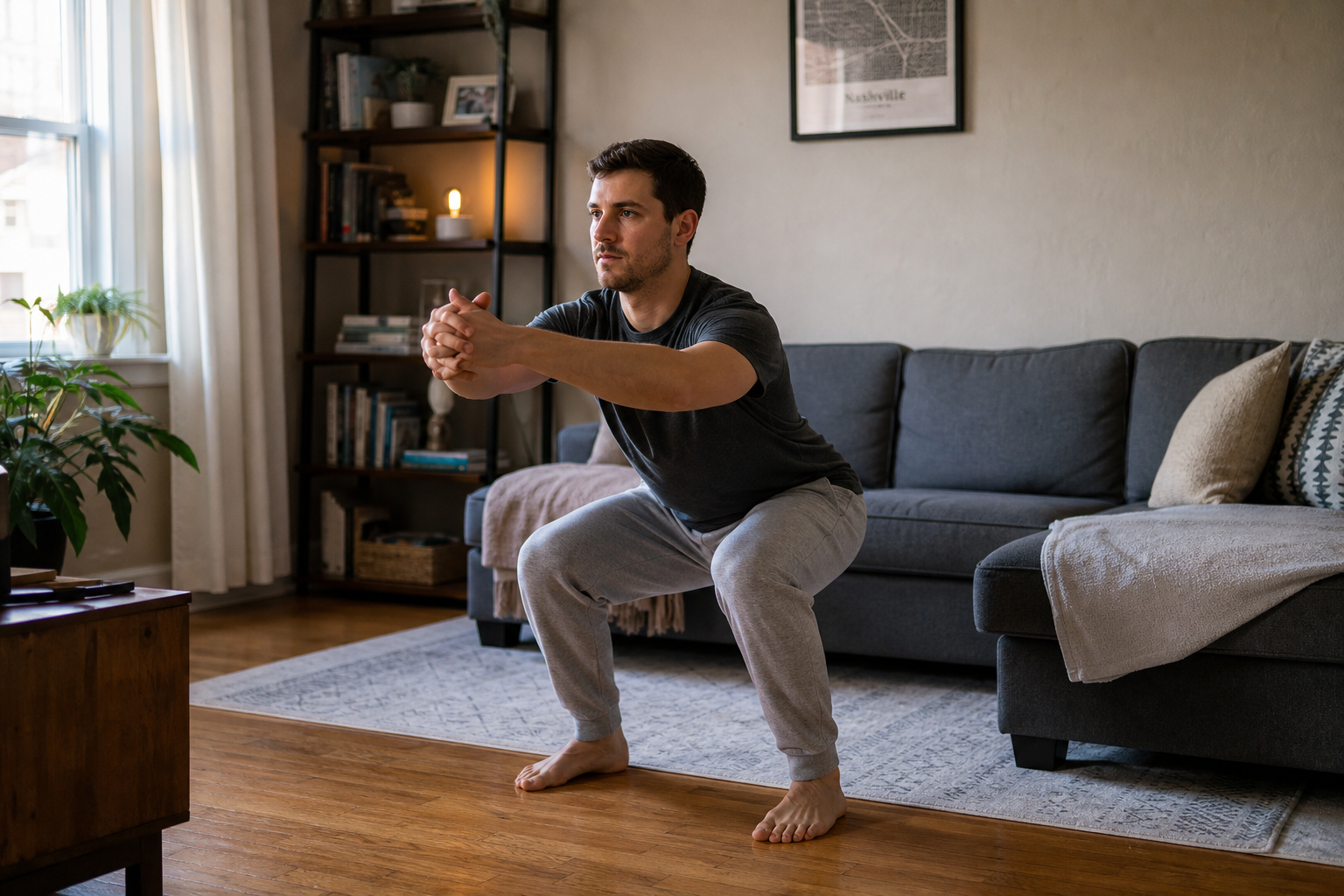
| Strength | Squat pattern | 2–3 sets of 8–12 reps | 45–75 seconds | Chair squat; goblet squat with dumbbell; loaded backpack squat |
| Strength | Push-up pattern | 2–3 sets of 6–12 reps | 45–75 seconds | Wall, counter, knee, floor, or tempo push-up |
| Strength | Hinge or split-stance lower-body pattern | 2–3 sets of 8–10 reps per side | 45–75 seconds | Reverse lunge; split squat; dumbbell Romanian deadlift |
| Strength | Anti-rotation or rotational control | 2 sets of 8–10 reps per side | 45–60 seconds | Bird dog; band press-out; band rotation |
| Power | Fast hip turn or step-behind rotation | 3 sets of 4–6 reps per side | 45–60 seconds | Bodyweight; light band only if control stays clean |
| Power | Snap-down to athletic stance or quick squat-to-reach | 2 sets of 5 reps | 45–60 seconds | Bodyweight |
| Cool-down | Child's pose, supine twist, diaphragmatic breathing | 30–45 seconds each | None | Bodyweight |
If you are short on time, keep one mobility drill, one squat or hinge, one push-up variation, one rotational control drill, and one power drill. What you should not do is start with power swings cold, then add a stretch at the end and call it golf-specific.
Mobility First: Make the Swing Shape Available
The mobility block is short on purpose. Most golfers will not do a 20-minute corrective warm-up before a 20-minute workout, and pretending otherwise is bad coaching. The goal here is more modest: open the hips, free the upper back, and let the pelvis and rib cage rotate without asking the low back to fake all of it.
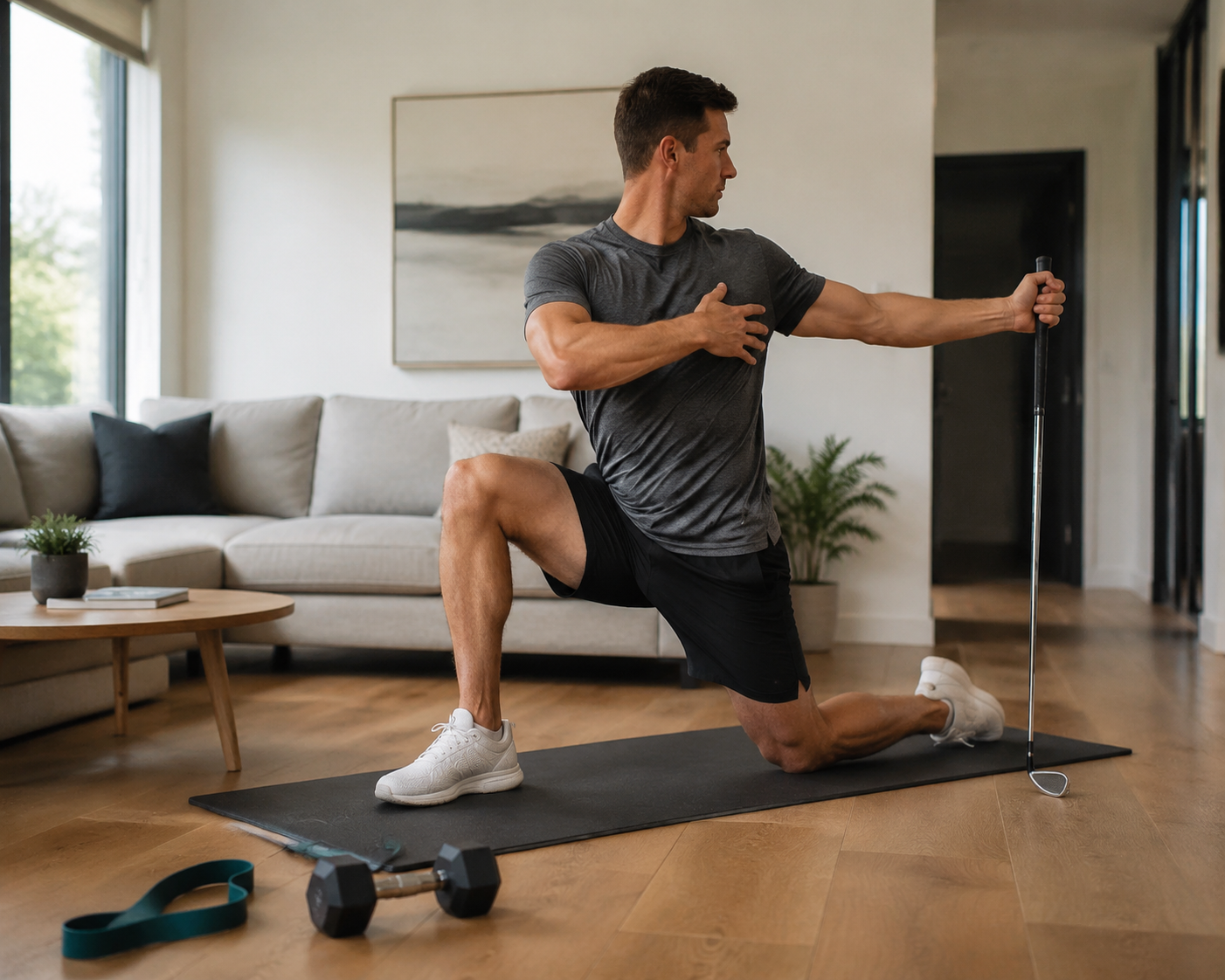
Half-kneeling hip flexor stretch with reach
Set one knee on the floor and the other foot in front. Lightly tuck your pelvis, squeeze the glute on the down-knee side, and reach that same-side arm overhead. Take four slow breaths, then switch sides. You should feel the front of the hip open, not a pinch in the low back.
Open-book thoracic rotation
Lie on your side with knees bent, arms straight in front of your chest. Rotate your top arm open toward the floor behind you while your knees stay stacked. Do six slow reps per side. The rep counts only if the rotation comes from your upper back and ribs rather than your top knee peeling away.
90/90 hip switches
Sit with both knees bent, one leg in front and one leg to the side. Rotate both knees to switch sides without rushing. Use your hands behind you if needed. Six total reps are enough; this is a readiness drill, not a flexibility contest.
This block should leave you feeling more available, not tired. If it becomes the hardest part of the workout, reduce the range and slow down.
Strength Second: Build Force You Can Control
The strength block is where the routine earns its value. You are training legs, trunk, pushing strength, and rotational control with exercises that fit a living room. MyGolfSpy’s bodyweight golf routine shows that squats, push-ups, bird dogs, lunges, IYTs, and shoulder-tap planks can form a complete golf-relevant session without equipment.[3] The job here is to make those patterns progressive instead of random.
Squat pattern
Do 2–3 sets of 8–12 reps. Start with a chair squat if depth or balance is an issue: sit back to a chair, touch lightly, and stand without collapsing your knees inward. If that is easy, hold one dumbbell at your chest for a goblet squat or wear a loaded backpack. Stop each set with 1–2 solid reps left in the tank.
Push-up pattern
Pick the version that lets you own 6–12 clean reps: wall push-up, counter push-up, knee push-up, floor push-up, or slow tempo push-up. Keep your ribs down and your body moving as one piece. Mike Carroll’s Fit For Golf dumbbell home routine uses push-up difficulty levels in this same spirit: the pattern stays, but the entry point changes.[4]
Hinge or split-stance lower-body pattern
Choose one: reverse lunge, split squat, or dumbbell Romanian deadlift. Do 2–3 sets of 8–10 reps per side. Lunges and split squats build single-leg control, which matters because the golf swing does not load both legs evenly. A dumbbell Romanian deadlift is the better choice if your knees dislike lunges or you need more hip and hamstring work.
Anti-rotation or rotational control
Bodyweight-only homes should use bird dogs: hands under shoulders, knees under hips, opposite arm and leg reaching long, hips level. Band homes should use a press-out: anchor the band at chest height, stand sideways to the anchor, press the band straight out, and resist being pulled into rotation. If you already control that well, use a slow band rotation.
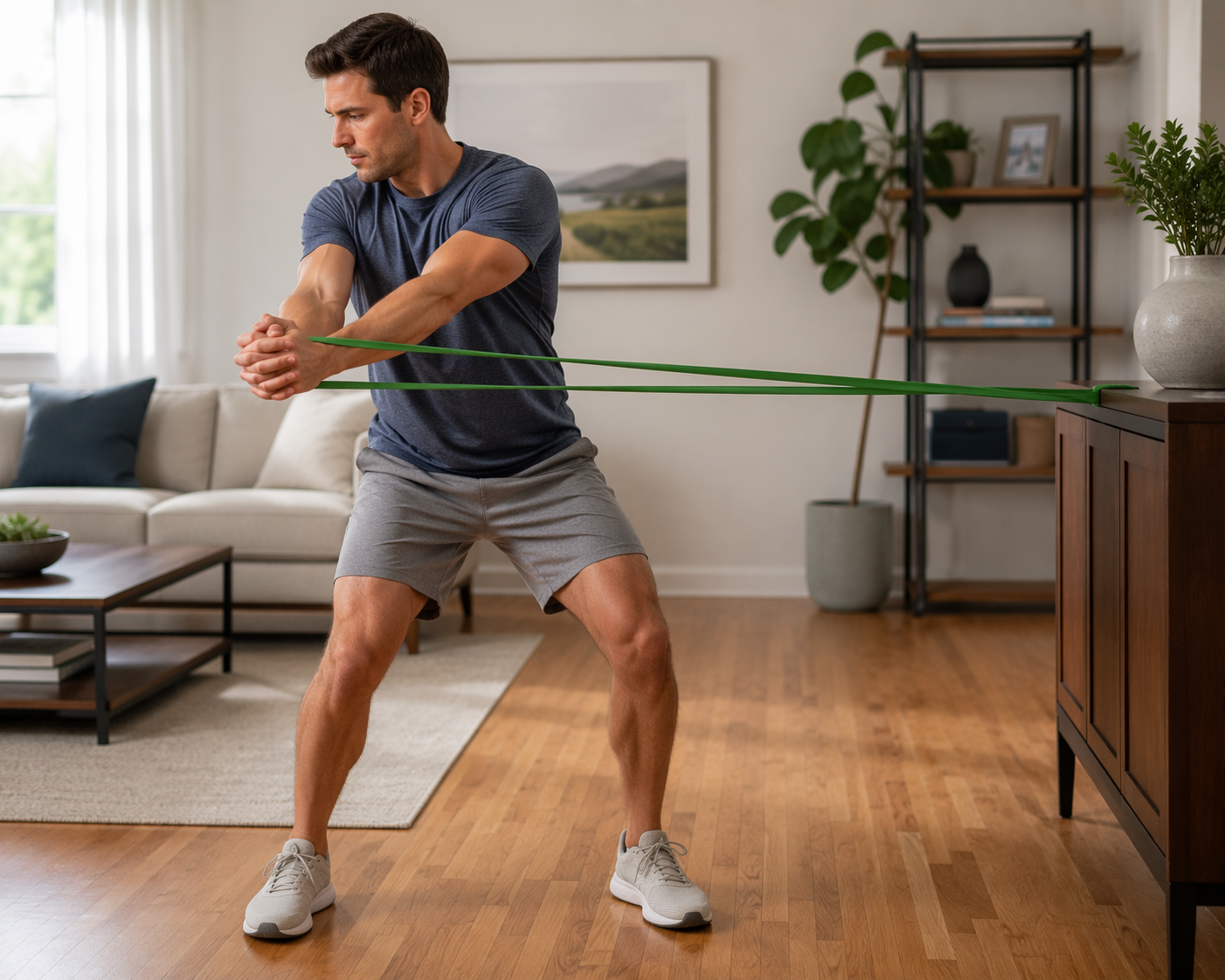
For golf, this drill is not just an ab exercise. It teaches your trunk to transmit force instead of leaking it. Keep the pelvis quiet, turn through the torso when rotation is intended, and avoid yanking the band with your arms.
Power Third: Move Fast After You Have Earned It
Power work belongs late in the session because speed needs preparation. The reps are low, the rest is real, and the movements should look crisp. If the exercise turns sloppy, the set is over.
Fast hip turn or step-behind rotation
Stand in golf posture with arms crossed or hands lightly together. Turn your hips and chest quickly into a finish position, then reset. Do 3 sets of 4–6 reps per side. If you have room and coordination, use a step-behind rotation: step, rotate, stick the finish. This is a speed drill, not a conditioning drill.
Snap-down to athletic stance
Start tall on your toes with arms overhead. Quickly pull your arms down and land in an athletic stance, knees soft, hips back, feet quiet. Do 2 sets of 5 reps. You are practicing the ability to create and absorb force, which is useful before asking your body for aggressive rotation.
Do not chase fatigue here. A tired fast rep is usually just a slow rep with worse mechanics.
Equipment Swaps That Keep the Routine Intact
The session should not fall apart because you do not own the right toy. Keep the pattern, then choose the tool.
| Pattern | Bodyweight-only | Band-only | Dumbbell or household load |
|---|---|---|---|
| Squat | Chair squat or tempo squat | Band-resisted squat if you can set it safely | Goblet squat, loaded backpack squat, laundry-bottle front hold |
| Push | Wall, counter, knee, or floor push-up | Band-resisted push-up only if setup is secure | Push-up still works; dumbbells can be handles if wrists need help |
| Hinge / single-leg | Glute bridge, reverse lunge, split squat | Band good morning | Dumbbell Romanian deadlift or suitcase split squat |
| Rotational control | Bird dog or shoulder-tap plank | Pallof press, band rotation | Suitcase carry march or half-kneeling dumbbell hold |
| Power | Fast hip turn, snap-down | Light band rotation if speed stays clean | Usually bodyweight is enough; avoid heavy fast twisting |
If you only have bodyweight, the routine is still legitimate. If you are new to home training and the golf-specific version feels too demanding, build a base first with a general no-equipment home workout plan before returning to the rotational work.
How Often to Do It
Use this routine 2–3 times per week on non-consecutive days. Fit For Golf recommends 2–3 non-consecutive home strength sessions per week, while University of Utah Health, Men’s Health, MyGolfSpy, and Par4Success also use or support a 2–3 day weekly rhythm for golf training.[2][3][4][5][6]
A simple week looks like this:
- Monday: home golf workout routine
- Tuesday: range, short game, walk, or rest
- Wednesday: home golf workout routine
- Thursday: mobility only or easy practice
- Friday: home golf workout routine if recovery is good
- Weekend: play, practice, or rest based on how your body feels
Two days per week is enough to start. Three days is useful when the sessions stay sharp and your swing practice is not suffering. Par4Success cautions that doing too much can create fatigue that undermines swing mechanics, which is exactly the tradeoff a golfer should avoid.[6]
How to Progress Without Turning It Into a Gym Program
Progress one variable at a time. Most golfers get into trouble by adding weight, reps, speed, and extra sessions in the same week. The swing is already practice; the workout should support it, not compete with it.
- Week 1: Do 2 sets for each strength exercise and learn the order.
- Week 2: Add reps until you reach the top of the range with clean form.
- Week 3: Add a third set to one or two strength exercises, not all of them.
- Week 4: Make one exercise harder with a slower tempo, harder variation, stronger band, or heavier household load.
After that, keep cycling those same progressions. When 3 sets of 12 chair squats are easy, move to goblet squats. When counter push-ups are easy, lower the surface. When bird dogs are clean, use a band press-out. When band press-outs are steady, add controlled band rotation.
Every fourth week, consider reducing volume if you are playing more golf, feeling unusually sore, or seeing your practice quality drop. Verywell Fit’s golf weight-training guidance includes lower-volume in-season maintenance and rest-week thinking, which fits the reality that training has to coexist with rounds and practice.[7]
Where This Fits Around Practice and Playing
Avoid hard training right before a serious range session or round. Men’s Health advises not training on the same day as course practice when possible; if it cannot be avoided, separate the sessions between morning and afternoon and bias the golf work toward short game rather than power driving.[5]
That advice is practical, not precious. Heavy legs and a tired trunk can change how you sequence the club. If you want to test swing changes, arrive fresh. If you want to train, train. Trying to do both hard on the same day often turns the second session into compensation practice.
The cool-down is also where you make the routine easier to repeat. Use child’s pose, a supine twist, and diaphragmatic breathing for 30–45 seconds each. If you regularly finish rounds with specific leg discomfort, pair this routine with pain-location recovery work such as golf leg pain relief exercises instead of simply adding more strength work.
What This Routine Can and Cannot Promise
This routine can give you a repeatable way to train the qualities a golf swing needs: hip and thoracic mobility, lower-body strength, trunk control, and controlled speed. It can also make your home setup less dependent on perfect equipment.
It should not be sold as a guaranteed number of extra miles per hour or yards. The sources behind home golf training support the sequencing, the exercise choices, and the 2–3 day frequency, but they do not prove that this exact living-room routine produces a specific clubhead-speed gain for every golfer.
Start with two sessions this week. Keep the mobility short, make the strength work honest, keep the power reps fast and clean, and progress one small piece at a time.
References
- The Home Workout: How to Keep Your Golf Strength and Conditioning on Track, TPI
- Your Strength Training Guide for a Better Golf Game, University of Utah Health, July 2025
- Bodyweight Strength Training for Golf, MyGolfSpy
- Simple Strength Training Home Workout, Fit For Golf
- Golf Workout Program, Men’s Health
- Golf Specific Workouts for the Home Gym, Par4Success
- Weight Training for Golf, Verywell Fit
Comments
Join the discussion with an anonymous comment.