
Start With the Pain Location
Golf leg pain is easier to fix when you stop calling every ache a hamstring problem. If the pain begins in the lower back or buttock and then shows up in the leg, that is one pattern; hip pain, knee pain, and plain muscle soreness are others. Amateur golfers have reported lifetime injury incidence of 25.2%–67.4%, and the low back and knee are common injury sites. [1][2]
Only 22%–27% of amateur golfers do any injury-prevention work, and the samples behind those numbers are heavily male-skewed, so this guide is useful as a starting pattern rather than a perfect diagnosis. [3]
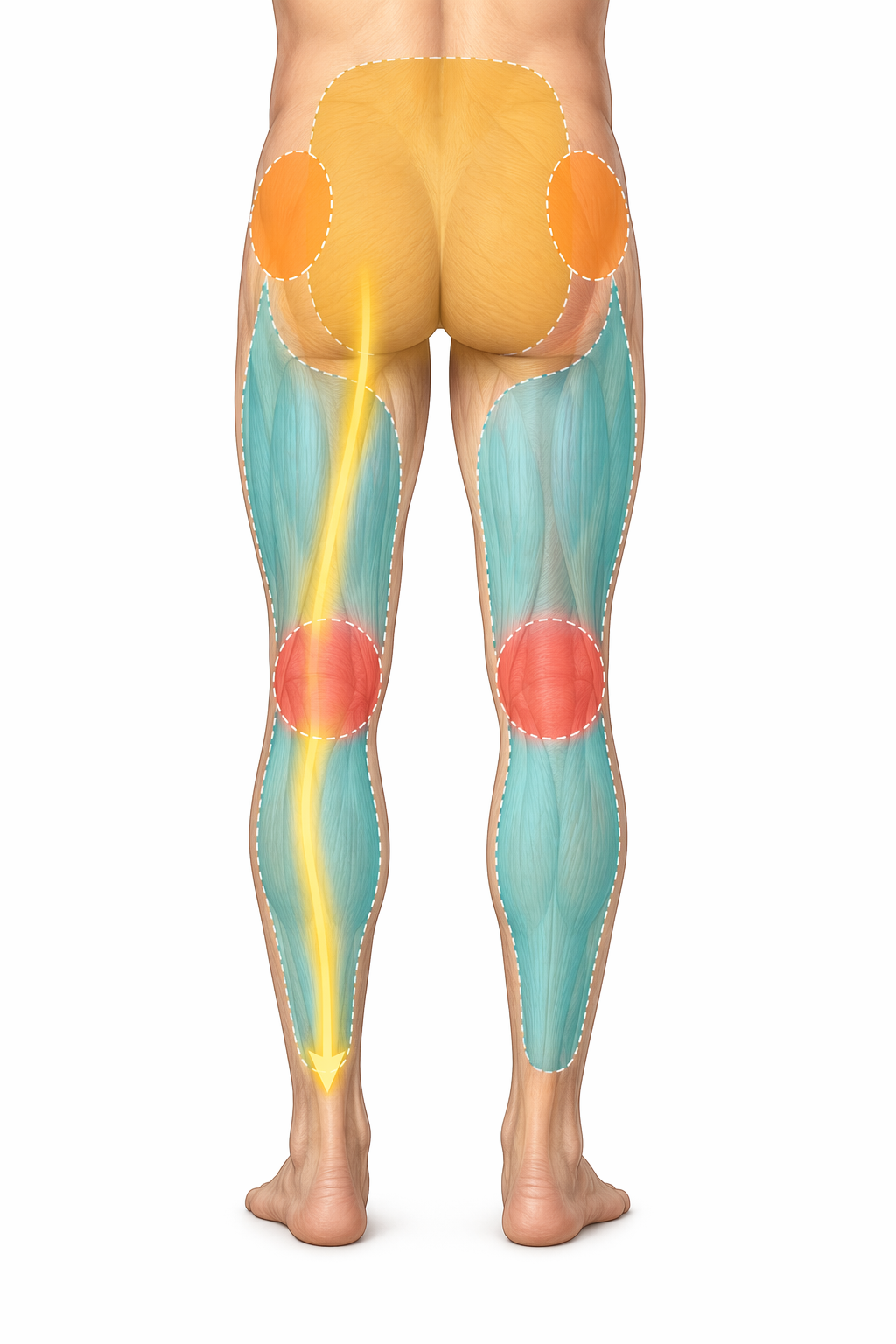
Use this quick sort before you start stretching.
| Pain pattern | What it usually feels like | Best first moves | Get checked if |
|---|---|---|---|
| Lower-back-referred pain into the leg | Starts near the low back or buttock and may travel down the leg | Glute bridge, bird dog, standing hamstring stretch | Numbness, worsening radiating pain, or bowel/bladder changes |
| Hip pain | Deep groin, side hip, or outer buttock pain; turning feels blocked | 90/90 hip switches, standing hip circles, clamshells | Sharp catching, major swelling, or inability to bear weight |
| Knee pain | Pain centered on the knee, worse with stairs, walking, or squat depth | Straight leg raises, shallow mini-squats, single-leg balance | Swelling, sharp joint pain, or locking |
| Generalized muscle soreness | Diffuse ache in the quads, calves, or lower legs after play | Calf raises, quad stretch, leg swings | One-sided swelling or point tenderness |
That split matters because the golf swing is not gentle. Sports-performance summaries of the research describe spine compression loads up to 8x body weight and more peak bending and shear in amateurs than in professionals. [4]
The exercise lists below are not four separate programs so much as the smallest useful starting cluster for each pattern. A generic stretch can miss the tissue doing the complaining.
Lower-Back-Referred Pain Into the Leg
When pain starts near the spine, slides into the buttock, or keeps traveling down the leg, treat it like back-driven pain first. That overlap with sciatica is why a golfer can swear the hamstring is tight when the low back is doing the talking. The most consistent at-home starting point across golf rehab resources is a small trio: glute bridge, bird dog, and standing hamstring stretch. [5][6][7]
- Glute bridge: lie on your back with knees bent, press through the heels, and lift the hips without arching the low back.
- Bird dog: start on hands and knees, reach one arm and the opposite leg long, then keep the pelvis level instead of twisting.
- Standing hamstring stretch: keep it light, hinge at the hips, and stop if the stretch turns into a sharp pull or leg symptom.
If the symptoms feel more nerve-like or the pain tracks below the knee, the more relevant next stop is the Relieve Sciatica with This 20-Minute Home Workout rather than piling on more hamstring work.
Hip Pain
Hip pain usually feels more local than referred back pain: the discomfort sits in the groin, side hip, or outer buttock, and the lead hip often feels blocked when you rotate through the swing. Reduced internal rotation in the lead hip is a known predictor of low back pain in golfers because the lumbar spine starts borrowing motion it was not built to provide. [5] The home approach is mobility first, then light activation: 90/90 hip switches, standing hip circles, and clamshells. [8][9][5]
- 90/90 hip switches: sit with both knees bent, rotate the knees side to side, and keep the motion smooth rather than forced.
- Standing hip circles: hold a wall lightly, circle one knee through a comfortable range, and avoid pinching the front of the hip.
- Clamshells: lie on your side, keep the feet together, and open the top knee without rolling the pelvis backward.
Knee Pain
Knee pain is common enough to matter and narrow enough to treat with caution. Systematic review data put knee injuries at 3%–18% of golf injuries, with older golfers at higher risk. [2] This is the section where self-treatment goes wrong most often: swelling, sharp joint pain, locking, or a knee that hates weight bearing is not a cue for deeper stretching. Keep the range shallow and the work controlled: straight leg raises, mini-squats only to about 45 degrees, and single-leg balance show up most often in golf knee rehab resources. [10][11]
- Straight leg raises: tighten the front of the thigh, lift the leg slowly, and keep the knee locked straight.
- Mini-squats: stay shallow, sit the hips back a little, and stop well before a deep knee bend.
- Single-leg balance: stand tall on one leg, keep the knee soft, and build time only if the joint stays calm.
If the knee pain is sticking around or feels more structural, a more complete follow-up is Phased Knee Cartilage Rehab Exercises You Can Do at Home or Low-Impact Workout for Knee Pain You Can Do at Home.
Generalized Muscle Soreness
When the problem is a diffuse ache in the calves, quads, or lower legs after a round, the fix is simpler: get blood moving and ease stiffness. Golf recovery content keeps coming back to calf raises, quad stretch, and leg swings as the no-equipment reset for ordinary soreness. [12][13][14] These are for dull muscle ache, not sharp joint pain.
- Calf raises: rise slowly onto the balls of the feet, pause at the top, and lower under control.
- Quad stretch: keep the knees close, hold the ankle gently, and avoid yanking the leg behind you.
- Leg swings: hold a wall, swing the leg forward and back in a controlled arc, and stay out of pain.
For a broader cool-down sequence, Your Complete Post-Workout Recovery Routine at Home fits here; if you want a tool-based add-on later, Best Home Recovery Tools for Your Home Gym: A Buyer's Guide is the place to look.
When To Get Checked
Stop self-treating and get evaluated if the pain comes with radiating numbness, swelling, sharp joint pain, or bowel or bladder changes. Those are not the kind of symptoms that should be pushed through with a few extra mobility drills. The point of matching pain location to the right exercise is to get you to the correct first move faster than a generic stretching routine, then hand off to a clinician when the pattern says it is time.
References
- Golf injuries in amateur golfers, PMC, 2024
- Epidemiology of golf-related injuries: a systematic review, SpringerLink, 2017
- Injury prevention exercises among amateur golfers, BMJ Open Sport & Exercise Medicine, 2023
- Golf Injuries, Vasta Performance
- Best Exercises for Golf, The Prehab Guys
- The Facts About Low Back Pain and Golf, FX Physical Therapy
- The Most Important Considerations for Treating Golfers With Lower Back Pain, Titleist Performance Institute
- 7 Best Hip Mobility Exercises for Golfers, Fairway Performance
- Best Golf Leg Workout, Par4Success
- 5 Essential Exercises for Knee Pain Relief for Golfers, Power PT
- Putting the Spring Back in Your Step: Golf Related Knee Injury Exercises, Atlanta Human Performance Center
- Best Stretches and Exercises for Golf Pain, Results Physiotherapy
- Golf Fitness Tips: 5 Lower Body Exercises for More Power, PGA.com
- Golfers' 6 Exercises, EW Motion Therapy

Comments
Join the discussion with an anonymous comment.