
Which New Balance sneakers work for walking at home?
For home walking workouts, New Balance's runner-style trainers beat retro lifestyle sneakers on measured cushioning — and the ~$70 608 v5 clears the same heel-cushion bar as the ~$170 1080 v15. Use this tier guide to match specific New Balance pairs to a $0-100 or $100-300 budget, with the width, breathability, and walking-pad factors that tip the choice indoors.
- Equipment tier required
- $0-100
- Duration
- 45 min
- Difficulty
- beginner
- Target area
- lower body
- Space footprint needed
- compact
- Noise level
- low
The useful surprise is that you do not have to start at the $170-ish New Balance Fresh Foam X 1080 v15 to get a home-walking shoe with serious heel cushioning. RunRepeat’s 2026 New Balance walking-shoe testing puts the much cheaper 608 v5 at 116 SA heel shock absorption, above the roughly 100 SA heel-cushion mark RunRepeat recommends for 30–60 minute treadmill-walking sessions; the 1080 v15 scores higher at 147 SA, but it is not the only pair that clears the indoor-walking bar.[1][2]
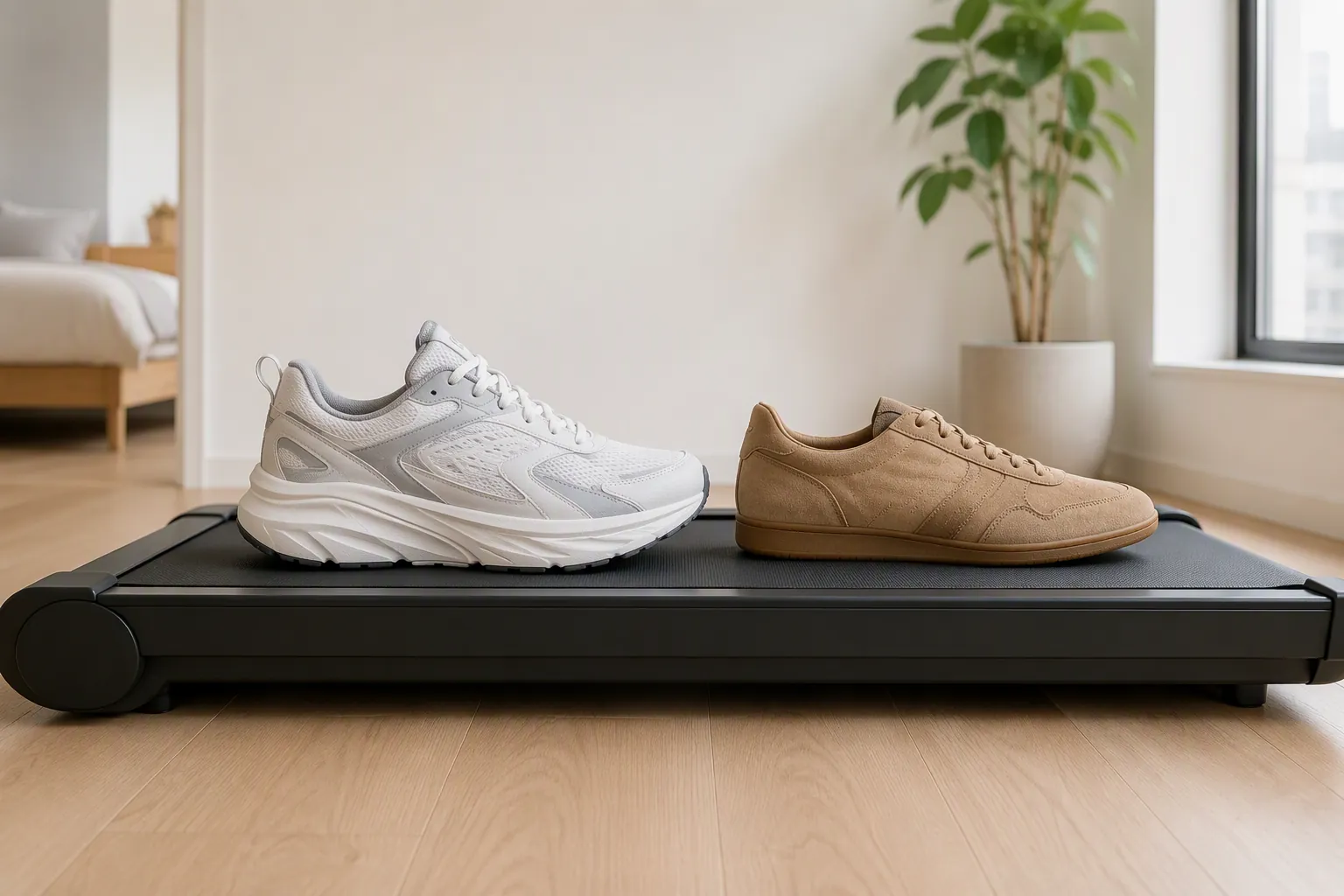
That makes the answer to “which New Balance sneakers work for walking workouts at home?” less glamorous and more useful: start with measured cushioning, then check stack, drop, weight, width availability, and heat buildup. For a walking pad or compact treadmill, runner-style daily trainers and comfort trainers make more sense than retro lifestyle pairs such as the 574, 327, or 1906R. Those shoes can be perfectly fine for errands. They are just not the first place to spend money if the job is 30 to 60 minutes on a thin moving deck in a warm apartment.
The quick tier guide
Prices below come from third-party testing and roundup sources, not verified first-party New Balance product pages. Recheck current pricing and width availability before buying, especially because model generations vary across outlets.
| Budget tier | Best New Balance direction | Why it fits home walking | Watch before buying |
|---|---|---|---|
| $0–100 | New Balance 608 v5, tested around $70 | RunRepeat measured 116 SA heel shock absorption, with a 31.7 mm heel stack and 22.1 mm forefoot stack; that clears its 30–60 minute treadmill-walking cushion threshold at a much lower tested price.[1][2] | Less modern and less plush than the premium Fresh Foam runners; likely the stopping point for budget walkers, not the dream shoe for maximum softness. |
| $100–300 | Fresh Foam X 1080 v15, tested around $170 | RunRepeat ranked it as the best overall New Balance walking shoe in its 2026 list, with 147 SA heel shock absorption, 13.1% more cushioning than average, and a listed 9.0 oz weight.[1] | RunRepeat also flags limited stability, so it is not the obvious pick if overpronation support is the main issue.[1] |
| $100–300 | Fresh Foam X More v6, tested around $155–160 | The maximum-cushion option: RunRepeat measured 152 SA at the heel, 144 SA at the forefoot, a 41.8 mm heel stack, and a very wide measured platform of 122.5/102.0 mm.[1] | A lot of shoe for a small apartment. Great if the walking pad feels harsh; less appealing if you dislike tall, bulky trainers. |
| $100–300 | Fresh Foam X 880 v15, tested around $140–150 | A balanced daily-trainer option with a 39.7/35.4 mm stack and rocker geometry in RunRepeat’s testing.[1] | RunRepeat warns about only 1.9 mm of outsole rubber, while RunToTheFinish praises it as a durability-and-cushion choice for serious walkers — a split that matters less indoors than outdoors.[1][3] |
| $100–300 | Fresh Foam X 840v1 | Verywell Fit selected it as its tested “best for walking” New Balance pick, noting an APMA Seal of Acceptance, three widths, and treadmill use by a tester.[4] | Useful when fit and width matter more than chasing the biggest lab cushion number. |
| $100–300 | 928v3 or Vongo v6 | Shape’s podiatrist-sourced roundup points to the 928v3 for plantar-fasciitis-adjacent needs and the Vongo v6 for overpronation support, with the Vongo v6 also described as APMA-approved.[5] | Treat these as support-fit candidates, not casual medical fixes. Pain changes the buying standard. |
Why walking pads change the shoe decision
A walking pad is not a sidewalk, and it is not quite a gym treadmill either. You are usually on a thinner deck, in a warmer room, often walking at a steady pace for longer than you would while running errands. Advanced Feet & Ankle Care’s January 2026 walking-pad warning says thinner walking-pad decks provide “significantly less shock absorption” than traditional gym treadmills.[6] That does not mean walking pads are bad. It means the shoe is doing more of the comfort work.
This is where many sneaker recommendations get lazy. Outdoor outsole durability, trail-style lugs, and retro styling do not solve the main indoor problems: heel fatigue, heat, forefoot pressure, and the slightly dead feel of a compact deck. RunRepeat’s treadmill-walking guide points toward at least 100 SA heel cushioning for 30–60 minute sessions, a breathable upper, and avoiding 3+ mm lugs.[2] Indoors, I would rather give up some rugged outsole than spend 45 minutes in a hot, stiff shoe that looked better on a product grid.
If floor contact, apartment noise, and belt feel are part of the decision, compare this New Balance guide with the Skechers apartment walking test. The brand is different, but the small-space questions are similar: how much shoe do you need between your foot and the floor, and how much heat or bulk are you willing to live with?
$0–100: the 608 v5 is the budget pick that actually matters
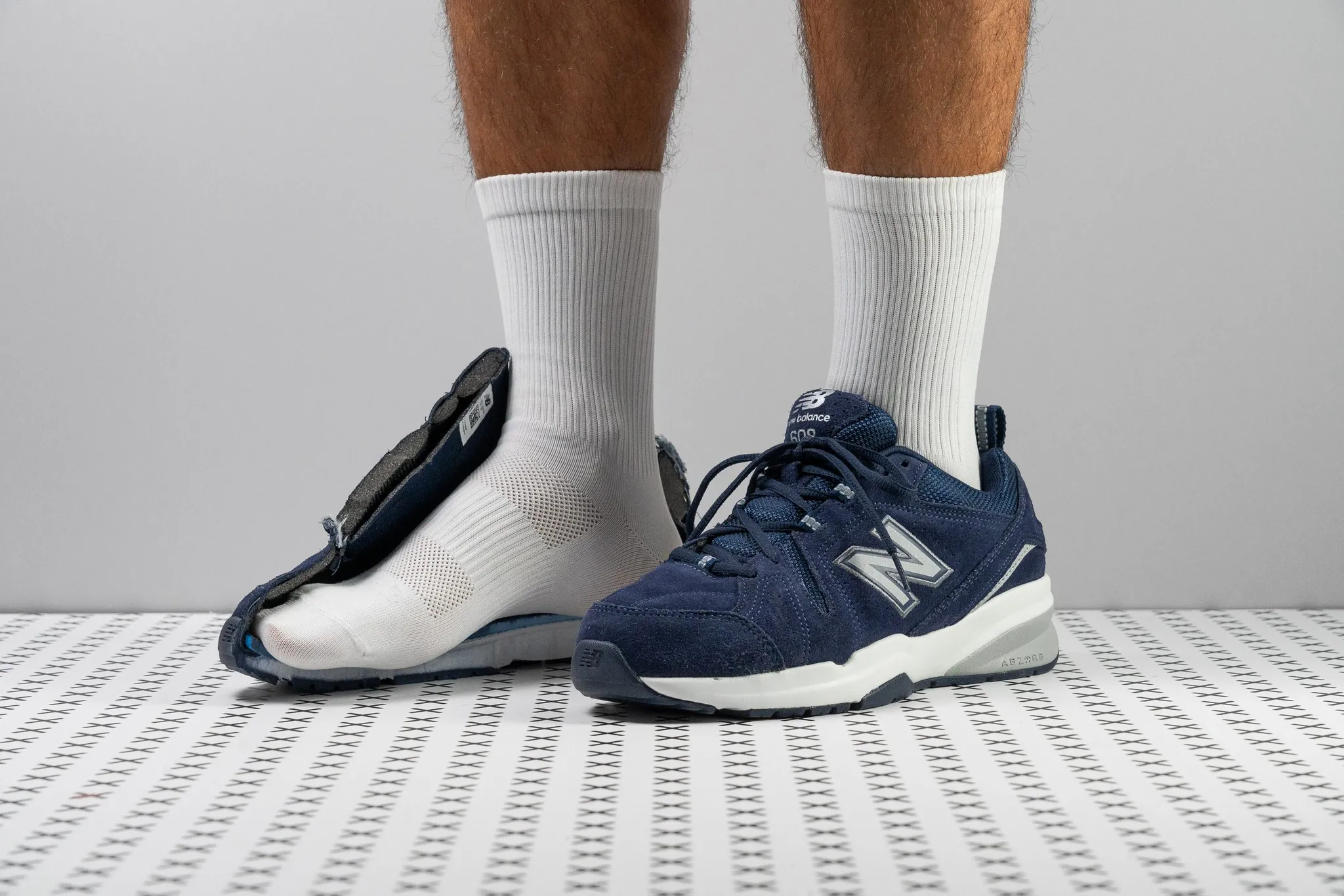
The New Balance 608 v5 is not the shoe that gets sneaker people excited. Good. For at-home walking, excitement is overrated if the shoe absorbs enough impact, fits predictably, and does not eat the whole budget that could have gone toward the walking pad, fan, or mat.
RunRepeat lists the 608 v5 around $70 against a roughly $119 category average and measures it at 116 SA heel shock absorption, with a 31.7 mm heel stack and 22.1 mm forefoot stack.[1] The important part is not that it beats the premium models. It does not. The important part is that it clears the same RunRepeat heel-cushion threshold used for 30–60 minute treadmill walking sessions.[2]
That makes the 608 v5 the reasonable stopping point for a lot of people: renters doing moderate walking-pad sessions, beginners building a habit, anyone who wants a dedicated indoor pair without turning the purchase into a running-shoe research project. If the routine is mostly flat walking, not speed intervals, and your feet feel stable in the shoe, the upgrade case has to be about comfort preference rather than minimum adequacy.
The reasons to move up are also clear. If the walking pad feels hard after 20 minutes, if you are sensitive under the heel or forefoot, if your apartment runs hot and the upper feels swampy, or if you want a lighter, more modern rolling feel, the premium Fresh Foam models start to make sense. The 608 v5 wins on value; it does not magically become the softest or most breathable New Balance shoe.
$100–300: separate softness, balance, and support
Once the budget moves past $100, the question is no longer “can I get enough cushion?” It becomes “which kind of comfort am I paying for?” A soft neutral trainer, a maximal stack shoe, a balanced daily trainer, and a support-oriented walking shoe are not interchangeable just because they all say New Balance.
1080 v15: the premium neutral pick for soft daily walking
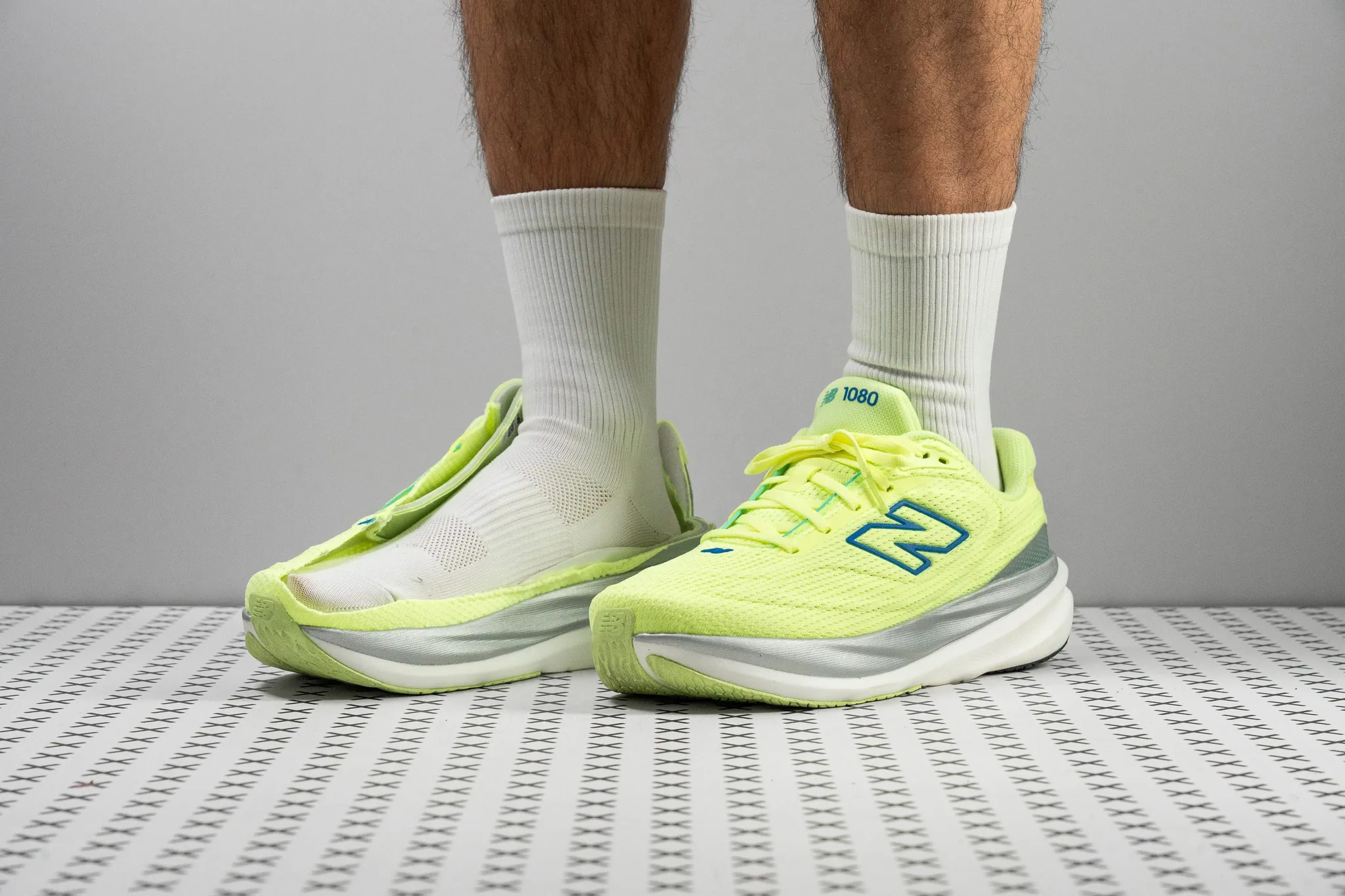
The Fresh Foam X 1080 v15 is the cleanest premium answer if you want one shoe for steady indoor walking and do not need extra stability. RunRepeat’s 2026 list ranks it as the best overall New Balance walking shoe, with 147 SA heel shock absorption, 13.1% more cushioning than average, and a 9.0 oz listed weight.[1]
For a walking pad, that combination is attractive: high heel cushioning without turning the shoe into a visibly enormous platform. It is the model I would compare against the 608 v5 if the budget stretch is possible and the main complaint is that cheaper comfort trainers feel dated, warm, or dull underfoot.
The caution is stability. RunRepeat flags limited stability on the 1080 v15.[1] That does not make it a bad walking shoe; it just means it should not be treated as the universal premium answer for every foot. If you already know you collapse inward or prefer a more guided platform, skip the prestige pick and look at the support section.
Fresh Foam X More v6: maximum cushioning for harsh decks
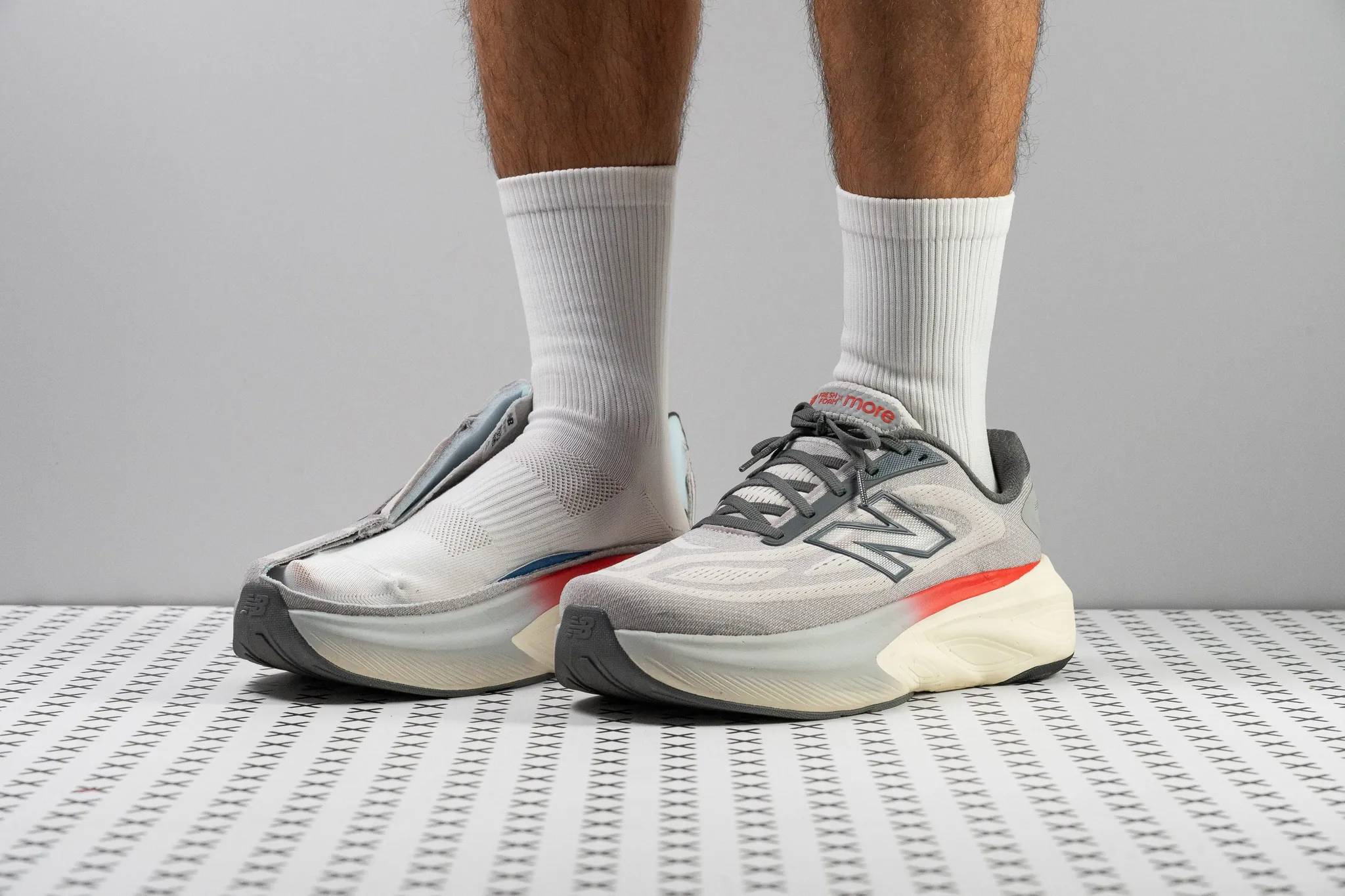
The Fresh Foam X More v6 is the pair that makes sense when the walking pad itself feels unforgiving. RunRepeat measured 152 SA heel shock absorption and 144 SA forefoot shock absorption, plus a 41.8 mm heel stack and one of the widest measured platforms in its data at 122.5 mm in the forefoot and 102.0 mm in the heel.[1]
That is a lot of foam and a lot of base. Indoors, the benefit is obvious: more material between the foot and the thin deck, especially for walkers who feel heel thud or forefoot slap as the session drags on. The trade-off is also obvious in a small apartment. A maximal shoe takes up more visual and physical space, and some people do not like the elevated feeling on a narrow walking pad.
Between the 1080 v15 and More v6, I would not choose by price first. Choose by sensation. If you want a premium neutral trainer that still feels like a daily shoe, start with the 1080 v15. If the deck feels hard and you want maximum soft landing, the More v6 is the more direct tool.
880 v15: the middle option with an indoor-friendly caveat
The Fresh Foam X 880 v15 sits in the sensible middle: a daily trainer rather than a maximum-cushion statement. RunRepeat measures a 39.7 mm heel stack and 35.4 mm forefoot stack and notes rocker geometry, while RunToTheFinish names it a durability-and-cushion winner for serious walkers.[1][3]
The disagreement is useful. RunRepeat flags only 1.9 mm of outsole rubber on the 880 v15.[1] For someone grinding miles outdoors on abrasive pavement, that is a real caution. For an indoor walker using a belt at home, outsole rubber thickness drops lower on the priority list. I would still care if this were the only shoe you planned to wear outside, but for a dedicated walking-pad pair, upper comfort and underfoot feel matter more.
Width and support: when fit is the limiting factor
New Balance’s width reputation is one of the few brand reputations that actually matters for home walking. A shoe can have excellent cushion numbers and still be wrong if the toes are squeezed or the heel swims. RunRepeat’s New Balance size-chart work lists width ranges from 2A to 6E across the brand, though exact availability depends on the model and retailer.[7]
The Fresh Foam X 840v1 deserves attention here because Verywell Fit’s tested roundup selected it as the best New Balance shoe for walking, noting three widths, an APMA Seal of Acceptance, and a tester who used it on a treadmill.[4] That is not the same kind of lab-cushion proof as RunRepeat’s SA numbers, and Verywell Fit is an affiliate roundup, but the fit signal is relevant for people who are shopping around width rather than chasing the softest foam.
For more specific support needs, Shape’s podiatrist-sourced list points to the 928v3 around $157 for plantar-fasciitis-adjacent use, citing a removable polyurethane footbed and lace or hook-and-loop closure options; it also points to the Vongo v6 as an APMA-approved overpronation pick.[5] Shape is also an affiliate roundup, so I would treat those as leads to try on carefully, not as a diagnosis-by-sneaker.
If pain, injury, or recovery is part of why you are walking at home, the shoe decision should get more conservative. Removable footbeds matter if you use orthotics. Stability matters if a soft neutral platform makes you feel like you are drifting inward. And if symptoms are active, use a clinician’s guidance rather than trying to solve everything with a thicker midsole. For movement ideas around recovery, see the home foot-injury recovery exercise guide.
Why the retro New Balance pairs are not the home-walking answer
The 574, 327, and 1906R have their place. The place is not necessarily 45 minutes on a compact treadmill while the room slowly warms up and the deck gives you less forgiveness than you expected. Retro New Balance models can be comfortable for daily wear, but for a dedicated home walking workout shoe, they start behind the running-style trainers because the useful evidence here is cushioning, stack, breathability, and fit.
This is also where it helps to separate walking shoes from other at-home New Balance content. The Cameron Brink New Balance home-workout guide deals with models for strength and HIIT-style use. That is a different job. A walking shoe can be softer and more rolling; a strength shoe usually needs more lateral control and a flatter, more planted feel.
Small-apartment buying logic
A home walking setup is a system: shoe, walking pad, floor protection, airflow, and the amount of time you actually walk. If the budget is tight, it is hard to justify spending the whole upgrade fund on the shoe when the 608 v5 already clears RunRepeat’s treadmill-walking cushion threshold. That money may be better split across a mat, a fan, or the walking pad itself.
For space and budget context, the small-apartment home gym tour and compact home-gym space tiers are more useful than pretending the shoe exists in a vacuum. A $70 shoe that leaves room for better airflow can be more livable than a $170 shoe worn in a hot corner with no fan.
Volume matters too. Women’s Health cites physical-therapy sources recommending proper shoes for walking-pad use and limiting weekly volume increases to about 10%.[8] If you are just starting, pair the shoe with a routine you can repeat, such as a beginner home workout plan, or use the long vs. short walks guide to decide whether one longer walk or several shorter ones fits the day.
Heat is the quiet deal-breaker. A shoe that feels plush for five minutes in a store can feel heavy and warm after half an hour indoors. If your apartment runs hot, prioritize breathable uppers and consider the setup advice in the extreme-heat indoor workout guide. The softest shoe is not automatically the best shoe if it turns the session into a foot sauna.
The practical chooser
- If the budget is tight, start with the New Balance 608 v5. It is the value disruption because RunRepeat measured 116 SA heel shock absorption at a much lower tested price than the premium Fresh Foam models.[1]
- If cushioning is the priority, compare the Fresh Foam X 1080 v15 and Fresh Foam X More v6. Pick the 1080 v15 for a softer premium daily-trainer feel; pick the More v6 if the walking pad feels harsh and you want maximum stack and platform width.[1]
- If you want a middle daily trainer and mostly walk indoors, consider the 880 v15, but understand the outsole-rubber warning matters more outside than on a walking pad.[1]
- If width or support is the limiting factor, look at the 840v1, 928v3, or Vongo v6 before forcing yourself into a softer neutral shoe that does not fit your foot well.[4][5]
- If the shoe is mainly for dedicated home walking workouts, skip retro lifestyle pairs as the first choice. They may look familiar, but measured cushioning, breathability, and width do more work indoors.
References
- 7 Best New Balance Walking Shoes in 2026 — RunRepeat, 2026
- Best Treadmill Walking Shoes — RunRepeat
- Best New Balance Walking Shoes for Serious Walkers — RunToTheFinish
- The Best New Balance Shoes — Verywell Fit
- The Best New Balance Shoes — Shape
- The “Walking Pad” Warning: Why Your Feet Might Hate This Trend — Advanced Feet & Ankle Care, January 2026
- New Balance shoe size chart — RunRepeat
- Walking Pad Workouts — Women’s Health
What a small equipment investment adds
Can insect protein build muscle at home?
Insect protein from crickets and mealworms produces a muscle protein synthesis response comparable to milk protein in acute trials, but the only training study in young men found no extra strength or size gain. This verdict sorts out what the human research actually supports so home lifters can decide if insect protein is worth buying.
Swimming Pool Under $5? The Real Price Ladder
No swimming pool under $5 can support home exercise — that budget buys a resistance band or one community-pool day pass. The verified price ladder runs from $125 inflatables to $25,999+ swim spas, with a depth rule that separates pool toys from real training.
Tour a Small Apartment Home Gym at $100, $300, and $800
Three real apartment gym setups at $100, $300, and $800 with itemized costs, measured decibel ratings, floor-protection methods, and honest notes on what each tier can and cannot do — so you can choose the right entry point without risking your deposit or your neighbor's patience.
How often should you repeat this?
See our recovery and rest reference for citation-anchored rest-interval guidance.
Spot something off?
Tell us if a movement, tier assumption, or duration didn't match your experience.