
12-Week Home Workout Plan for Weight Loss Without Ozempic
A 12-week home workout plan for weight loss without Ozempic, built for people priced out, insurance-denied, or side-effect-averse. It lays out the honest tradeoff — the drug produces larger losses on the scale, but the non-drug route preserves more muscle at a fraction of the monthly cost — and the weekly strength-plus-cardio structure that supports a calorie deficit in a small home space.
- Equipment tier required
- none
- Duration
- 20-60 min
- Difficulty
- beginner
- Target area
- full body
- Space footprint needed
- yoga mat area
- Noise level
- low
If you searched for a weight loss without Ozempic home workout plan, the first honest sentence is this: a home plan should not pretend it produces the same scale loss as semaglutide. In STEP 1, adults with overweight or obesity using once-weekly semaglutide 2.4 mg plus lifestyle intervention lost 14.9% of body weight over 68 weeks, compared with 2.4% in the lifestyle-only group [1].
That number matters because it prevents a cheap kind of fitness advice: the kind that acts as if medication is just a shortcut and a set of squats can reproduce a drug trial. They cannot. The better case for the no-drug route is narrower and more useful: you use a calorie deficit to create weight loss, strength training to defend muscle, cardio to raise weekly energy expenditure and conditioning, and a repeatable home structure so Monday does not depend on motivation.

The tradeoff is not “exercise beats Ozempic”
The STEP 1 comparison is useful, but it is easy to misuse. The lifestyle-only arm in that trial was not the same thing as a rigorous, highly supported home-and-diet program. A review in ACSM’s Health & Fitness Journal notes that intensive lifestyle programs in separate research can approach about 10% weight loss at 52 weeks [2]. That does not erase the semaglutide result. It simply keeps the comparison from turning into two false claims: “exercise is just as powerful as the drug” on one side, and “without the drug, nothing works” on the other.
The muscle issue is where the home plan gets its strongest argument. Rogers and colleagues summarize estimates that 25% to 39% of GLP-1-associated weight lost may come from lean mass, while lifestyle-mediated weight loss is often closer to 15% to 20% lean mass loss [2]. A 2024 Lancet Diabetes & Endocrinology review similarly reports that non-pharmacological caloric restriction studies often show fat-free mass losses in the 10% to 30% range [3]. The point is not that medication “burns muscle” in some cartoonish way. Weight loss of many kinds can include some fat-free mass loss. The point is that if you are losing weight without Ozempic, lifting is not decoration. It is one of the main reasons to choose this route seriously.
Cost also changes the decision. Novo Nordisk lists Ozempic at about $997.58 for a monthly pen, before insurance or other savings programs [4]. Cash-pay estimates commonly land around $900 to $1,200 per month, and pricing can shift with insurance rules, shortages, coupons, and manufacturer programs [5]. As of 2026, Novo Nordisk has also advertised a lower self-pay option for eligible patients, so the cleanest statement is not “Ozempic costs everyone $1,000.” It is that many people still face a monthly bill large enough to make the decision practical before it is philosophical [4].
| Route | What it is strongest at | What you still have to manage |
|---|---|---|
| Semaglutide route | Larger average scale loss in STEP 1 | Cost, access, side effects, medical supervision, muscle-preserving training |
| No-Ozempic home route | Cost control, continuity, strength habit, muscle-preserving structure | Calorie deficit, slower scale change, consistency, compensation from hunger or fatigue |
Starting, stopping, switching, or skipping a GLP-1 medication is a medical decision. This article is the training and routine side of the non-drug path, not a substitute for a clinician’s advice.
The operating system: deficit, strength, cardio, tracking
For weight loss without Ozempic, the calorie deficit is the engine. Mayo Clinic frames a daily deficit of 500 to 750 calories as a common target for losing about 1 to 1.5 pounds per week [6]. That range is useful because it is plain and unglamorous. It also keeps the workout plan in its proper place: training supports the deficit, but it should not be asked to do all the work.
Strength training protects what the bathroom scale cannot see. Cardio supplies additional weekly energy expenditure, conditioning, and a habit of moving even when you are not chasing a personal record. Tracking keeps you from declaring failure after one salty dinner or pretending a stalled month is still “probably working.”
If you are taking a GLP-1 already, use the on-drug version instead: GLP-1 weight loss home workout plan. If you want the deeper lean-mass discussion, the companion piece on GLP-1 home workouts and muscle preservation is the better side door. Here, the job is to make the no-drug plan usable.
Your 12-week home workout plan at a glance
You need enough room for a mat, a pair of dumbbells or a backpack, and a walking route or low-impact cardio option. The first four weeks are deliberately modest. That is not because modest training is magical. It is because the person who can repeat a plan has a better problem to solve than the person who burns down after six heroic sessions.

| Weeks | Strength | Cardio | Main goal |
|---|---|---|---|
| 1–4 | 3 days/week, full-body sessions | 2 days/week, 20–30 minutes easy to moderate | Build the floor: show up, learn form, start the deficit |
| 5–8 | 3 days/week, more sets or harder variations | 3 days/week, 25–40 minutes | Increase weekly training dose without making recovery chaotic |
| 9–12 | 3–4 days/week depending on recovery | 3–4 days/week, working toward 150–250 minutes/week total moderate-to-vigorous activity | Push activity range while keeping strength performance from collapsing |
The activity target in the final phase is not invented for drama. ACSM guidance connects 150 to 250 minutes per week of moderate-to-vigorous physical activity with weight loss, while higher amounts are often discussed for weight-loss maintenance [7]. In this plan, you approach that range gradually. Jumping there in week 1 is a good way to confuse soreness with progress.
Weeks 1–4: make the plan repeatable
Your first month has one job: finish most of the sessions you planned. Keep two reps “in the tank” on strength moves. You should feel like you trained, not like you negotiated with the floor afterward. If the workout feels too easy in week 1, good. You are buying consistency.
| Day | Session |
|---|---|
| Monday | Strength A, 30–40 minutes |
| Tuesday | Cardio, 20–30 minutes easy to moderate |
| Wednesday | Rest or 10 minutes mobility |
| Thursday | Strength B, 30–40 minutes |
| Friday | Cardio, 20–30 minutes easy to moderate |
| Saturday | Strength A again, or a shorter full-body session |
| Sunday | Rest, walk, meal prep, or gentle mobility |
Strength A
- Goblet squat or chair squat: 2–3 sets of 8–12 reps
- Incline push-up on a counter, couch, or sturdy table: 2–3 sets of 6–12 reps
- One-arm dumbbell row, band row, or backpack row: 2–3 sets of 8–12 reps per side
- Glute bridge: 2–3 sets of 10–15 reps
- Dead bug or front plank: 2–3 controlled sets
Strength B
- Reverse lunge, split squat, or supported step-back: 2–3 sets of 6–10 reps per side
- Dumbbell floor press or elevated push-up: 2–3 sets of 8–12 reps
- Romanian deadlift with dumbbells, backpack, or bands: 2–3 sets of 8–12 reps
- Standing overhead press or band press: 2–3 sets of 6–10 reps
- Side plank, suitcase hold, or bird dog: 2–3 controlled sets
For cardio, use whatever you can repeat: brisk walking, marching intervals, step-ups on a safe low step, a stationary bike, dancing, or quiet low-impact circuits. Apartment-friendly cardio counts if your breathing rises and you can still speak in short sentences. If you need a 20-minute fallback for a low-motivation day, the Monday workout motivation template is built for exactly that kind of session.
Weeks 5–8: add training dose without turning it into punishment
In the second month, you keep the same basic exercises but make the work more productive. Add one set to the first two lifts of each strength session, choose a slightly harder variation, or add load if you have it. Do not upgrade everything at once. The boring rule is the safest one: when you can hit the top of the rep range with clean form for all sets, make that movement a little harder next time.
| Day | Session |
|---|---|
| Monday | Strength A, 35–45 minutes |
| Tuesday | Cardio, 25–35 minutes |
| Wednesday | Strength B, 35–45 minutes |
| Thursday | Cardio, 25–35 minutes or mobility if recovery is poor |
| Friday | Strength A or B, alternating weekly |
| Saturday | Cardio, 30–40 minutes |
| Sunday | Rest |
A small-space progression can be simple. A chair squat becomes a goblet squat. A counter push-up becomes a lower incline push-up. A glute bridge becomes a single-leg bridge or a hip thrust against the couch. A backpack row gets heavier by adding books. If your knees, shoulders, or back object, the progression is not a moral test. Change the variation and keep the pattern.

Cardio also gets more deliberate here. Keep one session easy. Make one session steady and moderate. Make one session interval-based, but not theatrical: alternate one minute brisk with one to two minutes easier for 20 to 30 minutes. If cycling is your best home cardio option, the home cycling training plan can be used as your cardio-day template.
Weeks 9–12: work toward the weekly activity range
The final month is where the plan starts looking like a real lifestyle rather than a challenge. You are not trying to win a 12-week transformation contest. You are trying to reach a weekly amount of movement that can survive work, family, joints, appetite, and an ordinary apartment.
| Option | Use it if | Weekly structure |
|---|---|---|
| 3-strength version | You are recovering well but busy, sore, or new to lifting | 3 full-body strength days + 3 cardio days + 1 rest day |
| 4-strength version | You recover well and enjoy lifting | 2 lower-body emphasis days + 2 upper/full-body days + 3 shorter cardio sessions |
For most people, the 3-strength version is enough. Use the fourth strength day only if it improves the week rather than stealing from it. A fourth day can be short: hinges, rows, carries, core, and mobility. It does not need to be another maximal effort.
A practical week in weeks 9–12
| Day | Session |
|---|---|
| Monday | Strength A, 40–50 minutes |
| Tuesday | Moderate cardio, 35–45 minutes |
| Wednesday | Strength B, 40–50 minutes |
| Thursday | Easy cardio or brisk walk, 30–45 minutes |
| Friday | Strength C, 35–45 minutes |
| Saturday | Longer cardio, 45–60 minutes, or intervals if joints tolerate them |
| Sunday | Rest, gentle walk, or mobility |
Strength C can be a lighter mixed session: split squat or step-up, row, floor press, Romanian deadlift, lateral raise or band pull-apart, and a carry or plank. Keep it smooth. If your lifts are getting weaker every week, your deficit may be too aggressive, your sleep may be too low, or the extra cardio may be crowding out recovery.
Food: enough structure, not a second full-time job
The plan assumes a calorie deficit, but it does not require a perfect meal plan. Start with the 500 to 750 calorie daily deficit frame, then watch your trend. If tracking calories makes you more consistent, use it. If it makes you obsessive or miserable, use a simpler plate structure: protein at each meal, mostly high-fiber carbohydrates, vegetables or fruit, and measured fats rather than free-poured ones.
Protein deserves attention because you are trying to lose fat while defending lean mass. The detailed protein ranges and minimum lifting frequency already live in the GLP-1 training guide, especially the home workout tips for GLP-1 users. Even off medication, the same practical idea applies: make protein easy to repeat, then train the muscles you are asking your body to keep.
Do not “eat back” every estimated calorie from a workout. Exercise calorie estimates are noisy, hunger can rise, and compensation is one reason exercise-only weight loss varies so much. Let the scale trend, waist measurement, and training log tell you whether the weekly setup is working.
How to know it is working
Use four signals, not one. Body weight tells part of the story. Waist measurement tells another. Strength performance tells you whether the plan is preserving function. Adherence tells you whether the design is survivable.
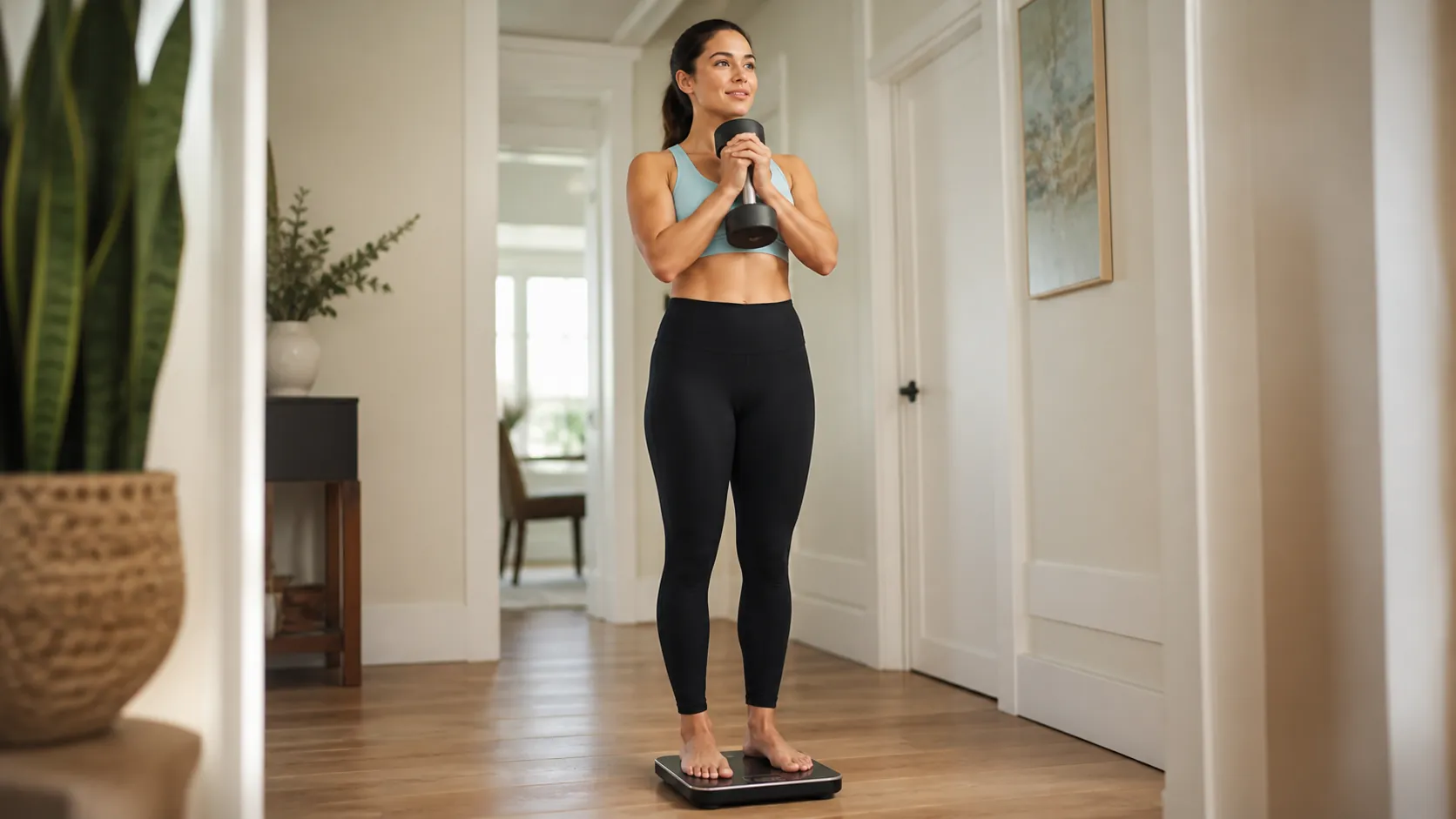
- Weigh yourself on a consistent schedule and compare weekly averages, not single mornings.
- Measure your waist every two to four weeks under similar conditions.
- Track reps, load, or exercise variation for your main lifts.
- Track completed sessions. A plan you complete at 80% is more informative than a perfect plan you abandon.
If the scale has not moved for several weeks and your adherence is honest, adjust one lever. Reduce food intake slightly, add a small amount of walking, or tighten weekend portions. Do not slash calories, double cardio, and add harder lifting in the same week. That only makes it harder to know what caused the next result.
For plateaus and expectations, use the weight loss motivation and expectations guide rather than trying to solve every flat week with a new program.
Gear, space, and the monthly cost difference
The no-drug route should not require a garage gym. A mat, one pair of adjustable dumbbells or two fixed dumbbells, and a resistance band can carry the first 12 weeks. If you have nothing, use chair squats, incline push-ups, backpack rows, hip hinges with a loaded bag, step-backs, and walking.
This is where the cost comparison becomes concrete. A month of Ozempic at common cash prices can exceed the total cost of a basic home setup. That does not make the setup medically equivalent, and it does not help someone whose clinician believes medication is appropriate. It does mean the person who was quoted an unaffordable price can still build a serious system rather than waiting for permission to begin.
If you want to match the plan to your budget and apartment constraints, use FitAtHome’s $0–$100–$300–$800 Builds approach through the equipment-tier guidance. Start lower than your ego wants. Upgrade only when a missing load or cardio option is clearly limiting the work.
Why maintenance belongs in the conversation
The maintenance problem is not unique to medication. Any route that creates weight loss has to answer what happens when the active push ends. In STEP 4, participants who switched from semaglutide to placebo after a 20-week run-in regained 6.9% from week 20 to week 68, while those who continued semaglutide lost an additional 7.9% over that period [8].
That is one reason exercise matters more after weight has started coming off. National Weight Control Registry data summarized in Diabetes Spectrum reports that 90% of long-term weight-loss maintainers report regular exercise, averaging about 383 calories per day across 7 days per week [9]. Self-reported registry data does not prove that exercise alone caused maintenance, but it does show that the people who keep weight off tend to have movement embedded into ordinary life.
This is the quiet advantage of the 12-week home plan. It does not wait until the scale is lower to start building the behavior you will need later. You learn which cardio you tolerate, which lifts fit your joints, which days are fragile, and what kind of deficit you can live with.
What this plan can and cannot promise
It can promise structure. It can give you a rational weekly schedule, a way to progress strength, a cardio target that grows over time, and a tracking method that keeps expectations sane. It can make weight loss without Ozempic more than “try harder.”
It cannot promise a STEP 1-style average scale result. It cannot remove the need for a calorie deficit. It cannot guarantee that appetite, stress, sleep, medications, pain, or medical conditions will cooperate. If those factors are making weight loss feel impossible, that is a reason to involve a clinician, not a reason to call yourself undisciplined.
If Ozempic is unavailable, unaffordable, poorly tolerated, or simply not the route you want, a structured 12-week home plan is not a consolation prize. It is the version that builds the muscle-preserving base and exercise habit you will still need later, whatever your medical options become.
References
- Once-Weekly Semaglutide in Adults with Overweight or Obesity — STEP 1, NEJM, 2021
- Exercise for Clients Taking an Anti-Obesity Medication, ACSM's Health & Fitness Journal
- Muscle matters: the effects of medically induced weight loss on skeletal muscle, Lancet Diabetes & Endocrinology, 2024
- Explaining the List Price of Ozempic®, NovoCare/Novo Nordisk
- Beyond Ozempic, Culina Health
- Exercise for weight loss: Calories burned in 1 hour, Mayo Clinic
- How Much Physical Activity is Needed for Weight Loss, Weight Loss Maintenance and Weight Gain Prevention?, Obesity Medicine Association
- Effect of Continued Weekly Subcutaneous Semaglutide vs Placebo on Weight Loss Maintenance — STEP 4, JAMA, 2021
- Role of Physical Activity for Weight Loss and Weight Maintenance, Diabetes Spectrum
What a small equipment investment adds
We don't have a build tagged to this exact tier yet. Browse all builds.
How often should you repeat this?
See our recovery and rest reference for citation-anchored rest-interval guidance.
Spot something off?
Tell us if a movement, tier assumption, or duration didn't match your experience.