
The X3 Bar costs $549. It is not a bar. It is a band system with handles. To get the resistance profile that most people imagine when they hear “bar,” you need the optional elite bands and probably a separate barbell collar. The $549 sticker is real but incomplete. That is the problem in a nutshell.
I have been burned by this before. You see a low shelf price, you think you are getting a deal, and then the subscription bill shows up every month, or you realize you need to drop another $800 on plates and a bench before you can do a single squat. The only price that matters is what you actually hand over over the period you actually train — including every mandatory add-on, every monthly charge, and every piece of gear you must buy to make the system usable. That is total cost of ownership (TCO), and it flips which machine is cheaper.
Four Components, One Real Number
Total cost of ownership for a compact home gym adds up from four components:
- Purchase price — what you pay upfront, including tax if the site includes it.
- Subscription fees — monthly or annual fees required for core functionality. A system that is a brick without a subscription (like Tonal) makes this the single biggest hidden cost.
- Installation — professional installation required by some machines. Tonal, for example, needs a pro mount that adds $250–$500 (common knowledge; the company does not publish a fixed fee).
- Mandatory accessories — hardware you must buy separately to make the machine usable. Foldable racks need a barbell, plates, and a bench. Plate-loaded all-in-ones need weight plates.
Maintenance is negligible for most of these systems (steel frames, digital components that rarely fail within warranty), so I skipped it. The numbers below use list prices from Garage Gym Reviews and CNET as of June 2026, and the analysis runs two time horizons: three years (short ownership) and five years (long-term commitment).
The Tonal Trap: $4,295 Plus $3,597 in Subscriptions
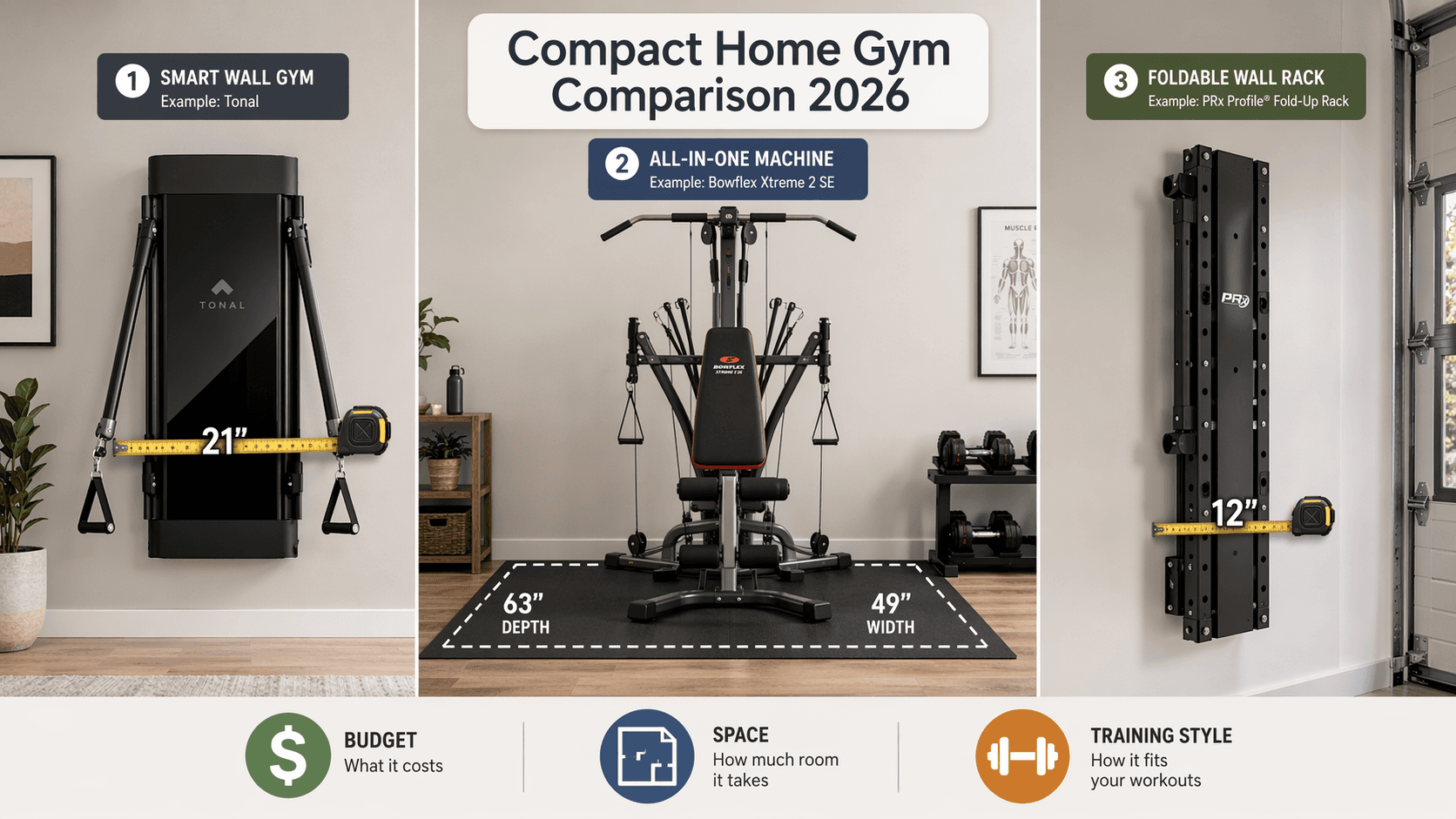
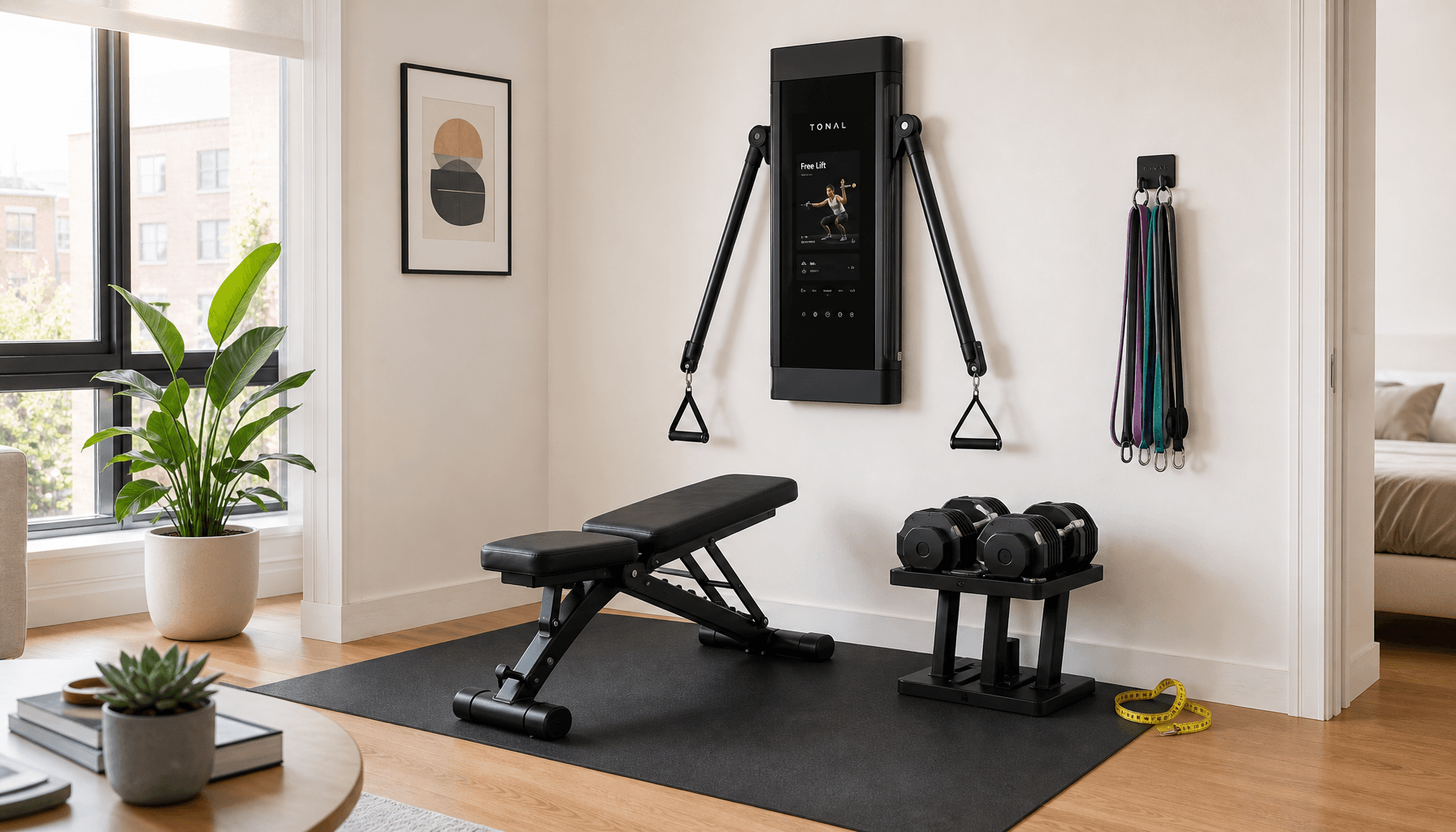
The most dramatic example of hidden subscription cost is the Tonal 2. Purchase price: $4,295. Mandatory membership: $59.95 per month. Without that membership, the machine is essentially a dumb pulley — you cannot use the guided workouts, the automatic resistance adjustment, or any of the software that makes it a “smart” gym. You can still pull cable, but you are paying $4,295 for a wall-mounted functional trainer that costs less than half that without a screen. Over three years the subscription alone comes to $59.95 × 36 = $2,158.20. Over five years: $59.95 × 60 = $3,597. Add installation at the low end of $250, and the five-year total becomes $4,295 + $3,597 + $250 = $8,142. That is nearly double the purchase price.
The Speediance Gym Monster ($3,199) has no subscription. Its digital resistance tops out at 220 lbs — lower than Tonal’s 250 lbs — but for most home users that range covers nearly any compound lift you can perform in a small footprint (it folds to 15 inches deep). Over five years the Speediance costs exactly what you pay upfront: $3,199. The difference with Tonal is $4,943. That is the cleanest case for why TCO matters. A $1,096 price gap at the register turns into a roughly $5,000 gap after five years.
All-in-One Machines: No Subscription, but Watch the Resistance Ceiling
If the subscription model makes you wince, the traditional all-in-one cable machine is the obvious next look. The Bowflex Xtreme 2 SE is the most compact full-body cable gym in this category: $1,499, zero subscription, no professional installation. Stock resistance is 210 lbs (upgradeable to 410 lbs with the optional rod kit). The footprint is 63 inches long, 49 inches wide, 83 inches tall — it will fit a spare room or a tidy corner of a garage.
The Bowflex is not a replacement for a barbell — the cable path is fixed, and the max resistance, even with the upgrade, is lower than what a serious lifter would use for heavy squats or deadlifts. But for the vast majority of pull exercises, rows, presses, and accessory work, it covers the bases at a TCO that no subscription-based machine can touch.
Bells of Steel offers a plate-loaded all-in-one starting at $1,299 and a weight-stack version at $1,899. No subscription. The plate-loaded version requires you to buy plates (typically $1–$2 per lb), so add $200–$500 for 255 lbs of plates plus a barbell. The real cost for the plate-loaded system is roughly $1,500–$1,800, still well under the five-year TCO of any subscription smart gym. The trade-off is convenience: you load and unload plates manually, which is slower than a pin-select weight stack.
| System | Purchase Price | Subscription (5 yr) | Installation | Estimated Accessories | Total 5 yr |
|---|---|---|---|---|---|
| Bowflex Xtreme 2 SE | $1,499 | $0 | $0 | $0 | $1,499 |
| Bells of Steel plate-loaded (baseline) | $1,299 | $0 | $0 | $200–$500 | $1,499–$1,799 |
| Speediance Gym Monster | $3,199 | $0 | $0 | $0 | $3,199 |
| Tonal 2 | $4,295 | $3,597 | $250–$500 | $0 | $8,142–$8,392 |
Foldable Racks: The $1,099 Rack That Costs $1,700 to Use
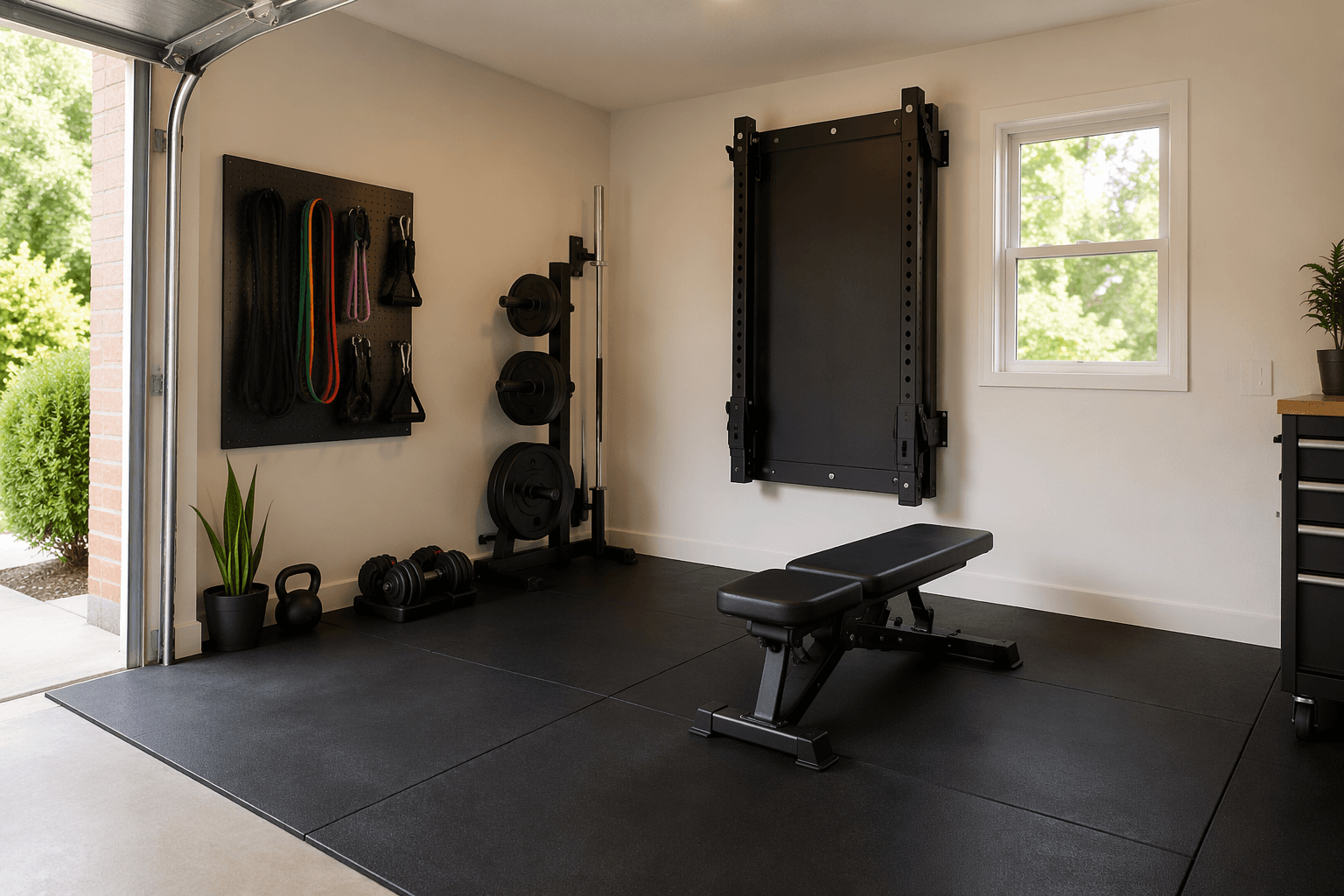
The PRx Profile PRO folds flat to 12 inches from the wall — it is the gold standard for space-saving strength training. Purchase price: $1,099. No subscription. No installation fee if you mount it yourself. But it is a rack, not a complete gym. You need a barbell (at least $150 for a decent entry-level bar), weight plates (roughly $400–$600 for 255 lbs of iron), and a bench ($150–$250). That brings the real entry cost to about $1,700–$2,100.
That number is still competitive: $2,000 for a true barbell setup is less than a five-year Tonal 2. But it is nearly double the $1,099 shelf price. The asterisk matters because many buyers see the rack price, assume the rest is a few hundred dollars, and end up spending more than expected.
The advantage of a foldable rack is that it offers real barbell strength training — squats, bench, deadlifts — that no cable-based machine can replicate. If your primary goal is progressive overload on compound lifts, the PRx setup gives you the lowest TCO for that specific capability.
Portable Systems: A Different Product Class
Systems like the X3 Bar ($549) and TRX (roughly $250) have the lowest absolute cost — no subscription, no installation, no accessories beyond what comes in the box. The X3 Bar claims up to 300 lbs of resistance (600 with the elite band), and TRX does bodyweight rows, presses, and core work.
But these are not substitutes for a full gym. The X3 bar is a band system — the resistance curve feels different from free weights or cables, and it cannot load the legs the way a barbell or squat rack can. TRX is limited to the exercises your body weight can handle. Ranking these systems alongside smart gyms or racks by TCO would mislead readers: they belong in a separate tier for minimalist training, travel, or as a supplement to a main setup.
If your goal is a full-body strength program that you can follow for years, a portable band system is not a TCO bargain — it is a different product class. The table below therefore keeps them in their own grouping.
The Full TCO Ranking: 3-Year and 5-Year Tables
The table below collects every system discussed, with purchase price, subscription cost over two time periods, installation estimate where applicable, and a best-estimate accessory line where required. All numbers are from Garage Gym Reviews and CNET unless noted as estimates.
| System | Purchase Price | Subscription (3 yr) | Subscription (5 yr) | Installation | Accessories (est.) | Total 3 yr | Total 5 yr |
|---|---|---|---|---|---|---|---|
| Tonal 2 | $4,295 | $2,158 | $3,597 | $250–$500 | $0 | $6,703–$6,953 | $8,142–$8,392 |
| Speediance Gym Monster | $3,199 | $0 | $0 | $0 | $0 | $3,199 | $3,199 |
| Bowflex Xtreme 2 SE | $1,499 | $0 | $0 | $0 | $0 | $1,499 | $1,499 |
| PRx Profile PRO + gear | $1,099 | $0 | $0 | $0 | $600–$1,000 | $1,699–$2,099 | $1,699–$2,099 |
| Bells of Steel plate-loaded + plates | $1,299 | $0 | $0 | $0 | $200–$500 | $1,499–$1,799 | $1,499–$1,799 |
| X3 Bar | $549 | $0 | $0 | $0 | $0 | $549 | $549 |
The best value is not the lowest TCO — it is the lowest TCO for the training style you actually use. If you want barbell lifts, the PRx setup wins. If you want cable workouts without a subscription, Bowflex is unbeatable. If you want smart coaching and can stomach the subscription, Tonal delivers — but you are paying an extra $5,000 over five years for that convenience. Decide what you actually need, then add up every cost before you click buy.

Comments
Join the discussion with an anonymous comment.