
A home gym week rarely asks one wearable to do one clean job. Monday might be dumbbell presses and rows, Tuesday an incline treadmill walk, Thursday a kettlebell circuit that leaves your forearms sweaty, and by Saturday the most useful number may be whether your sleep and resting heart rate say you should train hard or back off. That is where the fitness tracker ring versus watch decision gets less like a style choice and more like a question of which part of training you actually use data for.
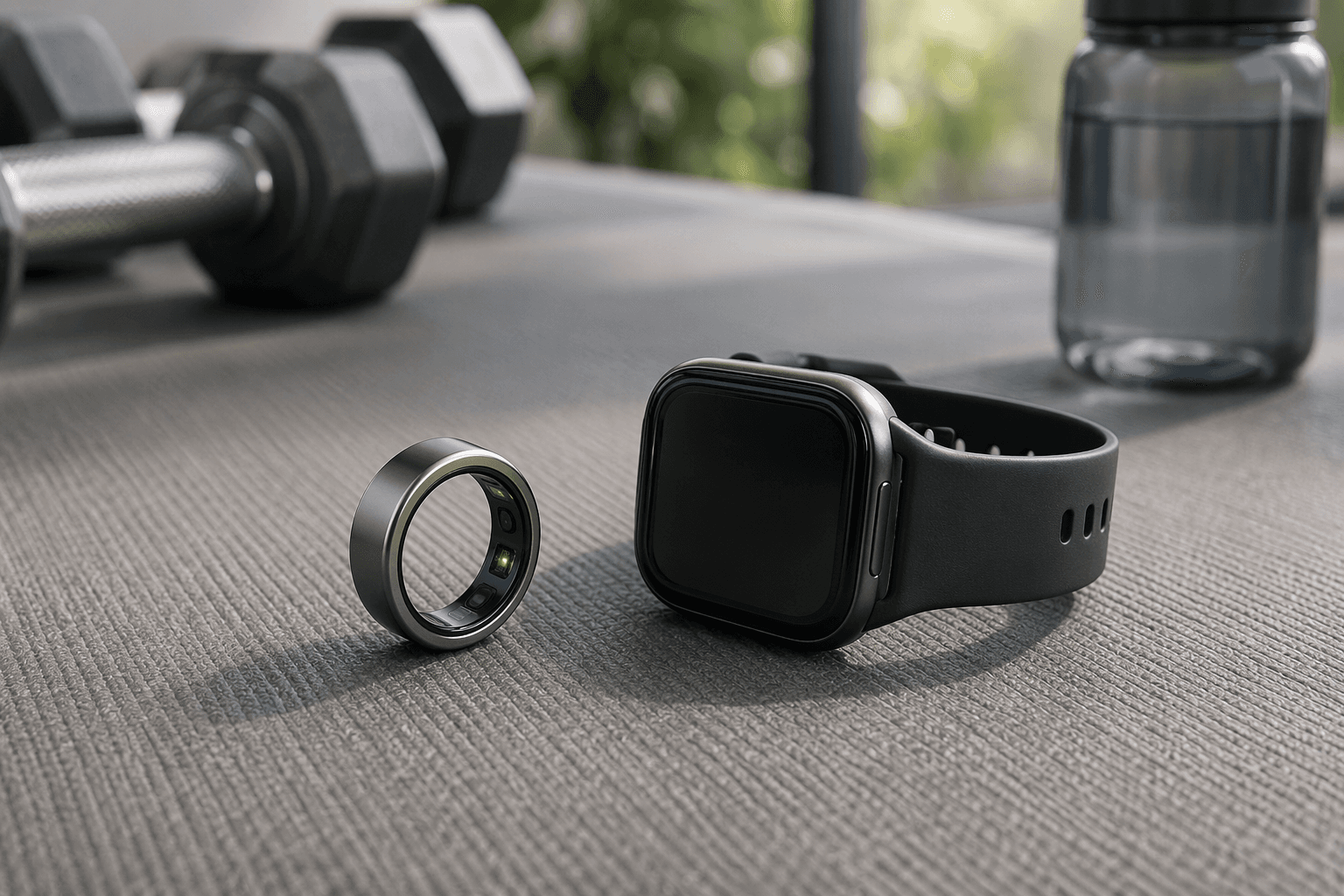
The short version: rings are strongest when your body is still; watches are stronger when your body is moving. That sounds simple, but it changes the buying decision dramatically depending on whether your training week is built around lifting, cardio, mixed conditioning, or recovery.
| Tracking job | Fitness tracker ring | Fitness watch | Home gym consequence |
|---|---|---|---|
| Sleep staging | 92–95% accuracy vs. polysomnography | 84–91% | Rings have the better case for sleep-led recovery decisions. [1] |
| Resting heart rate | 98–99% accuracy | Strong, but ring data is especially well suited to overnight baselines | A ring is useful if you care more about recovery trends than live workout feedback. [1] |
| Exercise heart rate | Weaker during active training, especially high intensity | 90–97% during steady-state cardio | A watch is the safer pick when you adjust effort during the session. [1] |
| Step counting | 85–92% | 96–98% | If steps are part of your daily target, wrist tracking has the structural edge. [1] |
| Workout auto-detection | 60–70% | 85–94% | A watch is less likely to miss that treadmill walk or conditioning session. [1] |
| GPS and live display | No built-in GPS and no real-time stats display | Common on fitness watches and smartwatches | Outdoor running, cycling, and pace-based cardio still favor the watch. [2] |
Those numbers should not be read as a universal scoreboard. They describe different conditions. A ring that does an excellent job measuring resting heart rate overnight is not automatically a better device for treadmill intervals. A watch that gives useful pace and heart-rate feedback during cardio is not automatically something you will tolerate on your wrist all night.
Start with the kind of home gym week you actually have
If you are trying not to buy twice, begin with the sessions that dominate your week, not the wearable category. A ring can be the right purchase for one home gym routine and the wrong one for another.
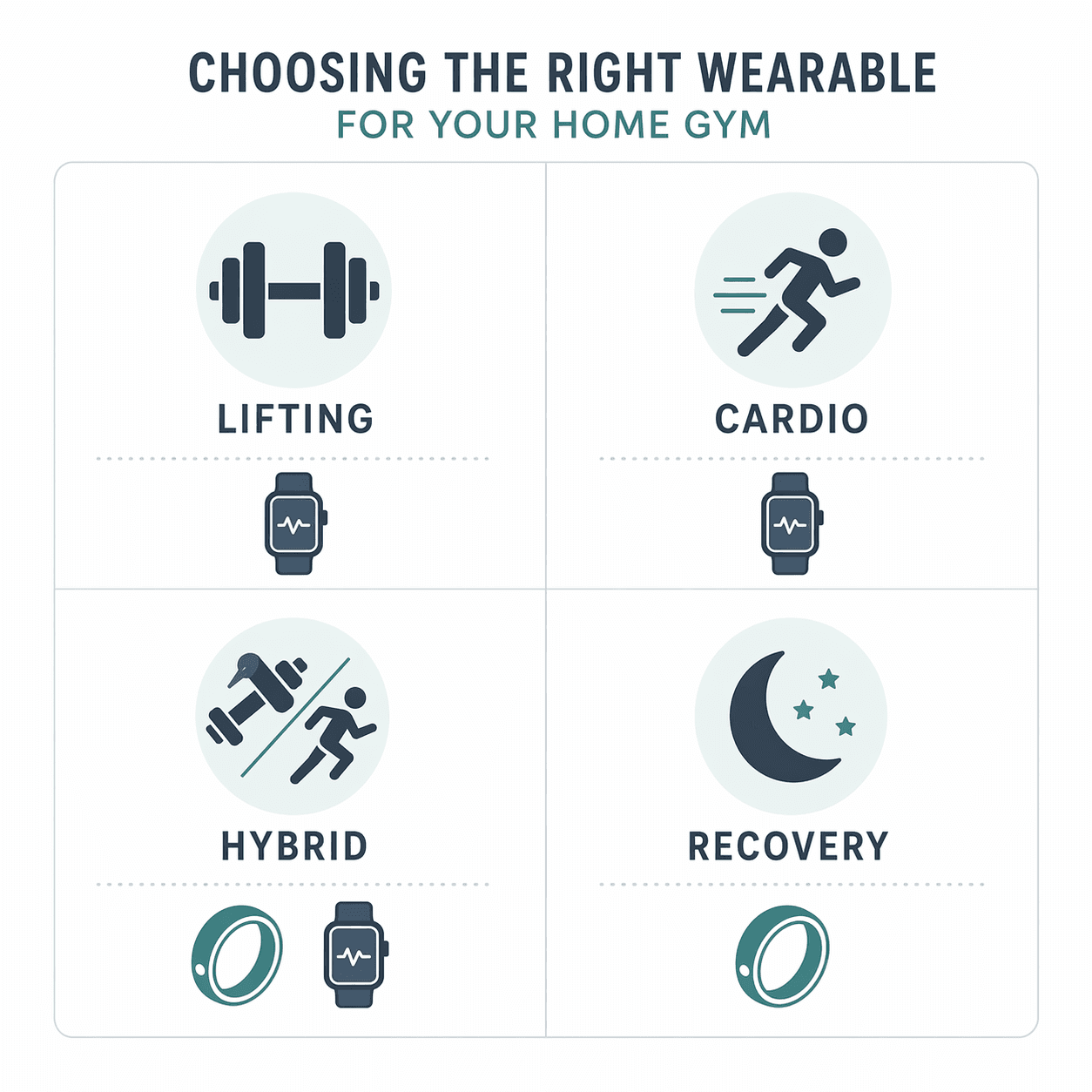
| Your usual week | Better primary wearable | Why |
|---|---|---|
| Mostly lifting | Watch, with ring optional for recovery | The ring is comfortable outside the workout, but weights create durability and comfort problems. |
| Mostly cardio | Watch | You need live heart rate, pace, GPS support, step accuracy, and reliable workout detection. |
| Hybrid strength plus conditioning | Both, if budget allows | Use the ring for overnight trends and the watch for session capture. |
| Recovery-led training | Fitness tracker ring | Sleep, resting heart rate, and overnight consistency matter more than live workout controls. |
For lifting, the ring looks convenient until the bar is in your hand
Lifting is the home-gym trap in this comparison. A fitness tracker ring is easy to like during the other twenty-three hours of the day. It does not flash, buzz, or fight with a hoodie sleeve. It is easier to sleep in than a chunky watch. Then you pick up a knurled dumbbell, and the compromise becomes physical.
Barbell and dumbbell knurling can scratch rings, and heavy gym use is a known durability concern. Titanium PVD coatings may hold up better than softer finishes, but they are not scratch-proof; Forbes Vetted found the RingConn Gen 2 Air held up best in its scratch-resistance testing, while garage-gym-focused coverage still treats ring wear under weights as a real concern rather than a solved problem. [3][4]
There is also the grip issue. A ring between your finger and a dumbbell handle is not the same thing as a watch sitting above the wrist. Some lifters will remove the ring for pulling work, kettlebell swings, or loaded carries. That is reasonable, but it also means the ring may miss the very session you hoped it would track.
For strength training, a watch is still the more practical primary device if you want session-level feedback. It can show elapsed time, rest intervals, heart rate, and workout controls without asking you to open your phone between sets. The watch may not perfectly understand every set of goblet squats or rows, but it is at least built to be consulted while you are training.
A ring still has a place for lifters who care about recovery. It can help show whether a poor night of sleep, elevated resting heart rate, or lower readiness trend lines up with a flat-feeling session. That is different from using it as the main lifting tracker. If your home gym is mostly strength work, buy the watch first unless your current problem is recovery consistency rather than workout capture.
Cardio is where the watch earns its space
During cardio, the difference is not just accuracy after the fact. It is whether the wearable can help while the workout is happening. A treadmill incline walk, bike session, rower interval, or outdoor run often depends on live feedback: heart rate zone, pace, elapsed time, lap cues, distance, or whether the device even noticed the workout started.
Wrist devices have the better evidence for steady-state exercise heart rate, with reported ranges of 90–97%, while rings are not primarily designed for active heart-rate tracking. Step counting also favors watches at 96–98% versus 85–92% for rings, partly because a ring does not get the same arm-swing signal a wrist device uses. [1]
The display matters just as much as the sensor. If your heart rate is drifting too high during a zone 2 treadmill session, you need to see that before the cooldown. If your outdoor run depends on distance or pace, a ring’s lack of built-in GPS is not a small omission; it means the ring must lean on a phone or connected device, and even then it cannot show you real-time stats on your finger. Current smart rings also lack a display for workout stats. [2]
Auto-detection is another quiet difference. Rings are reported around 60–70% for workout auto-detection, while wrist devices land higher at 85–94%. [1] That matters for normal home gym behavior, because many people do not start a formal workout every time they step onto a treadmill or knock out a short conditioning circuit. A missed workout is not catastrophic, but if it happens often, your weekly training picture gets thinner.
For a deeper look at where smart rings struggle during active workouts, especially exercise heart rate and high-intensity misses, see our guide: Can a Smart Ring Replace Your Fitness Watch for Workout Tracking? This article stays focused on the purchase decision, but the workout-tracking gap is the reason cardio-heavy users should be careful about replacing a watch with a ring.
Hybrid training is the one place “use both” is not excessive
For a lot of home gym users, the week is not cleanly strength or cardio. It is dumbbells, treadmill, a kettlebell finisher, a recovery walk, and one night of terrible sleep that changes the plan. This is where wearing both a ring and a watch can be practical rather than gadget-hoarding.
The ring handles the quiet data: sleep staging, resting heart rate, overnight trends, and recovery signals. The watch handles the noisy data: exercise heart rate, time, pace, steps, GPS, workout controls, and auto-detection. Serious home gym users who can afford both commonly use this split setup: ring for sleep and recovery, watch for workouts. [1]
That does not mean everyone needs both. It means the two devices solve different parts of the same training week. If you already own a watch you like, a ring can add value if your biggest blind spot is overnight recovery. If you already own a ring and keep wishing you could see your heart rate during intervals, the answer is probably not to wait for the ring to become a watch. It is to add or keep the wrist device.
There is one practical annoyance with dual wear: duplicated data. Two devices may estimate calories, heart rate, sleep, or activity differently. Pick one source of truth for each category. For example, use the ring app for sleep and readiness, and the watch ecosystem for workouts and steps. Otherwise you end up comparing dashboards instead of training.
Recovery-led routines are where a fitness tracker ring makes the strongest case
If your training decisions start with sleep quality, resting heart rate, and whether you feel ready to push, a fitness tracker ring is much easier to justify. The biggest advantage is not only that rings perform well on sleep and resting metrics. It is that people actually keep them on overnight.
Published-research reviews cited in the comparison data found 98% overnight wear compliance for ring users versus 67% for smartwatch users. [1] That difference is not glamorous, but it is huge for recovery tracking. The best sensor is not very useful if it is charging on the nightstand when your sleep happens.
This is the fairest version of the ring recommendation: choose it when you want a low-friction recovery device first and a workout tracker second. That could be the right call if your home gym routine is moderate, your cardio sessions do not depend on live metrics, and your main goal is noticing patterns such as poor sleep before hard sessions or elevated resting heart rate after a stressful week.
If you are specifically looking at Oura-style recovery workflows, our guide on using Oura Ring to improve recovery and avoid overtraining is a better next read than another generic spec comparison. For a ring-focused setup across sleep, readiness, and training adjustments, see Fitness Tracker Rings: A Practical Guide to Using Them for Home Fitness Recovery.
Why the form factor creates the difference
The ring-versus-watch gap is not just brand maturity. It comes from where the device sits and what it can physically do.
- Finger placement helps with overnight vitals. A ring sits close to blood vessels in the finger and is easy to wear during sleep, which supports resting heart rate and sleep-trend tracking.
- Wrist placement helps with activity signals. A watch can use wrist movement, arm swing, a larger body, and often more workout-oriented sensors and software to support exercise tracking.
- A screen changes behavior. You can glance at a watch mid-session, adjust pace, stop a workout, check a timer, or watch your heart-rate zone. A ring cannot show that feedback by design.
- GPS changes outdoor training. No current smart ring has built-in GPS, so runners and cyclists who care about distance and route data still need a watch, phone, or another GPS-capable device. [2]
- Metal on the finger changes gym durability. A ring can meet knurling, plates, handles, and kettlebell horns directly. A watch is not immune to damage, but it is not sitting under your grip.
That is why “which is more accurate?” is too broad to answer cleanly. More accurate for sleep staging? The ring has the stronger case. More accurate for step counting and steady cardio heart rate? The watch has the stronger case. More useful during a sweaty interval? The device with a display wins before the algorithm even enters the conversation.
A few 2026 buying caveats before choosing
The smart ring category is moving quickly enough that model-specific advice needs a date stamp. As of late June 2026, Oura Ring 5 is still too new for a settled independent testing consensus, so it is worth separating launch excitement from proven long-term performance. Broader 2026 smart ring testing from WIRED and PCMag still frames the category around health, sleep, comfort, battery life, and app experience as much as workout performance. [5][6]
If you are considering Ultrahuman, verify current U.S. availability before treating it as an easy checkout option. If you are waiting for RingConn Gen 3, remember that announced hardware is not the same thing as independently tested hardware. And if subscription cost matters, include it in the total ownership math rather than comparing only the device price.
For readers who want the larger wearable-form-factor view, including bands, our broader comparison is here: Fitness Tracker Ring vs. Smartwatch vs. Fitness Band: Which Wearable Fits Your Home Workout? This article is narrower on purpose: ring versus watch, matched to the way you train at home.
So, should you buy the ring or keep the watch?
Choose a fitness tracker ring if your home gym routine is recovery-led and you care most about sleep, resting heart rate, overnight comfort, and consistent baseline trends. It is the cleaner choice for someone who wants quiet data in the background and does not need to check metrics mid-workout.
Choose a watch if your training depends on live workout metrics: exercise heart rate, treadmill or outdoor cardio feedback, step accuracy, GPS, timers, intervals, and automatic workout detection. It is the better primary device for cardio-heavy weeks and for lifters who want to manage sessions without reaching for a phone.
Use both if you train seriously enough to care about both sides of the equation: recovery trends overnight and performance feedback during the session. The ring does not have to replace the watch to be useful, and the watch does not make the ring pointless if you hate sleeping with something on your wrist.
No wearable here is a medical-grade certainty machine. Treat the numbers as directional wellness tools, then match the device to the part of training where you actually change your behavior.
References
- Smart Ring vs Fitness Tracker vs Smartwatch: Ultimate Comparison 2026 — jointcorp.com
- Best Smart Rings 2026 — The Gadgeteer — May 23, 2026
- Best Smart Rings 2026 — Forbes Vetted
- The Best Fitness Tracker Rings, According to Experts (2026) — Garage Gym Reviews
- 3 Best Smart Ring Brands: Oura, RingConn, and Samsung (2026) — WIRED
- The Best Smart Rings We've Tested for 2026 — PCMag
Comments
Join the discussion with an anonymous comment.