
If your Pilates habit is already showing up on the bank statement every month, the question is not whether a pilates machine for home is cheaper in theory. The question is whether it is cheaper for the way you actually train. A studio bill of $160–$320 per month becomes $9,600–$19,200 over five years, before any late-cancel fees, grippy socks, parking, or extra workshops enter the picture.[1]
That five-year number is why home reformers get tempting fast. A mid-range reformer can cost roughly $1,500–$2,500, a premium home model often sits around $2,500–$5,000, and commercial-grade machines can move beyond $5,000. One seller-owned cost breakdown puts a $2,500 reformer at about a 10-month breakeven point for someone replacing two studio sessions per week at $240 per month, while an $8,499 commercial-grade reformer reaches breakeven at about 35 months under the same usage assumption.[1]
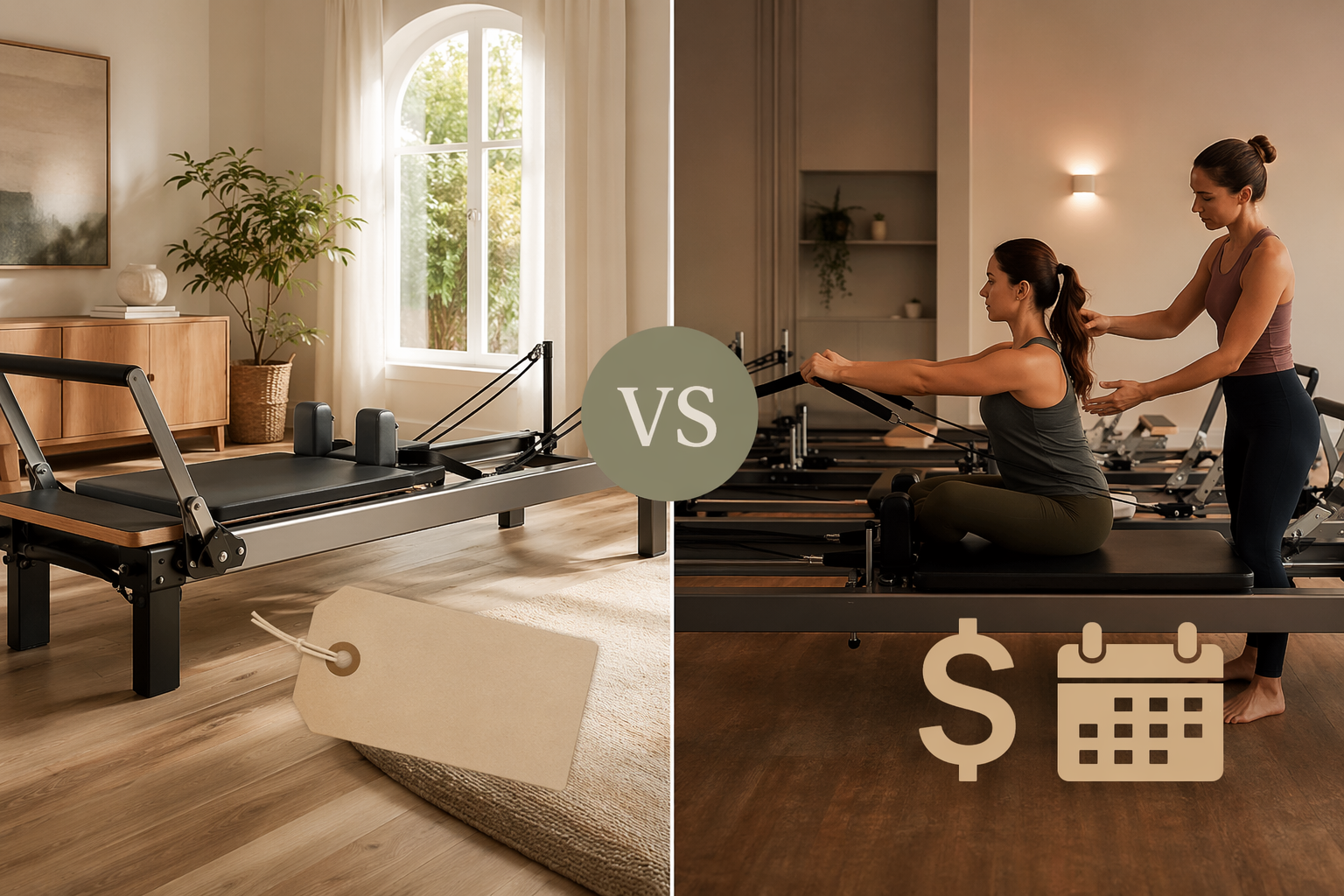
Those numbers are useful, but they are not a permission slip to buy the largest machine that fits through the door. Breakeven math is only as honest as its weakest assumption, and the weak point is usually not the studio price. It is whether the person who buys the reformer keeps using it after the first month feels less exciting.
Start With The Monthly Bill You Are Actually Replacing
Studio Pilates pricing varies by city, instructor model, class size, and membership structure. A boutique studio in a high-rent metro area will not price like a small suburban studio, and private sessions are a different calculation altogether. The $160–$320 monthly range is best treated as a U.S.-centric working range for regular group-class attendance, not a universal law.[1]
For a clean comparison, use the part of your current spend that a home machine would actually replace. If you plan to keep one studio class every week for instruction and use the reformer at home between visits, do not count your full studio membership as savings. If two people in the same household will both use the machine, count the combined studio spend the machine replaces, because that changes the payback period dramatically.
| Current pattern | Monthly studio spend to compare | What the number means |
|---|---|---|
| 1x/week | About half of the 2x/week baseline | Slowest breakeven; often better as a hybrid or beginner phase |
| 2x/week | $240/month baseline used in published examples | Most useful single-user breakeven scenario |
| 3x/week | Higher monthly replacement value than 2x/week | Home ownership becomes much more compelling if consistency is real |
| Two-person household, 3x/week each | Combined replaced studio spend | Breakeven can shorten sharply because one machine serves two users |
Breakeven By Machine Tier And Training Frequency
The most useful way to look at a home reformer is not as one big purchase, but as a replacement for repeated studio payments. The table below uses the documented $240/month, 2x/week scenario as the anchor, then scales the usage pattern for comparison. The months are approximate because real studio prices, sales tax, financing, delivery, and maintenance can move the result.
| Scenario | Mid-range reformer: $2,500 example | Premium reformer: $5,000 example | Commercial-grade reformer: $8,499 example |
|---|---|---|---|
| 1x/week solo use | About 21 months | About 42 months | About 71 months |
| 2x/week solo use | About 10 months | About 21 months | About 35 months |
| 3x/week solo use | About 7 months | About 14 months | About 24 months |
| Two people, 3x/week each | About 3–4 months per household | About 7 months per household | About 12 months per household |
The 2x/week line is the fairest place to begin. It is frequent enough to represent a real Pilates habit, but not so intense that the comparison only works for enthusiasts who train almost daily. At that level, the mid-range example pays back in roughly 10 months and the commercial-grade example in roughly 35 months when compared with a $240 monthly studio spend.[1]
The 1x/week line is where the purchase starts looking less automatic. A mid-range reformer may still make sense if you strongly prefer home training or expect to increase your practice, but the financial case takes longer to prove. A premium or commercial-grade machine for once-a-week use can spend years trying to justify itself, especially once ownership costs are added.
At 3x/week, the math changes because the machine is replacing more studio visits. This is the user who is already scheduling Pilates as part of the week, not as a hoped-for identity upgrade. For that person, even a higher-priced reformer has a clearer path to breakeven inside a three-year window, assuming the home setup is convenient enough to keep the habit alive.
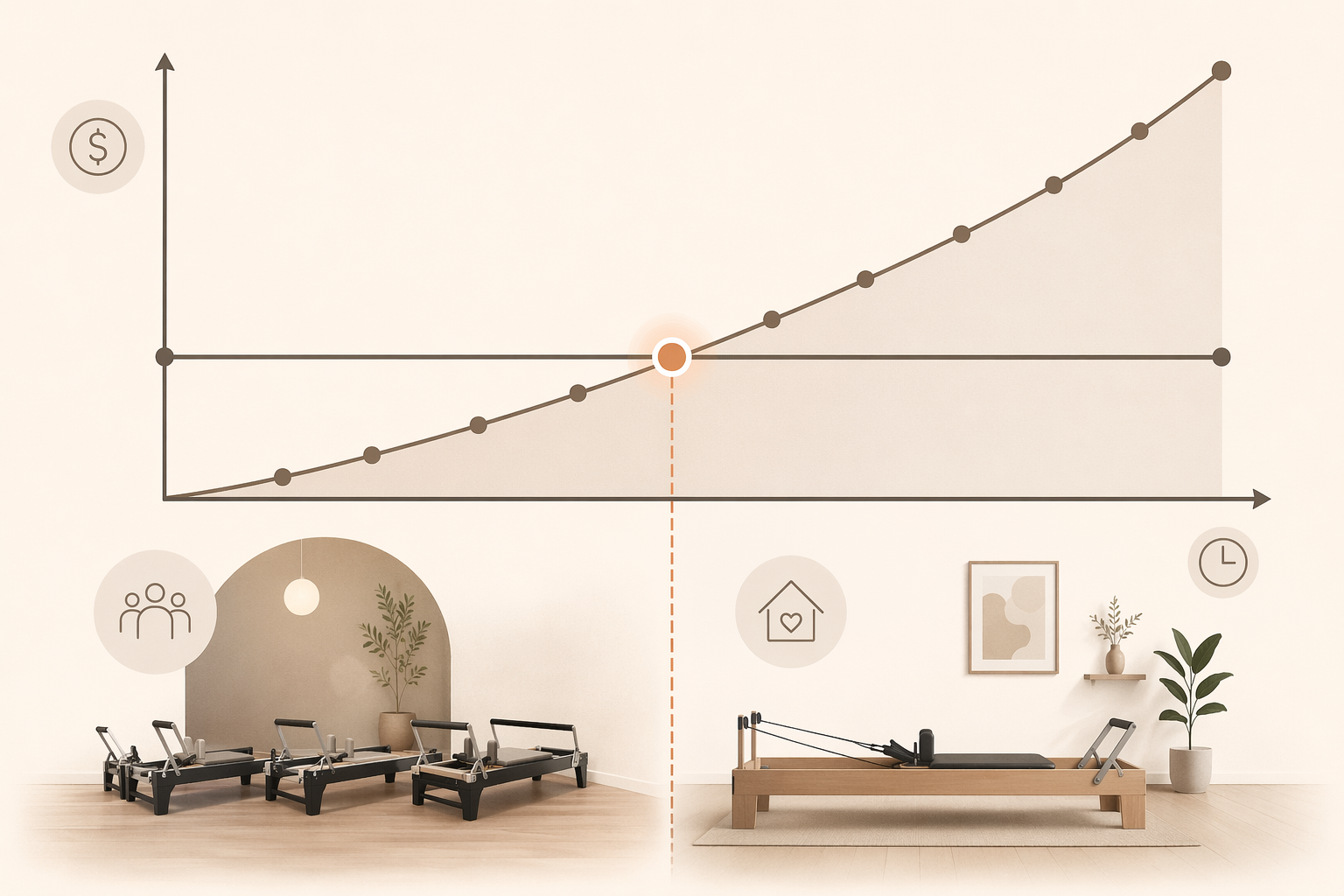
The Household Case Is Not A Footnote
A shared household is one of the few cases where the reformer economics improve without pretending the equipment got cheaper. Peak Primal Wellness describes a two-person scenario in which both people use the same reformer three times per week, effectively reducing the per-person burden because one machine replaces two separate studio habits.[2]
This does not mean every couple, roommate pair, or family should buy one. It means the machine needs to be evaluated as a household asset if two regular users will actually train on it. A reformer used six times per week by two competent users is a different financial object from a reformer used once on Sunday by someone who misses the studio schedule.
Sticker Price Is Not Total Cost
The clean breakeven table is the start, not the finish. Home ownership has costs that studio memberships hide inside the monthly fee. The ones that matter most are delivery, assembly, spring replacement, and any app or class subscription you need to make the machine useful.
| Ownership cost | Typical amount or timing | How it affects the decision |
|---|---|---|
| Shipping | $200–$600 | Adds upfront cost before the first workout |
| Assembly | Varies by seller and service area | Worth pricing before assuming the delivered machine is usable immediately |
| Spring replacement | $80–$150 per set every 3–5 years | Small compared with studio dues, but real over a long ownership period |
| App subscription | $15–$30/month | Can materially lengthen breakeven if it replaces studio instruction |
A $2,500 reformer that needs $400 in shipping and a $25 monthly app is not really competing as a $2,500 purchase. It is competing as a higher upfront cost plus a small recurring bill. That still may beat studio pricing for a consistent 2–4x/week user, but it pushes the payback point later than the simplest spreadsheet suggests.
Here is the useful adjustment: add every unavoidable first-year cost to the machine price, then subtract any ongoing home subscription from the monthly studio spend you expect to replace. If your studio bill is $240/month and your home app is $25/month, the reformer is not saving $240/month. It is saving $215/month before maintenance. That difference is not fatal, but it is the difference between buying with a plan and buying with a sales page open.
The Three-Year And Five-Year View
The longer the habit holds, the more forgiving the numbers become. A regular studio attendee in the $160–$320/month range spends $5,760–$11,520 over three years and $9,600–$19,200 over five years.[1] That is the window where a home reformer can stop looking like an indulgence and start looking like a controlled cost.
A mid-range machine has the easiest financial case because the breakeven point can arrive before the first year is over for a 2x/week user. A premium machine asks for more certainty. A commercial-grade machine can still be financially rational, but usually for someone who trains frequently, shares the equipment, wants studio-like build quality, and expects to keep the machine for years rather than months.
The five-year comparison also exposes a common problem with cheap certainty. If the machine becomes a furniture piece after six months, the studio membership was not the expensive mistake; the unused equipment was. The most financially sound purchase is usually not the fanciest reformer you can afford. It is the reformer that matches your actual practice well enough to stay in use.
When A Home Machine Makes Financial Sense
A home reformer has the strongest cost case when the buyer is already a regular Pilates student. That usually means you know how to set springs safely, understand basic carriage control, can modify familiar exercises, and do not need an instructor watching every repetition to avoid turning the session into guesswork.
- You currently attend studio Pilates at least twice per week and expect that schedule to continue.
- Your monthly studio spend is high enough that a reformer would replace a meaningful recurring cost.
- You have a permanent place for the machine, not a storage puzzle that has to be solved before every session.
- You can practice without constant hands-on correction, or you plan to keep occasional studio sessions for form checks.
- Another person in the household will use the same machine consistently.
Convenience matters here only because it protects usage. A reformer in a spare room that gets used before work is financially different from one folded behind a sofa under winter coats. Privacy and schedule flexibility are nice, but the money is saved only when they turn into completed sessions.
Who Should Wait, Rent Time, Or Go Hybrid
New Pilates students should be slower to buy. Early instruction is not just motivational; it is where many people learn how to control the carriage, organize their spine and pelvis, manage spring changes, and recognize when an exercise is too advanced. A home machine cannot watch you compensate.
The same caution applies if your studio attendance is inconsistent. If you currently cancel often, skip weeks, or rely on a booked class to make the workout happen, home ownership may remove the one structure that kept you practicing. In that case, the reformer purchase is not replacing a stable expense; it is betting that your behavior will change because equipment arrived.
A hybrid setup is often the more honest middle ground: keep a small studio pass for instruction and progression, then move simpler repeat sessions home. The savings are smaller than canceling the studio entirely, but the arrangement can preserve the part of studio Pilates that is hardest to replace: expert eyes, hands-on cueing, and external accountability.
If you are deciding whether you need a reformer at all, compare it with lower-cost setups first in At-Home Pilates Equipment: Reformer vs. Mat-and-Props. If you are still building the habit, the Pilates Home Equipment: A Phased Buying Guide for Beginners is a better first stop. If space is the limiting factor, start with the apartment Pilates equipment guides before you fall in love with a frame that cannot live comfortably in your home.
The Bottom Line On Buying A Pilates Machine For Home
For someone already taking Pilates 2–4 times per week, a pilates machine for home can be financially sound. The clearest breakeven window is roughly 10–35 months for the documented 2x/week comparison, with faster payback for higher-frequency users and shared households, and a stronger advantage over three to five years.[1][2]
The purchase becomes weaker when it depends on a future version of you who suddenly trains more often, no longer needs instruction, and does not mind moving furniture to exercise. Buy when the habit already exists, the space is real, the machine tier matches the expected use, and the total cost includes delivery, assembly, springs, and subscriptions. Otherwise, keep the studio, go hybrid, or build the home practice in phases before letting a reformer claim the room.
References
- Are Pilates Reformers Worth It? Honest Cost Breakdown (2026), thecorecollabusa.com
- Studio Pilates vs Home Reformer: Is Buying Your Own Worth It?, peakprimalwellness.com

Comments
Join the discussion with an anonymous comment.