
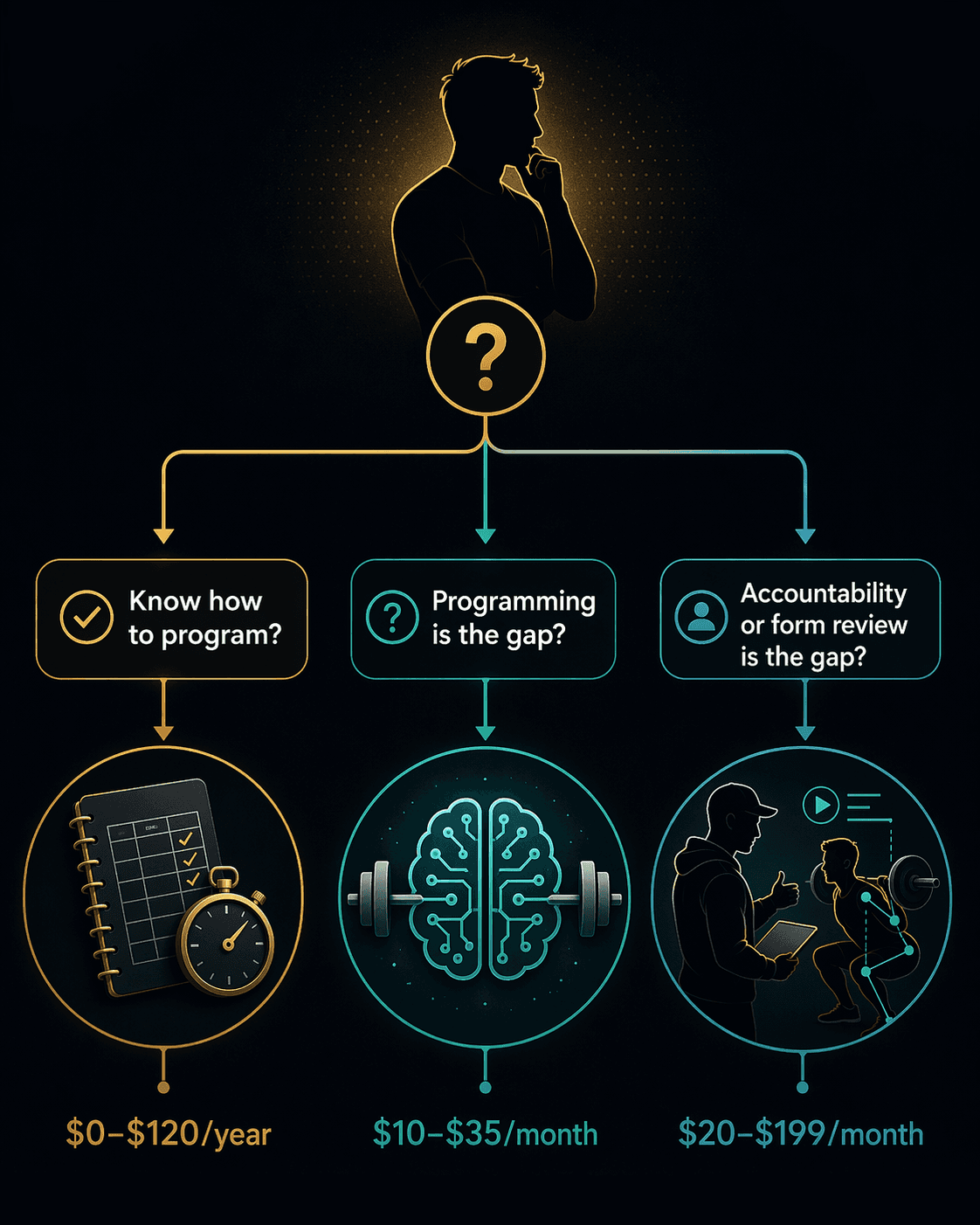
If you have trained consistently for a year or two and your workout log is starting to look more serious than your program, the best strength training app is not automatically the one with the most coaching language around it. Use a manual tracker if you already know how to progress your lifts. Consider an AI programming app if the missing piece is structure, exercise selection, or planned progression. Pay for a human-coached platform only when the real bottleneck is accountability, adherence, or form feedback.
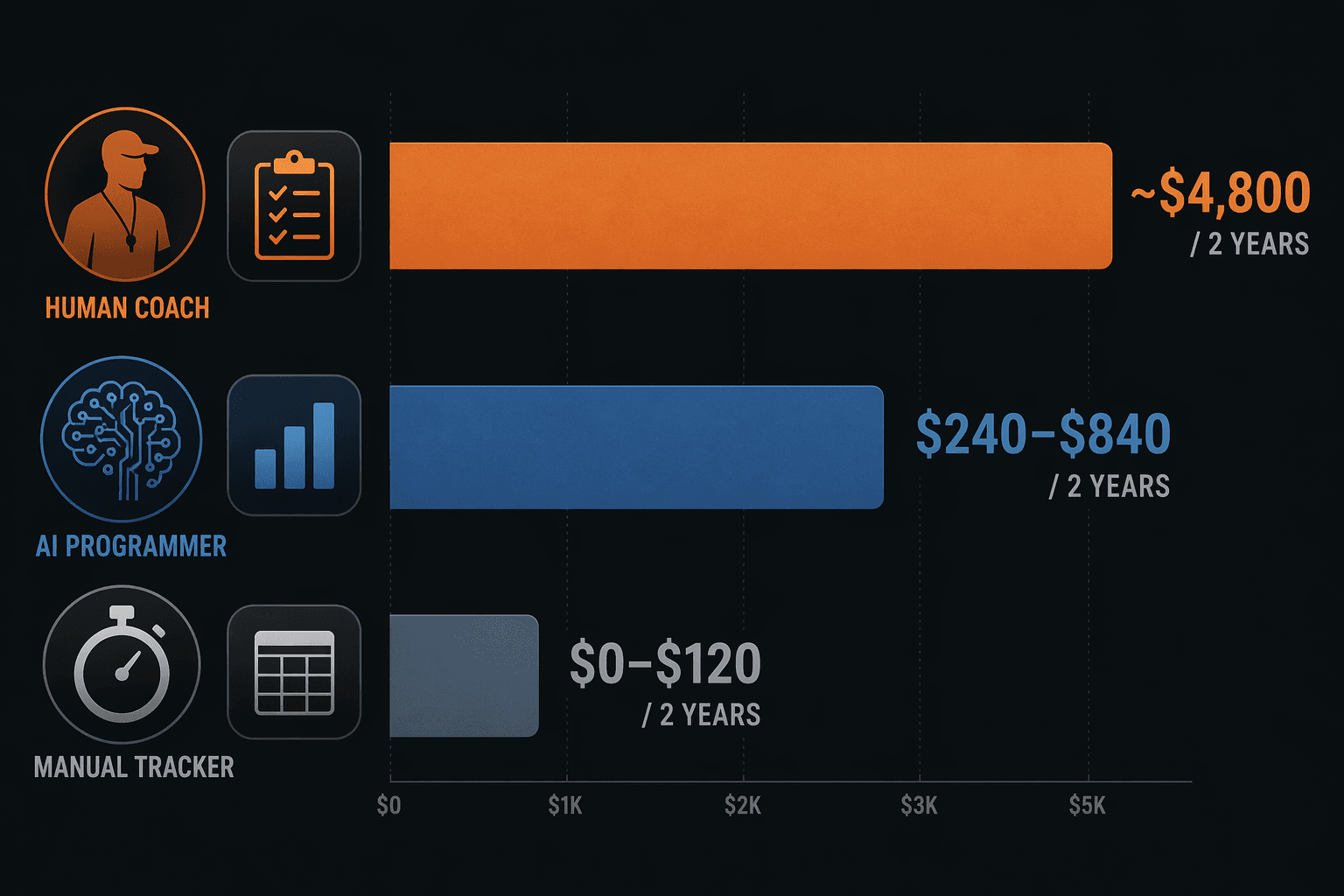
The price spread makes that rule less abstract. Based on mid-2026 pricing cited across app reviews, two years with a tracker-level setup can run about $0–$120, two years with AI programming lands roughly around $240–$840, and two years of high-touch human coaching can approach $4,776–$4,800.[1][2][3][4] That does not mean the expensive option is foolish. It means the expensive option has to solve an expensive problem.
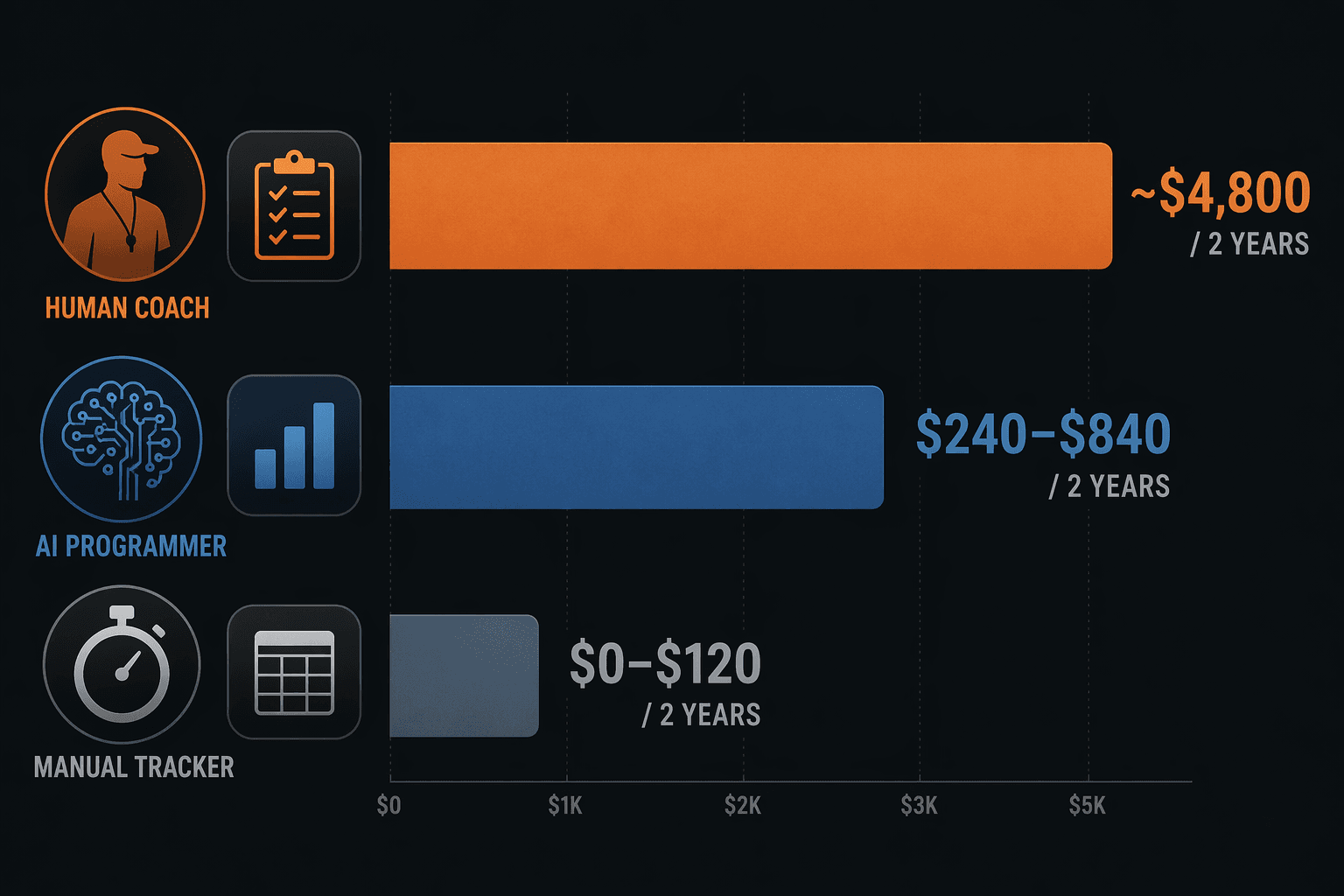
| App model | Best fit | What it solves | Two-year cost range |
|---|---|---|---|
| Manual tracker | You already have a sound program | Fast logging, history, personal records, workout reuse | $0–$120 |
| AI programmer | You need better structure and progression | Exercise rotation, volume changes, equipment-aware plans | $240–$840 |
| Human coach | You need accountability or form review | Check-ins, nudges, human judgment, video feedback | $4,776–$4,800 for premium coaching |
Start With The Bottleneck, Not The App
A stalled intermediate lifter usually has one of three problems. The first is record keeping: workouts are scattered across a notes app, old screenshots, and half-remembered warm-up sets. The second is programming: the lifter trains hard, but weekly volume, deloads, exercise order, and progression rules are mostly vibes. The third is behavior: the plan is fine, but missed sessions, sloppy reps, or pain workarounds keep interrupting it.
Those are different problems. Strong, Hevy, and Caliber Free are not failed versions of Future or JuggernautAI. They are lower-intervention tools. Fitbod, Shred, and JuggernautAI are not just prettier logs. They are trying to make programming decisions for you. Future and Caliber Premium are selling another human in the loop. Treating all of them as contestants in one “best app” bracket is how someone pays for coaching when they only needed a cleaner progression rule.
Manual Trackers Are For Lifters Who Can Already Steer
A good manual tracker should disappear during the workout. You open the session, enter load and reps quickly, check last week’s numbers, maybe copy a previous template, and get back under the bar. Hevy, Strong, and Caliber Free make the most sense when the program is already coming from somewhere else: a coach you used to work with, a proven template, or your own competent plan.
That also explains why a low coaching score is not always an indictment. Garage Gym Reviews scored Hevy 1/5 for progressive overload and 1/5 for accountability, while still treating it as a useful weightlifting app; the point is that Hevy is primarily a logging tool, not a programming authority.[1] If you know that your squat moves from 3x5 to 3x6 to a small load jump, the app does not need to invent that logic. It needs to make the next entry painless.
The warning sign is when the log is clean but the decisions are not. If every chest day becomes “bench until it feels heavy, then add random accessories,” the tracker is faithfully recording a weak system. At that point, upgrading does not mean you have outgrown discipline. It means the bottleneck has moved from logging to programming. A deeper look at apps with real progressive overload is more useful than comparing interface colors.
Where AI Programming Starts To Earn Its Subscription
AI programming apps become interesting when you are no longer asking, “What did I lift last time?” and start asking, “What should I do next week?” Fitbod, Shred, and JuggernautAI all sit in this middle zone, but they do not serve the same lifter. The subscription is paying for structure: planned workouts, exercise substitutions, volume adjustments, and some attempt to account for available equipment.
Fitbod is the broad, generalist example. It can be useful for home lifters with changing equipment and hypertrophy-oriented goals, but it should not be treated as equally strong across every style of training. Garage Gym Reviews found Fitbod’s AI “wildly off” for Olympic lifting and gave it a 3/5 instruction score, even while noting stronger equipment flexibility.[1] That distinction matters. A dumbbell-heavy upper/lower routine and a clean-and-jerk progression are not the same programming problem.
Shred is closer to the general strength-and-physique lane, with JEFIT reporting a 4.28/5 overall score and 5/5 for equipment flexibility in its 2026 testing.[3] That makes it easier to justify for someone training at home with adjustable dumbbells, bands, a bench, and occasional gym access. The value is less about magical AI and more about reducing the number of small decisions that cause a session to drift.
JuggernautAI is the more specialized case. Its appeal is not that it is the cheapest AI option; it is that its periodization is built around strength sport logic. Garage Gym Reviews gave JuggernautAI 5/5 for powerlifting periodization, which is the kind of score that matters if your training is organized around squat, bench, and deadlift performance rather than general muscle-building variety.[1] For a home lifter who mostly wants bigger arms and a better dumbbell press, that specialization may be overkill. For someone running powerlifting-style blocks, it may be the point.
The cleanest AI upgrade test is this: if you can explain your current progression rule, weekly set targets, and deload plan without hand-waving, stay with a tracker. If you cannot, and your training has become a pile of hard sessions without a plan, an AI programmer may be worth the monthly fee. For a fuller cost threshold, the comparison between free and paid strength training apps is the next decision point.
Human Coaching Is Expensive Because It Adds A Person
The case for Future or Caliber Premium is strongest when the issue is not knowledge. Some lifters know exactly what to do and still skip the third session, cut depth when sets get hard, or keep aggravating the same shoulder because nobody is watching. In that situation, a human coach is not charging twenty times more because a spreadsheet cannot calculate sets. The price is for attention.
Garage Gym Reviews’ coach-model reviews score 5/5 on accountability, and the available comparisons identify Future and Caliber Premium as options that include video form review rather than only automated programming.[1][5] Future’s commonly cited price is $199/month, which puts two years near $4,776 before any promotions or pricing changes.[4] That is a rational purchase only if check-ins, nudges, and form feedback are the missing variables.
There is a fair version of this choice. A lifter coming back from repeated technique pain, training alone in a garage, or needing someone to notice missed sessions may get more from one human review than from another algorithmic block. But if the only complaint is that the current log looks boring, human coaching is probably too much tool for the job. Use experience-level app matching before jumping from a free tracker to a premium coaching relationship.
The Hidden Cost Is Your Training History
Price is not only the subscription. It is also the friction of leaving. Trackers such as Hevy and Strong have CSV export features, while AI programming apps such as Fitbod and JuggernautAI do not reliably offer the same kind of portable workout-history export in the reviewed comparisons.[1] That matters more after two years than it does on day one, because your log becomes part of how you make training decisions.
Before paying for a smarter app, check what happens if you cancel. Can you export exercises, dates, loads, reps, notes, and body measurements? Can you read the file without the app? Does the free tier keep your history visible? Free does not always mean portable, and paid does not always mean owner-friendly. The broader question of what “free” means in fitness apps is really a question about control.
Market Momentum Does Not Pick Your Program
Mobile exercise apps ranked No. 4 in ACSM’s 2026 Worldwide Fitness Trends, which confirms that fitness professionals still see them as a major category.[6] Useful context, but not proof that a particular app will add pounds to your bench.
For muscle gain, the mechanism still has to be visible. A tracker helps if it makes progressive overload easier to execute. An AI programmer helps if it gives you a better training plan than the one you were improvising. A human coach helps if adherence or technique is costing you productive sessions. If a feature claim does not connect to one of those mechanisms, treat it as decoration.
A Clean Upgrade Rule
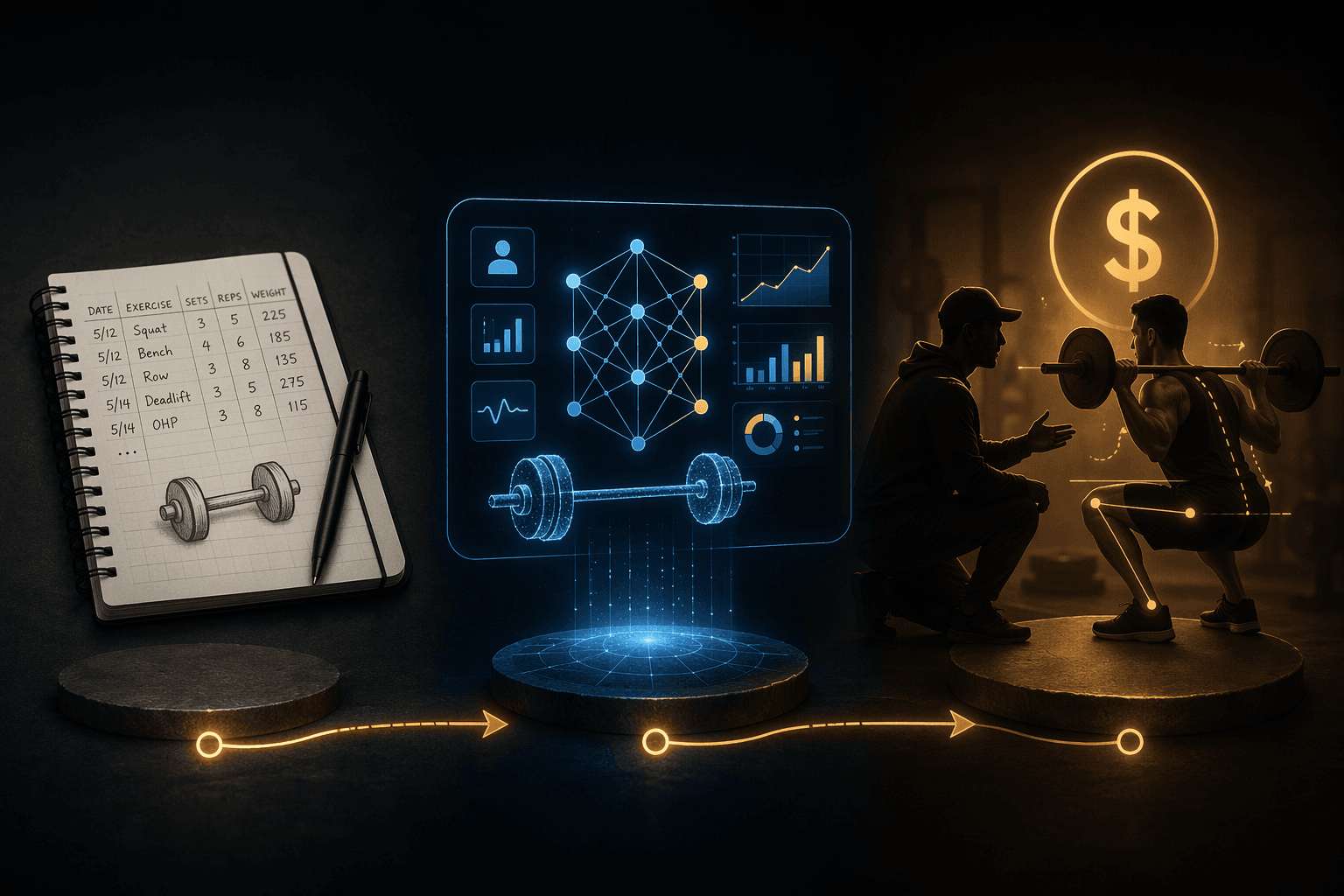
Stay with a manual tracker if your program is sound and the app’s job is to make logging faster. Pay for AI programming if your sessions are consistent but your progression, weekly structure, or exercise choices are poorly organized. Pay for a human only when the missing variable is behavior or form feedback that software cannot provide.
That rule will not name one universal winner, which is why it is more useful than most rankings. The best strength training app is the least expensive model that solves the actual problem in front of you.
References
- Expert-Tested: Best Weightlifting Apps (2026) — Garage Gym Reviews
- Best Weightlifting Apps (2026) — BarBend
- Best Strength Training Apps for 2026: 7 Options Tested by Lifters — JEFIT
- Best Workout Apps (2026): Fitness Expert Approved — Fortune
- Best Strength Training Apps in 2026: Tested on Apple Watch — FindYourEdge
- ACSM Fitness Trends 2026 — ACSM
Comments
Join the discussion with an anonymous comment.