The awkward part of using an HRV recovery score is not reading it. It is deciding what to do after it appears.
The shoes are by the door. The strength session is already written down. The interval workout looked reasonable last night. Then your wearable says recovery is low, reduced, yellow, red, or simply “pay attention.” A good HRV recovery score can make you want to add work. A bad one can make you feel as if training would be reckless.
Neither reaction is quite right. A daily HRV recovery score is a readiness signal, not a verdict. It becomes useful when you compare it with your own baseline and with how you actually feel that morning. One low reading should not automatically cancel training. A pattern of low readings, especially over 3 or more days, deserves a different kind of workout.
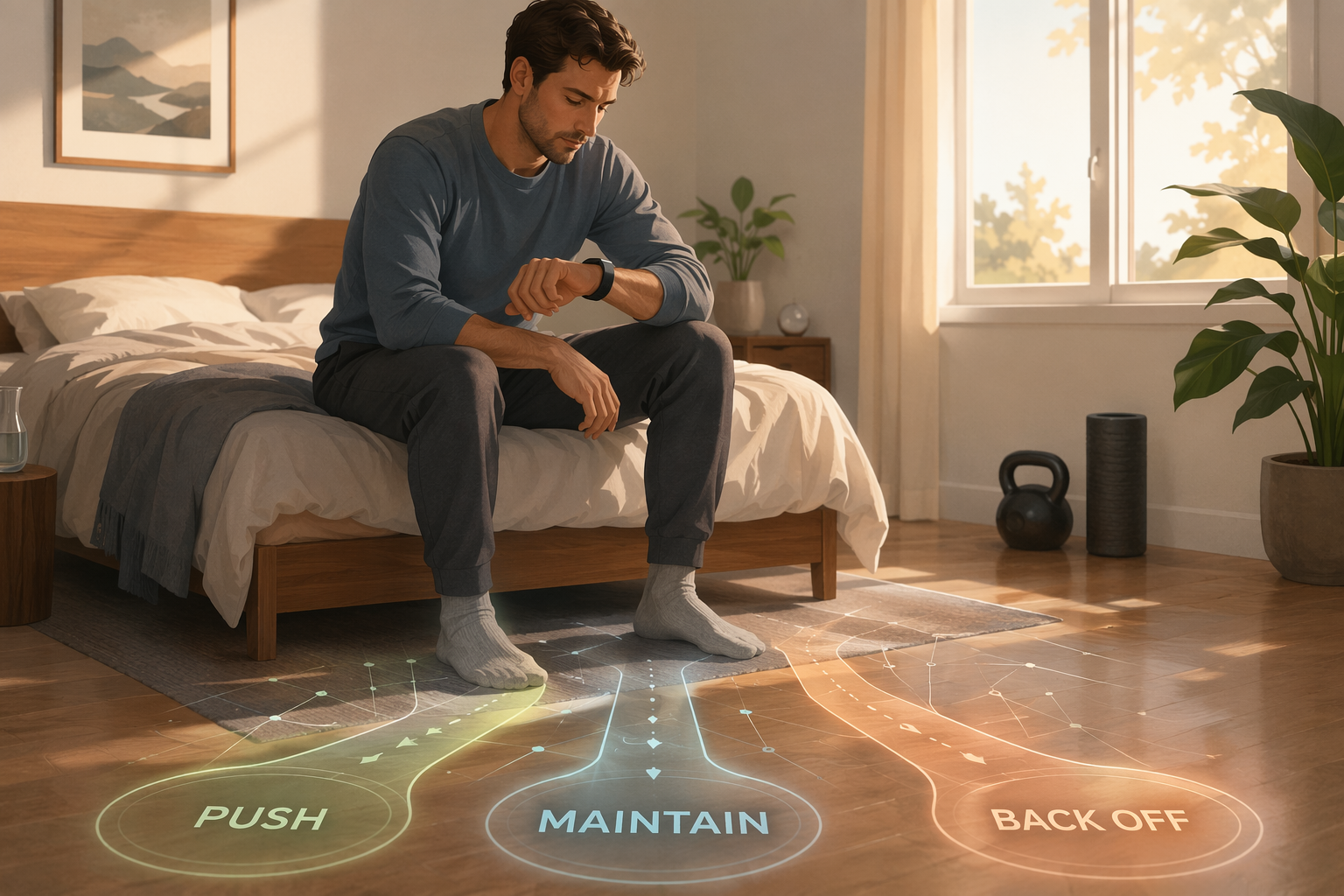
The Morning Rule: Compare, Then Decide
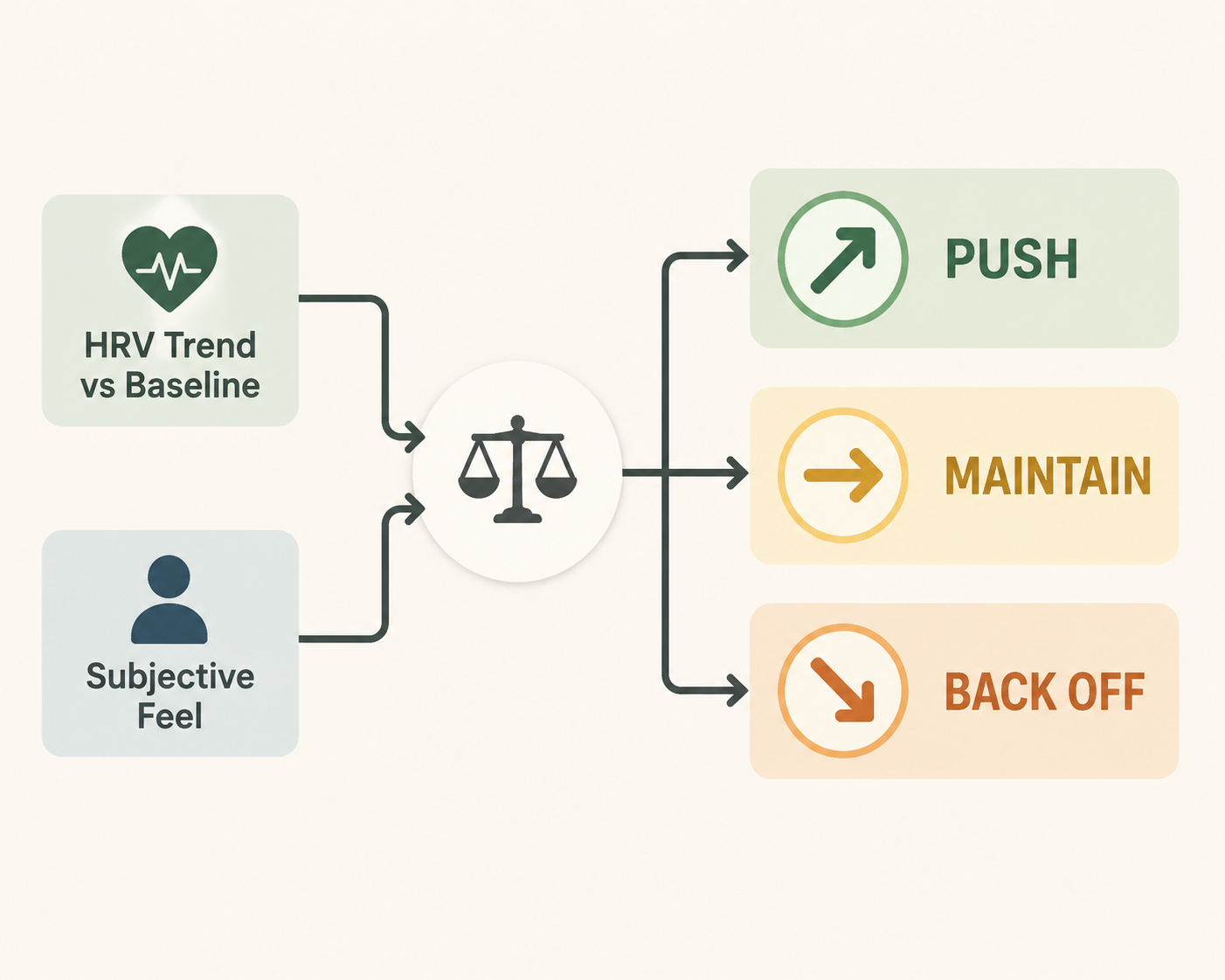
The most useful question is not “Is my score good?” It is “Is today’s signal different from my normal, and does my body agree with it?”
That puts the score in the right role. It is one vote in the decision, alongside sleep, soreness, mood, illness symptoms, motivation, and the cost of the workout you planned. The same score can mean different things for two people because HRV is individual. A number that looks low on social media might be normal for you. A number that looks fine on the device can still be a warning if it is below your own recent pattern.
Morpheus makes this practical by pairing HRV relative to baseline with subjective feel, then translating the combination into push, maintain, or back-off decisions. Its framework includes scenarios where HRV is above, near, or below baseline, and where the athlete feels good or poor; the important move is that the score does not act alone.[1]
| Morning signal | Subjective feel | Training decision |
|---|---|---|
| HRV is at or above your normal baseline | You feel good, rested, and motivated | Push: keep the demanding workout or add quality if it was already appropriate |
| HRV is normal, or only slightly off | You feel normal or mixed | Maintain: do the planned session, but avoid turning it into a test |
| HRV is low for one day | You feel mostly fine | Maintain with caution: warm up honestly, cap intensity, and be ready to adjust |
| HRV is low for multiple days | You feel tired, sore, stressed, or run-down | Back off: reduce intensity first, then shorten or replace the session if needed |
| HRV is low and you have illness symptoms | You feel clearly unwell | Rest or choose only gentle movement |
ROUVY uses the same kind of translation in a training table that maps HRV patterns and context to actions such as threshold work, an easy spin, or a rest day.[2] That is the level where HRV finally becomes helpful: not as a score to admire, but as a way to remove the daily negotiation.
Push When the Score and Your Body Agree
A push day is not every green day. It is the cleaner situation where your HRV is at or above your baseline, your sleep and energy are decent, and the workout already makes sense in the larger week.
For a runner, that might mean keeping the interval session, tempo run, hill repeats, or longer aerobic workout. For a home strength user, it might mean keeping the heavier lower-body day, a higher-effort circuit, or a session with explosive work if that kind of training is already part of the plan.
WHOOP’s training zones are a useful example of this logic, not because they reveal a universal formula, but because they treat recovery and training load as a pair. WHOOP says its Optimal, Overreaching, and Restoring zones are based on analysis of nearly 1 million days of Recovery and Strain data.[3] The practical takeaway is simple enough: better recovery can support more strain; poorer recovery calls for less strain. The exact weighting behind the platform remains proprietary, so it should not be treated as a public equation.
A push decision still has boundaries. If you slept badly, feel unusually sore, or have a stressful day stacked behind the workout, a high recovery score does not erase that. It can support the decision to train hard; it does not require it.
If you use WHOOP and want a deeper explanation of its green, yellow, and red recovery system, this site’s WHOOP Recovery Score guide is the better place for platform-specific detail. For today’s workout decision, the category matters less than the agreement between trend, feel, and planned stress.
Maintain When the Signals Are Mixed
Most mornings are not dramatic. HRV is normal but you feel flat. HRV is slightly reduced but your warm-up feels fine. The device gives an amber signal, yet nothing else is obviously wrong. These are maintain days.
Maintaining means you train, but you stop pretending the score is a dare. Keep the planned easy run easy. Keep the strength session at the planned loads instead of chasing a personal best. Do the home circuit, but do not add extra rounds because the first 10 minutes felt better than expected.
COROS uses labels such as Elevated, Normal, Reduced, and Low for Overnight HRV, with each category connected to a suggested training response.[4] Oura’s Readiness Score uses a 0–100 scale where 85 or above is described as optimal, 70–84 as good, and under 70 as a reason to pay attention; the score is built from seven contributors.[5] Garmin’s HRV Status compares a 7-day rolling average against a personal baseline range, with examples shown as millisecond ranges such as 33–45 ms.[6]
Those systems look different on the screen, but they point toward the same habit: do not compare your number with someone else’s; compare today with your own rolling normal. A wearable can label the signal. You still have to decide whether the workout in front of you is easy enough to absorb, hard enough to matter, or too costly for the day.
Back Off When the Trend and Your Body Both Say So
The back-off decision is where people tend to overcorrect in both directions. Some push through several bad signals because the calendar says intervals. Others cancel a useful workout because one morning’s score looks ugly.
Marco Altini’s useful distinction is that a single low HRV reading does not mean performance is impossible. It suggests the body may be less likely to positively assimilate additional stress.[7] That is a different message. You might still be able to run fast, lift well, or finish a hard session. The question is whether adding that stress today helps the next few days of training.
Back off when the low signal persists, especially across 3 or more days, and your subjective signs line up with it: heavy legs, unusual soreness, poor sleep, elevated stress, irritability, low motivation, or early warm-up efforts feeling harder than they should. If you have illness symptoms, the decision gets simpler: rest or keep movement gentle.
What Backing Off Actually Looks Like
Backing off does not have to mean doing nothing. Most of the time, the first lever to pull is intensity.
Altini, discussing work from Stephen Seiler, highlights intensity as a major driver of autonomic disruption compared with volume.[7] In plain training terms: when HRV is down, the riskiest part of the plan is usually the hard work, not every form of movement.
- Change threshold, tempo, VO2 max, sprint, or HIIT work into easy aerobic work.
- Keep the session duration but lower the effort if movement usually helps you feel better.
- Shorten the session if fatigue is obvious before the warm-up is finished.
- For strength training, reduce load, sets, speed demands, or proximity to failure before removing all movement.
- Use mobility, walking, easy cycling, or light technique work when the goal is circulation rather than fitness gain.
- Rest when low HRV is paired with illness symptoms, unusually poor sleep, or several days of clear fatigue.
A runner who planned 6 hard repeats might jog easily and add a few relaxed strides only if the body comes around. Someone doing a home dumbbell session might keep the movement pattern but drop the load and stop well short of failure. Someone who planned a short conditioning workout could turn it into a walk and mobility session. If you need a very low-stress option, a short routine such as a 7-minute workout frequency plan only makes sense if you keep the effort easy rather than turning it into a max-effort test.
Why HRV-Guided Training Has Earned a Place, Especially for Endurance
The case for HRV-guided training is strongest when it is used to adjust endurance-style loading rather than to micromanage every workout type. In a 2007 study by Kiviniemi and colleagues, an HRV-guided endurance training group improved maximal running velocity more than a pre-planned training group.[8] A 2016 study associated with Firstbeat and Vesterinen reported that HRV-guided training improved 3000 m performance more than predefined training in recreational endurance runners.[9]
That does not mean every wearable score can prescribe the perfect session. It means there is credible support for adjusting endurance training based on readiness rather than following a fixed plan blindly. The useful claim is narrow enough to trust: HRV can help decide when to place harder aerobic work and when to reduce stress.
For home strength and power training, the evidence is less settled. Science for Sport notes that ultra-short 1-minute HRV recordings can be reliable, but also states that HRV has not been validated for strength and power development.[10] That caveat matters if your main training is lifting, plyometrics, kettlebells, or short high-power intervals.
The practical adjustment is not to ignore HRV. It is to use it more conservatively. Low readiness should make you question high-intensity sets, explosive work, grinding reps, and training to failure before it makes you abandon all movement. Easy skill work, light accessories, mobility, walking, and submaximal strength practice can still have a place.
How to Use Different Wearable Scores Without Getting Trapped by Them
Different platforms package readiness differently. That can make HRV feel more complicated than it is. The better move is to translate each system into the same three training decisions.
| Platform signal | How to translate it |
|---|---|
| WHOOP Recovery or training zone | Use it to match the day’s strain to recovery, while remembering the exact algorithm is proprietary. |
| Oura Readiness Score | Treat 85+ as supportive, 70–84 as generally workable, and under 70 as a prompt to check fatigue and context. |
| Garmin HRV Status | Respect the 7-day rolling comparison against your own baseline more than a single overnight value. |
| COROS Overnight HRV | Map Elevated, Normal, Reduced, or Low to push, maintain, or back-off choices instead of chasing the label. |
| Morpheus recovery guidance | Use the combination of HRV versus baseline and subjective feel as the main decision structure. |
If you want a WHOOP-only version of this decision process for home sessions, the WHOOP Recovery Score home workouts guide goes deeper into that ecosystem. If you are still deciding which device belongs on your wrist, a fitness tracker for home workouts comparison is the more relevant question. Once you already own a wearable, the daily behavior matters more than the branding.
A Repeatable Decision Flow for Today
Use the score after you know what it is being compared with. If your device gives you a baseline, use that. If it gives you a color or readiness label, translate it into whether today looks above normal, normal, slightly reduced, or clearly low for you.
- Check the trend: one odd reading is weaker evidence than 3 or more days moving away from your baseline.
- Check your body: sleep, soreness, mood, stress, illness symptoms, and how the warm-up feels.
- Check the planned stress: easy aerobic work, heavy strength, threshold training, HIIT, and max-effort sets do not cost the same.
- Choose push, maintain, or back off before you start bargaining mid-session.
Push when recovery and feel line up positively. Maintain when the score is normal or mixed and your body is not sending strong warnings. Back off when reduced HRV persists for multiple days or fatigue is obvious. Do not let one low score automatically cancel training; compare it with your baseline, check how you feel, and choose the amount of stress you are likely to absorb.
References
- Morpheus Push/Maintain/Back Off framework, Train With Morpheus.
- How to use HRV for training, ROUVY.
- WHOOP Training Zones, WHOOP.
- COROS Overnight HRV categories, COROS.
- Readiness Score, Oura.
- Garmin HRV Status, Garmin.
- Marco Altini case study, Substack.
- Endurance training guided individually by daily heart rate variability measurements, Kiviniemi et al., 2007.
- Individual endurance training prescription with heart rate variability, Vesterinen / Firstbeat, 2016.
- Heart Rate Variability, Science for Sport.
Comments
Join the discussion with an anonymous comment.