The best fitness tracker for a home workout is the one that can see the workout you actually repeat. A treadmill walker, a Peloton rider, a dumbbell lifter, and someone doing yoga on a mat are not asking the same question, even if they all search for the same phrase: best fitness tracker.
Start with the movement pattern, then worry about the phone. That order saves people from buying a beautiful watch that records notifications perfectly and misses the one job sitting in front of them: counting treadmill steps, sending heart rate to a bike screen, tracking sets, or staying out of the way during floor work.
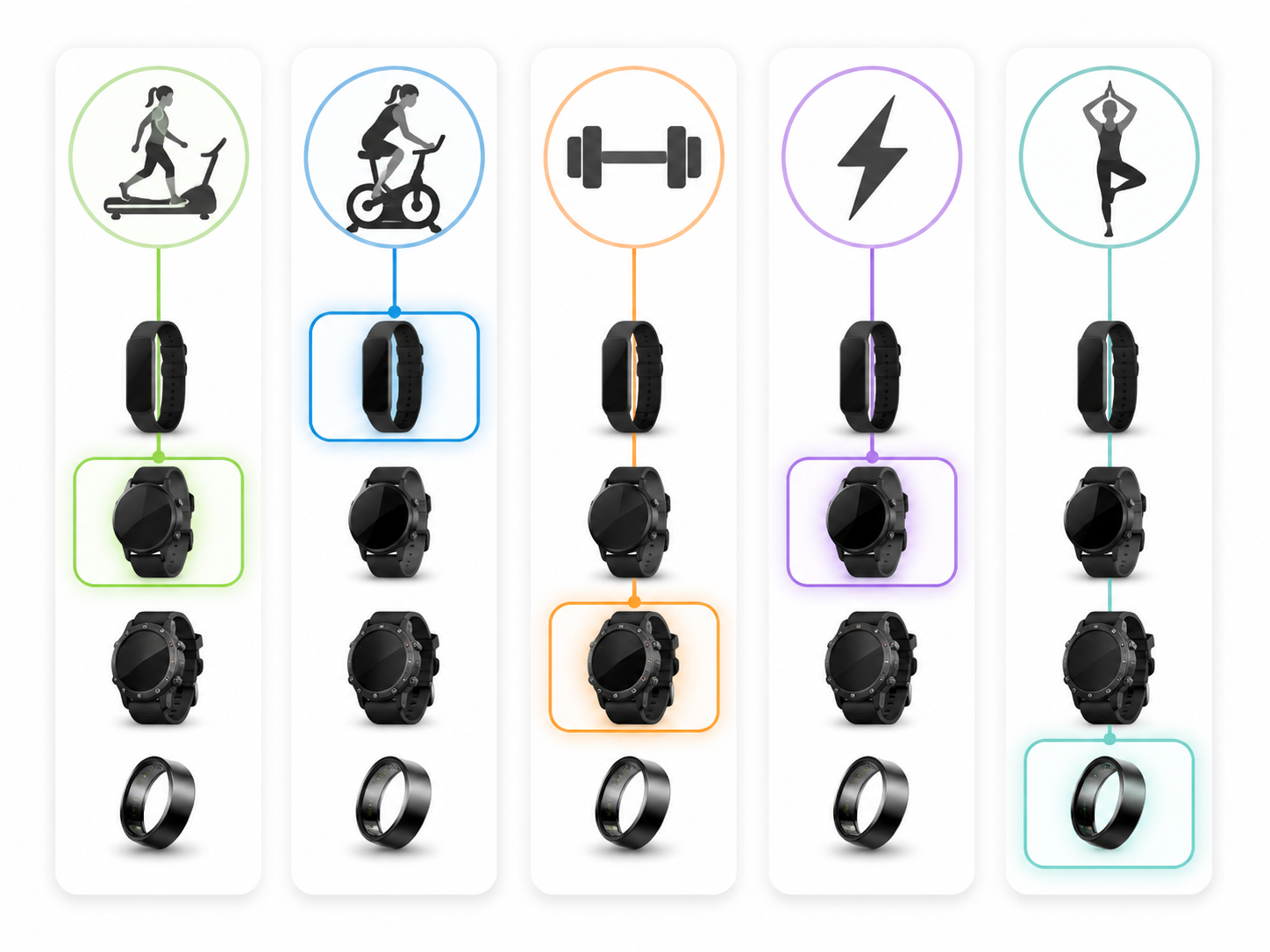
| Home workout type | What matters most | Shortlist to consider | Watch-out |
|---|---|---|---|
| Treadmill walking | Step-count consistency and comfort | Fitbit Inspire 3; Fitbit Charge 6 | GPS and smartwatch apps matter less indoors |
| Indoor cycling or connected equipment | Live heart-rate broadcast and zone visibility | Fitbit Charge 6; Garmin watches; Whoop | Apple Watch does not broadcast live HR to non-Apple equipment |
| Dumbbell, barbell, or circuit strength | Rep/set tracking, workout structure, durability | Garmin Venu 3; Garmin Forerunner 265 or 970 | Many trackers record HR but do little with lifting sets |
| HIIT | Fast, reliable heart-rate response | Apple Watch Series 11; Garmin higher-end models | Published accuracy results are still single-tester conditions |
| Yoga, Pilates, mobility, bodyweight | Comfort, low distraction, recovery metrics | Oura Ring 5; Fitbit Air; Fitbit Inspire 3 | Rings can be awkward for gripping weights |
| Screenless or recovery-first routine | Battery life, sleep/recovery scoring, low wrist distraction | Whoop 5.0; Oura Ring 5; Fitbit Air | Subscriptions can dominate the real price |
Treadmill walkers should care less about GPS and more about steps
For indoor walking, the tracker is not proving a route. It is trying to infer steps from wrist motion while your hands may be floating, gripping rails, holding a remote, or resting near the treadmill console. That is a different problem from outdoor running, and it is why a cheaper band can sometimes be the more sensible buy.
In Wirecutter’s published lab testing, the Fitbit Inspire 3 had a 0.32% step-count error, which makes it unusually easy to recommend for treadmill walkers under $100, while still keeping the conclusion narrow: this was published testing, not a guarantee that every gait, rail-grip habit, or treadmill speed will produce the same result.[1]
That narrowness matters. If your main home workout is a 30- to 45-minute incline walk, you do not need to overpay for dual-frequency GPS, a giant app store, or a rugged case built for trail maps. You need a light band that you will actually wear, with step tracking that has performed well in a relevant test environment. If you are comparing low-cost models, our budget fitness tracker accuracy guide is the better rabbit hole than another premium smartwatch comparison.
The Fitbit Charge 6 is the upgrade if you also want better equipment compatibility, more on-screen workout information, and live heart-rate broadcast. But for a walker who simply wants clean daily movement data and a small wrist profile, the Inspire 3 is the kind of boring pick that often survives real use.
Indoor cycling changes the question to heart-rate broadcast
Once a bike or connected treadmill enters the room, the question shifts. You are no longer asking only whether the tracker records a workout after the fact. You may want live heart rate on the equipment screen while the class, zone target, or interval is happening.
Per Fitbit’s support documentation and reporting from Wareable and The Verge, the Fitbit Charge 6 can broadcast live heart rate to compatible Bluetooth exercise machines, including Peloton bikes and NordicTrack treadmills; it is identified here as the only tracker under $200 with that specific advantage.[2][3][4]
That one feature can matter more than a prettier smartwatch interface. If the bike already gives you cadence, resistance, output, and class structure, the missing piece is often heart rate. A Charge 6 that puts pulse data on the equipment screen can be more useful in the session than a more expensive watch that keeps the number trapped on your wrist.
The important caveat is that compatibility here is based on manufacturer specifications and published compatibility notes, not direct testing with every home bike and treadmill model. If your setup depends on this feature, check the exact equipment model before buying. Home gyms are full of almost-compatible devices.
Apple Watch is the obvious counterexample. The Series 11 has strong heart-rate accuracy evidence, but it cannot broadcast live heart rate to non-Apple equipment. For a rider who trains inside Apple Fitness+ or keeps everything on the watch, that may be fine. For someone staring at a Peloton or NordicTrack screen, it can be the wrong kind of excellent.
For dumbbells and circuits, Garmin earns attention for a real reason
Strength training exposes the limits of many fitness trackers quickly. Heart rate during lifting is useful, but it is not the workout. A set of goblet squats, a rest period, a set of rows, and a finisher circuit all create data that most general trackers flatten into a generic strength session.
Garmin’s Venu 3 and Forerunner 265/970 stand out because they can auto-count reps and sets during strength training, a feature highlighted in Forbes Vetted testing and Garmin’s own documentation.[5][6] The auto-counting will not magically understand every odd-angle band pull or half-rep in a fatigue set, but it changes the interaction. You are correcting a workout log instead of building one from scratch.
That is especially useful in a home gym, where the phone may be across the room, the bench is also your storage area, and the workout plan lives in three places unless you deliberately simplify it. If your training is built around progressive overload, the most important record is not that you “worked out.” It is which exercises, how many sets, how many reps, and whether the load moved up or stalled.
The sensible pairing for many lifters is not necessarily a more expensive wearable. It may be a Garmin watch plus a dedicated lifting app, or a simpler tracker plus one of the tools in our strength training apps comparison. If you want to design the training itself before buying another device, start with a practical full-body dumbbell workout framework and then choose the tracker around the log you actually need.
HIIT rewards heart-rate accuracy, but only if you will use the feedback
HIIT is where wrist heart-rate claims get tested hard. Burpees, squat jumps, bike sprints, and fast transitions give optical sensors less steady contact than a smooth walk. If you actually train by zones or recovery drops between intervals, heart-rate accuracy is not a spec-sheet luxury.
CNET’s lab testing found the Apple Watch Series 11 averaged less than 1% heart-rate error across its test, making it the strongest case among the cited published tests for HR-zone HIIT and indoor cycling where pulse precision matters most.[7] As with the Inspire 3 step result, this should be read as published single-tester testing, not a universal performance guarantee for every wrist size, skin tone, strap fit, or workout style.
That caveat does not make the result useless. It just keeps the buying decision honest. If your HIIT sessions are structured around work-rest intervals and you glance at your wrist between sets, Apple Watch Series 11 is a strong iPhone-first choice. If your intervals happen on a bike screen that needs live HR, the Charge 6 or a compatible Garmin may still fit the room better.
For people doing casual bodyweight circuits, the difference may matter less. A tracker that starts quickly, stays comfortable, and gives a reasonable post-workout trend can be enough. Paying for top-tier HR performance only makes sense if the number changes what you do during the workout.
Yoga, Pilates, mobility, and floor work favor low-friction devices
For mat work, the tracker should not become the most noticeable object in the session. A bulky watch can press into the wrist during planks, distract during slower mobility work, or make a gentle routine feel like a dashboard exercise.
This is where screenless and low-profile devices make sense. Fitbit Air at $99.95 with 8.5-day battery life, Whoop 5.0 starting at $199 per year with 14-day battery life, and Oura Ring 5 at $399 with 9-day battery life are stronger fits for people who do not need phone notifications mid-workout.[3][8][9][10]
Oura is the most recovery-first option in that group, especially for someone who cares more about sleep, readiness, and low-distraction wear than live workout controls. It is not the best shape for gripping dumbbells, kettlebells, or pull-up bars, so it fits better when lifting is occasional rather than central. For a deeper recovery-focused view, see our Oura Ring fitness tracker guide.
Fitbit Air needs a lighter touch in recommendations because it was released on May 26, 2026, and Wirecutter lists it as a “what to look forward to” product rather than a tested recommendation.[1][3] It is promising for a screenless, budget-friendly home routine, but early product appeal is not the same as long-term reliability.
The phone ecosystem filter comes after the workout filter
Phone compatibility still matters. It just should not be the first cut unless the device literally will not work with your phone. Narrow by workout type first, then use the ecosystem filter to avoid friction.
- iPhone-first homes: Apple Watch SE 3 or Series 11 makes the most sense when you want tight iOS integration, strong smartwatch features, and, in the Series 11 case, published HR accuracy for interval work.[7]
- Android-priority homes: Samsung Galaxy Watch 8 and Pixel Watch 4 deserve attention when phone integration, notifications, and Google/Samsung services matter more than equipment HR broadcast.
- Mixed-phone households: Garmin, Fitbit, Oura, and Whoop are easier to justify when devices may move between iOS and Android users or when the tracker is not meant to behave like a phone extension.
- Connected-equipment homes: confirm the bike, treadmill, rower, or app compatibility before buying, because a tracker can be excellent in isolation and still fail the room.
The Verge’s tracker recommendations emphasize the same broad ecosystem reality: Apple Watch is strongest inside Apple’s world, while Fitbit, Garmin, Oura, and similar devices are more flexible across platforms.[4] That does not make one camp universally better. It changes where the friction shows up.
Subscription cost can change the real winner
A $100 tracker and a $399 ring are not the full story if the useful features sit behind a recurring fee. Over two to four years, subscriptions can double the effective price of some trackers, according to SimplyCodes’ total cost comparison and official brand pricing cited here.[8]
| Device or service | Upfront or base price | Subscription cost | Buying implication |
|---|---|---|---|
| Whoop 5.0 | Device-free strap model | $199–359 per year | Best considered as a subscription, not a one-time purchase |
| Fitbit Premium | Varies by device | $80–100 per year | Can change the value of low-cost Fitbit hardware |
| Oura Ring 5 | $399 | $70 per year | Recovery-first appeal depends on accepting ongoing cost |
| Garmin Connect+ | Varies by watch | $70 per year optional | Most core features remain free, so the subscription is less decisive |
| Fitbit Air | $99.95 | Fitbit Premium may apply for advanced features | Promising screenless price, but long-term testing is limited |
This is where budget buyers need to be stubborn. If the feature you care about is step counting, live workout recording, or basic heart-rate trends, do not let a recovery score subscription quietly become the most expensive part of the purchase. If you do want recovery metrics, understand what the score actually measures before paying for it; our guide to fitness tracker recovery scores is useful before committing.
Whoop is the clearest example. It can be excellent for people who want a screenless strap, strain/recovery framing, and long battery life, but the purchase is really a membership decision. If that style appeals to you, compare it against the recovery logic in our Whoop recovery score guide rather than treating it like a normal watch alternative.
Garmin looks expensive upfront, but its cost profile is different because most features remain available without Garmin Connect+, while the optional service is listed at $70 per year.[8] For strength-focused users, that can make a higher upfront watch easier to defend over several years than a cheaper device whose best insights require a subscription.
A few home-gym mismatches to avoid
Most bad tracker purchases are not absurd. They are almost right. The watch works, the app looks good, and the battery is acceptable. Then the owner discovers that the one daily workout they care about is exactly where the device is awkward.
- Do not buy primarily for outdoor GPS if your routine is treadmill walking, indoor cycling, and dumbbell work.
- Do not assume a premium smartwatch can broadcast live HR to your bike or treadmill; confirm the exact compatibility first.
- Do not buy a smart ring as your only tracker if heavy gripping, barbells, or kettlebells are central to your routine.
- Do not pay for recovery scoring unless the result will change training, sleep, or rest decisions.
- Do not compare only launch prices; compare the two- to four-year cost if a subscription is part of the appeal.
Indoor GPS is another place to be careful. Wareable found Huawei Watch Fit 4’s dual-frequency GPS accurate even indoors, while budget trackers such as the Amazfit Bip 6 showed significant drift on indoor runs.[3] That is useful if you care about indoor run mapping or pace estimates, but it is still secondary for walkers who mainly need reliable steps and time in motion.
If your home setup is still changing, the tracker should not be the first expensive decision. A phased approach to home exercise equipment or a compact small-space gym setup will often clarify whether you need broadcast HR, strength tracking, or just a comfortable band that records consistent movement.
Conditional picks by home workout
There is no single winner that deserves to sit above every home routine. There are, however, sensible shortlists once the room and the workout are clear.
- Best for treadmill walkers: Fitbit Inspire 3, because its published 0.32% step-count error gives it the strongest cited evidence for this specific job under $100.[1]
- Best for equipment HR broadcast: Fitbit Charge 6, especially for compatible Peloton and NordicTrack setups where live heart rate on the equipment screen matters.[2][3][4]
- Best for HR-zone HIIT on iPhone: Apple Watch Series 11, because CNET’s published testing found less than 1% average HR error, with the usual single-tester caveat.[7]
- Best for dumbbell and circuit strength: Garmin Venu 3 or Garmin Forerunner 265/970, because rep and set tracking directly matches the way lifting progress is recorded.[5][6]
- Best for screenless recovery-minded users: Whoop 5.0 or Oura Ring 5, if the subscription cost and form factor match your routine rather than just your curiosity.[8][9][10]
- Best budget screenless watchlist pick: Fitbit Air, but only with the caution that it is new and has limited long-term independent testing as of June 2026.[1][3]
If you still have two or three options left, choose by the nuisance you are least willing to tolerate: charging often, paying monthly, wearing a large watch, correcting strength data, losing equipment compatibility, or being locked into one phone ecosystem. That answer is usually more useful than another universal ranking.
References
- The 3 Best Fitness Trackers of 2026, Wirecutter / The New York Times
- How do I connect my Fitbit device to another app?, Fitbit Help
- Best fitness tracker 2026: Reviewed, tested, and compared, Wareable
- Here are the fitness trackers I actually recommend, The Verge
- Best Fitness Trackers 2026 | Trainer Tested, Forbes Vetted
- Strength Training Activity, Garmin Support
- I Ran 30 Miles With 5 Smartwatches, CNET
- Fitness tracker total cost of ownership comparison, SimplyCodes
- Whoop 5.0, Whoop
- Oura Ring 5, Oura
Comments
Join the discussion with an anonymous comment.