
The first question with an affordable fitness tracker is not whether it is accurate. It is which number you need to trust. Step count, exercise heart rate, resting heart rate, and sleep stages are different jobs. A band can do one of them well and still be the wrong device for your workouts.
That matters most under $100, where the best answer is metric-specific. In published testing, the Fitbit Inspire 3 has the cleanest budget case for step counting: Wirecutter found it was off by just 0.32% compared with a validated lab pedometer over a two-day test period.[1] That is a strong result, but it is not a license to treat every number from the same wristband as equally reliable.
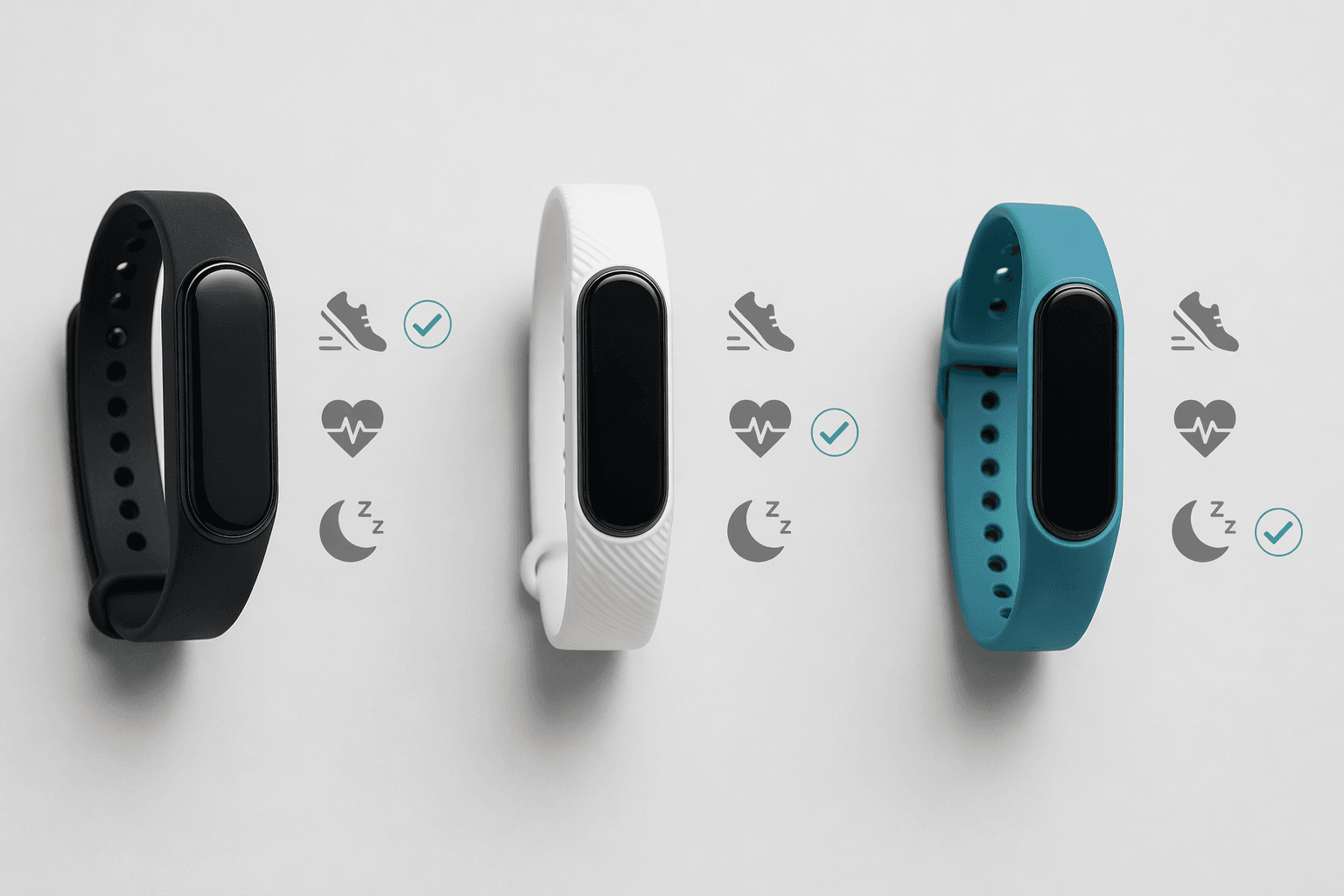
The practical caveat is simple: no sub-$100 tracker should be treated as clinically accurate across steps, exercise heart rate, resting heart rate, and sleep stages. These devices are useful for directional home-fitness tracking. They are not medical instruments, and they are not equally good at every measurement.
| If this is the number you care about most | Best-supported budget judgment | What to watch |
|---|---|---|
| Steps | Fitbit Inspire 3 has the strongest published budget result | The 0.32% error figure comes from Wirecutter's two-day validated-pedometer comparison, not every possible walking condition |
| Exercise heart rate | Sub-$100 trackers are much less convincing here | Interval work, sweaty wrists, arm motion, and lifting can expose optical sensor limits |
| Resting heart rate | Budget trackers are generally more usable here than during workouts | Use trends, not single readings, especially after poor sleep, illness, or hard training |
| Sleep | Sleep duration is more useful than sleep-stage labels | Stage classification is still a weak point for budget wearables |
Step Count Is Where Budget Trackers Look Best
Step counting is the cleanest win for the budget category because the motion is comparatively regular and the test can be checked against a known reference. Wirecutter's result for the Fitbit Inspire 3 is useful precisely because it is bounded: the tracker was compared with a validated lab pedometer over two days, and the reported error was 0.32%.[1]
That does not prove the Inspire 3 will be within 0.32% for every person, gait, stroller walk, treadmill session, or grocery run. It does show that, among the tested devices in that protocol, the Inspire 3 handled ordinary step counting extremely well. For a buyer whose main goal is daily movement tracking, that is the strongest accuracy argument in the sub-$100 range.
The buying implication is narrower than most product pages make it sound. If you mainly want a tracker to keep a realistic daily step target, compare weekdays with weekends, or see whether a new commute adds meaningful movement, the Inspire 3 is the budget device with the most persuasive published step-count evidence. You still should not read a single day's total as exact down to the step.
Fitbit Premium complicates the value math, though not the step-count result. At $80 per year, the subscription can add 80% to the first-year cost of a $99 Inspire 3.[1] For basic steps, that should not be the deciding feature. The step-count case rests on the sensor result, not on a paid layer of coaching or extra wellness interpretation.
Exercise Heart Rate Is the Harder Test
Heart rate during exercise is where the affordable fitness tracker conversation gets less comfortable. Wrist-based optical sensors have to estimate blood-flow changes while the device is moving, the skin is sweating, the strap may be shifting, and the workout intensity may be changing quickly. The number can look authoritative on the screen while lagging or spiking in the moments that matter most.
CNET's higher-price benchmark shows what stronger performance looks like outside the sub-$100 lane. In lab testing over more than 30 miles of runs against a Polar H10 chest strap, the Apple Watch Series 11 had the lowest heart-rate error at 0.98%, or about 1.40 BPM.[2] That is useful context, but it should not be smuggled into a budget recommendation: the Series 11 is not a sub-$100 tracker.
The Apple Watch SE 3 is the closer compromise for readers willing to leave the budget category. CNET identifies it as a sub-$250 option with the same processor, but at $219 it still more than doubles a $100 ceiling.[2] For readers comparing strict budget bands, it mainly serves as a reminder that better exercise heart-rate tracking often costs more than the cheapest band aisle suggests.
The Xiaomi Smart Band 10 shows the other side of the trade. It is attractive because it packs a lot into a very low price, but CNET's testing found a serious exercise-heart-rate problem: during a leisurely walk, it sometimes reported 180 BPM while the chest strap showed a much lower figure.[3] That is not a small rounding issue. If a tracker can mistake an easy walk for near-max effort, its workout zones and calorie estimates become hard to trust for that session.
This is why exercise heart rate deserves more skepticism than steps. A bad step count is usually boringly wrong. A bad heart-rate reading can change how hard someone thinks they are training, whether they back off, or whether they believe a workout was more intense than it was. For steady, low-stakes cardio, a budget band may still be directionally useful. For intervals, tempo work, weightlifting, or heart-rate-zone training, the gap between a cheap wrist sensor and a chest strap can matter.
For the mechanics behind that inconsistency, see our guide to fitness tracker heart-rate accuracy. The short version for buying is this: if exercise heart rate is your primary metric, a sub-$100 band is the wrong place to expect the cleanest data. Either accept rough trends, use a chest strap for serious sessions, or look at a stronger smartwatch tier such as the devices covered in our Apple Watch fitness accuracy comparison.
Xiaomi Smart Band 10 Is a Value Pick, Not an Accuracy Pick
The Xiaomi Smart Band 10 deserves a fair hearing because value still matters. Wareable found that it delivers about 90% of the features for 30% of the price of premium bands.[4] That is exactly the kind of budget device that can make pricier trackers look bloated.
But feature density is not the same as measurement reliability. Wareable also notes that the Smart Band 10 lacks built-in GPS and has less polished app data, and its U.S. availability is mainly through third-party importers on Amazon and Walmart.[4] That last point is not just retail trivia. Importer availability can affect warranty expectations, returns, and support if the bargain turns into a problem.
For someone who wants a bright screen, basic activity logging, notifications, and a low purchase price, the Xiaomi case is easy to understand. For someone choosing primarily on exercise-heart-rate accuracy, the CNET walking result is hard to ignore.[3] The Smart Band 10 may still be a reasonable cheap tracker, but it should not be described as the most reliable budget measurement tool.
Readers weighing that kind of compromise may want the broader breakdown in what you actually lose with a $50 fitness tracker. The trade is rarely just one missing sensor. It is usually a bundle of hardware, app, warranty, and data-quality compromises.
Resting Heart Rate Is More Forgiving
Resting heart rate is a better fit for inexpensive wrist wearables because the measurement is usually taken when the body is still. Wareable, Wirecutter, and DC Rainmaker's testing and reviews converge on the same broad pattern: budget trackers tend to handle resting heart rate better than hard exercise heart rate, while struggling more with intervals, weightlifting, and sleep-stage classification.[1][4][5]
The useful number here is usually the trend, not the isolated reading. If your resting heart rate is usually in one range and then sits noticeably higher after a hard week, poor sleep, travel, or illness, that pattern can be useful. The band does not need to be perfect to show a consistent personal baseline moving in the wrong direction.
What it should not do is turn a consumer wearable into a diagnostic device. A budget tracker can help you notice a pattern worth paying attention to. It should not be used to rule out a medical issue or validate a training plan by itself.
Sleep Tracking: Trust Duration Before Stages
Sleep is where budget trackers often sound more confident than they should. Time asleep, wake windows, and broad schedule consistency are useful enough for many people. Sleep-stage labels are a different claim. Wareable, Wirecutter, and DC Rainmaker all point toward the same limitation: budget wearables are weaker at classifying sleep stages than at simpler, steadier measurements like resting heart rate.[1][4][5]
That does not make sleep tracking worthless. If a band shows that you are sleeping an hour less on work nights, or that your bedtime has drifted later for two weeks, the practical signal is real enough to act on. The shaky part is treating a neat breakdown of light, deep, and REM sleep as if it were lab-grade staging.
If sleep, HRV, and readiness are the main reason you want a wearable, the buying problem changes. A cheap band can show habits and broad trends, but recovery-focused buyers should compare devices on sleep and recovery methodology rather than general feature count. Our guide to fitness trackers for recovery is the more relevant next stop for that use case.
Fitbit Air Is Interesting, but Still Too New
Fitbit Air adds a new wrinkle because it arrived at $99 on May 26, 2026.[5] On price alone, it belongs in the conversation. On evidence, it needs more time.
DC Rainmaker's early review compares Fitbit Air's accuracy against Whoop 5.0, which makes it useful early material rather than a long-term verdict.[5] A new device can look promising in a first review and still need months of real-world wear, firmware updates, durability reports, and broader user testing before it should displace a tracker with stronger accumulated evidence.
Fitbit Air may become a serious $99 option, especially for buyers interested in a Whoop-like approach without the same pricing structure. For a buyer making one budget purchase today and asking which measurement is best supported by published accuracy data, the Inspire 3 still has the cleaner step-count case.
Which Budget Tracker Should You Buy for Accuracy?
If step count is your priority, the Fitbit Inspire 3 is the easiest budget recommendation to defend because Wirecutter's two-day validated-pedometer test gives it a concrete, strong result.[1] Buy it for daily movement tracking, not because every Fitbit metric inherits that same precision.
If exercise heart rate is your priority, be careful with the sub-$100 category. CNET's best heart-rate result belongs to the Apple Watch Series 11, and even the cheaper Apple Watch SE 3 sits above the budget at $219.[2] The Xiaomi Smart Band 10 is tempting on price and features, but its reported exercise-heart-rate behavior makes it a poor pick for anyone training by zones.[3][4]
If resting heart rate is your priority, budget trackers are more usable, especially for trend watching. If sleep is your priority, treat duration and consistency as more credible than stage labels. If you decide those compromises are too much, move the search from cheap bands to better-tested watches; our smartwatch fitness buyer's guide is built for that step up.
The cleanest way to buy an affordable fitness tracker is to choose the number that matters most. For steps, the best-published budget evidence points to the Fitbit Inspire 3. For serious workout heart rate, the budget category is much less convincing. For resting heart rate and sleep, use the device as a trend tool, not as a clinical judge.
References
- The 3 Best Fitness Trackers of 2026 — Wirecutter
- The Best Fitness Trackers of 2026 — CNET
- I've tried a lot of fitness trackers, and this under-$50 one is truly great — CNET
- Best fitness tracker 2026: Reviewed, tested, and compared — Wareable
- Fitbit Air In-Depth Review: A True Whoop Competitor for $99? — DC Rainmaker, May 2026
Comments
Join the discussion with an anonymous comment.