Search for a full body dumbbell workout and you will usually get the finished routine before you get the decision-making. Three sets of goblet squats, incline dumbbell presses, Romanian deadlifts, rows, lunges, curls, maybe a plank. Fine, if you own the right dumbbells, have the right bench, recover on the same schedule, and happen to need that exact amount of work.
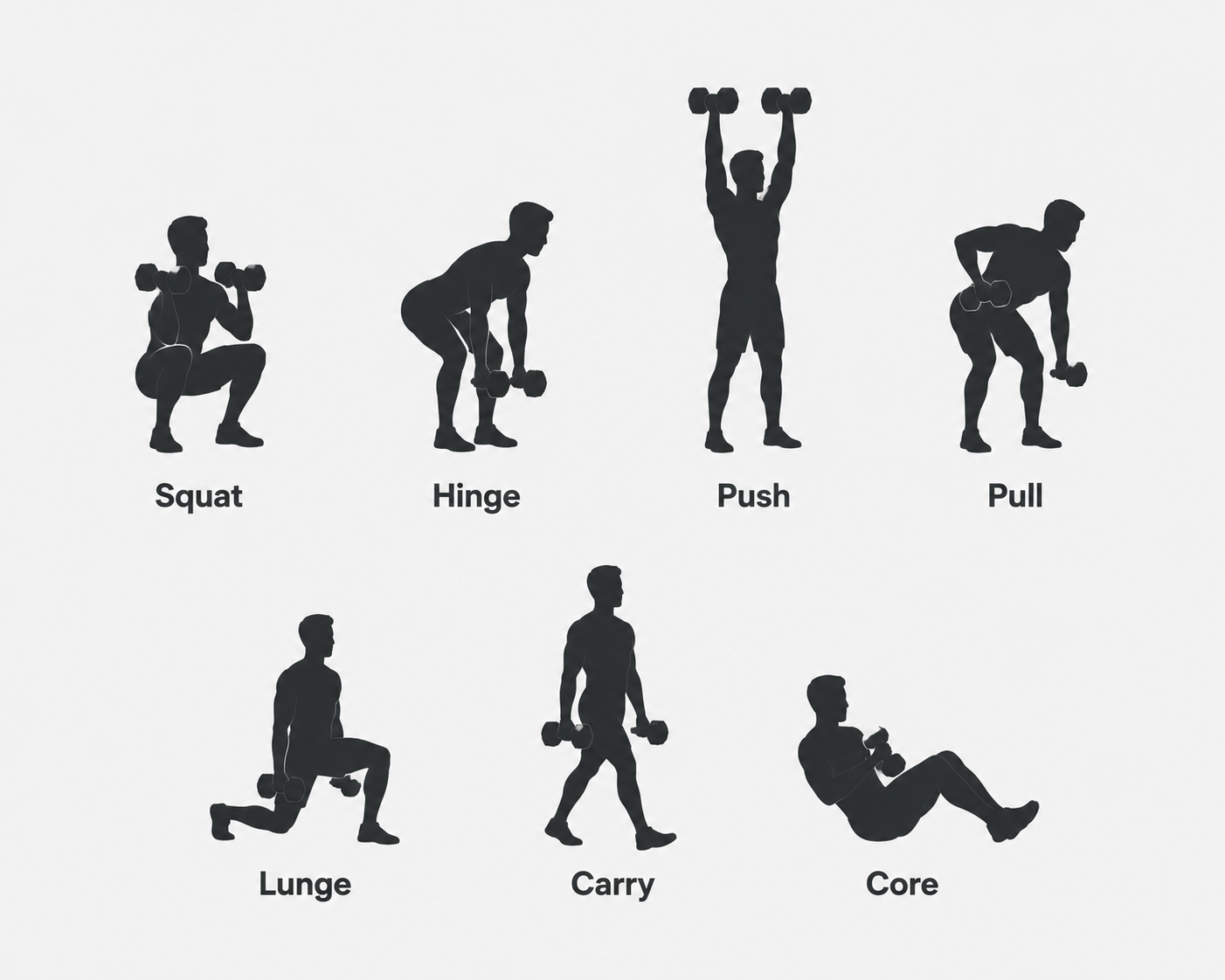
Most people do not fail at home training because they lack a perfect exercise. They fail because the plan assumes equipment they do not own, loads they cannot progress, or training days they cannot repeat. A better full-body dumbbell workout starts with seven movement slots: squat, hinge, push, pull, lunge, carry, and core. That pattern-based approach is common in strength coaching and shows up in dumbbell programming from ATHLEAN-X, but it is best treated as a practical organizing tool, not a sacred taxonomy.[1]
Start With Your Constraints, Not the Exercise List
Before choosing exercises, answer four boring questions. They decide more than any influencer’s favorite variation.
- What dumbbells do you actually have: one fixed pair, several pairs, or adjustable dumbbells?
- Do you have a bench, and if so, can it incline, or is it only flat?
- How many non-consecutive days can you train most weeks: two, three, or more?
- Is the main goal strength, muscle gain, muscular endurance, fat-loss support, or just getting consistent?
A person with one pair of 20-pound dumbbells and no bench should not be handed the same workout as someone with adjustable 5–50s and an incline bench. The exercise names may overlap, but the choices inside each slot should change.
If you have no bench or very light dumbbells, use the framework below, but expect more floor presses, split squats, single-leg hinges, tempo reps, and higher-rep lower-body work. For a routine built specifically around that limitation, use this no-bench full-body dumbbell workout. If you are still deciding what to buy, start with a home gym equipment decision framework or a compact home gym setup by training goal before building the plan.
The Seven Slots of a Complete Dumbbell Session
| Slot | What It Trains | Good Default Choices | Equipment Reality Check |
|---|---|---|---|
| Squat | Quads, glutes, trunk bracing | Goblet squat, dumbbell front squat, heels-elevated squat | Light dumbbells often need slower reps, pauses, or higher reps |
| Hinge | Hamstrings, glutes, posterior-chain strength | Dumbbell Romanian deadlift, kickstand RDL, single-leg RDL | Most people can outgrow two light dumbbells quickly here |
| Push | Chest, shoulders, triceps | Floor press, flat bench press, incline press, overhead press | No bench changes the angle, not the whole workout |
| Pull | Upper back, lats, rear delts, biceps | One-arm row, chest-supported row, bent-over row, renegade row | Bench support helps, but a staggered stance works |
| Lunge | Single-leg strength, balance, hip control | Reverse lunge, split squat, step-up, walking lunge | Usually more useful than adding another squat variation |
| Carry | Grip, traps, trunk, conditioning | Farmer carry, suitcase carry, front-rack carry | Small spaces can use timed holds or marching in place |
| Core | Anti-extension, anti-rotation, trunk control | Plank drag, dead bug, side plank, weighted sit-up | Pick control before load |
You do not need seven different exercises every single time forever. You need those seven jobs covered across the workout. For a simple session, choose one exercise from each slot. If time is short, pair compatible movements: squat with core, push with pull, hinge with carry. If recovery is poor, trim sets before you start deleting whole patterns.
Choose the Exercise That Fits Your Dumbbells
Squat: When the Dumbbells Are Too Light
The goblet squat is the cleanest starting point because it is easy to set up, easy to bail out of, and hard to turn into a circus. If your heaviest dumbbell makes 8–12 controlled reps challenging, use it. If you can do 20 relaxed reps while thinking about dinner, the exercise is not useless, but it is no longer your main lower-body strength builder.
That is when you make the squat harder without pretending your dumbbell got heavier: elevate your heels, pause at the bottom, slow the lowering phase, use a 1.5-rep style, or move more work into split squats and lunges. Very light dumbbells push lower-body training toward higher reps and unilateral work. That is not failure; it is the honest consequence of limited load.
Hinge: Do Not Waste Your Hamstrings
A dumbbell Romanian deadlift belongs in most full-body dumbbell workouts because it covers a pattern that squats and lunges do not. Hold two dumbbells, push the hips back, keep the dumbbells close to the legs, and stop when your hamstrings limit the range rather than your lower back taking over.
If the weight is too light, use a kickstand RDL or single-leg RDL before adding more random exercises. Those variations make one leg do more of the work, which is often the only practical way to keep a home hinge challenging without heavier dumbbells.
Push: Bench, Floor, or Overhead
If you have an adjustable bench, the incline dumbbell press is useful because it gives you a chest-and-shoulder angle that the floor press cannot fully replicate. Built With Science points to research comparing bench angles when discussing incline pressing, but the practical takeaway at home is simpler: incline is helpful if you have it, not mandatory if you do not.[2]
No bench? Use a dumbbell floor press. It shortens the range of motion, but it is stable, repeatable, and far better than skipping horizontal pushing. Pair it with an overhead press on a different day or later in the week if your shoulders tolerate it.
Pull: Pick the Row You Can Repeat
Rows are where home workouts often get sloppy. A one-arm dumbbell row with one hand on a bench is excellent if you own the bench. Without one, use a staggered stance row with the non-working forearm braced on your thigh, or a two-dumbbell bent-over row if your lower back can hold position.
The goal is not to find the hardest-looking row. It is to find the row where the upper back works harder than your grip, neck, or lumbar spine. If every rep turns into a body heave, reduce the load or choose a more supported version.
Lunge: Your Best Friend When Load Is Limited
Reverse lunges and split squats do a lot of quiet work in home dumbbell programming. They let lighter weights feel heavier because one leg carries more of the demand. Beginners usually do better with reverse lunges or stationary split squats than walking lunges, because there is less coordination tax and fewer chances to wander into furniture.
If balance is the limiting factor, hold one dumbbell goblet-style or use light fingertip support on a wall. Balance can improve, but it should not be the thing that prevents your legs from getting trained.
Carry and Core: Simple Does Not Mean Optional
Carries are useful because they train grip, posture, trunk stiffness, and breathing under load without needing another complicated movement. A farmer carry uses two dumbbells. A suitcase carry uses one and forces the trunk to resist side-bending. If you do not have space, stand tall and march slowly in place or hold the dumbbells for time.
For core work, choose control before load. A dead bug, side plank, plank drag, or slow mountain climber can be more useful than a rushed weighted sit-up. The point is to make the rest of the workout stronger, not to exhaust your hip flexors at the end.
How Often to Train Full Body
For most beginner and intermediate home lifters, two or three full-body sessions per week is the sensible target. Three non-consecutive days, such as Monday, Wednesday, and Friday, gives each pattern repeated practice while leaving roughly 48 hours between sessions. A 2021 comparison of full-body and split routines supports the practical idea that training muscle groups 2–3 times weekly can produce equivalent or better hypertrophy outcomes than once-weekly splits when total weekly volume is accounted for. Because full-text access was limited here, treat that as support for the frequency choice, not as a reason to overbuild the whole plan around one study.[3]
Two days still works if you are consistent. Four days can work if you manage volume carefully, but at that point many people drift into an upper/lower split because each full-body day gets crowded. If you only train on Tuesdays and Saturdays, build a two-day plan you can repeat. Do not borrow a five-day split and then feel guilty for not living inside it.
| Available Days | Best Fit | How to Use the Seven Slots |
|---|---|---|
| 2 days/week | Full body both days | Use all seven slots, 2–4 sets for the big patterns |
| 3 days/week | Full body on non-consecutive days | Rotate emphasis: squat/push, hinge/pull, lunge/carry |
| 4 days/week | Full body light/heavy or upper/lower | Use fewer sets per session or split patterns across days |
Sets, Reps, Rest, and Weight Selection
The clean starting point is 2–4 working sets per movement slot. Bigger patterns such as squats, hinges, presses, rows, and lunges usually deserve more attention than carries and core work. Carries can be timed. Core can be controlled. Neither needs to turn the session into a 90-minute ordeal.
| Goal | Typical Reps | Rest | Load Feel |
|---|---|---|---|
| Strength emphasis | 4–8 reps | About 2 minutes or more for hard compound sets | Heavy, with clean reps left in reserve |
| Muscle gain | 8–12 reps | About 60–120 seconds depending on the exercise | Last 2–3 reps hard but doable |
| Muscular endurance | 12–20+ reps | Shorter rests if technique stays clean | Moderate to light, controlled fatigue |
| Fat-loss support | 8–15 reps or timed circuits | Shorter rests, but not at the cost of form | Moderate loads that keep movement quality |
ACSM-style resistance training guidance commonly uses 8–12 repetitions for hypertrophy-oriented work and longer rest for demanding compound exercises than for smaller isolation work.[4] That gives you a useful default, not a law. A dumbbell floor press for 10 hard reps and a suitcase carry for 30 seconds do not need to fit the same box.
For choosing weight, use the last-rep test. Peloton trainer Ben Alldis describes beginner-friendly light, medium, and heavy dumbbell categories and emphasizes that the final reps should feel challenging without breaking form.[5] REP Fitness gives a similar practical cue for beginners: finish sets with a small number of reps still in reserve rather than grinding every set to failure.[6]
In plain gym language, most of your working sets should feel like RPE 7–8: hard enough that you are paying attention, controlled enough that you could do roughly 2–3 more good reps if you had to. If a chart says your dumbbells are “medium” but the last five reps are easy, the chart loses. If the first rep already looks ugly, the chart also loses.
Build the Workout
Here is a complete template. It is not the one true workout. It is the kind of session you can modify without breaking the logic.
| Pattern | Default Exercise | Sets and Reps | If No Bench or Limited Load |
|---|---|---|---|
| Squat | Goblet squat | 3 x 8–12 | Heels-elevated goblet squat or tempo goblet squat |
| Hinge | Dumbbell Romanian deadlift | 3 x 8–12 | Kickstand RDL or single-leg RDL |
| Push | Dumbbell bench press | 3 x 8–12 | Dumbbell floor press |
| Pull | One-arm dumbbell row | 3 x 8–12 each side | Staggered stance row |
| Lunge | Reverse lunge | 2–3 x 8–12 each side | Split squat with pause |
| Carry | Farmer carry | 2–4 x 30–60 seconds | Suitcase hold or marching carry |
| Core | Side plank or plank drag | 2–3 controlled sets | Dead bug or side plank |
If you train three days per week, do not repeat the exact same emphasis every time unless you enjoy being bored. Keep the seven slots, but rotate the stress. Day one can use goblet squats and floor presses. Day two can use RDLs and rows as the heavier work. Day three can push lunges, carries, and overhead pressing. The pattern stays stable; the fatigue moves around.
If fat loss is the main goal, the strength logic still matters. You can arrange the session as circuits, shorten rest periods, or pair non-competing exercises, but the exercises still need appropriate load and progression. For a more conditioning-focused version, use this full-body dumbbell fat-loss circuit guide.
Progress Without Guessing
A dumbbell workout without a progression rule becomes exercise sampling. The easiest rule is double progression: choose a rep range, keep the same weight until you can hit the top of that range for all prescribed sets with clean form, then increase the dumbbell weight and return to the lower end of the range. Bony to Beastly uses this kind of progression logic in its dumbbell programming recommendations.[7]
For example, if your floor press target is 3 sets of 8–12, you might start with 10, 9, and 8 reps. Next time, aim to add one rep somewhere without changing technique. When you can do 12, 12, and 12 with the same dumbbells and the last reps are still controlled, move up in weight if you can. If you cannot move up because you own one fixed pair, make the exercise harder with slower lowering, pauses, unilateral variations, longer range of motion where appropriate, or more total reps.
Do not progress every slot the same way. Carries can progress by distance, time, load, or posture. Core work can progress by control, lever length, or anti-rotation demand. Lower-body work with light dumbbells may progress by unilateral difficulty before load. If your dumbbells are maxed out and every lower-body set has become a long cardio event, use the dumbbell progression framework or the training plan for progressing without heavier dumbbells.
How This Differs From Copying a Fixed Routine
Fixed routines can be useful. Muscle & Strength publishes a 3-day full-body dumbbell workout, and Nourish Move Love offers a full-body dumbbell workout with a more follow-along style.[8][9] Those can be perfectly reasonable if they match your equipment and schedule. The problem starts when a plan assumes an incline bench, multiple dumbbell jumps, or a weekly frequency you cannot repeat.
Use finished routines as examples, not commandments. If a plan calls for incline dumbbell press and you have no bench, substitute floor press or overhead press based on the push slot. If it calls for heavy goblet squats and your dumbbell is too light, shift the difficulty toward split squats, pauses, and tempo. If it includes too many exercises for the time you have, preserve the seven movement jobs before preserving every exercise name.
Once your framework is built, you can match it to your exact setup with this equipment-based full-body dumbbell routine selector. If you want a longer plan that grows with your equipment, use a home gym workout plan by equipment tier.
A Simple Decision Flow
- Choose your training frequency: two or three non-consecutive full-body days for most home lifters.
- Fill the seven slots: squat, hinge, push, pull, lunge, carry, and core.
- Select variations that fit your bench, dumbbell load, floor space, and coordination.
- Use 2–4 working sets for the main patterns and choose reps based on your goal.
- Pick weights by the last-rep test: hard, clean, and usually 2–3 good reps from failure.
- Progress with reps first, then load when available; use tempo, pauses, and unilateral work when load is capped.
That is enough structure to build a real full-body dumbbell workout without pretending every home setup is the same. The best routine is not the one copied most perfectly. It is the one you can perform, recover from, understand, and progress next week.
References
- The Perfect Full Body Workout, ATHLEAN-X.
- The #1 Full Body Workout Plan for Growth, Built With Science.
- Effects of Resistance Training Frequency on Measures of Muscle Hypertrophy: A Systematic Review and Meta-Analysis, PMC.
- ACSM Position Stand: Progression Models in Resistance Training for Healthy Adults, American College of Sports Medicine.
- How to Choose the Right Weights for Strength Training, Peloton.
- Full Body Dumbbell Workout for Beginners, REP Fitness.
- 3-Day Full-Body Dumbbell Workout for Size, Strength & Aesthetics, Bony to Beastly.
- 3 Day Full Body Dumbbell Workout, Muscle & Strength.
- Full Body Dumbbell Workout, Nourish Move Love.
Comments
Join the discussion with an anonymous comment.