
The awkward moment with a wearable fitness tracker usually comes after the number appears, not before it. Your watch says the workout burned 612 calories. Your ring says you barely got deep sleep. Your wrist tracker says your heart rate hit a new high during intervals. The useful question is not whether the device is accurate in some absolute, lab-grade sense. It is whether that number is accurate enough to change what you do today.
For most home training decisions, the answer depends heavily on the metric. Resting heart rate and step count are usually good enough to guide broad behavior. Workout heart rate can be useful, but it depends on the activity and sensor placement. Calorie burn and sleep-stage charts need much more caution: calorie estimates can be off by 15–40%, and sleep staging varies enough across devices that it should be treated as a trend signal rather than a diagnosis or precise recovery score.[1]
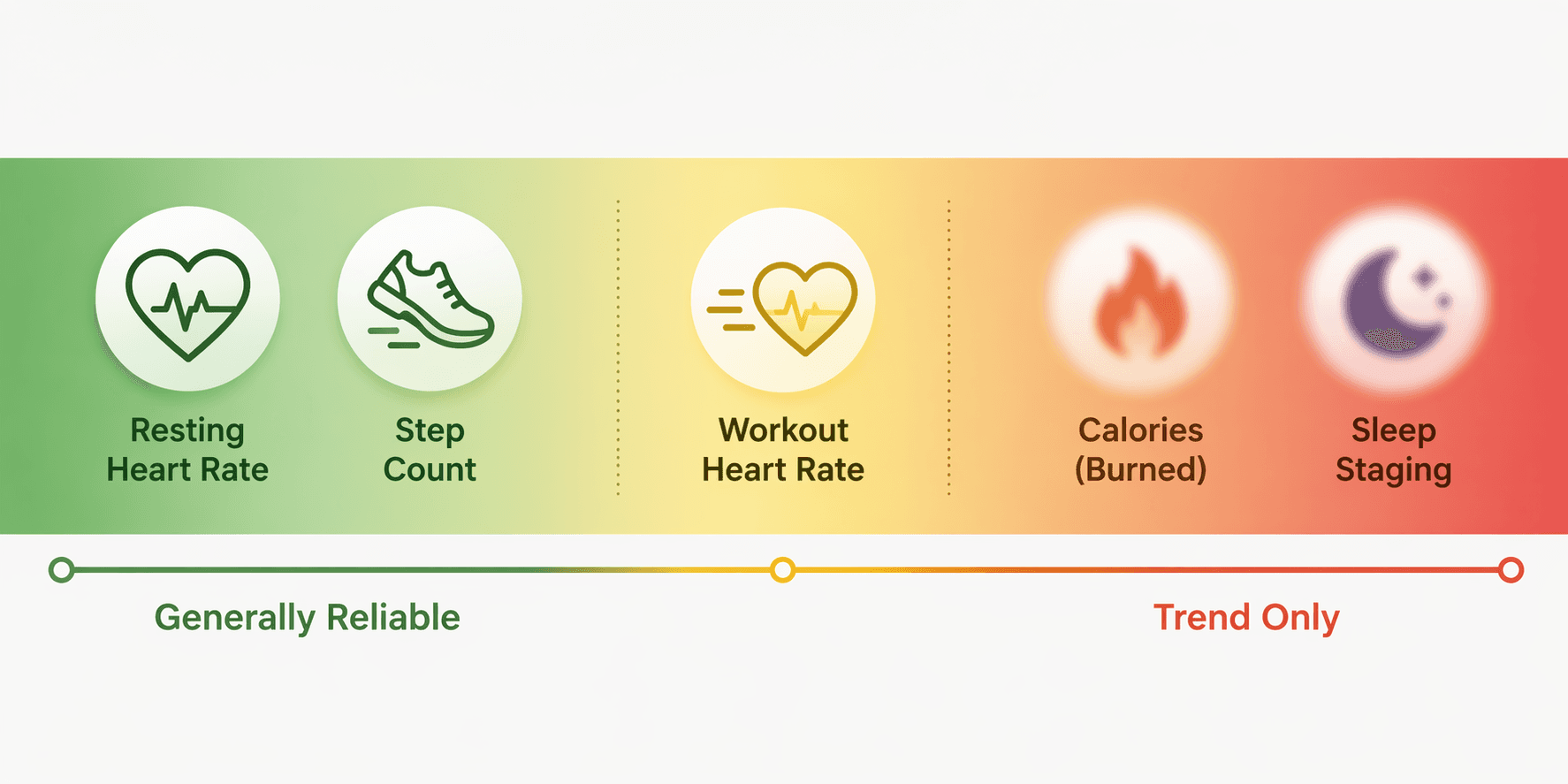
| Metric | How much to trust it | Best use | Where it breaks down |
|---|---|---|---|
| Resting heart rate | Generally usable | Baseline changes, fatigue clues, long-term fitness trend | Poor fit, illness context, inconsistent wearing habits |
| Steps | Generally usable | Daily movement consistency | Cycling, pushing strollers, carrying loads, non-step workouts |
| Workout heart rate | Activity-dependent | Easy cardio, steady runs, broad intensity zones | Intervals, strength training, rapid heart-rate changes, wrist motion |
| Calories burned | Trend only | Comparing similar workouts over time | Precise fueling, dieting math, judging one workout |
| Sleep stages | Trend only | Spotting repeated sleep-pattern changes | Diagnosing sleep quality, deciding recovery from one night |
Heart Rate Is the Most Useful Metric—and the Easiest to Overuse
Heart rate is where wearables earn a lot of their keep. In controlled or steady conditions, resting heart rate is one of the strongest metrics across major brands, and it is one of the few numbers I would actually let influence a training week. If your usual morning resting heart rate drifts up and stays there, that is worth noticing. It does not automatically mean you are overtrained, sick, or under-recovered, but it is a credible signal to check against how you feel, how you slept, and what your last few workouts looked like.[1]
Workout heart rate needs a narrower reading. CNET reported that the Apple Watch Series 11 had the lowest average heart-rate error, under 1%, in its 30-mile lab test against a Polar H10 chest strap.[2] That is a strong result, and it matters if you care about wrist-based heart-rate tracking. It is not a license to assume every Apple Watch reading, in every workout, on every wrist, is equally close.
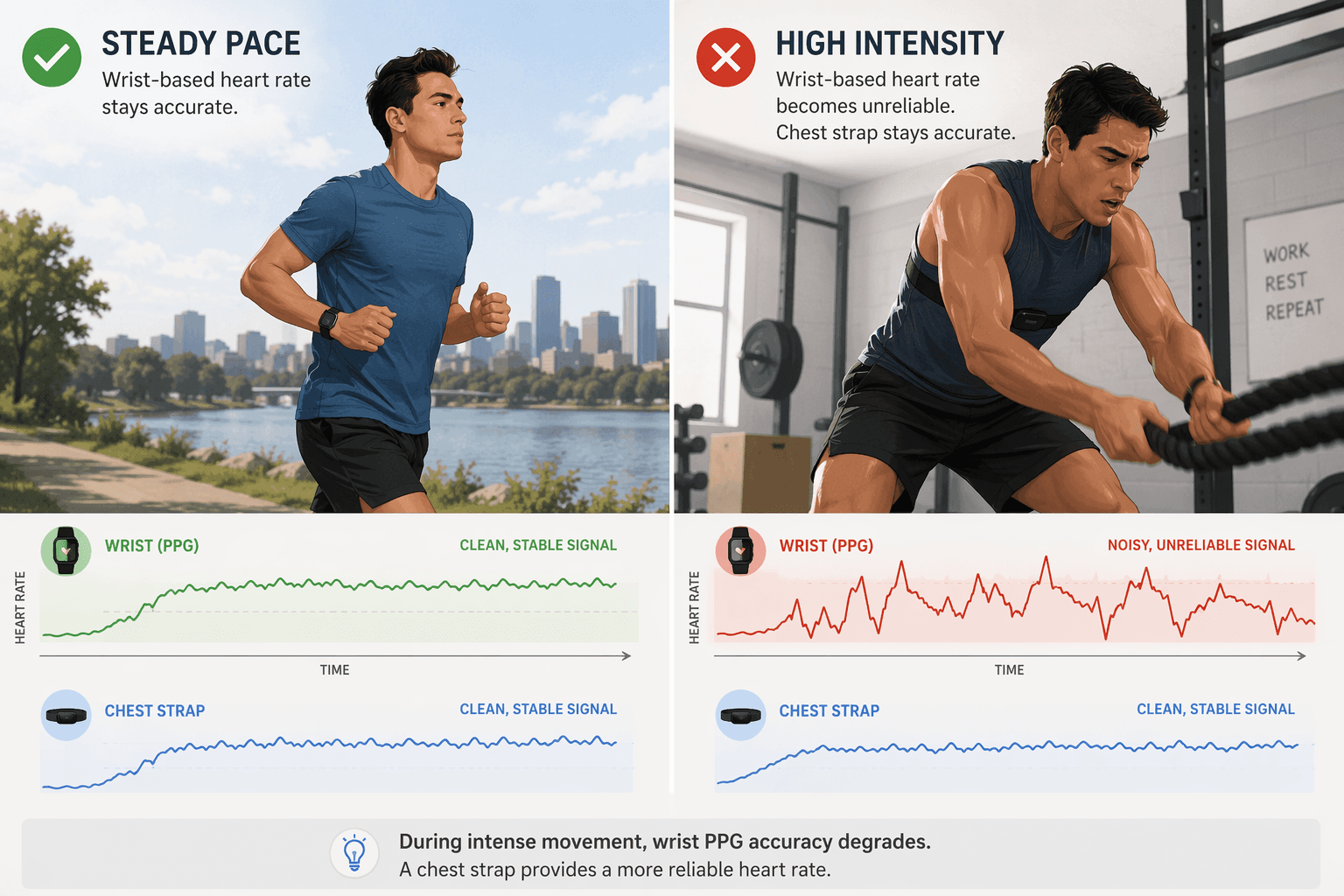
The reason is the sensor. Most wrist wearables use photoplethysmography, or PPG: LEDs shine light into the skin, and the sensor estimates pulse from blood-volume changes. That works best when the device sits still, the signal is clean, and heart rate changes gradually. It gets harder when your wrist bends, your grip tightens around dumbbells, the watch shifts during burpees, or your heart rate jumps quickly during intervals.
That is why I would use wrist heart rate differently for different sessions. For an easy run, incline walk, indoor bike ride, or general cardio session, a good wrist tracker can be useful for staying roughly in the intended zone. For short intervals, kettlebell work, HIIT circuits, or strength training, I would not make fine adjustments from the wrist number alone. The lag and motion noise can be large enough to make the display look confident while the underlying signal is struggling.
If the point of the workout is accurate intensity control, use a chest strap. A strap such as the Polar H10 measures the heart’s electrical activity rather than estimating pulse through optical changes at the wrist, which is why it is commonly used as the comparison benchmark in wearable tests.[2] It is not necessary for everyone. It is necessary when the decision depends on a clean heart-rate signal: threshold intervals, tightly prescribed zones, return-to-training monitoring, or any session where a 10-second lag changes what you do next.
For a deeper technical look at this specific problem, the heart-rate guide in the fitness trackers section is the better place to go. The short version here is simple: wrist heart rate is good enough for many steady workouts, but it should not be treated like a lab ECG during fast, messy movement.
Step Count Is Boring in the Best Way
Step count does not feel as advanced as readiness scores or sleep-stage graphs, but it is often more useful because the decision it supports is less fragile. If your goal is to move more during the day, a tracker does not need to count every step perfectly. It needs to be consistent enough that 4,000 steps, 8,000 steps, and 11,000 steps mean meaningfully different days.
That makes step count a good behavior metric. It can tell you that your work-from-home day was more sedentary than you realized, or that a walk after dinner brought you closer to your normal baseline. It is less useful for comparing unlike activities. A wrist tracker may undercount cycling, miss steps when your arm is still, or behave oddly when you are carrying groceries or pushing a stroller. But for daily movement consistency, it passes the practical-validity test.
Calories Look Precise, but the Error Range Is Too Wide
Calorie burn is the metric I trust least for exact decisions, partly because it is presented so cleanly. A number like 487 calories looks more actionable than “moderately hard session,” but that confidence is misleading. Current evidence puts wearable calorie-burn error margins around 15–40%, depending on the device and activity type.[1]
That range is not a small rounding problem. If your tracker says a workout burned 500 calories, a 15–40% error range means the real value could be far enough away to derail precise fueling or weight-loss math. The problem is not that the device is useless. The problem is that the number is often used for a job it is not accurate enough to do.
Calories can still be useful as a directional signal. If the same tracker, worn the same way, says your usual 30-minute ride is lower effort than last month’s version, that may reflect a real change in intensity, efficiency, or settings. But I would not eat back an exact calorie total, judge a workout’s worth by the burn number, or build a deficit plan around what a wrist device reports after each session.
Sleep Tracking Is Better at Timing Than Staging
Sleep tracking has improved, especially for basic sleep timing. If a device consistently catches when you went to bed, when you woke up, and whether your night was unusually fragmented, that can help. The trouble starts when the graph turns into confident slices of light sleep, deep sleep, REM sleep, and wake time.
The brand examples show why caution is warranted. Oura Ring 4 has reported sleep-stage precision in the 76–80% range, which is good enough to take seriously as consumer wearable data.[1] In contrast, one study cited in the same Forbes analysis found that the Fitbit Charge 4 underestimated deep sleep by 41 minutes.[1] Those two facts can both be true: sleep staging can be improving, and it can still be too inconsistent to treat as a clinical-grade explanation for how recovered you are.
For home training, I would use sleep data in layers. Bedtime, wake time, and obvious short sleep get the most trust. Repeated patterns in total sleep and restlessness deserve attention. A single night’s deep-sleep score should not decide whether you cancel a workout, add intervals, or assume your recovery is ruined.
If sleep and recovery metrics are the main reason you wear a device, it is worth separating ring-specific claims from wrist-tracker claims. The guides on fitness tracker ring accuracy and Oura Ring accuracy go deeper on that narrower question.
Skin Tone, Wrist Anatomy, and Fit Can Change the Signal
Accuracy is not only about brand. It is also about the person wearing the device. PPG sensors depend on light moving through skin and tissue, so skin tone, sensor design, wrist shape, strap tightness, tattoos, hair, and movement can all affect the signal. That does not mean every device fails in the same way for every person. It does mean “worked great in one test” is not the same as “will work equally well on your wrist.”
The skin-tone evidence deserves a careful reading. Hung et al. reported that, on the Fitbit Charge 5, mean error for darker skin tones at more than 60% heart-rate reserve reached 11.7 beats per minute, compared with less than 4 beats per minute for lighter skin at low intensity.[3] That is a meaningful difference for training decisions if you are using wrist heart rate to control intensity.
But the broader literature is mixed. A review discussed by Koerber et al. found that across 10 studies, four reported no skin-tone effect, four reported decreased accuracy for darker skin, and two reported mixed results.[4] The Fitzpatrick scale, often used in this research, was developed for phototherapy dosing rather than precise melanin measurement, and small samples limit how widely any single result should be applied.[4]
The practical takeaway is not panic or reassurance. If your wrist heart rate regularly disagrees with your effort, seems delayed during hard work, or produces strange spikes and drops, do not ignore that just because the device has good reviews. Try a tighter fit, move the watch slightly higher on the wrist, compare it during steady cardio, and consider a chest strap when accurate heart-rate data matters.
Brand Examples Help, but They Do Not Settle the Whole Question
Brand-specific numbers are useful when they answer a specific question. The Apple Watch Series 11 result against the Polar H10 is useful for wrist heart rate.[2] Oura Ring 4’s sleep-stage precision is useful when judging ring-based sleep tracking.[1] Fitbit Charge 4’s deep-sleep underestimate is useful as a warning against overreading sleep stages.[1] Fitbit Charge 6’s 98% positive predictive value for atrial fibrillation detection is useful, but it belongs in a different lane from workout tracking because medical-detection performance does not automatically prove calorie, sleep, or interval accuracy.[1]
What those examples should not become is a universal ranking. A device can be excellent at resting heart rate and mediocre at calorie burn. A ring can be convenient for sleep and poor for strength-training heart rate. A watch can win one lab comparison and still struggle when the wearer has a loose fit, small wrist, heavy wrist movement, or an activity the algorithm handles poorly.
That is also why affiliate-heavy “best tracker” lists should be read with a filter. A roundup can be helpful for features, battery life, comfort, and price. Accuracy claims need independent testing, the activity being tested, and the comparison method. Without those, “most accurate” is usually too broad a promise.
What to Trust for Training Decisions
The cleanest way to use a wearable fitness tracker is to match each metric to the decision it is strong enough to support. The same number can be useful for one decision and too weak for another.
- Trust resting heart rate as a baseline trend. Use it to notice sustained changes, not to diagnose the reason by itself.
- Use step count for movement consistency. It is good for comparing your own days, less good for comparing different activities.
- Use wrist heart rate for steady cardio and broad intensity zones. Be cautious during intervals, HIIT, and strength training.
- Use calorie burn only directionally. Do not build precise meal, deficit, or workout-value decisions around the displayed total.
- Use sleep stages as pattern clues. Do not treat one deep-sleep or REM number as a diagnosis of recovery.
- Use a chest strap when heart-rate accuracy is the point of the workout. It is the better tool for fast-changing intensity.
A home-training week makes the distinction clearer. If your tracker shows a higher resting heart rate for several mornings, your legs feel heavy, and your sleep duration has dropped, it is reasonable to make today’s workout easier. If the only warning sign is that last night’s deep-sleep slice looked low, I would not let that graph alone rewrite the plan. If your interval session depends on holding a narrow heart-rate zone, I would rather see a chest strap than a wrist reading that updates after the interval has already ended.
Form factor matters here. A wrist watch is convenient and usually better for live workout display. A ring may be easier to wear overnight and may appeal to people who dislike sleeping with a watch. A chest strap is less convenient but more trustworthy for accuracy-intensive heart-rate work. If you are choosing between those trade-offs, the wrist vs. chest strap vs. armband vs. smart ring guide is more useful than a single winner list.
The Accuracy Rule That Holds Up
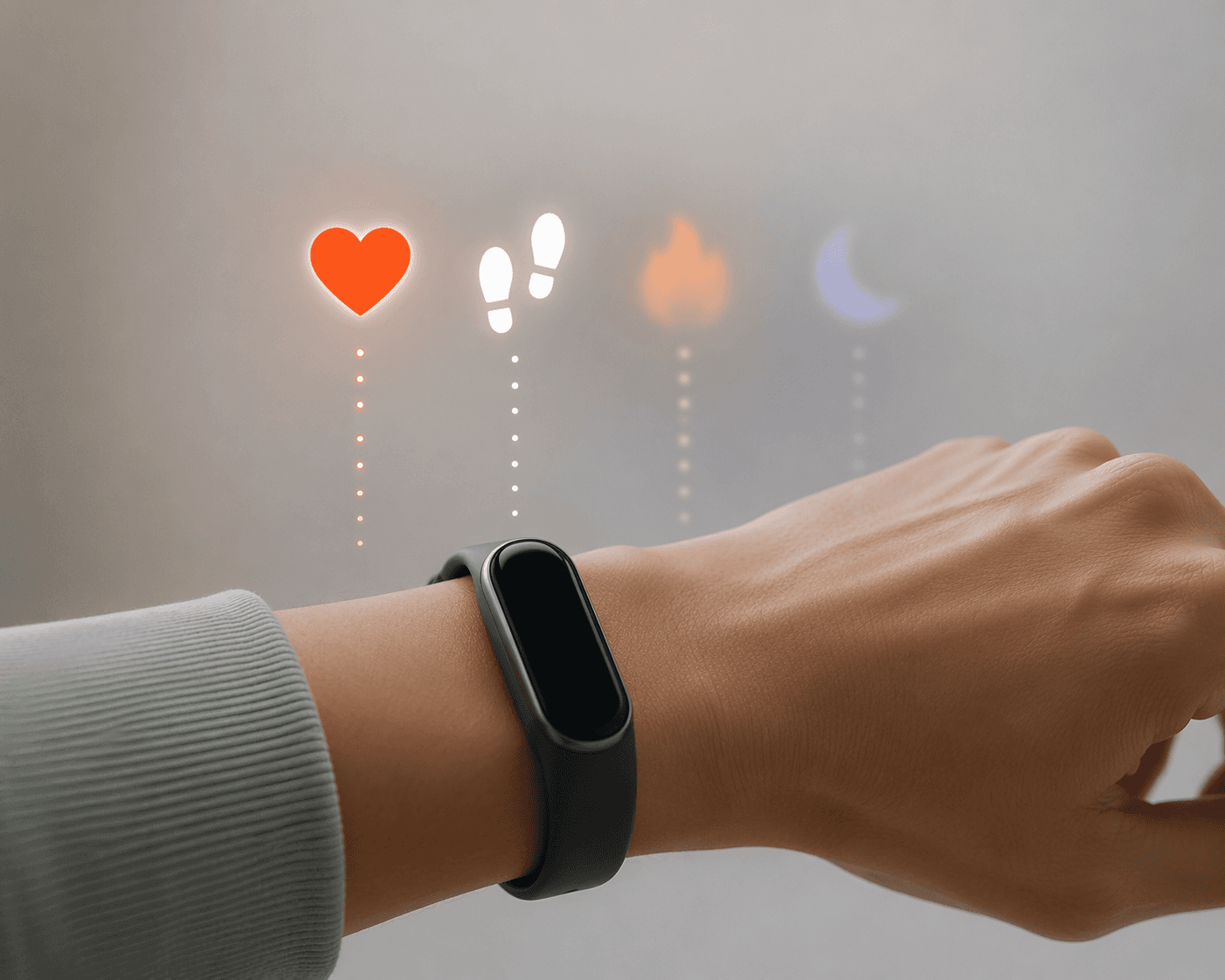
A wearable does not need to be perfect to be useful. It needs to be honest enough for the decision you are asking it to support. Resting heart rate trends, daily movement, and steady-cardio heart rate can help you train with more context. Calorie totals, sleep-stage slices, and high-intensity wrist heart rate should stay in the “trend and context” category unless you have a better measurement tool confirming them.
Use the tracker as a compass. Let it show direction, repetition, and change. Do not treat its calorie burn, sleep stages, or hard-interval wrist heart rate as a ruler.
References
- Which Fitness Tracker Is Most Accurate? Here’s Data On 9 Top Brands, Forbes, Mar. 11, 2026.
- Best Fitness Tracker, CNET, 2026.
- Skin tone and the accuracy of wearable heart rate monitors, PLOS ONE, 2025.
- Wrist HR Accuracy & Skin Tone, 5kRunner, Jun. 19, 2026.
Comments
Join the discussion with an anonymous comment.