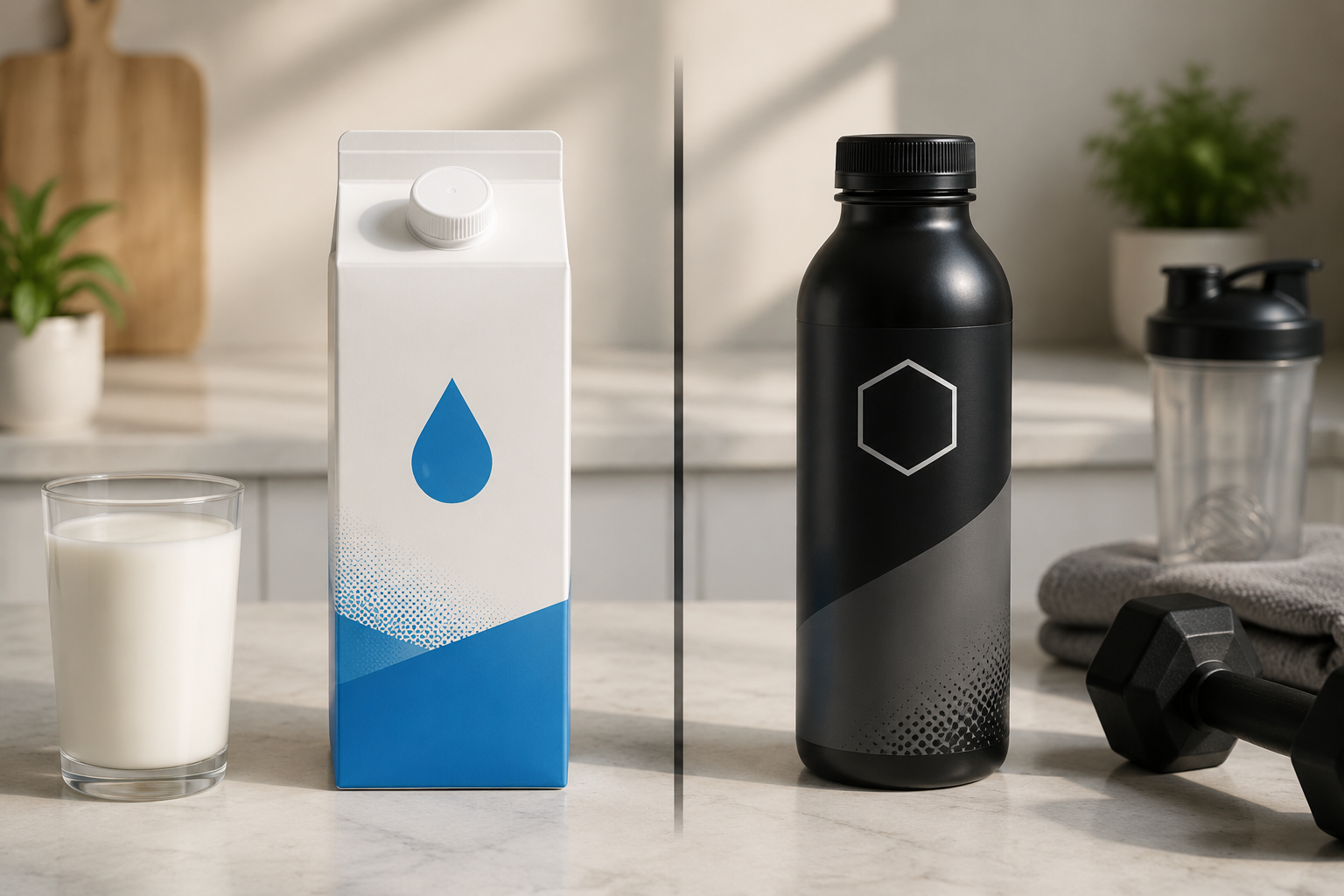
If you are choosing the best protein milk for muscle building, start with the real split: do you want the most protein for your calories, or the most protein in one ready bottle? Ultra-filtered milk is usually the better daily protein-density and budget play. Ready-to-drink protein shakes are usually the better one-bottle recovery-dose play.
That sounds like a small distinction until you are buying the same drink every week. A cup of ultra-filtered milk can land around 13 grams of protein with about 50% less sugar than regular milk, while higher-dose RTD shakes can push into the 40-gram range in a single bottle.[1][2][3] Both can be useful. They are not the same purchase.
The Short Buying Rule
| Your Priority | Better Format | Why |
|---|---|---|
| Protein per calorie | Ultra-filtered milk | About 13g protein per cup, lower sugar than regular milk, easy to scale up or down |
| One-bottle post-workout dose | RTD shake | Products like Core Power Elite and Muscle Milk Pro can deliver roughly 40g-plus per bottle |
| Budget over repeated grocery trips | Usually ultra-filtered milk | Price checks put ultra-filtered milk around $0.05–$0.08 per gram of protein versus about $0.12–$0.20 for many RTD shakes |
| No prep, no measuring, no shaker cup | RTD shake | You pay more, but the serving is already built |
| Cutting or calorie control | Ultra-filtered milk or a lower-calorie 30g RTD | The right choice depends on whether you need a small protein add-on or a full recovery bottle |
| Dairy avoidance | Plant-based protein drink | Useful if dairy is off the table, but not nutritionally interchangeable with dairy milk |
For most home lifters, the default answer is boring in a good way: keep ultra-filtered milk around if you want a repeatable, lower-calorie protein source, and use RTD shakes when you specifically need a full protein serving without making food.
Why Milk Protein Works After Resistance Training
Milk is useful for muscle building because it naturally brings complete dairy protein: whey, which digests faster, and casein, which digests more slowly. That matters more than the word “milk” on the label. The useful question is whether the drink helps you reach a meaningful protein dose after training, not whether it looks like a recovery product.
The study-aligned target range for post-exercise protein is roughly 20–40 grams. In one 6-week resistance-training study in young males, 30 grams of high-protein dairy milk after exercise and before sleep was associated with greater gains in lean mass, strength, and power than the comparison condition.[4] In a 12-week randomized controlled trial in adults aged 50 and older, high-protein dairy milk combined with resistance exercise led to greater muscle strength gains than either intervention alone.[5]
There is also a reason dairy milk should not be casually swapped with every plant-based drink. In a study comparing skim milk with an isonitrogenous soy drink after resistance exercise, milk promoted greater muscle protein accretion than soy.[6] That does not make plant-based drinks useless. It means they should be judged on their actual protein amount, amino acid profile, calories, sugar, and whether the user needs to avoid dairy.
Protein milk also does not rescue underbuilt training. If the workouts are too easy or too random, the bottle is just a grocery habit. For the broader food side, see The Home Gym Athlete’s Nutrition Plan. For the training side, pair recovery nutrition with a real progression plan such as a 6-week progressive home leg workout plan or a workout split you can repeat.
Ultra-Filtered Milk: The Protein-Density Pick
Ultra-filtered milk is made by filtering milk to concentrate protein and reduce some sugar. The result is a drink that still behaves like milk in a kitchen but carries more protein per cup. Fairlife-style ultra-filtered milks, Kroger Carbmaster, Organic Valley Protein Plus, and Kirkland Signature high-protein options sit in the same broad format: around 13 grams of protein per cup, with less sugar than regular milk.[1]
That makes ultra-filtered milk especially good when the serving size is flexible. One cup can support breakfast or a smaller snack. Two cups can push you toward a more substantial post-workout dose. It mixes into oats, cereal, smoothies, coffee, or a homemade shake without forcing a 40-gram serving every time.
The tradeoff is that a single cup usually does not match the 30- to 40-gram dose many lifters want after training. If you are walking in from a garage workout and need protein now, one cup of ultra-filtered milk may be a useful start, not the whole recovery plan.
Best Fit: Cutting, Calorie Control, and Daily Use
Ultra-filtered milk is the better first look if you are watching calories, using milk daily, or trying not to let “recovery” become a hidden subscription. It gives you high-quality dairy protein without making every serving a full meal replacement.
It is also the better format if you already eat enough carbohydrates around training. Some post-workout drinks try to solve protein and carbs at once. That can be useful after long or demanding sessions, but not every home workout needs a big carb-containing bottle. If dinner is thirty minutes away, ultra-filtered milk may be enough to bridge the gap.
RTD Shakes: The Total-Dose and Convenience Pick
Ready-to-drink shakes win when the job is simple: one bottle, meaningful protein dose, no measuring. Fairlife Core Power Elite lists 42 grams of protein and 230 calories per bottle.[2] Muscle Milk Pro’s 2026 reformulation lists 40–42 grams of protein, 220 calories, and a new base made with real ultra-filtered milk, with no artificial sweeteners, flavors, or added colors.[3]
That reformulation matters because it blurs the old shelf distinction. Muscle Milk Pro is still an RTD shake in how you buy and use it, but its move to ultra-filtered milk makes the category less clean than “milk carton versus protein shake.” If you had written off RTD shakes as only powder-in-a-bottle products, the 2026 version deserves a fresh label read.
Fairlife Nutrition Plan and Premier Protein also map neatly to the 30-gram protein use case described in dairy protein research, though the exact best buy depends on calories, ingredients, flavor tolerance, and retailer price. Business Insider’s 2026 tasting review included Fairlife Core Power, Muscle Milk, Premier Protein, and Orgain among high-protein drinks ranked by taste, which is useful as a directional signal rather than a universal verdict.[7]
Best Fit: Post-Workout Convenience and Bulking
An RTD shake makes the most sense when the alternative is missing the meal. After a hard session, a 30- to 42-gram bottle is more reliable than intending to cook and then getting pulled into work, errands, or kids’ schedules.
It can also help during a bulk, especially for lifters who struggle to eat enough. Liquid calories are not magic, but they are easier to add than another full plate of food. For a broader recovery setup around timing, fluids, sleep, and mobility, use a protein drink as one part of a complete post-workout recovery routine at home, not as the whole routine.
The Comparison That Actually Matters
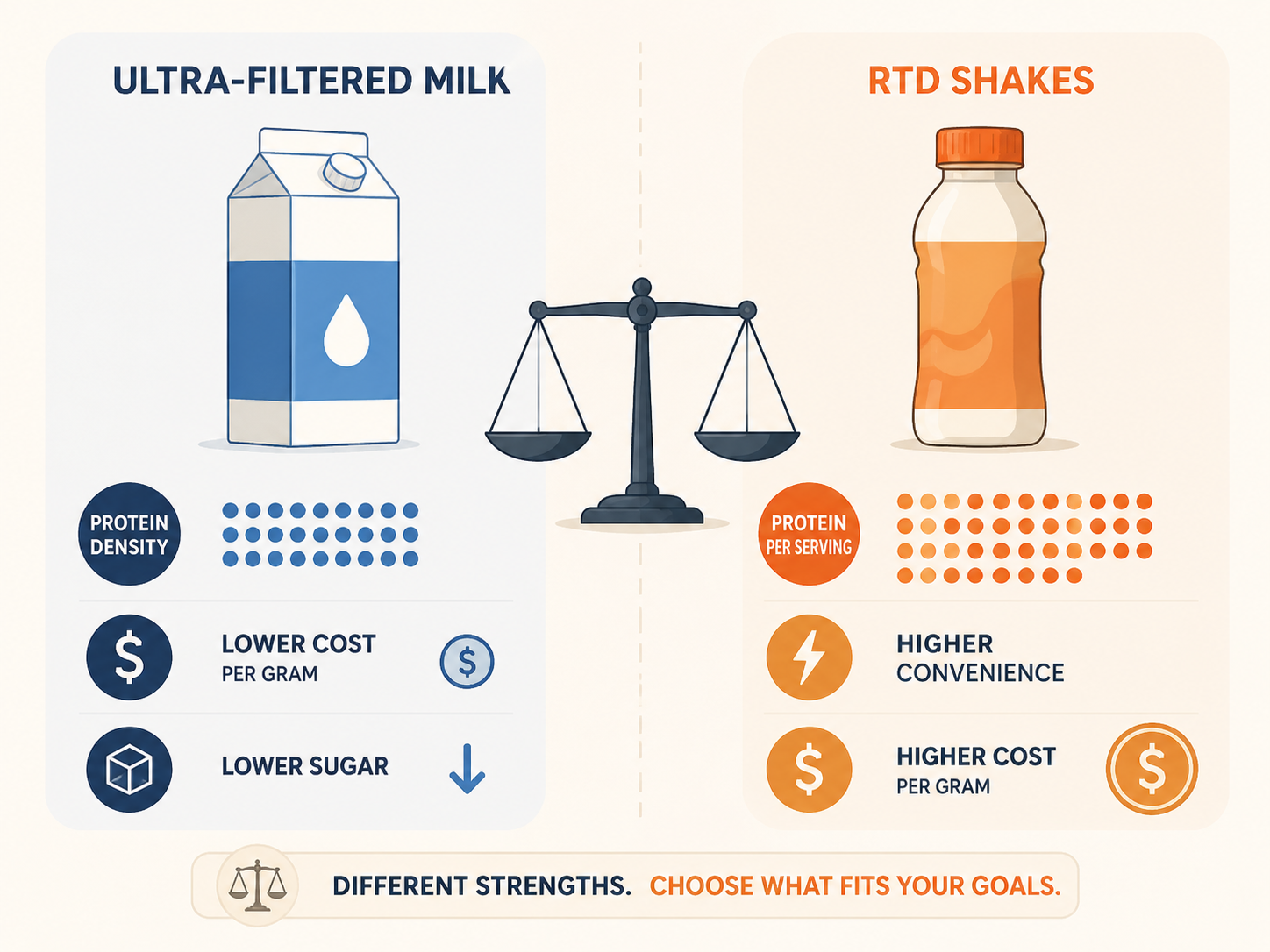
| Criterion | Ultra-Filtered Milk | RTD Protein Shake | How to Use the Difference |
|---|---|---|---|
| Protein per calorie | Usually strong, especially around 13g per cup | Can be strong, but varies by product | Choose milk when you want to add protein without committing to a large serving |
| Total protein per serving | Often lower unless you drink multiple cups | Often 30–42g per bottle | Choose RTD when one serving needs to cover the post-workout dose |
| Cost per gram | Estimated at about $0.05–$0.08/g | Estimated at about $0.12–$0.20/g | Recheck local prices, especially multipacks and warehouse-club deals |
| Carbs for recovery | Lower sugar than regular milk; flexible with meals | Depends heavily on formula | Add carbs separately if the workout demands them and the drink is mostly protein |
| Taste | More milk-like; brand differences matter | More dessert-like or shake-like | Use taste tests as clues, then buy the smallest pack first |
| Convenience | Requires a cup, fridge space, and measuring if you track | Open and drink | Pay extra only when convenience changes behavior |
The cost row deserves more attention than it usually gets. If ultra-filtered milk costs about half or less per gram of protein than many RTD shakes, the difference compounds quickly for someone drinking it most training days. But those numbers should not be treated as permanent. Multipacks, warehouse stores, grocery promotions, and regional availability can flip a specific product comparison.
The clean way to compare is to ignore the front label for a minute. Divide the package price by total grams of protein in the package. Then check calories per serving and decide whether the serving fits your day. That calculation catches a lot of expensive branding before it reaches your cart.
Product Picks by Goal
Best for Protein Density: Fairlife-Style Ultra-Filtered Milk
For daily muscle-building support, ultra-filtered milk is the first format to check. Fairlife is the best-known example, but the broader category now includes Kroger Carbmaster, Kirkland Signature, and Organic Valley Protein Plus-style options around the same 13-gram-per-cup idea.[1]
Organic Valley’s Protein Plus lactose-free milk entered the market in 2026 with 13 grams of protein per cup, which makes the category more competitive for shoppers who want a carton rather than a shake bottle.[8] That is good for buyers. More carton competition should make it easier to choose based on price, taste, lactose tolerance, and store availability rather than automatically defaulting to one brand.
Best for One-Bottle Recovery: Fairlife Core Power Elite or Muscle Milk Pro
If the job is one bottle after training, Fairlife Core Power Elite and Muscle Milk Pro are the obvious high-dose comparisons. Core Power Elite brings 42 grams of protein and 230 calories per bottle.[2] Muscle Milk Pro’s 2026 version brings 40–42 grams of protein and 220 calories, now with ultra-filtered milk as the base.[3]
The better pick between them is not universal. If one tastes better to you and costs less at your retailer, that is the answer. If the price is close, compare ingredient preferences and how the bottle sits in your stomach after training. A technically impressive protein count does not help much if you stop drinking it by week three.
Best 30g Bottle: Fairlife Nutrition Plan or Premier Protein
A 30-gram RTD shake is a practical middle lane. It lines up well with the 30-gram dairy milk studies without forcing a 40-gram serving, and it often fits better for smaller athletes or anyone already eating a protein-containing meal near training.[4][5]
Fairlife Nutrition Plan and Premier Protein both belong in this comparison. The difference should come down to calories, taste, ingredient tolerance, and current price per gram. If you are drinking one every day, do not buy a case until you have tried a single bottle cold, after a workout, the way you will actually use it.
Best Budget Habit: The Cheapest Ultra-Filtered Milk You Enjoy
For budget, brand loyalty should be weak. Compare the carton price, protein per serving, servings per container, and whether you actually finish it before it spoils. A cheaper bottle that sits in the fridge is not cheaper protein.
This is where store brands can make sense. If Kroger Carbmaster, Kirkland Signature, or another ultra-filtered option gives you the same useful protein dose at a lower price, the label does not need to look like a supplement brand to be the better buy.
Best Taste Tie-Breaker: Use Rankings Carefully
Taste rankings help when you are narrowing a shelf, but they are not lab results. Tasting Table’s June 2026 blind taste test ranked six ultra-filtered milk brands, including Fairlife, Kroger Carbmaster, and Organic Valley Protein Plus.[9] Business Insider’s 2026 review ranked high-protein drinks by taste across products including Fairlife Core Power, Muscle Milk, Premier Protein, and Orgain.[7]
Use those rankings to decide what to try first, not what to buy forever. Sweetness, thickness, aftertaste, and stomach comfort are personal enough that the best taste test is still your own refrigerator.
Best for Dairy Avoidance: Plant-Based Drinks, With Clear Expectations
If you avoid dairy, a plant-based protein drink can still be the right product for you. The mistake is treating it as a straight nutritional substitute for dairy protein milk without checking the label. Plant-based options such as Ripple, Orgain, and Silk Protein can differ materially on protein density, amino acid profile, and sugar.
For muscle building, choose the plant-based option with enough total protein, reasonable calories, and a formula you tolerate well. If it falls short on protein, pair it with food instead of pretending the carton solved the same problem as a dairy-based 30- or 40-gram shake.
How to Check a Protein Milk Label
- Start with protein per serving: 13g per cup is useful for milk; 30–42g per bottle is the RTD recovery range.
- Check calories next: a higher-protein bottle is only better if the calories fit your goal.
- Calculate cost per gram: package price divided by total protein grams in the carton or case.
- Look at sugar and carbs: lower sugar helps calorie control; more carbs may be useful after harder sessions.
- Respect tolerance: lactose-free does not guarantee every stomach likes every formula.
- Buy small first: taste and texture matter more when the product becomes a weekly habit.
For post-workout use, the label also has to fit the meal around it. If you are eating dinner soon, you may not need a 42-gram bottle. If you train early and cannot cook, a full RTD shake may be the more reliable recovery choice. If you are building your week around a 3-day, 4-day, or 5-day home gym workout split, the right protein milk is the one that helps you repeat the plan without overspending or overshooting calories.
Final Buying Rule
Choose ultra-filtered milk if daily protein density, calorie control, and cost efficiency matter most. Choose an RTD shake if one bottle needs to deliver a full muscle-building protein dose with no prep. Let taste and stomach comfort break close ties, then verify current retailer pricing before you commit to a case.
References
- High Protein Milk: It’s Not Just Milk With Added Protein Powder, McGill University Office for Science and Society
- Fairlife Core Power Shakes Review, cheatdaydesign
- Muscle Milk Reformulates Its Protein Shakes With Ultra-Filtered Milk, Up To 42g Complete Protein, And No Artificial Sweeteners, Flavors Or Added Colors, PRNewswire, May 2026
- Effects of High-Protein Milk Supplementation Consumed after Resistance Exercise and before Sleep on Lean Body Mass, Muscle Strength, and Power in Young Males: A Randomized Controlled Trial, Nutrients, 2021
- Effect of High-Protein Dairy Milk on Muscle Strength, Body Composition and Physical Performance in Middle-Aged and Older Adults: A Randomized Controlled Trial, Frontiers in Nutrition, 2021
- Consumption of Fluid Skim Milk Promotes Greater Muscle Protein Accretion after Resistance Exercise than Does Consumption of an Isonitrogenous and Isoenergetic Soy-Protein Beverage, American Journal of Clinical Nutrition
- 14 Best High-Protein Drinks Ranked by Taste, Business Insider, 2026
- Organic Valley High-Protein Lactose-Free Milk Review, Delish, March 2026
- Is Fairlife Really The Best Ultra-Filtered Milk?, Tasting Table, June 2026



Comments
Join the discussion with an anonymous comment.