The hard part is rarely starting the home gym habit. It is keeping the eating side from lagging behind the training side. Three or four lifting sessions a week can become automatic while breakfast is still improvised, dinner depends on the workday, and protein gets patched together only when a shaker bottle happens to be clean.
A useful nutrition plan for home gym athletes does not need a special physiology. The body still responds to energy balance, protein, carbohydrate availability, dietary fat, hydration, sleep, and training stress. What changes at home is the execution: training times move around, equipment changes the loading pattern, no one is forcing intensity, and the food budget may already be sharing space with plates, dumbbells, bands, and a bench.
That distinction matters. There is not a large peer-reviewed category called “home gym athlete nutrition” that deserves its own biological rulebook. The better approach is to take standard sports nutrition ranges and make them flexible enough for the way home training actually happens.
Start With the Goal, Then Set the Range
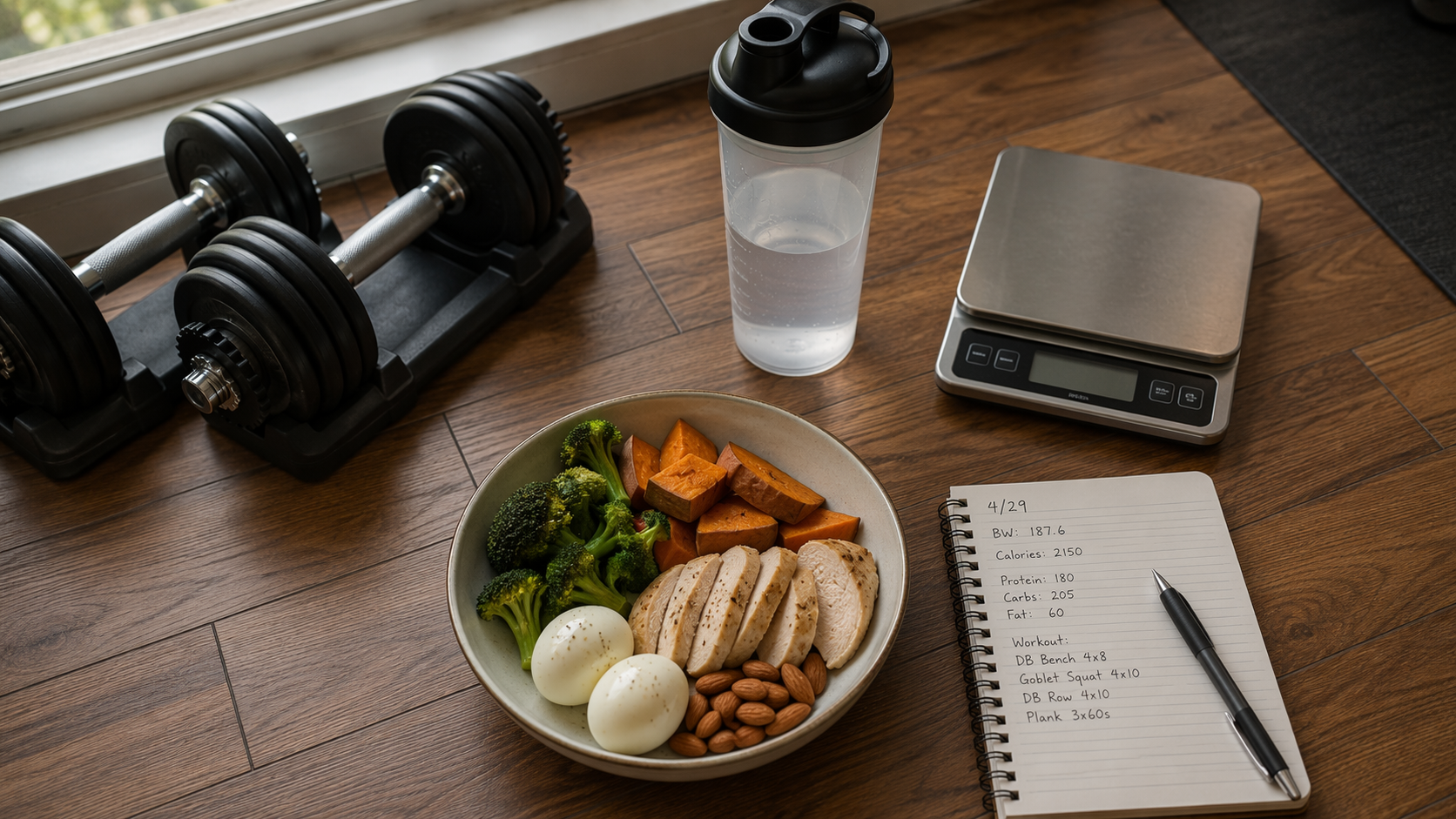
Most home lifters do better with ranges than fixed commandments. A lifter training hard with a barbell, adjustable dumbbells, and progressive overload needs more fuel than someone doing short band circuits twice a week. A lifter cutting body fat needs different calories than someone trying to add size. Age, sex, current body composition, training volume, and daily activity all move the numbers.
The macro targets below are starting points, not a morality test.
| Goal | Calories | Protein | Carbs | Fat |
|---|---|---|---|---|
| Muscle gain | About 10–20% above maintenance, adjusted by scale trend | 0.7–1.0g/lb bodyweight | Often toward the middle or high end of 1.5–2.5g/lb if training 3–5 days/week | Usually 0.3–0.5g/lb |
| Fat loss | Below maintenance, adjusted slowly enough to keep training quality | 0.7–1.0g/lb bodyweight | Enough to support sessions; reduce from the lower-priority calories first | Avoid dropping much below 0.3g/lb |
| Maintenance or recomposition | Near maintenance, adjusted by performance, measurements, and bodyweight trend | 0.7–1.0g/lb bodyweight | Match the hardest training days first | Usually 0.3–0.5g/lb |
Protein: Enough, Spread Out, and Repeatable
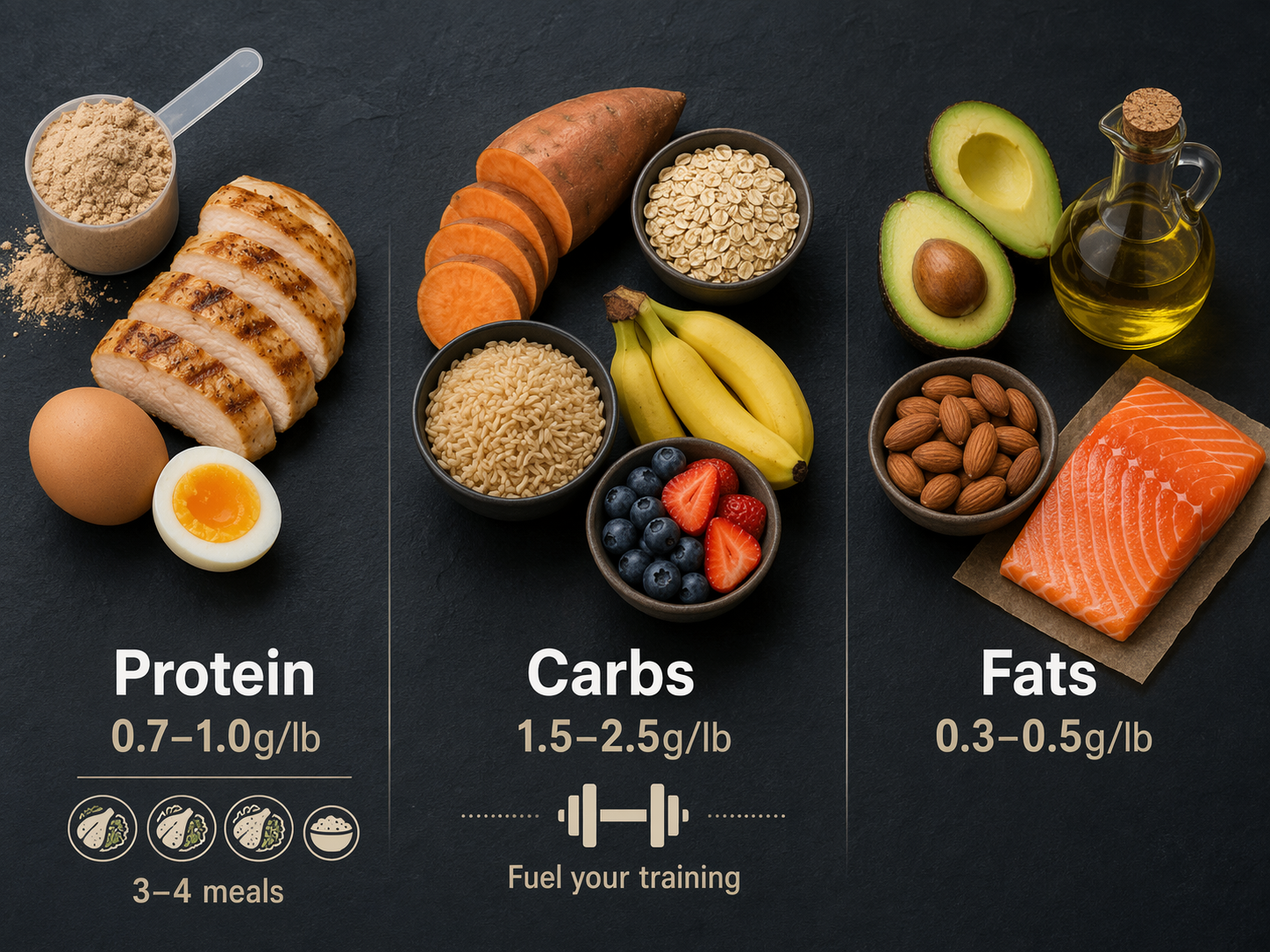
For active people trying to support muscle, the International Society of Sports Nutrition position stand gives a daily protein range of roughly 0.7–1.0 grams per pound of bodyweight, commonly distributed across 3–4 meals with about 20–40 grams per meal to support muscle protein synthesis across the day.[1]
That range is more useful than the usual argument over the “perfect” protein number. A 180-pound lifter would start somewhere around 126–180 grams per day. The lower end may be enough for maintenance or a moderate recomposition phase. The upper end may make more sense during fat loss, higher training volume, or when meals are inconsistent.
The practical move is to stop letting protein depend on the one heroic dinner. Three meals with a clear protein anchor, plus one optional snack or shake, usually beats a plan that requires six perfectly timed feedings. Eggs, Greek yogurt, chicken, tuna, lean beef, tofu, lentils, cottage cheese, milk, and protein powder can all fit; powder is convenience, not a separate category of progress.
Calories: Muscle Gain Needs a Surplus, Not an Excuse
For gaining muscle, a review on nutrition recommendations for bodybuilders describes a 10–20% calorie surplus above maintenance as a practical starting point, with novice and intermediate athletes often aiming for about 0.25–0.5% bodyweight gain per week.[2]
That weekly gain target is the guardrail. Home training can be brutally effective, but it can also be uneven. Some weeks have heavy squats, rows, presses, and hard accessories. Other weeks have late-night dumbbell work after the kids are asleep and no appetite for another plate of rice. A surplus should follow the trend, not the fantasy version of the program.
If bodyweight is not moving after two or three weeks and lifts are not improving, add food. If weight is climbing faster than the target while performance feels the same, trim the surplus. The adjustment does not need to be dramatic. Most problems here come from treating a bulk as unlimited permission or from being so cautious that the body never has the material to build.
Fat Loss and Recomposition Do Not Need a Home-Gym Exception
Fat loss still requires an energy deficit. The home-gym adjustment is behavioral: keep the deficit small enough that training does not turn into survival work. If the dumbbells feel heavier every week for the wrong reason, sleep worsens, and every session needs more warm-up just to reach normal numbers, the deficit may be too aggressive for the workload.
Maintenance and recomposition are also legitimate, especially for intermediate home lifters who are still improving exercise selection, range of motion, and consistency. If bodyweight is stable, waist measurement gradually improves, and performance is moving up, there is no need to force a bulk or cut just because a commercial-gym template says the calendar must have one.
Carbs Are Usually the Macro Home Lifters Undervalue
Protein gets the attention, but carbohydrates often decide whether the fourth set is productive or just technically completed. NASM’s strength nutrition guidance uses a carbohydrate range of about 1.5–2.5 grams per pound for people strength training 3–5 days per week, and resistance training can substantially reduce muscle glycogen during a session.[3]
Limited equipment does not automatically mean low demand. A garage session built around Bulgarian split squats, Romanian deadlifts, dumbbell presses, pull-ups, rows, and high-rep accessories can burn through plenty of usable training fuel. Bands and adjustable dumbbells often push lifters toward higher reps and shorter rest periods, which can make carbs more relevant, not less.
For a home athlete training 3–5 days per week, carbs usually belong around the sessions that matter most. Oats, rice, potatoes, fruit, pasta, tortillas, beans, cereal, and bread all work. The expensive version is optional. The useful version is the one that keeps showing up before and after training.
This is also where the training plan matters. Someone following a low-volume strength routine needs different fuel than someone running dense full-body sessions in a garage with dumbbells and bands. If the equipment setup changes the workout style, the food should follow. A home lifter comparing routines can use an equipment-based home gym routine to see whether the program is more strength-focused, hypertrophy-focused, or conditioning-heavy before deciding how high to push carbs.
Do Not Push Fat Too Low
Dietary fat does not need as much spreadsheet attention as protein and calories, but it should not be treated as disposable. NASM’s strength diet guidance notes that fat intakes below about 0.3 grams per pound can negatively affect hormone production, while a range around 0.3–0.5 grams per pound supports hormone function and fat-soluble vitamin absorption.[3]
In real meals, this means keeping some eggs, olive oil, avocado, salmon, nuts, seeds, dairy, or fattier cuts in the rotation instead of cutting every visible fat source to make room for more protein powder and chicken breast. During a fat-loss phase, fat may come down. It just should not be the macro that gets driven into the floor because it is less fashionable than protein.
Meal Timing Should Survive Morning, Lunch, and Evening Training
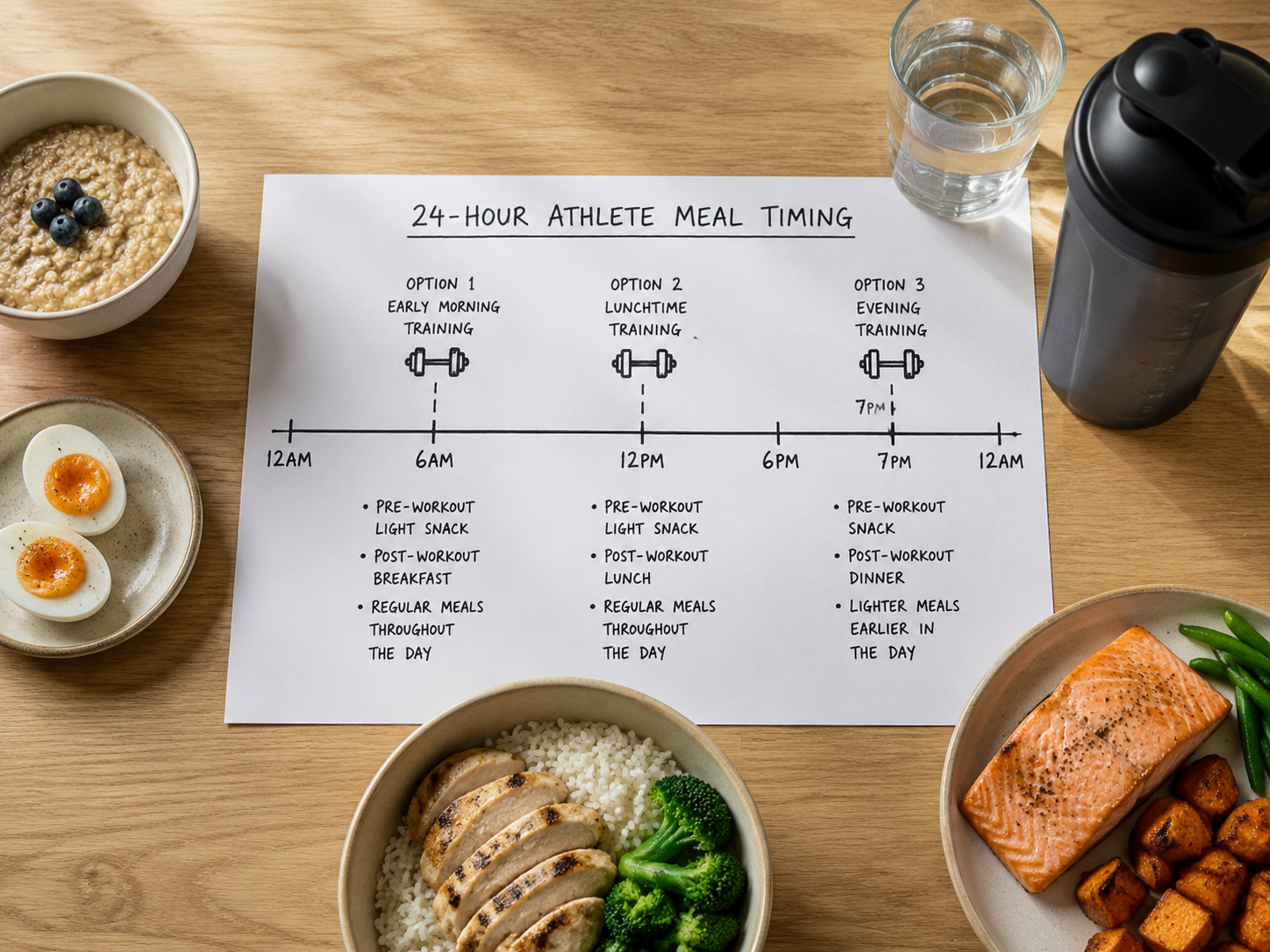
Home training is convenient until the schedule changes. A commercial gym plan may assume the same 5:30 p.m. lifting slot every day. At home, a serious session might happen before work on Monday, during lunch on Wednesday, and after dinner on Friday. The nutrition plan has to bend without becoming random.
Before Training
For most sessions, a meal 1–3 hours before training that includes both carbohydrate and protein is enough. American Heart Association and EatRight guidance both support the general pattern of eating before activity with digestible carbohydrate and some protein rather than relying on a complicated pre-workout ritual.[4][5]
- Morning session: banana or toast plus Greek yogurt, eggs, milk, or a small shake if a full meal sits badly.
- Lunch session: normal breakfast, then a carb-and-protein snack midmorning if training intensity is high.
- Evening session: lunch should not be the last real fuel; add a late-afternoon meal or snack with carbs and protein.
The closer the meal is to training, the simpler it should be. A large, high-fat meal right before squats is not more anabolic; it is just harder to train on.
After Training
The old 30-minute anabolic window is less urgent than it was often made to sound. Schoenfeld and colleagues’ 2013 meta-analysis found no significant hypertrophy advantage from immediate post-workout protein timing when total daily protein intake was controlled.[6]
That does not mean post-workout food is irrelevant. It means the priority is the day’s total intake, then the meal pattern. If dinner is within a reasonable window after training, eat dinner. If the session ends late and a full meal is not happening, a protein-and-carb option can bridge the gap. The recovery problem is not missing a magic minute; it is finishing a hard session at 9:30 p.m., eating almost nothing, sleeping poorly, and repeating that pattern twice a week.
Food is only one part of recovery, but it is the part that often gets neglected because no one else sees it. Pairing consistent post-training meals with a practical post-workout recovery routine at home makes the recovery target less vague.
Hydration Is Boring Until It Costs You Sets
A simple baseline is to drink about half your bodyweight in ounces of fluid per day, then add around training based on sweat, heat, session length, and how salty your food is. ACE hydration guidance emphasizes drinking before, during, and after exercise rather than waiting until thirst is the only signal left.[7]
Garage and small-room setups make this easier to overlook. The bottle is ten feet away, but the session is squeezed between work calls, laundry, or bedtime. Put the water where the lifting happens. If the room is hot, the session is long, or sweat loss is obvious, electrolytes or salty food may matter more than another supplement tab in the browser.
This is one of the quiet constraints of training at home. A lifter working in a small home gym under 50 square feet may be dealing with heat, limited airflow, and no obvious place to stage food or fluids. That does not change the hydration principle, but it does change whether the habit happens.
Supplements: Keep the Filter Tight
A home gym already has enough ways to spend money. Supplements should solve a specific problem, not become a second hobby.
| Supplement | Useful Role | Practical Take |
|---|---|---|
| Creatine monohydrate | Supports strength and high-intensity performance | 3–5g/day is the simplest evidence-backed default |
| Caffeine | Can improve alertness and training drive | 150–300mg before training is optional; avoid it when it disrupts sleep |
| Protein powder | Helps hit daily protein when meals fall short | Use it as food convenience, not as a requirement |
| BCAAs | Often marketed for recovery | Usually unnecessary when total protein is already adequate |
| Fat burners and testosterone boosters | Marketed for body composition or hormones | Skip unless there is a specific, clinician-guided reason |
NASM and practical fitness guidance place creatine, caffeine, and protein powder in a more defensible category than products such as BCAAs, fat burners, and testosterone boosters, especially when the basics are not yet consistent.[3][8]
Creatine is the one most home strength athletes can consider without much drama: take it daily, do not time it obsessively, and give it time. Caffeine is more situational. It can rescue a flat session, but the late-evening home lifter has to weigh that against sleep. Protein powder belongs wherever it keeps the protein target realistic without crowding out normal meals.
Adjust by the Trend, Not the Day
A repeatable nutrition plan needs a feedback loop. Daily bodyweight bounces around too much to steer the whole plan by one weigh-in. Use weekly averages, performance notes, hunger, sleep, and measurements. If the goal is muscle gain, the 0.25–0.5% weekly bodyweight gain range keeps the surplus honest.[2] If the goal is fat loss, the useful deficit is the one that still lets you train with intent.
- If lifts are improving and bodyweight is moving at the intended pace, keep the plan steady.
- If performance is flat and bodyweight is not changing during a muscle-gain phase, add calories, usually from carbs first.
- If weight gain is too fast and waist measurements are jumping, reduce the surplus before blaming the program.
- If fat loss is working but sessions are collapsing, consider a smaller deficit, more carbs around training, or better sleep before adding supplements.
- If soreness keeps stacking up between sessions, look at total food, protein distribution, sleep, and active recovery together rather than treating nutrition as the only lever.
For lifters who train alone, the recovery signal can be easy to misread. There is no coach watching bar speed, no training partner asking why every warm-up looks slow. Nutrition should be checked alongside sleep, programming, and soft-tissue work such as foam rolling and active recovery for home gym training. Sometimes the answer is more food. Sometimes it is fewer junk sets, better rest days, or not turning every limited-equipment exercise into a burnout test.
The plan that works is usually plain: protein in the 0.7–1.0g/lb range, calories matched to the goal, carbs high enough to support 3–5 real training days, fats not cut below a functional floor, meals placed around the training window without panic, water handled before it becomes a problem, and supplements kept in their place. Evidence gives the ranges. Home training decides how flexible those ranges have to be.
References
- International Society of Sports Nutrition Position Stand: protein and exercise, Journal of the International Society of Sports Nutrition, 2017.
- Nutrition Recommendations for Bodybuilders in the Off-Season: A Narrative Review, PMC, 2019.
- The Strength Athlete's Guide to a Plant-Based Diet, NASM.
- Food as Fuel Before, During and After Workouts, American Heart Association.
- Timing Your Pre- and Post-Workout Nutrition, EatRight.org.
- Nutrient timing revisited: is there a post-exercise anabolic window?, Journal of the International Society of Sports Nutrition, 2013.
- Healthy Hydration, ACE.
- Supplements, Total Body Fitness.
Comments
Join the discussion with an anonymous comment.