
Before comparing an exercise bike vs rowing machine for small spaces, put a tape measure on the floor. Not around the whole room. On the usable run of floor where the machine would actually go: wall to bed, wall to sofa, closet door to radiator, corner to dresser. That measurement usually answers more than a spec-sheet footprint does.
Exercise bikes are usually shorter machines, with many upright models landing around 41 to 57 inches long and about 21 to 24 inches wide. Rowers are the opposite shape: compact models often run about 80 to 86 inches long and roughly 19 to 24 inches wide, while standard rowers can be around 95 inches long. Recumbent bikes complicate the easy “bike is smaller” answer because they can stretch closer to 68 to 70 inches long.[1][2]
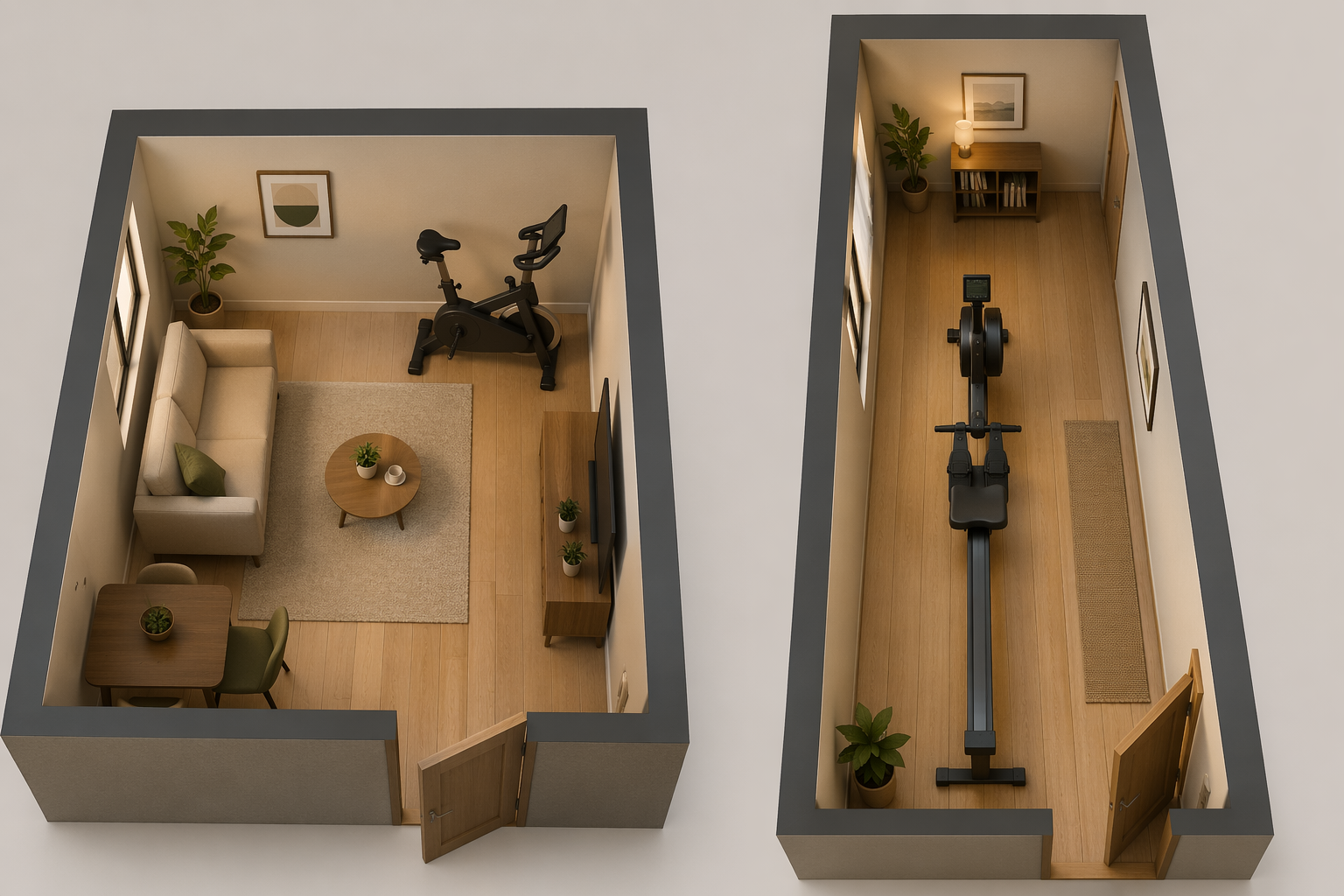
That shape difference matters. A 10-square-foot rectangle and a 10-square-foot strip do not behave the same way beside a bed. A bike can live in a corner and ask for less length every day. A rower may demand an entire lane during the workout, then nearly disappear if it stores upright.
Use the sofa test before you shop
The fastest rower reality check is a standard three-seat sofa. If your open floor run is shorter than a typical sofa, roughly 84 to 90 inches, a full-size rower probably is not realistic at full slide extension. A compact rower may still fit near the upper end of that range, but the room has to give you one clean lane, not a theoretical diagonal between furniture legs.
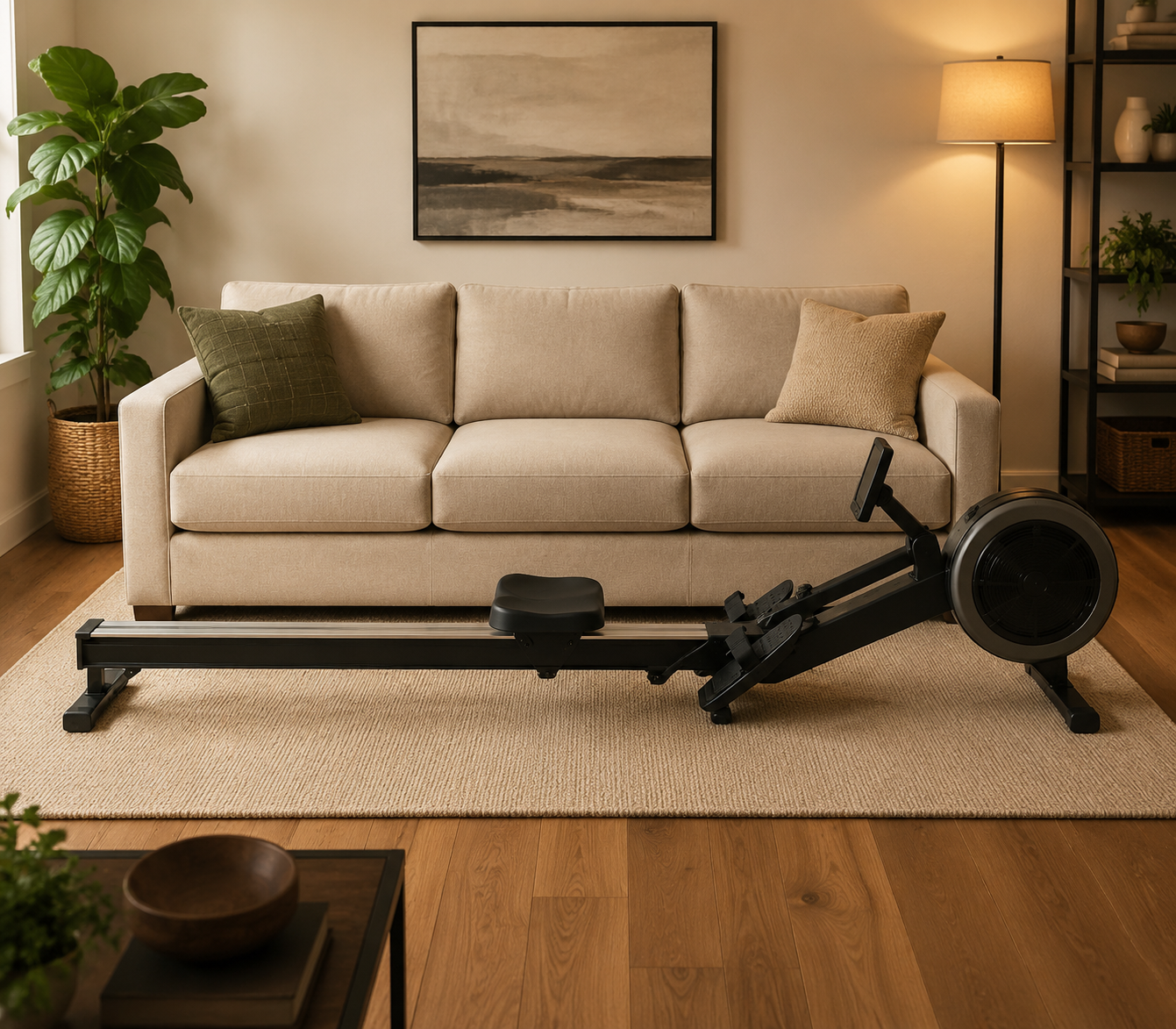
This is where many small-apartment mistakes happen. The rower looks narrow, so it seems easy. Then the rail blocks the walkway, the handle path reaches into the coffee table zone, or the seat needs a few extra inches behind the advertised machine length. The width was never the problem. The uninterrupted length was.
For an exercise bike, the sofa test is less important. Most upright bikes do not need 7 or 8 feet of straight floor. They need a stable rectangle, room to mount and dismount, and a spot where the handlebars and screen do not turn a closet door or walkway into a daily negotiation.
The room shape decides more than the machine category
Once you have the floor run, sort your room by shape rather than by square footage.
| Your space looks like this | Likely better fit | Why |
|---|---|---|
| Short room with a usable corner or wall | Upright or folding exercise bike | The bike asks for less length and can sit against the edge of the room. |
| Long, narrow lane of 80 to 95 inches | Rowing machine | The rower uses length more than width, so a hallway-like zone can work. |
| Room with open floor during workouts and tall wall storage afterward | Vertical-storage rower | The active footprint is large, but the idle footprint can shrink sharply. |
| Closet-first or under-bed storage setup | Folding exercise bike | A folding bike may store more easily than either a standard bike or a rower. |
| Short room where comfort matters more than compactness | Not usually a recumbent bike | Recumbent bikes are bike-shaped in use, but their longer frames weaken the usual bike advantage. |
A short-wide room is bike territory. Think bedroom corner, office wall, or the dead zone beside a dresser. The bike may not fold, and it may not vanish, but it does not need a long runway.
A long-narrow room is where a rower starts making sense. The machine can run along a wall, behind a sofa, or through a strip of floor that would be awkward for a bike. You still need to sit on it, pull, return, and clear the rail, so do not measure only the frame. Measure the human using it.
A storage-friendly room is the exception that makes rowers more competitive than their active length suggests. If you have enough ceiling height and a wall where upright storage is safe, a rower can be the bigger machine during a workout and the smaller object afterward.
Active footprint and stored footprint are different questions
An exercise bike usually keeps asking for its floor space after the workout. You can slide some models a little closer to a wall, and folding bikes are a separate case, but a sturdy upright or connected bike is often a permanent object in the room. That is not automatically bad. Permanent can be useful if it means you actually ride it. It just means the idle footprint is close to the active footprint.
Many rowers behave differently. Compact and standard rowers can occupy roughly 10 to 15 square feet during use, then store vertically at about 3.5 to 5.7 square feet depending on the model. BarBend’s compact rower guide lists examples such as the Ergatta at 3.59 square feet stored and the Hydrow Rower at 5.73 square feet stored, with models such as the Hydrow Wave, Ergatta, and Concept2 RowErg designed around vertical storage.[2]
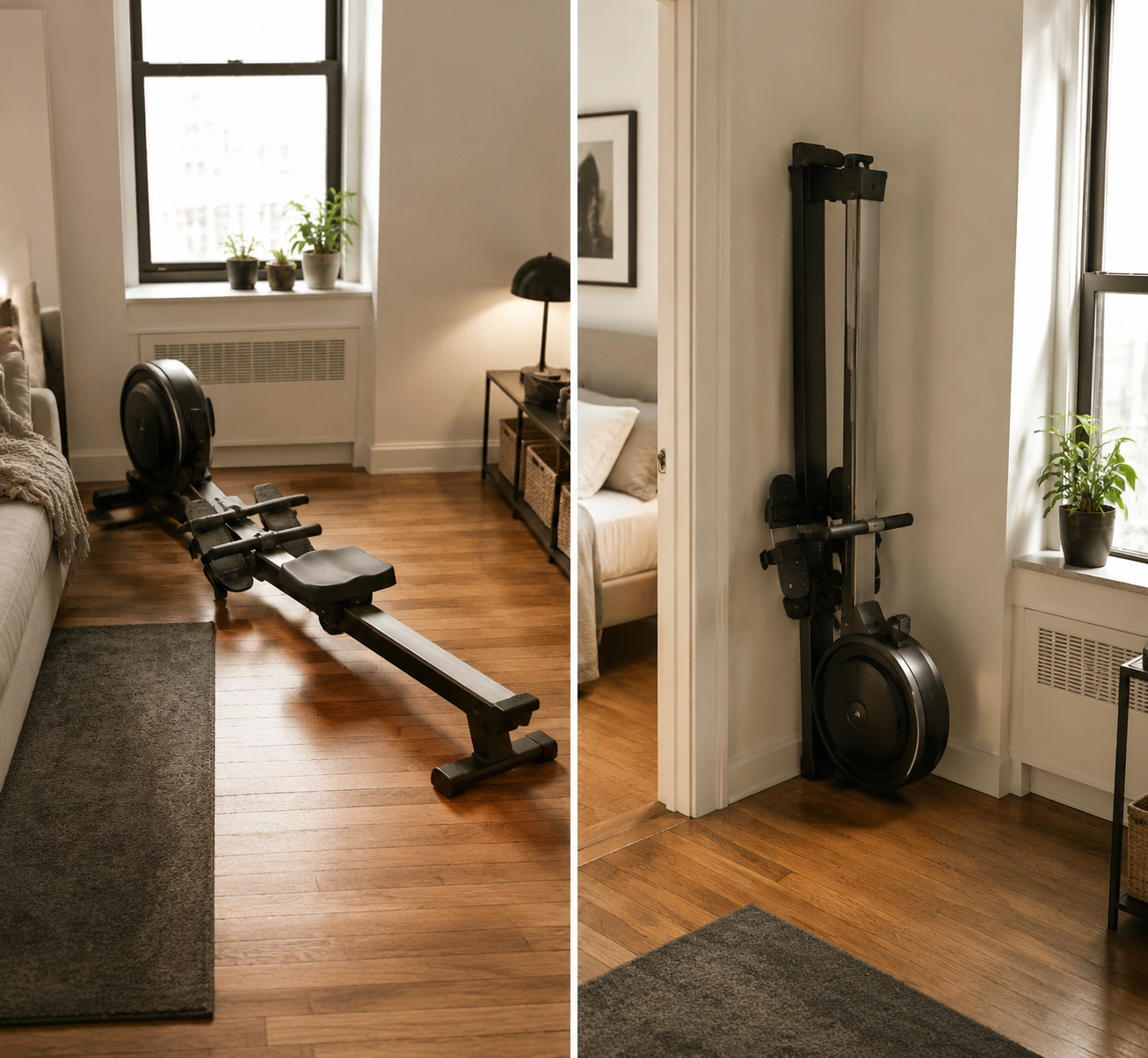
That sounds like a loophole, and sometimes it is. But vertical storage is not magic storage. You still need a ceiling that clears the upright machine, commonly around 6 to 7 feet of vertical clearance, and you need a wall spot where the stored rower will not block a door, heater, curtain, or light switch. In older apartments, the wall that looks perfect on paper is often the one with the radiator.
The Concept2 RowErg adds another wrinkle because it can separate into two pieces for storage and transport, with the machine listed at 57 pounds total on Concept2’s product page.[3] That is useful if you need to move it between rooms or tuck it into a closet. It should not be treated as normal rower behavior. Most buyers should assume a rower is either stored vertically as one long object or left down in its full working length.
Where exercise bikes win
Choose the bike side of the exercise bike vs rowing machine for small spaces decision when your room is length-limited. If the only open area is beside the bed, at the end of a desk, or in a corner near the window, an upright bike is usually easier to place than a rower. You can turn it slightly, tuck the rear stabilizer near a wall, and still use it without needing a full rail-length lane.
This is especially true if the machine can stay out. A bike that occupies one corner all week is less annoying than a rower that must be lowered, used, lifted, and re-parked every session, especially in a room where the storage wall and workout lane are not the same place.
The main bike warning is category drift. An upright bike and a recumbent bike do not solve the same space problem. Recumbent bikes can be much more comfortable for some riders, but their longer 68- to 70-inch frames move them closer to rower-length territory without giving you the same narrow rail shape.[1]
If the bike answer already looks likely, it is worth comparing specific compact and folding options rather than treating all bikes as interchangeable. The Best Exercise Bikes for Small Spaces and Apartments guide is the next stop for low-footprint models, while How to Choose a Stationary Bike for Your Home is more useful if you are still deciding among upright, indoor cycling, folding, and recumbent formats.
Where rowers win
Choose the rower when your space gives you length more easily than width. A narrow room, a long strip beside a wall, or an open lane behind furniture can fit a rowing machine better than a bike, even if the rower’s listed footprint looks intimidating. The shape is the point: long and skinny can be easier to live with than short and blocky.
Rowers also win when the active-workout zone and idle-storage zone are both real. If you can roll or lift the rower into place, use the full slide, then store it upright without blocking the room, the machine may reclaim more floor space after a workout than a standard bike can. That is the reason the stored footprint numbers matter more than the active footprint alone.
Do not let the common “rowing uses 86% of muscles” claim make the room decision for you. That figure is widely repeated as an industry estimate, but this comparison does not need a winner for workout quality. If the rower blocks the only path to the closet, its theoretical full-body advantage will not help much on laundry day.
Apartment readers should also separate space from neighbor impact. Noise varies by resistance type, floor, mat, and building construction, and the available evidence is better for directional guidance than exact room-to-room predictions. If your decision is turning on storage, floor vibration, and shared-wall problems, The Renter’s Guide to a Compact Home Gym is a better place to handle those apartment-specific tradeoffs.
Folding bikes are the closet exception
A folding exercise bike can beat both categories if your real goal is to make the machine disappear. The Marcy Foldable Upright Exercise Bike, for example, folds from 32 inches long to 14 inches long and weighs 37 pounds, making it a serious closet or under-bed candidate in a way most rowers and standard bikes are not.[1]
The tradeoff is that a folding bike is not just a smaller version of a sturdier upright or connected bike. Models in this lane commonly use simpler resistance systems, with examples such as 8 magnetic resistance levels, and the ride feel may be less substantial than a heavier frame.[1] That may be a perfectly good trade if the bike has to live under the bed. It is not the same buying decision as choosing a permanent training bike for a dedicated corner.
The fit decision
Choose an exercise bike if your room is short on length but gives you a corner, a wall, or a folding-storage plan. The bike is the safer fit when you cannot create an 80- to 95-inch open lane and do not want to handle vertical storage after every workout.
Choose a rowing machine if your room has a long, narrow run and you can either leave that lane open during workouts or store the rower upright afterward. The rower asks more from the room while you use it, but some models give back much more floor space when stored.
Now do two checks in the actual room. First, measure the open floor run against the sofa test. If the usable length is shorter than a three-seat sofa, be very cautious with a full-size rower. Second, measure the idle storage spot: the corner for a bike, the closet or under-bed space for a folding bike, or the wall height and floor patch for a vertical rower. The label that says “compact” matters less than what your tape measure says after the closet door opens.
References
- The 7 Best Exercise Bikes for Small Spaces of 2026 — BarBend
- The 8 Best Compact Rowing Machines (2026) — BarBend
- Concept2 RowErg official product page — Concept2
Comments
Join the discussion with an anonymous comment.