
The first mistake in a windy round usually happens before the club reaches the ball. You feel the gust, brace harder, swing harder, and then watch a shot climb, peel, or stall in a way that makes the whole motion feel exposed. The wind did not create every fault, but it makes the loose ones expensive: sway off the ball, a rushed transition, a flipping lead wrist, or balance that only works when the air is still.
That is why useful golf wind practice drills should not start with a magic phrase like flight it lower. Lower ball flight comes from physical control: staying centered, rotating without lunging, controlling the lead wrist, holding ground pressure, and keeping tempo from speeding up just because the shot looks uncomfortable.
The old line swing easy when it is breezy is partly useful and partly too neat. Effort is not the only problem. MyGolfSpy's July 2026 field test found that a normal swing into a 30 to 35 mph headwind, with gusts to 50 mph, lost roughly 40 yards on a 150-yard shot because spin and trajectory punished the ball flight, not because the golfer failed to try hard enough.[1]
The stakes are not theoretical. Andrew Rice Golf has shown in player testing that wind predictably shifts club path and delivery for every golfer tested, and a 20 mph headwind can make a 150-yard shot play about 20% longer.[2] Galvin Green gives a similar practical benchmark with a 1-yard-per-mph headwind adjustment rule.[3] Those are not club-selection laws, but they are enough to explain why a high, spinny strike turns a manageable hole into damage control.
The At-Home Wind Routine
This routine takes about 18 to 25 minutes. It needs a wall, a towel, a light resistance band, a golf club or broomstick, and a metronome app. If you already train at home, it fits well after a short mobility session or on a non-lifting day. If you are newer to home exercise, use the same patient progression you would use in a no-equipment beginner workout plan: clean reps first, more volume later.
| Exercise | Main Skill | Dose |
|---|---|---|
| Head-on-the-Wall Rotation | Centered posture and anti-sway control | 2 sets of 8 slow rotations per side |
| Resisted Rotation with Band | Compact hip-shoulder rotation | 2 to 3 sets of 8 to 10 reps per side |
| Towel Lag Drill | Lead-wrist control and lower-flight feel | 2 sets of 6 to 8 slow half-swings |
| Single-Leg Balance with Club | Lower-body grounding in gusts | 2 rounds of 20 to 30 seconds per leg |
| Slow-Motion Metronome Swings | 3:1 tempo discipline | 3 sets of 6 swings |
Before starting, spend three to five minutes warming up: 10 hip hinges, 10 bodyweight squats, 10 shoulder circles each direction, and 6 gentle practice turns with a club across your chest. Nothing here should create back pain, wrist pain, or knee pain. Keep the band light, stay short of end range, and stop if a drill makes you guard or twist sharply.
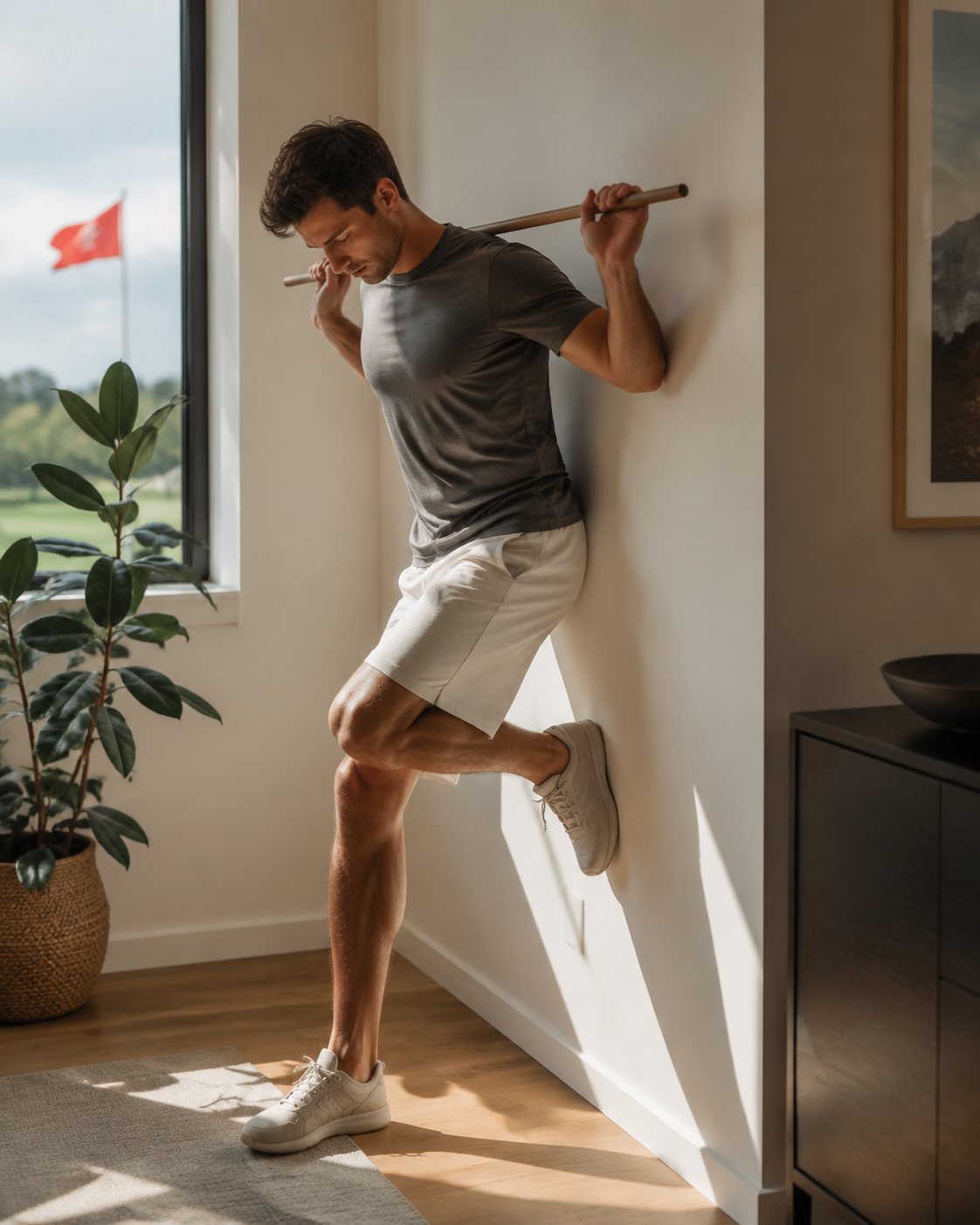
1. Head-on-the-Wall Rotation
Stand in golf posture with your forehead lightly touching a wall. Hold a club across your shoulders or across your chest. Your feet should be about stance width, knees soft, hips hinged, and pressure spread through the middle of both feet. The wall is not there to support you. It is there to tell the truth.
- Set your forehead against the wall with only gentle contact.
- Turn your chest slowly as if making a backswing, keeping the head from sliding along the wall.
- Pause for one breath at the end of the turn.
- Rotate back through center and slightly toward a follow-through position.
- Repeat for 8 slow rotations per side, then rest.
The useful feedback is immediate. If your forehead rubs sideways, your upper body is drifting. If your hips thrust toward the wall, you are losing posture. If you cannot turn without pushing your head into the wall, you are turning tension into fake stability.
In wind, this matters because a gust does not give you time to rebuild posture mid-swing. Andrew Rice Golf's testing found that wind shifted delivery for every golfer tested, which makes centered rotation more than an aesthetic preference.[2] You are training the body to turn around a steadier axis when the shot feels like it wants to shove you around.
Make it easier by crossing your arms over your chest instead of holding a club. Make it harder by narrowing your stance slightly or pausing longer at the end of the backswing. Do not add speed until you can keep the same light wall contact for the whole rep.
2. Resisted Rotation with Band
Anchor a light resistance band at chest height in a door or around a sturdy post. Stand in golf posture with the band held in both hands at the center of your chest. Step away until the band has mild tension. This is not a max-strength drill. It is a compact-rotation drill.
- Start with feet grounded and ribs stacked over hips.
- Rotate your chest away from the anchor without letting the knees collapse inward.
- Keep the hands in front of the sternum rather than pulling with the arms.
- Return slowly to center for a 2-second count.
- Complete 8 to 10 reps per side.
The wind version of overswinging usually starts with good intentions. You want to hit it solid, so the backswing gets longer, the arms disconnect, and the transition arrives before the lower body is organized. A light band gives you just enough resistance to feel whether the torso is rotating as a unit or whether the hands are dragging the motion around.
For a wind round, the carryover is a calmer 3/4 swing. Treat that as a useful rule of thumb, not a formula. The goal is not to make every windy shot three-quarters by measurement. The goal is to rehearse a turn that can stay compact without becoming stiff.
If you do not own a band, start with slow club-across-chest turns from a regular stance. If you are building a small home setup, a light band belongs near the top of the list, well before most expensive golf gadgets; the same logic applies in a broader beginner home-gym equipment framework.

3. Towel Lag Drill
Tuck a small towel under your lead arm, close to the armpit. Take your normal grip on a club or broomstick. Set up in golf posture and make short, slow half-swings. The towel should stay in place without being crushed. Your lead wrist should feel flat to slightly flexed as the club moves into the impact zone.
This drill gets extra attention because wrist control is where a lot of windy-round advice becomes vague. HackMotion's wind-golf analysis identifies lead wrist flexion at impact as the primary mechanical factor for controlling trajectory in wind.[4] You do not need its sensor to work on the feel, but the point is important: lower flight is not just a mental command. The club arrives differently when the lead wrist behaves differently.
- Make a half backswing with the towel still connected under the lead arm.
- Start down slowly, keeping the handle slightly ahead of the clubhead.
- Move through an imaginary impact position with the lead wrist flat or mildly bowed.
- Stop at waist height on the follow-through instead of making a full finish.
- Do 6 to 8 controlled reps, then reset your grip and posture.
Keep the rep small enough that you can feel the handle leading. If the clubhead throws past your hands early, the drill has done its job by exposing the flip. If the towel drops immediately, your arms and torso are separating faster than your body can organize.
Do not force a severe bowed wrist. That can create tension in the forearm and make the face harder to manage. The home target is a repeatable impact feel: connected lead side, quieter hands, and a delivery that makes a lower window possible when you later test it with real balls.
4. Single-Leg Balance with Club
Stand tall with a club held lightly across your chest. Lift one foot an inch or two off the floor. Soften the standing knee, keep the pelvis level, and hold for 20 to 30 seconds. If that is easy, hinge slightly into golf posture and make tiny chest turns while keeping the standing foot quiet.
- Round 1: hold still for 20 to 30 seconds per leg.
- Round 2: add slow mini-turns, 5 each direction.
- Regression: keep the toes of the lifted foot lightly touching the floor.
- Progression: close the stance slightly or pause in golf posture.
This is less about circus balance and more about lower-body honesty. If the foot grabs, the hip wobbles, or the shoulders twist to rescue the hold, you have found the kind of instability that shows up when wind hits during the transition.
Keep this drill near a wall or chair if balance is a limiter. The best version is controlled and boring. Falling out of position repeatedly does not build the grounding you want on a tee box.
5. Slow-Motion Metronome Swings
Open a metronome app and set it slow enough that you can move without rushing. A simple starting point is 60 beats per minute. Make practice swings using a 3:1 backswing-to-downswing rhythm: three beats to the top, one beat down through impact. PGA coaches including Kellie Stenzel, Keith Stewart, and Brendon Elliott point to the 3:1 tempo ratio as a consistent Tour benchmark, with TPI research also commonly referenced in that discussion.[5][6]
- Beat 1: start the club back without snatching it inside.
- Beat 2: continue turning, keeping pressure steady in the feet.
- Beat 3: arrive at the top without adding a last-second lift.
- Beat 4: swing down and through with the same balance you had at address.
Use a half swing first. Then a 3/4 swing. Only then try a full practice swing. The metronome gives you a number instead of a mood. Without it, smooth tends to mean whatever your nervous system feels like that day.
Wind tempts the transition to get quick. Once the transition gets quick, the body often loses sequence: pressure moves late, the arms fire early, and the wrist conditions from the towel drill disappear. This is why the tempo drill comes last. You are asking the posture, rotation, wrist, and balance work to show up inside a repeatable rhythm.
For quiet apartments or shared spaces, make this a no-ball, no-impact drill. A broomstick works. So does a short training club. If you already use quiet at-home workouts, this fits the same rule: make the movement precise enough that you do not need noise or speed to prove you trained.
How to Use the Routine Each Week
Use the full routine two or three times per week during windy-season play or before a trip to an exposed course. On busier weeks, keep a 7-minute minimum version: one set of wall rotations, one set of towel lag reps, and one set of metronome swings. That keeps the most wind-specific feels alive without pretending you completed a full session.
| Schedule | Best Use |
|---|---|
| 2 days per week | Maintenance for golfers already playing or practicing regularly |
| 3 days per week | Best short block before windy rounds, links trips, or tournament weeks |
| 7-minute minimum | Busy-week option when consistency matters more than volume |
Progress by improving control before adding speed. Add a second pause to the wall drill. Use slightly more band tension only if your posture stays clean. Make the towel swings a little longer only if the lead wrist feel survives. Increase metronome speed only after the 3:1 pattern stops feeling like a puzzle.
A simple four-week progression can work like any other bodyweight workout plan: start with a repeatable baseline, add small difficulty, then keep the movements sharp instead of chasing fatigue. Golf does not reward exhausted reps if those reps teach you to lose shape.
Safety and Transfer Notes
These are conditioning and feel drills. They can help you build the physical capacities that make lower, calmer ball flight easier to access, but they do not replace range testing. When you can, take the same feels to half shots and 3/4 shots with real balls. Watch starting line, curve, height, and contact before deciding the routine has transferred.
If you have persistent back, wrist, elbow, hip, or knee pain, get individual guidance before repeating rotational drills. If your ball flight problem is severe or persistent, a qualified golf professional can check whether the issue is physical capacity, clubface control, setup, equipment, or something else entirely.
The home work still matters. Wind punishes unstable posture, rushed tempo, and uncontrolled wrist delivery. A wall, towel, band, club, and metronome are enough to train those weak links before the next gust makes them obvious.
References
- Swing Easy When It's Breezy: Is That Even True?, MyGolfSpy, July 2026
- Andrew Rice Golf, Andrew Rice Golf
- How to Play Golf in the Wind, Galvin Green
- Playing Golf in the Wind, HackMotion
- Golf Tips: 5 Keys to Play Better in the Wind, PGA of America
- How to Play Better in Windy Conditions, GOLF.com
Comments
Join the discussion with an anonymous comment.