
How to Work Out at Home During a Heat Wave with No AC
Wondering whether you can work out at home during a heat wave in a small apartment without AC? Use the 90°F indoor-temperature rule to make the call, then follow a heat-scaled, no-jumping bodyweight circuit built for quiet, floor-safe training in a small space.
- Equipment tier required
- none
- Duration
- 15-22 min
- Difficulty
- beginner
- Target area
- full body
- Space footprint needed
- one mat or towel-width space
- Noise level
- quiet, no jumping
You are in the apartment, shoes on, fan pointed at the mat, trying to decide whether a short workout is still a good idea. For home workouts during a heat wave in a small apartment with no AC, the first move is not a warmup. It is a temperature check.
This article is the routine companion to FitAtHome’s broader heat-wave workout safety decision layer. Run that full train/scale/shift/skip framework when conditions are complicated. Here, the working gate is simpler: measure the indoor temperature, respect humidity and airflow, and if the room is around or above 90°F, do not treat a fan as proof that training is safe.
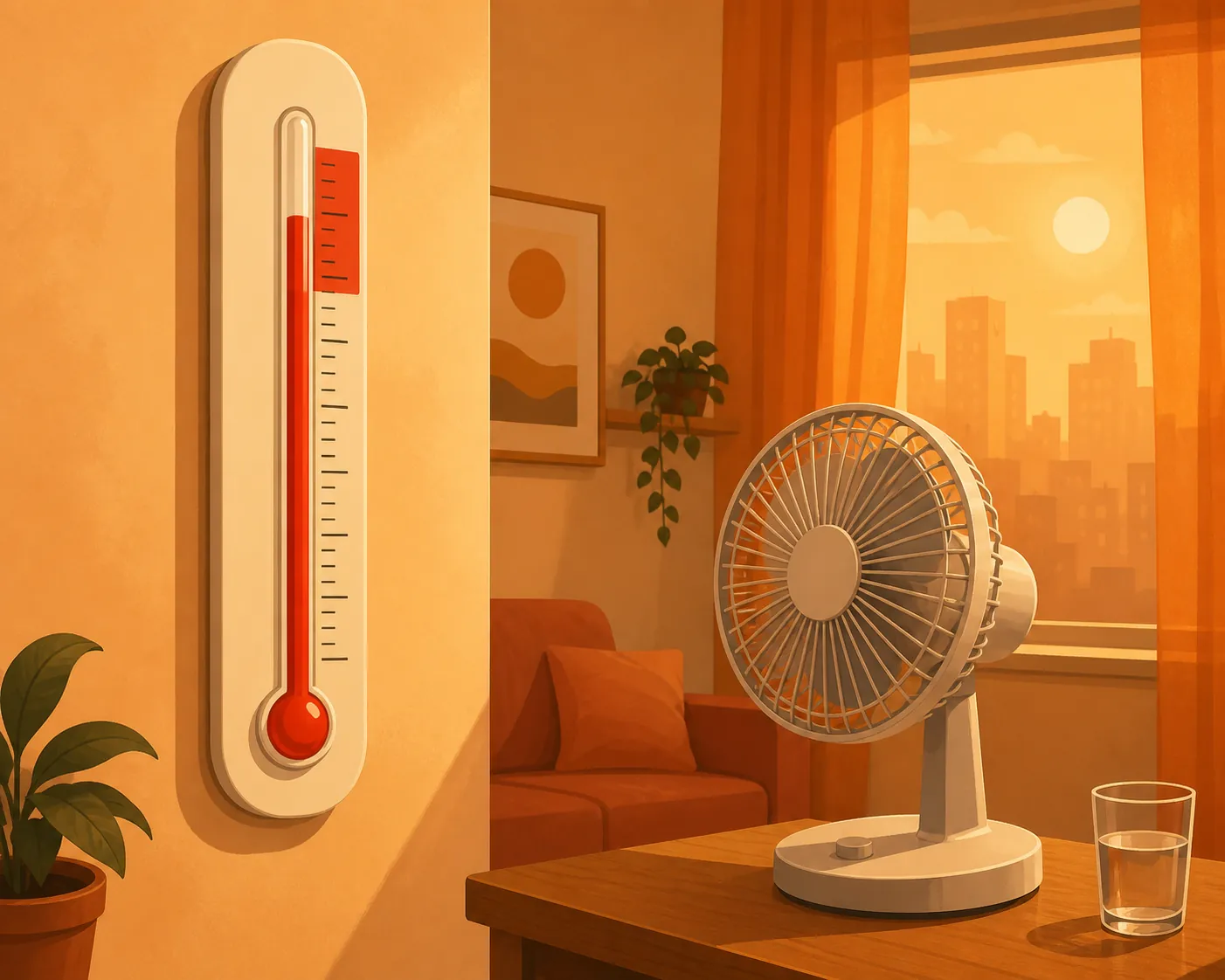
The go/no-go gate: is the room below 90°F?
CDC guidance says to use fans only when indoor temperatures are below 90°F; above that, a fan can increase body temperature instead of cooling you down.[1] That matters in a no-AC apartment because the fan may make the room feel more tolerable while still pushing warm air across skin that cannot dump heat effectively.
The 90°F line is not the only wording you will see. Some public-facing heat guidance phrases the fan caution higher, such as around the high 90s.[2] For a small rental with limited airflow, neighbors below, and no easy outdoor or garage fallback, the CDC number is the more useful house rule because it gives you a conservative decision point before you start sweating through a workout you should have moved.
Airflow is the second part of the gate. Heat stress rises in enclosed, low-airflow spaces because sweat evaporation is reduced; that is the missing assumption behind a lot of “just train indoors” advice.[3] Indoors with central air is one situation. A small, sun-loaded room with one desk fan is another.
| Indoor condition before the workout | Training call | What to do |
|---|---|---|
| Clearly below 90°F, airflow feels useful, and you can speak comfortably | Train, scaled | Use the quiet heat-scaled circuit below. Keep it short and leave reps in reserve. |
| Below 90°F but humid, stuffy, sun-loaded, or you already feel drained | Scale hard | Use the shortest timing option, cut rounds, or shift to mobility only. |
| Around 90°F or above | Shift or skip | Do not use the fan as your safety argument. Move the session to a cooler time, a cooler place, or a rest day. |
| Symptoms show up at any temperature | Stop | End the session, get cool, and reassess. Do not bargain with dizziness, weakness, nausea, or cramps. |
Why the workout has to shrink, even when the room passes
A heat-wave workout cannot be your normal circuit with “drink water” stapled onto the end. In a review of exercise under heat stress, Périard and colleagues reported that a 15-minute self-paced cycling effort produced about 17% less work at 40°C than at 20°C, and that VO2max fell by about 4% to 18% at 35°C to 45°C compared with 25°C.[4]
Those numbers are not a prescription for a specific apartment circuit. They do explain the design choice here: shorter work bouts, longer rests, no jumping, no breathless finishers, and no “one more round” just because the timer says you could.
Acclimatization also argues for restraint. Public guidance gives a broad range rather than one magic day count; the American Heart Association describes acclimating gradually over 4 to 14 days, and other heat-exercise guidance commonly lands in a similar one-to-two-week range.[3][5] In plain apartment terms: the first week of a heat wave is not the week to prove your conditioning.
Set up the coolest small-space version before you train
Do the dull setup before the timer starts. Pick the coolest room, reduce direct sun with curtains or shades, and improve airflow only if the indoor temperature is still below the fan threshold. NPR’s no-AC heat guidance also points to practical fallbacks such as libraries, cooling centers, and local 2-1-1 services on days when the apartment itself is the problem.[6]
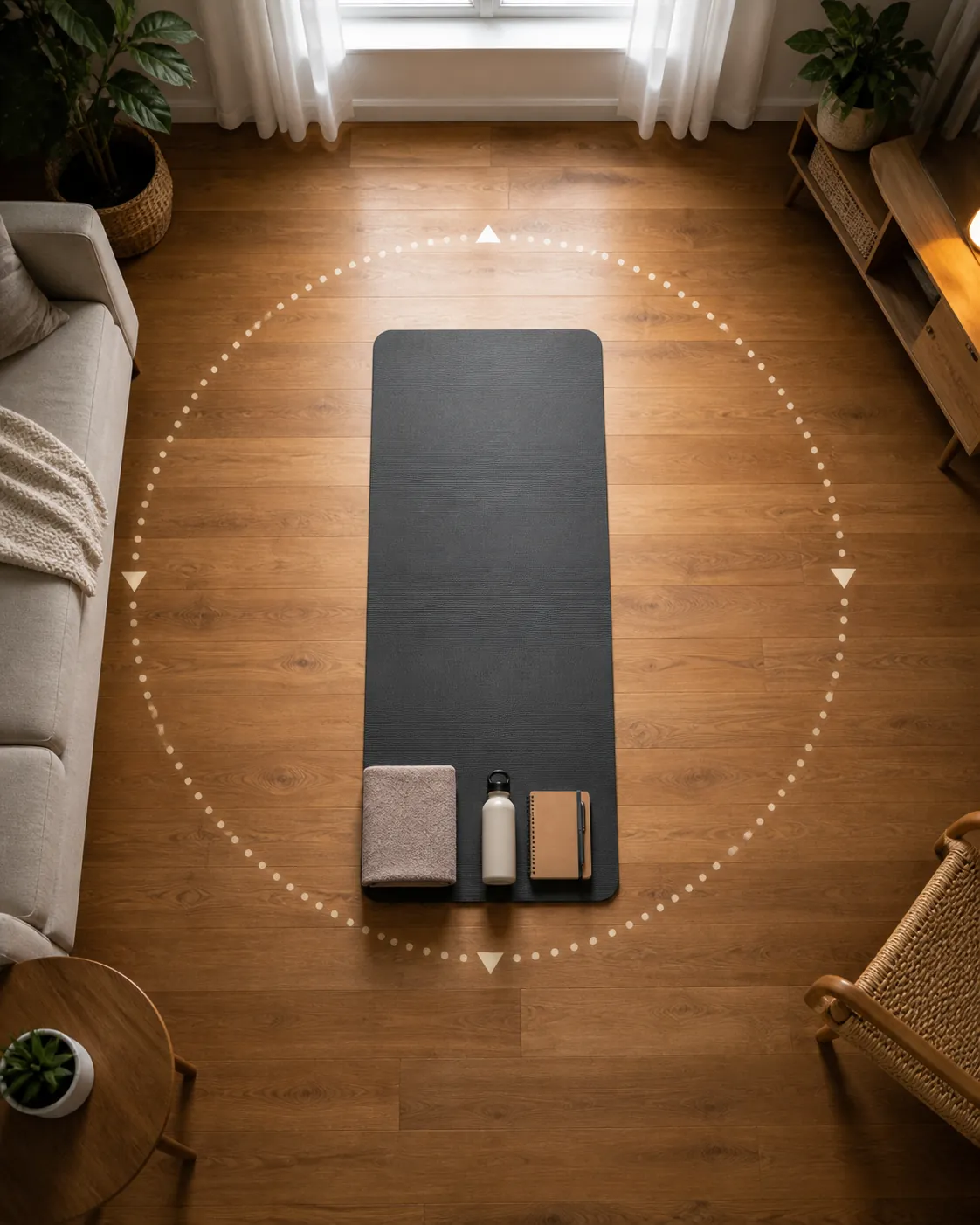
For the routine, clear only what you can actually keep clear: one mat or towel-width space, plus enough room to step one foot back without hitting furniture. If you cannot move without scuffing the floor, use a mat, folded towel, or rug that does not slide. If the floor creaks or the downstairs unit can hear every heel drop, choose the isometric options instead of stepping options.
- Put the thermometer where you are training, not across the apartment in a cooler hallway.
- Start before about 9 a.m. or after sunset when the apartment has a real chance of being cooler; 2026 heat-wave fitness guidance commonly points to those safer windows.[2]
- Keep a towel and water nearby, but do not use hydration as permission to train in a room that failed the temperature gate.
- Plan the post-workout cooling before you start. If you need a separate cooldown sequence, use FitAtHome’s guide to cooling down after a home workout without AC.
The heat-scaled, no-jumping bodyweight circuit
This is a $0, no-equipment circuit built for the apartment problems that usually get ignored: no jumping, no fast pivots, no dumbbells dropped on thin flooring, no burpees, and no assumption that you have a spare room. It borrows the quiet-training logic used in FitAtHome’s silent no-equipment circuits, but the timing is scaled specifically for heat.
Choose the timing before you start
| Room feel after the 90°F gate | Work | Rest | Rounds | Expected length |
|---|---|---|---|---|
| Below 90°F and manageable | 30 seconds | 30 seconds | 2 to 3 | About 15 to 22 minutes |
| Below 90°F but stuffy or humid | 20 seconds | 40 seconds | 2 | About 12 to 15 minutes |
| You are unsure, under-slept, new to heat, or early in the heat wave | 15 seconds | 45 seconds | 1 to 2 | About 8 to 14 minutes |
| Around or above 90°F | None | None | 0 | Shift, go somewhere cooler, or skip |
Use a timer you can hear without blasting it. Your pace should stay quiet enough that your feet do not slap the floor and controlled enough that you could stop mid-rep without stumbling. If you have to chase the clock, the interval is too ambitious for the room.
Warm up for three minutes
- Minute 1: easy marching in place without heel strikes, or seated marching if the room already feels heavy.
- Minute 2: shoulder rolls, wall slides, and slow arm circles.
- Minute 3: supported hip hinges and ankle pumps, keeping your breathing conversational.
The warmup is not there to raise your temperature aggressively. In this setting, it is a systems check: breathing, balance, room feel, and whether the fan still feels helpful rather than just loud.
Move 1: quiet chair squat or wall sit
Stand in front of a chair or couch. Sit back until you lightly touch the seat, then stand without bouncing or locking out hard. Keep the feet planted and the descent slow enough that the chair does not scrape.
- Easier: sit fully, pause, then stand with hands on thighs.
- Quieter: hold a wall sit or high squat hold for the interval.
- Harder, only if the room feels fine: slow 3-second lowers.
Move 2: wall push-up
Place your hands on a wall at chest height, step back slightly, lower under control, and press away. This keeps the workout off the floor if the mat area is too hot, dusty, or cramped, and it avoids the thud that comes from dropping into a plank.
- Easier: stand closer to the wall.
- Harder: use a sturdy counter or desk only if it will not slide.
- Heat downshift: hold the top position and breathe slowly instead of doing reps.
Move 3: supported split-squat hold or small reverse step
Hold the wall, a counter, or the back of a sturdy chair. Step one foot back softly, lower a few inches, and either hold or do small controlled pulses. Switch legs halfway through the interval.
If your floor transfers noise, do not step repeatedly. Set the feet once and hold. This is where apartment training usually gets ruined by advice written for garages; the quiet version is the better version today.
Move 4: slow hip hinge
Stand tall with hands on hips or ribs. Push your hips back, keep your back long, then return to standing. Think “close a car door with your hips,” not “touch the floor.” The range can stay small.
- Easier: hinge with fingertips on a wall or chair for balance.
- Quieter: make every rep a slow rep; there should be no foot movement.
- Downshift: hold the hinge for 5 seconds, stand, and repeat only a few times.
Move 5: dead bug heel taps
Lie on your back on the mat or towel, knees bent over hips. Tap one heel down, bring it back, then alternate. Keep the range small enough that your low back does not arch. This gives the circuit a floor-friendly core move without mountain climbers, plank jacks, or any other heat-wave nonsense disguised as “apartment-friendly.”
- Easier: keep both feet on the floor and march one foot at a time.
- No-floor option: stand with your back to the wall and do slow alternating knee lifts.
- Heat downshift: skip the legs and practice slow belly breathing for the interval.
Move 6: wall plank with shoulder taps
Return to the wall push-up position. Brace lightly, then lift one hand to tap the opposite shoulder. Alternate slowly. Your hips should not sway, and your feet should stay quiet.
- Easier: hold the wall plank without taps.
- Harder: step farther from the wall, but only if breathing stays easy.
- Wrist-sensitive option: press forearms into the wall instead of hands.
How to run the circuit without turning it into a heat problem
- Complete the three-minute warm-in.
- Do Move 1 through Move 6 using the timing option you chose before starting.
- Rest one full extra minute between rounds. Sit if you want. This is not wasted time.
- After each round, check the room and your body. If the room feels worse, cut the next round or stop.
- End with two to three minutes of easy walking, seated breathing, or lying on your back with feet elevated.
If you want more quiet-training ideas for cooler days, the same apartment logic shows up in FitAtHome’s quiet footwork tier and floor-friendly bodyweight patterns. During a heat wave, though, keep the menu boring. Boring is much easier to recover from in a room with no AC.
Stop-now signs
Do not keep training through heat symptoms to “see if they pass.” Johns Hopkins lists exercise-related heat exhaustion symptoms including rapid heartbeat, heavy sweating, dizziness, nausea, headache, weakness, and muscle cramps, and warns that heat exhaustion can progress to heat stroke.[7] CDC athlete guidance also treats muscle cramping as an early heat-illness sign and says dizziness or weakness means stopping all activity and getting to a cool place.[8]
- Cramps, especially if they arrive earlier than usual
- Dizziness, lightheadedness, or weakness
- Nausea or headache
- Rapid heartbeat that feels out of proportion to the easy work
- Heavy sweating with a sudden drop in coordination or focus
If any of those show up, the workout is over. Get cool, use the broader heat-wave home workout safety guidance if you need the full response framework, and do not restart the circuit just because the timer has minutes left.
When moving the workout is the workout
A small apartment with no AC can pass the gate in the morning and fail it by late afternoon. That is not a consistency failure; it is the room changing the deal. If the indoor temperature is below the threshold, keep the session short, quiet, and scaled. If it is around or above 90°F, the smart workout is the one you move to a cooler time, move to a cooler place, or skip.
References
- About Heat and Your Health | Heat Health | CDC — CDC, July 2026.
- US heat wave doesn't have to derail summer fun or fitness — CNN, June 13, 2026.
- How to exercise safely in hot weather — BBC Future.
- Exercise under heat stress: thermoregulation, hydration, performance implications, and mitigation strategies — Physiological Reviews, 2021.
- How to Be Active Safely in Warm Weather — American Heart Association.
- Keep cool in extreme summer heat without air conditioning — NPR, July 15, 2026.
- Exercise-Related Heat Exhaustion — Johns Hopkins Medicine.
- Heat and Athletes | Heat Health | CDC — CDC.
What a small equipment investment adds
We don't have a build tagged to this exact tier yet. Browse all builds.
How often should you repeat this?
See our recovery and rest reference for citation-anchored rest-interval guidance.
Spot something off?
Tell us if a movement, tier assumption, or duration didn't match your experience.