
The Core Dilemma: One Machine vs. Many Pieces
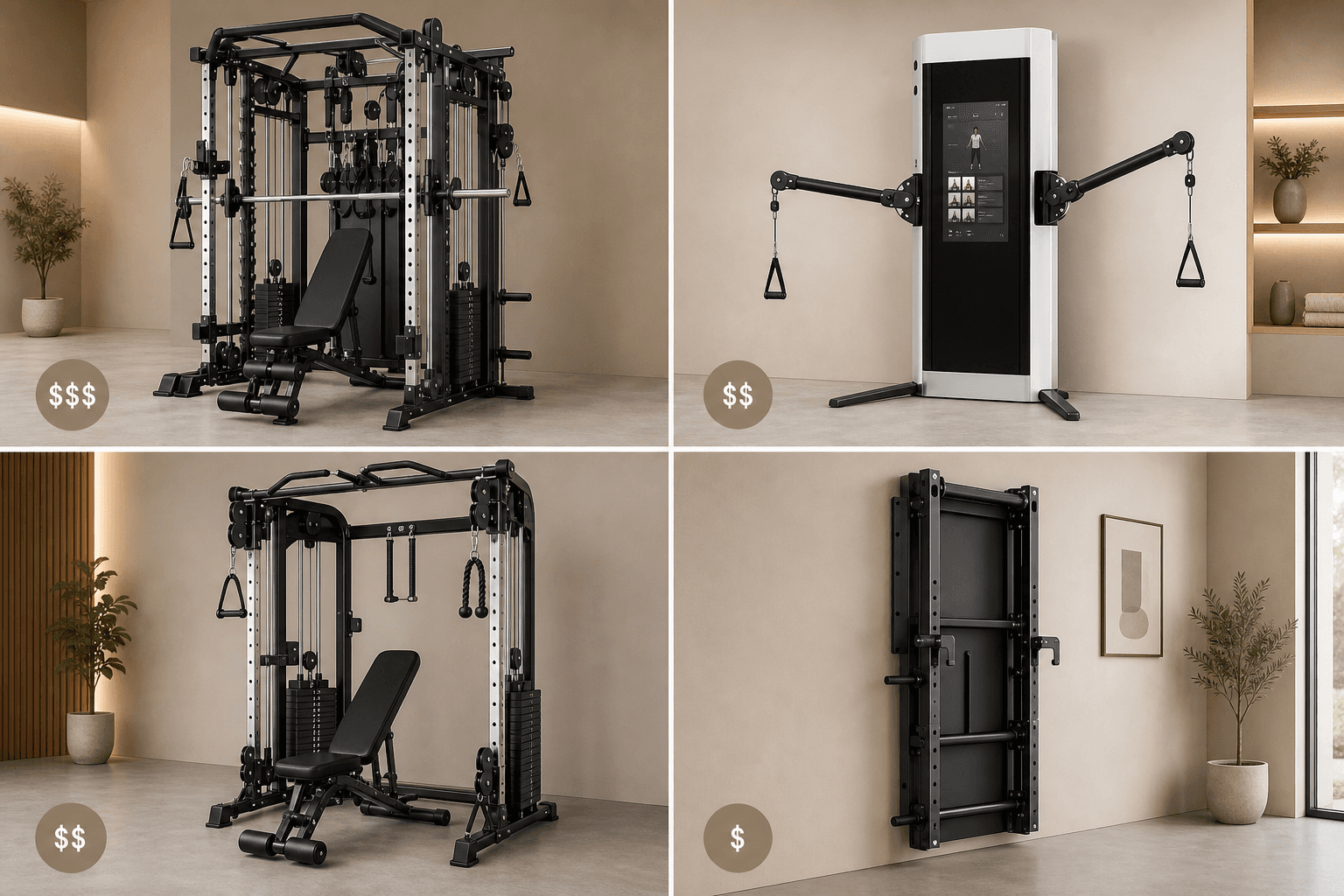
If you are shopping for a home gym with a budget between $1,500 and $4,000, you will face a structural fork in the road: buy a single all-in-one machine that tries to do everything, or assemble a modular setup from separate pieces — a power rack, a barbell, weight plates, an adjustable bench, and a cable tower. Each path has vocal advocates, and each makes different promises about space, cost, and training versatility.
The all-in-one camp argues that a single footprint, guided movements, and faster transitions between exercises make their approach the practical choice for anyone who does not want their living space to look like a commercial gym. The modular camp counters that separate pieces deliver higher resistance ceilings, better exercise variety, and a clear upgrade path — and that the all-in-one's convenience comes at the cost of long-term flexibility.
This article does not declare a universal winner. Instead, it compares the two strategies across five concrete dimensions — total cost of ownership, floor-space efficiency, resistance and exercise variety, upgradeability, and assembly and maintenance effort — then maps the results to specific buyer profiles so you can decide which approach fits your actual constraints. For a broader overview of the cost and space trade-offs between all-in-one machines and separate equipment, see our general comparison article.
Total Cost of Ownership: $2,500 All-in-One vs. $2,500 Modular Build
To make the comparison concrete, we built two hypothetical setups at the $2,500 price point — a realistic budget for a serious home gym that is not entry-level but not premium. On the all-in-one side, the strongest candidate in this range is the Force USA G3, priced between $1,600 and $2,000. It uses 11-gauge steel, plate-loaded cables (no selectorized weight stacks), and has a 992 lb weight capacity. Its footprint is 32.8 sq ft (78" W x 60.5" D x 87" H). The remaining budget covers shipping, a basic set of Olympic plates, and assembly. Another option at the top of the range is the Life Fitness G2 ($2,000–$2,500), which uses a 160 lb weight stack (upgradable to 210 lbs) and occupies 23.7 sq ft.
On the modular side, $2,500 buys a complete setup with no single component costing more than $600:
- Power rack: $400–$600 (basic 48" or 60" model with J-hooks and pull-up bar)
- Olympic barbell: $150–$300 (standard 20 kg bar with 1,500 lb rated capacity)
- Weight plates: $300–$500 (255–300 lbs of cast iron or bumper plates)
- Adjustable bench: $200–$400 (flat-to-incline with leg roller)
- Cable tower: $435 (Bells of Steel Cable Tower with weight stack, 210–250 lbs resistance)
- Remaining budget: $200–$1,000 for a plate tree, floor mats, collars, and shipping
The modular build leaves room for accessories and shipping, while the all-in-one at the same price point consumes most of the budget on the machine itself. However, the all-in-one includes a Smith machine and cable system in one unit — features that would cost more if bought separately.
| Cost Category | All-in-One (Force USA G3) | Modular Build |
|---|---|---|
| Machine / rack | $1,600–$2,000 | $400–$600 |
| Barbell | Included | $150–$300 |
| Weight plates | $200–$400 (estimated) | $300–$500 |
| Adjustable bench | Included | $200–$400 |
| Cable system | Included (plate-loaded) | $435 (Bells of Steel Cable Tower) |
| Accessories + shipping | $100–$200 | $200–$500 |
| Total estimated cost | $1,900–$2,600 | $1,685–$2,735 |
| Subscription required | No | No |
The modular setup's cost advantage is not dramatic at this price point — both strategies land within a few hundred dollars of each other. The real difference emerges in what each setup can do and how easily it can evolve.
Footprint Comparison: How Much Floor Space Does Each Strategy Really Need?
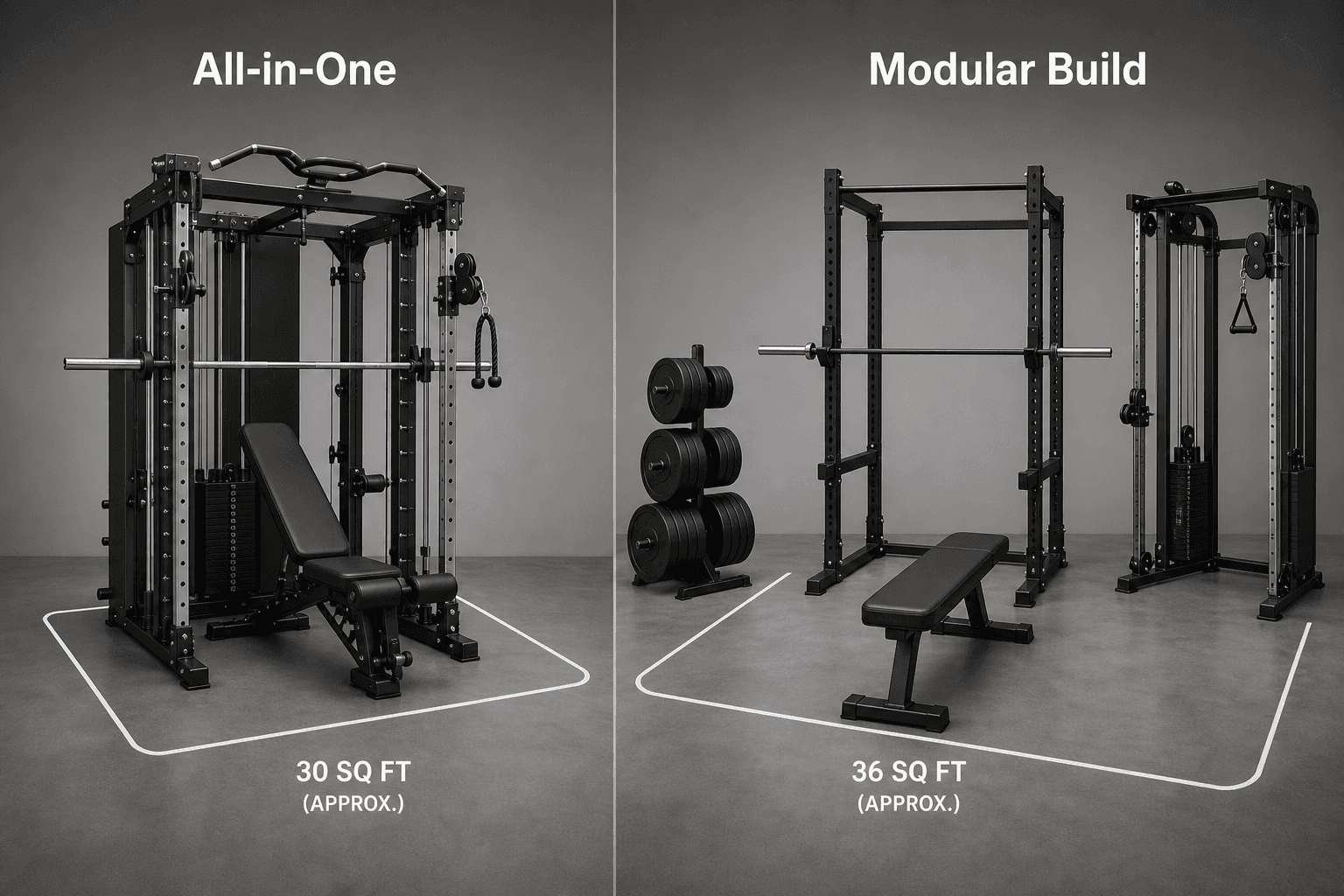
Floor space is often the deciding factor for buyers who do not have a dedicated garage or basement. The all-in-one approach wins this category decisively because it concentrates the entire workout zone into a single footprint. The Force USA G20, for example, occupies 29.2 sq ft (79.5" W x 53" D x 87.5" H). The Force USA G3 is slightly larger at 32.8 sq ft. The Life Fitness G2 is the most compact at 23.7 sq ft.
A modular setup with a 48" power rack, a barbell, an adjustable bench, and a separate cable tower spreads across a larger area when you account for working space. The rack itself may occupy only 12–15 sq ft, but you need clearance on all sides for barbell movements — especially for exercises like squats, bench presses, and deadlifts. A realistic working footprint for a modular setup is 35–45 sq ft, depending on the rack depth and whether you deadlift inside or outside the rack.
| Setup | Equipment Footprint | Working Space Needed | Total Area |
|---|---|---|---|
| Force USA G20 | 29.2 sq ft | Minimal (within machine) | ~30 sq ft |
| Force USA G3 | 32.8 sq ft | Minimal (within machine) | ~33 sq ft |
| Life Fitness G2 | 23.7 sq ft | Minimal (within machine) | ~24 sq ft |
| Modular (48" rack + barbell + cable tower) | ~15 sq ft (rack) + 4 sq ft (cable tower) | ~15–20 sq ft (barbell clearance) | ~35–45 sq ft |
If you have a dedicated space of 100 sq ft or more, the footprint difference is manageable. If you are working with a spare bedroom or a corner of a basement under 80 sq ft, the all-in-one's concentrated footprint becomes a significant advantage.
Resistance and Exercise Variety: Which Setup Lets You Do More?
This is where the modular approach pulls ahead for anyone who prioritizes raw strength development and exercise variety over convenience. A modular setup with a power rack and Olympic barbell can handle 500+ lbs for squats, deadlifts, and presses — loads that most all-in-one machines cannot come close to matching.
All-in-one machines typically use weight stacks or plate-loaded cables with lower resistance ceilings. The Titan Fitness Functional Trainer has dual 200 lb weight stacks (at a 2:1 ratio, meaning the user feels 100 lbs per arm). The Bells of Steel Cable Tower offers 210–250 lbs. The Major Fitness B17 has dual weight stacks up to 260 lbs each. These are adequate for most cable exercises (lat pulldowns, rows, chest flies, tricep pushdowns) but insufficient for heavy compound lifts.
| Exercise Type | All-in-One (Typical) | Modular Setup |
|---|---|---|
| Barbell squat | Not available (Smith machine only on some models) | Yes, up to 500+ lbs |
| Barbell deadlift | Not available | Yes, up to 500+ lbs |
| Barbell bench press | Smith machine only (fixed path) | Yes, free-weight path |
| Cable lat pulldown | Yes (160–310 lbs) | Yes (210–250 lbs with cable tower) |
| Cable row | Yes | Yes |
| Dumbbell exercises | Limited (some have pegs) | Yes (requires separate dumbbells) |
| Pull-ups | Yes (on most models) | Yes (on power rack pull-up bar) |
| Olympic lifts | Not available | Yes (with bumper plates) |
All-in-one machines that include a Smith machine add safety for solo lifters — the guided barbell path eliminates the risk of dumping a barbell on yourself during heavy squats or bench presses. A basic power rack with safety spotter arms provides similar protection for free-weight barbell exercises, but it requires proper setup and awareness. For a deeper breakdown of the different machine types mentioned here, see our full body workout machine types comparison.
Upgrade Path Analysis: Can You Grow With Your Investment?
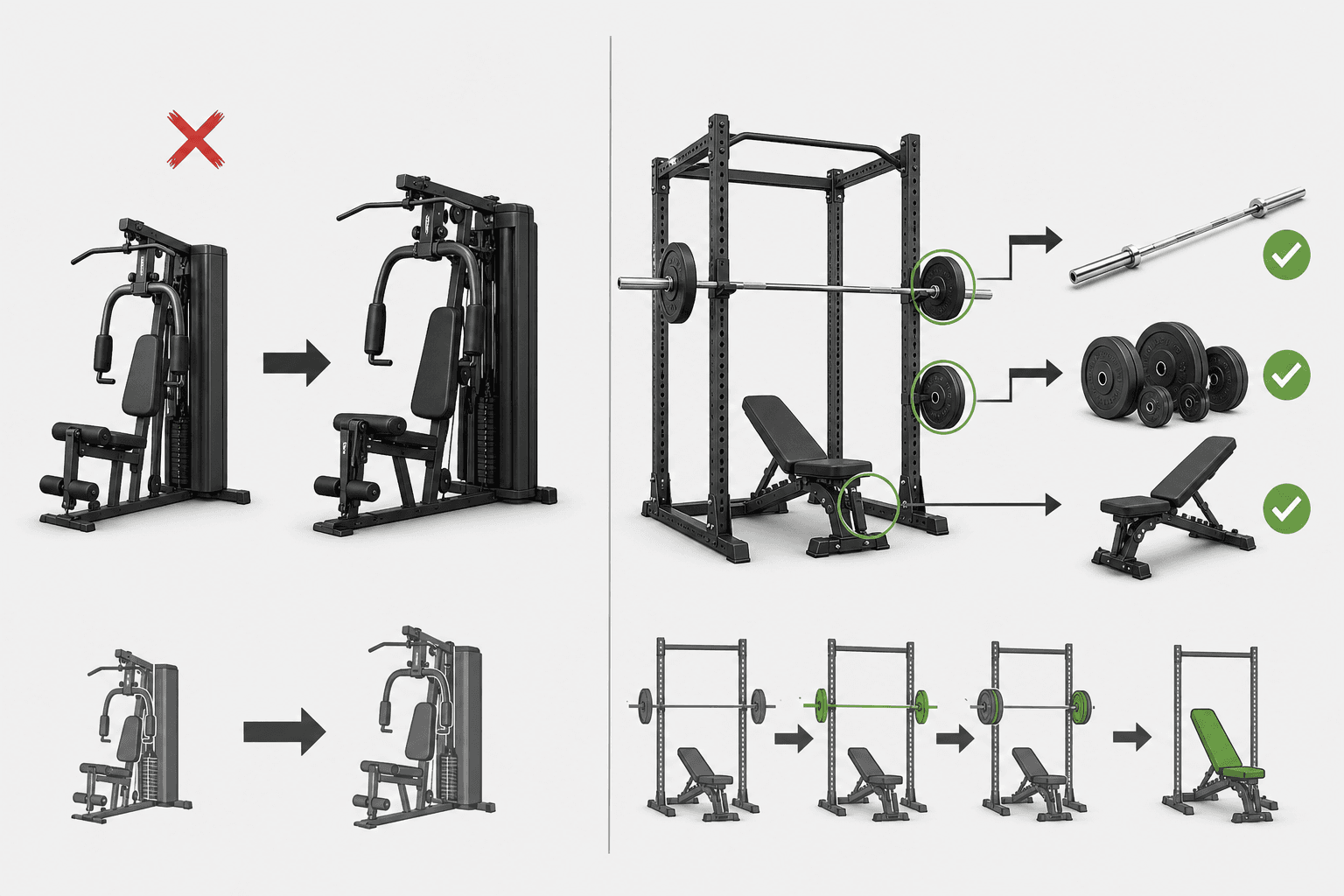
The upgrade path is where the modular strategy demonstrates its clearest long-term advantage. A modular setup allows you to replace or upgrade individual components as your strength increases, your budget allows, or your training goals evolve. You can swap a $150 barbell for a $400 Olympic bar with better knurling and whip. You can add 100 lbs of plates for $150. You can replace a basic flat bench with a premium adjustable model. Each upgrade is independent and incremental.
An all-in-one machine is a single, integrated system. If you outgrow its weight stack capacity — say, you need more than 200 lbs for lat pulldowns — your only option is to sell the entire machine and buy a new one with higher capacity. The same applies if you want to add a feature the machine does not have, such as a leg press attachment or a different cable ratio. The resale value of a used all-in-one machine is typically 40–60% of its original price, and selling a large, heavy machine involves significant logistics.
Individual pieces from a modular setup retain value better and are easier to sell separately. A power rack, barbell, and plates have a robust secondhand market because they are standard-sized and compatible with any future setup. A cable tower can be sold or kept as a standalone unit.
Assembly, Maintenance, and Daily Use: What's the Real Effort?
The practical realities of setting up and maintaining each approach differ substantially. All-in-one machines, particularly the larger multi-station models, are notorious for lengthy assembly. The Force USA G20 can take 35 hours to assemble solo, and reviewers strongly recommend white-glove installation. The Force USA G3 and Life Fitness G2 are simpler but still require several hours of work with two people.
Modular pieces are typically simpler to assemble individually. A power rack takes 1–2 hours. A cable tower takes 1–2 hours. A barbell and plates require no assembly. The total assembly time for a modular setup is usually 3–6 hours spread across multiple sessions, and each piece can be assembled by one person.
- All-in-one maintenance: Cable replacements (every 1–3 years depending on use), weight stack lubrication, frame bolt tightening, and occasional pulley bearing replacement.
- Modular maintenance: Barbell cleaning and oiling (monthly), plate storage organization, rack bolt checks, and cable tower cable replacement (same as all-in-one).
- Daily use: All-in-ones offer quicker transitions between exercises — you move from the Smith machine to the cable station without walking to a different piece of equipment. Modular setups require more movement between stations, which can add 10–15 seconds per transition.
For users who value workout flow and minimal setup time, the all-in-one's integrated design is a genuine advantage. For users who prefer the ritual of loading a barbell and moving between stations, the modular approach feels natural.
Space Constraint Scenarios: Apartment, Garage, and Basement
The best choice depends heavily on where you plan to set up. Here is how each strategy performs in common home gym spaces:
- Apartment or small spare room (under 100 sq ft): All-in-one is the stronger choice. The concentrated footprint (24–33 sq ft) leaves room for storage and movement. A modular setup with a 48" rack, barbell clearance, and a separate cable tower will feel cramped and may not allow safe barbell exercises.
- Garage (200–400 sq ft): Modular is the clear winner. You have space for a full power rack, barbell, cable tower, plate tree, and even a separate dumbbell set. The versatility and upgradeability of separate pieces fully realize their potential in a larger space.
- Basement (100–200 sq ft): Either approach can work, but ceiling height is a critical factor. All-in-one machines with Smith machines typically require 87–88" of vertical clearance. A power rack with a pull-up bar needs similar height. Measure your ceiling before committing to either strategy.
- Shared space (living room corner, bedroom): All-in-one is the practical choice. A single machine looks more intentional than a collection of separate pieces, and the concentrated footprint minimizes the visual and physical impact on the room.
For readers specifically interested in compact setups under 100 sq ft, our comparison of modular, all-in-one, and smart gym approaches for small spaces covers the trade-offs in more detail.
Buyer-Profile Recommendation Matrix: Which Strategy Is Right for You?
The following matrix matches specific buyer profiles to the recommended strategy, with a brief rationale and a suggested starting point.
| Buyer Profile | Recommended Strategy | Rationale | Suggested Starting Point |
|---|---|---|---|
| Budget-conscious beginner ($1,500–$2,000) | Modular | Lower upfront cost for a rack + barbell + plates; easy to add cable tower later | Power rack ($400) + barbell ($150) + 255 lb plate set ($300) + adjustable bench ($200) |
| Serious lifter (wants 500+ lb squat/deadlift) | Modular | All-in-one machines cannot handle heavy free-weight loads; modular allows progressive overload | Power rack with spotter arms ($600) + Olympic barbell ($300) + 500 lb plate set ($600) |
| Space-constrained apartment dweller (under 100 sq ft) | All-in-one | Concentrated footprint (24–33 sq ft) leaves room for living; guided movements are safer in tight spaces | Life Fitness G2 ($2,000–$2,500) or Force USA G3 ($1,600–$2,000) |
| Multi-user household (2+ people training) | All-in-one | Quick transitions between exercises; multiple users can share the same machine without adjusting multiple stations | Force USA G20 ($4,199) or Major Fitness B17 ($4,199) — higher budget but dual weight stacks support concurrent use |
| Upgrade-focused enthusiast (plans to invest over time) | Modular | Piece-by-piece upgrades without replacing the entire system; better resale value for individual components | Start with a basic power rack ($400) + barbell ($150) + plates ($300); add cable tower ($435) and premium barbell later |
| Solo lifter who values safety | Either (with Smith machine or spotter arms) | All-in-one with Smith machine provides guided safety; power rack with spotter arms provides equivalent protection for free weights | All-in-one: Force USA G3 ($1,600–$2,000). Modular: power rack with spotter arms ($500) + barbell ($200) |
No single strategy is right for everyone. The all-in-one machine delivers on its promise of convenience, space efficiency, and guided training — but it caps your resistance ceiling and locks you into a single system. The modular approach demands more space and more setup effort, but it rewards you with unlimited resistance potential, full exercise variety, and a clear path to upgrade over years of training.
If you are still unsure, start with the constraint that matters most to you. If floor space is your tightest constraint, go all-in-one. If long-term strength progression is your priority, go modular. If you are somewhere in the middle, the modular approach gives you more room to change your mind later.
Comments
Join the discussion with an anonymous comment.