
Best Home Exercise Equipment by Budget Tier: Under $200, $200–$500, $500–$1,500, Over $1,500
Nearly 39% of home fitness equipment buyers spend under $500 per item, yet most guides ignore this segment. This budget-tier comparison helps shoppers of all experience levels find the right gear for their spending ceiling, from sub-$200 starter essentials to premium smart gyms over $1,500.
Almost 39% of home exercise equipment buyers spend under $500 per item. That is the largest spending segment in the US market, according to a 2026 Statista survey. Another 16.2% spend $500–$799, and 15% land at $1,000–$1,499. So roughly 70% of all buyers shop below $1,500. The single biggest cohort: under $500.
Yet most review articles jump straight to $1,000+ machines, treat sub-$500 as a footnote, or bundle it all into a single “budget” bin. That misses the point. A $200 setup and a $500 setup serve different needs. Spending $150 on a mat, bands, and sliders is not a compromise — it is a legitimate training foundation. The problem is not the budget. It is that the guides do not match the data.
This article groups equipment by four real spending ceilings: under $200, $200–$500, $500–$1,500, and over $1,500. The best home exercise equipment is not a single product — it is the one that fits your budget tier and your actual training goal. Let us start where most buyers actually start.
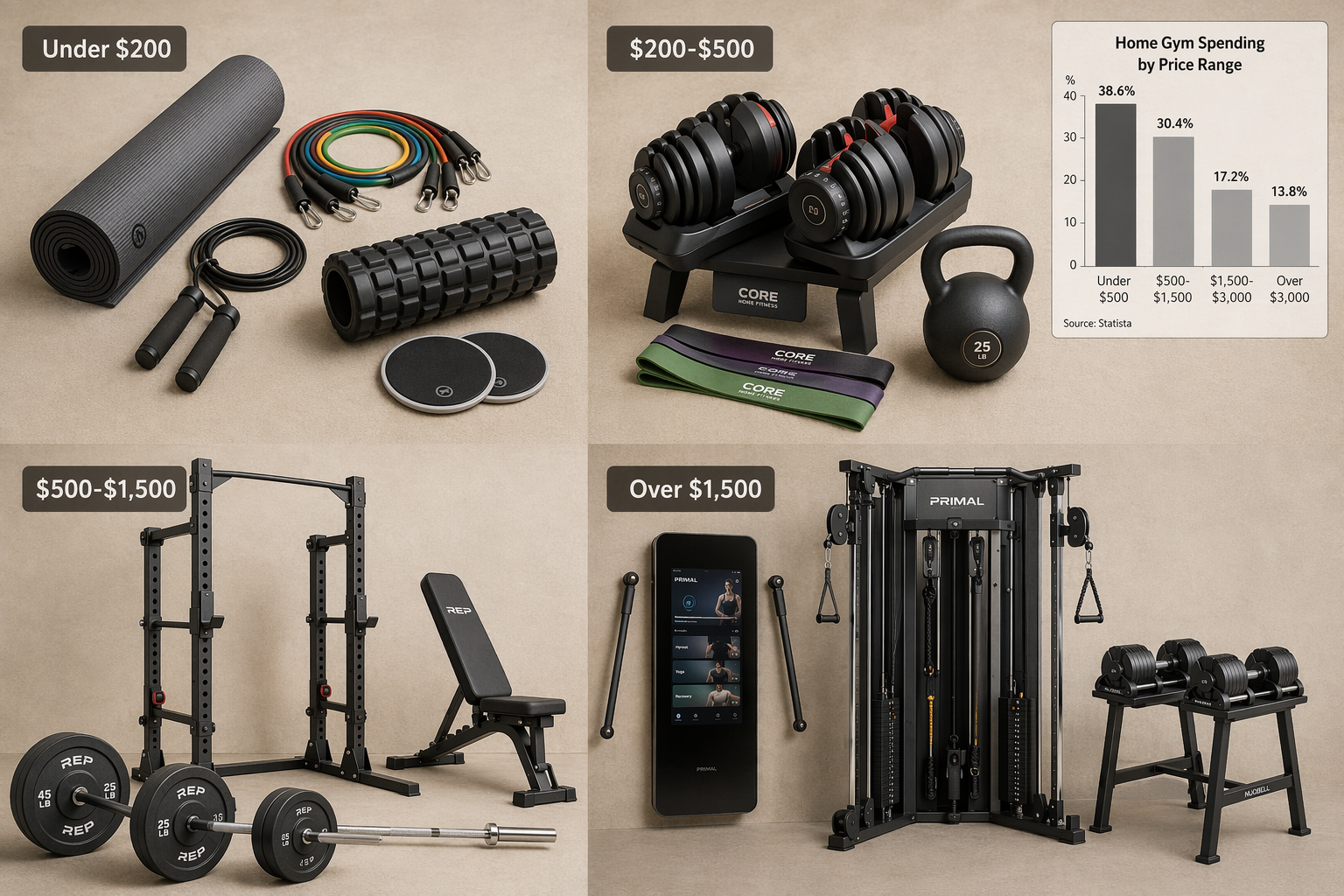
Under $200: A Real Starter Kit
I checked the products that reviewers at Verywell Fit and Siwicki Fitness actually tested. A Manduka PRO yoga mat costs $144 — lifetime build, no slip. A set of GYMB Non-Slip Resistance Bands runs $15. Synergee Core Sliders are $10. Add a jump rope (~$10) and an Amazon Basics Foam Roller ($23). Total: $202, essentially $200. You get a full-body resistance, mobility, cardio, and recovery setup that fits in a drawer.
Siwicki puts a complete starter setup (mat, bands, basic dumbbells) at $200–$300. Verywell’s picks confirm the individual items hold up. If you already have a mat, you can spend $150 on a decent pair of adjustable dumbbells — the BCBIG set ($100) is an option, though it lives in the next tier. Under $200 is not a consolation prize. It is a legitimate entry point for bodyweight, band, and light dumbbell work.
$200–$500: Where Most Buyers Actually Land
This tier gets the most attention from savvy shoppers, and still too little from reviewers. At $260, the YOSUDA Indoor Cycling Bike offers 100 resistance levels in a quiet, sturdy frame — tested and recommended by Verywell. At $100, the BCBIG Adjustable Dumbbells cover 10–40 lbs per hand and convert into a barbell. That leaves room for a CAP Barbell rubber-coated dumbbell set with rack ($139.99, from Siwicki) or a TYZDMY adjustable pair at 52.5 lbs ($269.99).
The real surprise is the Bells of Steel Cable Tower plate-loaded version at $434.99. It gives you a functional cable machine with up to 250 lbs of resistance, verified by Garage Gym Reviews. For under $500, you can have a dedicated cardio machine plus a full cable setup. That changes the conversation about what “budget” equipment can do.
If I had to pick one winner for this tier, it would be the YOSUDA bike. It is quiet enough for an apartment, the resistance range is wide, and it costs less than a year of a mid-tier gym membership. But the cable tower is the dark horse — it opens up exercises (lat pulldowns, rows, triceps pushdowns) that most home setups in this range cannot touch.
$500–$1,500: All-in-One Machines and Folding Racks
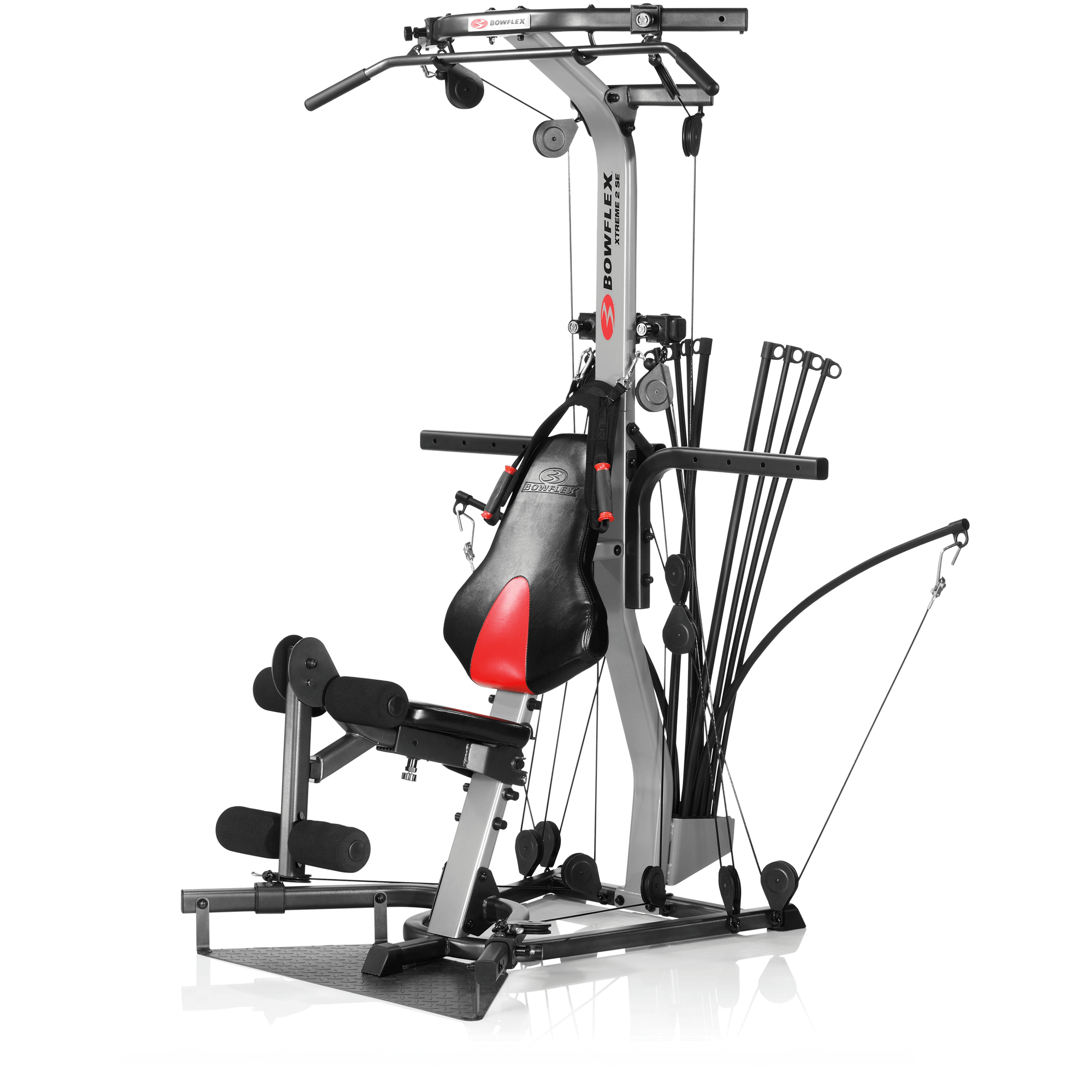
At $1,499, the Bowflex Xtreme 2 SE is the most well-known product here. It claims over 70 exercise combinations with 210 lbs of Power Rod resistance, upgradable to 410 lbs. Garage Gym Reviews calls it the strongest value in the mid-range. But note: 210 lbs is the starting resistance, not the maximum. For an intermediate lifter, that ceiling will come fast. The upgrade kit (~$300) pushes it to 410 lbs, making the true cost closer to $1,800. Still cheaper than a smart gym, but worth knowing upfront.
Other contenders: the X3 Bar ($549) uses band resistance up to 300 lbs in a footprint the size of a doormat. The PRx Profile PRO squat rack ($1,099.99) folds to 4 inches off the wall and holds 1,000 lbs — ideal for anyone sharing their space. The Freak Athlete Hyper Pro ($799.99) converts into 11 machines and stores vertically at 22×22×60 inches with a lifetime warranty. All are real options for serious strength equipment without a dedicated room.
Over $1,500: The Price of Membership You Didn't See
This is where the smart gyms live. Tonal 2 costs $4,295 plus a $59.95/month membership. NordicTrack X24 treadmill costs $3,000 with iFIT Pro at $40/month after the first year. Both are excellent machines. But the subscription changes the math dramatically.
I ran the numbers for Tonal 2. Sticker price: $4,295. Five years of membership: $59.95 × 60 = $3,597. Total: $7,892. That is nearly double the upfront cost. Compare that to a one-time purchase like the REP Ares 2.0 functional trainer. The bundle (including weights) runs around $4,220, covers dual 260-lb stacks, and has no subscription. Over five years, you save $3,672. Major Fitness B17 is similar: $4,200, no subscription.
| Equipment | Upfront Cost | Monthly Fee | 5-Year Total |
|---|---|---|---|
| Tonal 2 | $4,295 | $59.95 | $7,892 |
| REP Ares 2.0 (bundle) | ~$4,220 | $0 | $4,220 |
| Major Fitness B17 | ~$4,200 | $0 | $4,200 |
| NordicTrack X24 | $3,000 | $40 (after yr 1) | $4,920 (year 2–5) |
None of this means the smart gyms are bad. The guided workouts, form tracking, and digital resistance are genuinely valuable. But the subscription is a real cost, not an optional extra. PCMag and CNET both confirm Tonal’s pricing — neither buries it in fine print. Yet most listicles never show the five-year total. That omission matters.
Top Pick Per Tier at a Glance
| Tier | Top Pick | Price | Core Use | Subscription | Space |
|---|---|---|---|---|---|
| Under $200 | Starter kit (mat, bands, sliders, foam roller) | $200–$300 | Bodyweight, bands, recovery | No | A drawer |
| $200–$500 | YOSUDA Indoor Cycling Bike | $260 | Cardio, low-impact | No | 4 ft x 2 ft |
| $500–$1,500 | Bowflex Xtreme 2 SE | $1,499 | Full-body strength | No | 8 ft x 4 ft |
| Over $1,500 | REP Ares 2.0 (bundle) | ~$4,220 | Cable training, dual stacks | No | 8 ft x 4 ft |
How to Choose Your Tier
Under $200: bodyweight training, light resistance, recovery. Add a jump rope for cardio. Ideal if you are testing whether home fitness will stick — you lose almost nothing if it does not.
$200–$500: the widest range. Get a dedicated cardio machine, adjustable dumbbells, or a cable tower. The YOSUDA bike is the strongest single product; the Bells of Steel cable tower is the most versatile.
$500–$1,500: a single machine that can replace a gym. Bowflex is the safest bet — proven, good warranty, upgrade path. PRx rack is better if you lift heavy and need floor space. X3 Bar is minimal but effective for strength.
Over $1,500: commercial-grade or smart gyms. If you hate recurring fees, buy a functional trainer like the REP Ares. If you love guided workouts, Tonal is excellent — just know the real price.
For a deeper look at how budgets from $500 to $5,000+ compare on space and features, read our full home gym cost breakdown. If you are starting from scratch under $500, our starter kit guide walks through exactly what to buy. And if you are a beginner who wants a phased build plan, see our phased build guide for beginners.
This result comes from one real apartment under the stated conditions — it is a strong signal, not a guarantee your space will measure identically.
Builds this evidence supports
Small Treadmill Buying Guide: 7 Critical Specs to Check Before You Buy
A cross-category spec primer for apartment and small-space dwellers comparing walking pads, ultra-compact folding treadmills, and full-size folding treadmills. Learn the concrete thresholds for motor HP, deck length, noise, warranty, and subscription lock-in so you can compare apples to apples.
Where to Spend vs. Save on Affordable Home Gym Equipment: A Quality Tradeoff Guide
A practical guide for budget-conscious buyers (under $1,000) that reveals which equipment categories demand a higher investment for safety and durability, and where cutting costs is a smart move.
Spot something off?
If this result didn't match your own space, let us know — floor-damage and noise claims carry real deposit-risk consequences if we get them wrong.