
If 150 minutes of weekly cardio feels like a number from someone else’s life, the better starting question is smaller: what is the least cardio at home that can still move your fitness in a measurable direction?
For sedentary to recreationally active adults, the honest minimum is not “anything that makes you sweat.” The strongest short-session evidence points to hard intervals performed about three days per week. In one widely cited comparison, a sprint interval group did 3 × 20-second all-out cycling efforts within sessions lasting about 10 minutes, three times per week for 12 weeks. Their improvements in VO2max and insulin sensitivity were similar to a group doing 45 minutes of continuous cycling at 70% maximum heart rate, despite a much lower time commitment.[1]
That does not erase the Physical Activity Guidelines target of 150 minutes of moderate-intensity activity or 75 minutes of vigorous-intensity activity per week.[2] It just means the guideline is not a pass/fail doorway. If your current reality is a living-room mat, a phone timer, and a narrow gap before dinner, a smaller dose can still count—provided the intensity is real.

The catch: the lab version is not your living room
The Gillen-style sprint protocol and the original Tabata work were done on cycle ergometers, where researchers can control power output. That matters. A lab can ask for a specific workload; your apartment cannot tell you whether your mountain climbers equal a cycling sprint. The original Tabata protocol used 8 × 20 seconds at 170% peak power output with 10 seconds of rest, four days per week for six weeks, and improved both aerobic and anaerobic capacity.[1]
So the right translation is cautious. Burpees, squat jumps, fast step-backs, high-knee marches, skater steps, and mountain climbers can create a similar at-home training demand, but they do not precisely reproduce 170% peak power output. The bridge is intensity calibration: rate of perceived exertion, the talk test, and whether your movement quality is staying safe while the effort rises.
For deeper help judging that effort without a heart-rate strap, use Home Cardio Intensity Decoded. For this article, use the simple version: easy cardio lets you speak in full sentences; moderate cardio lets you speak in short phrases; very hard interval work makes conversation mostly unavailable until the recovery.
Three minimum-dose options for cardio at home
Pick the session by the constraint you actually have today, not by the one you wish you had. The shorter the workout, the more the result depends on intensity and recovery.
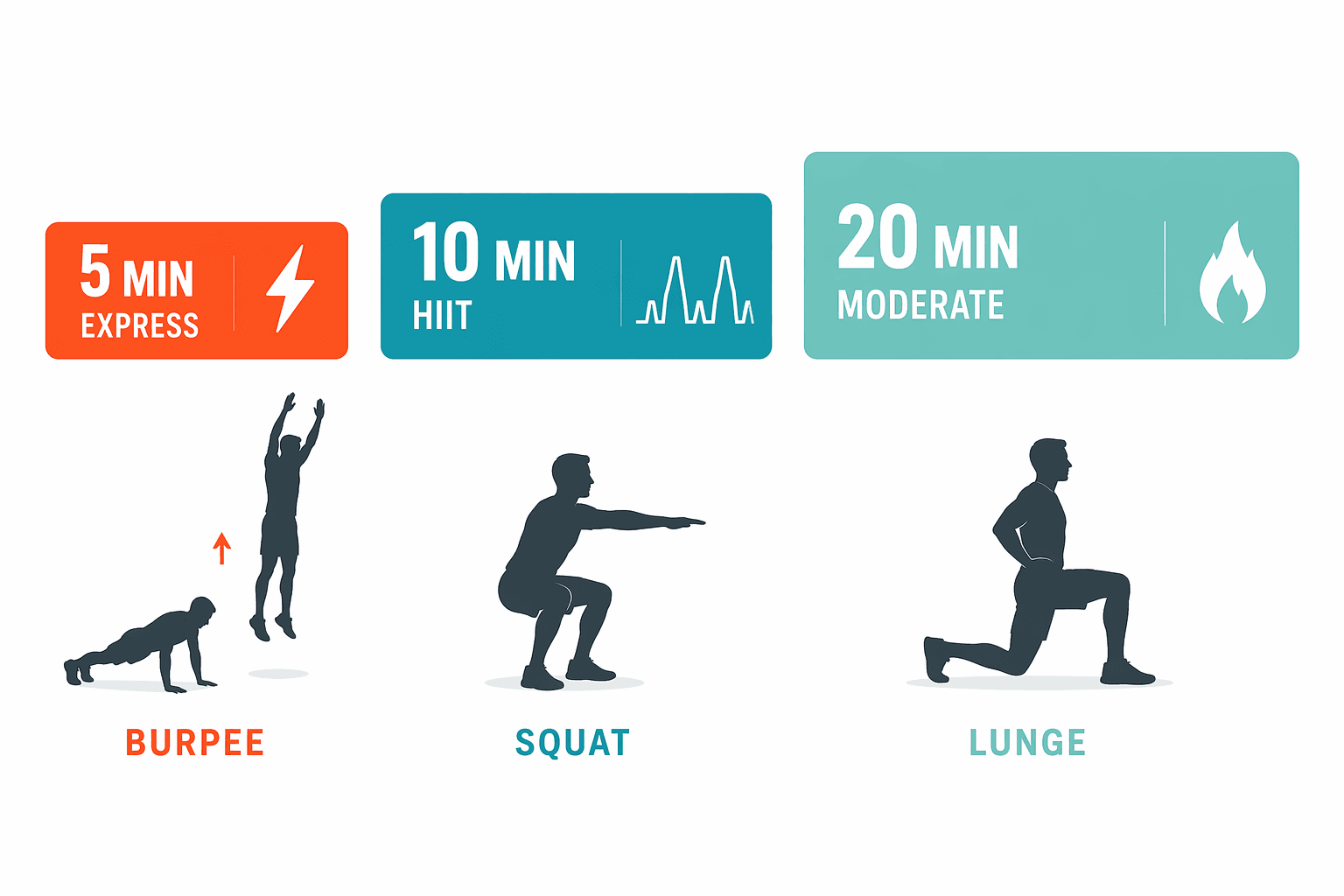
| Time available | Best fit | Effort target | Use it when |
|---|---|---|---|
| 5 minutes | Express SIT-style intervals | Very high to all-out on work bouts | You have almost no time and already tolerate hard efforts |
| 10 minutes | Tabata-style HIIT | RPE 8–9 on work bouts | You want the most time-efficient repeatable session |
| 20 minutes | Moderate continuous circuit | RPE 4–6 | You are newer, returning, managing impact, or avoiding all-out work |
The 5-minute express option: only if the hard parts are truly hard
A true sprint-interval session is not simply a five-minute warmup-free scramble. The research model behind this category used very short all-out efforts separated by enough easy recovery to let the next effort stay powerful.[1] At home, that means this option is best treated as an emergency minimum, not your default plan.
- Do 4 × 30 seconds of very hard effort.
- Recover very easily between efforts if you have extra time; if you truly only have five minutes, keep the session rare and do not pretend the shortened recovery matches lab SIT.
- Choose one movement you can perform safely at speed: fast step-ups to a low stair, squat-to-reach, low-impact skaters, mountain climbers, or burpees only if your joints and technique tolerate them.
- Stop the interval if speed drops into sloppy reps. The goal is high output, not surviving ugly movement.
This is the smallest tool in the box. It can help protect the habit on compressed days, but it is not the best place for a true beginner to start, and it is not a complete warmup-strength-mobility-fitness plan squeezed into five minutes.
The 10-minute option: the practical center of the plan
This is the session most people mean when they ask for the minimum effective dose: short enough to do before the shower, long enough to include a ramp-up, and intense enough to plausibly connect with the HIIT and SIT findings. It borrows the timing of Tabata—20 seconds hard, 10 seconds easy—but uses bodyweight movement and perceived effort instead of a lab bike.
| Minute | What to do | How it should feel |
|---|---|---|
| 0:00–2:00 | Warm up with marching, step-backs, arm swings, easy squats, or low-impact jacks | RPE 2–4; breathing rises but you can talk |
| 2:00–6:00 | 8 rounds: 20 seconds hard, 10 seconds easy | RPE 8–9 during work; by the last rounds, talking is not realistic |
| 6:00–8:00 | Easy movement: walk, march, slow step-touch | RPE 2–3; breathing comes down |
| 8:00–10:00 | Optional second easy ramp-down or light mobility | You should leave recovered enough to continue your day |
The hard block is only four minutes, which is why it gets abused online. If the 20-second efforts feel like ordinary circuit training, it is no longer a Tabata-style session in the way the research term is usually invoked. If the first two rounds are comfortable, you probably chose a movement that is too easy, moved too slowly, or protected yourself from the discomfort that makes the session work.
A good at-home movement for this session has three traits: it raises breathing quickly, it can be repeated without setup, and it does not punish your joints when fatigue arrives. For many people, that points to squat-to-calf-raise, fast low-impact skaters, alternating reverse lunges, mountain climbers with hands on a bench, or high-knee marching with aggressive arm drive. Burpees are optional, not mandatory.
Use one movement for all eight rounds if you want the cleanest intensity signal. Switching exercises every round can make the workout more entertaining, but it also makes effort harder to read. If you rotate, choose two movements at most: one lower-impact standing move and one floor or incline move.
- Too easy: you can speak a full sentence during the 20-second work interval.
- About right: you can maybe get out one or two words near the end of a work interval.
- Too hard or too risky: your landing gets loud, your back position changes, or you dread the next round because form is already gone.
Three sessions per week is the cleanest starting frequency because it matches the schedule used in the Gillen-style comparison.[1] Put at least one non-HIIT day between sessions when possible. On the other days, walking, mobility, easy cycling, or the 20-minute moderate circuit below can build the week without turning every session into a test.
If you want more than this minimum-dose article can give you, the next step is not adding random finishers. It is using a full structure, such as HIIT at Home, where the intervals, progressions, and recovery days are planned together.
The 20-minute moderate circuit: the option that keeps more people training
A moderate circuit is not a consolation prize. It is the right session when all-out work is premature, when your knees hate jumping, when sleep was poor, or when you need cardio that does not hijack the rest of the day. It also lines up more closely with the public-health intensity most people recognize as sustainable aerobic work.
Set a timer for 20 minutes and move continuously at RPE 4–6. You should breathe more heavily than at rest, but you should still be able to speak in short phrases. Cycle through four to six low-impact movements, changing every 45–60 seconds or whenever the movement starts to feel locally tired before your breathing is challenged.
- March or step-touch with strong arm drive
- Bodyweight squats to a chair or couch-height target
- Reverse lunges or alternating step-backs
- Incline mountain climbers with hands on a counter or couch
- Low-impact jumping jack pattern: step one foot out at a time
- Standing knee drives or shadow boxing
For a beginner, this may be the better minimum. The session is longer than the 10-minute HIIT option, but the cost is easier to recover from and the skill demand is lower. That makes it easier to repeat tomorrow, which matters more than proving you can tolerate one brutal round today.
If even this feels like a lot, start with a beginner progression rather than forcing high-intensity intervals. A plan like Cardio at Home for Beginners is a better entry point than pretending “all-out” is just a mindset.
How to choose the right minimum
The shortest session is not automatically the smartest one. Choose by readiness, recovery, and the kind of effort you can honestly produce.
| If this describes you | Start here |
|---|---|
| You are sedentary, returning after a long break, or unsure how your joints handle impact | 20-minute moderate circuit |
| You exercise occasionally and can push hard without losing form | 10-minute Tabata-style HIIT |
| You already tolerate hard intervals and truly have no time today | 5-minute express SIT-style option |
| You want a weekly routine instead of isolated sessions | Build a structured home cardio week |
The Harvard Nutrition Source notes that HIIT programs may require about 40% less time than moderate-intensity continuous training for equivalent body-composition improvements.[3] That is useful, but body composition is not the only reason to train. The bigger practical value is that shorter sessions reduce the scheduling friction that keeps people from starting at all.
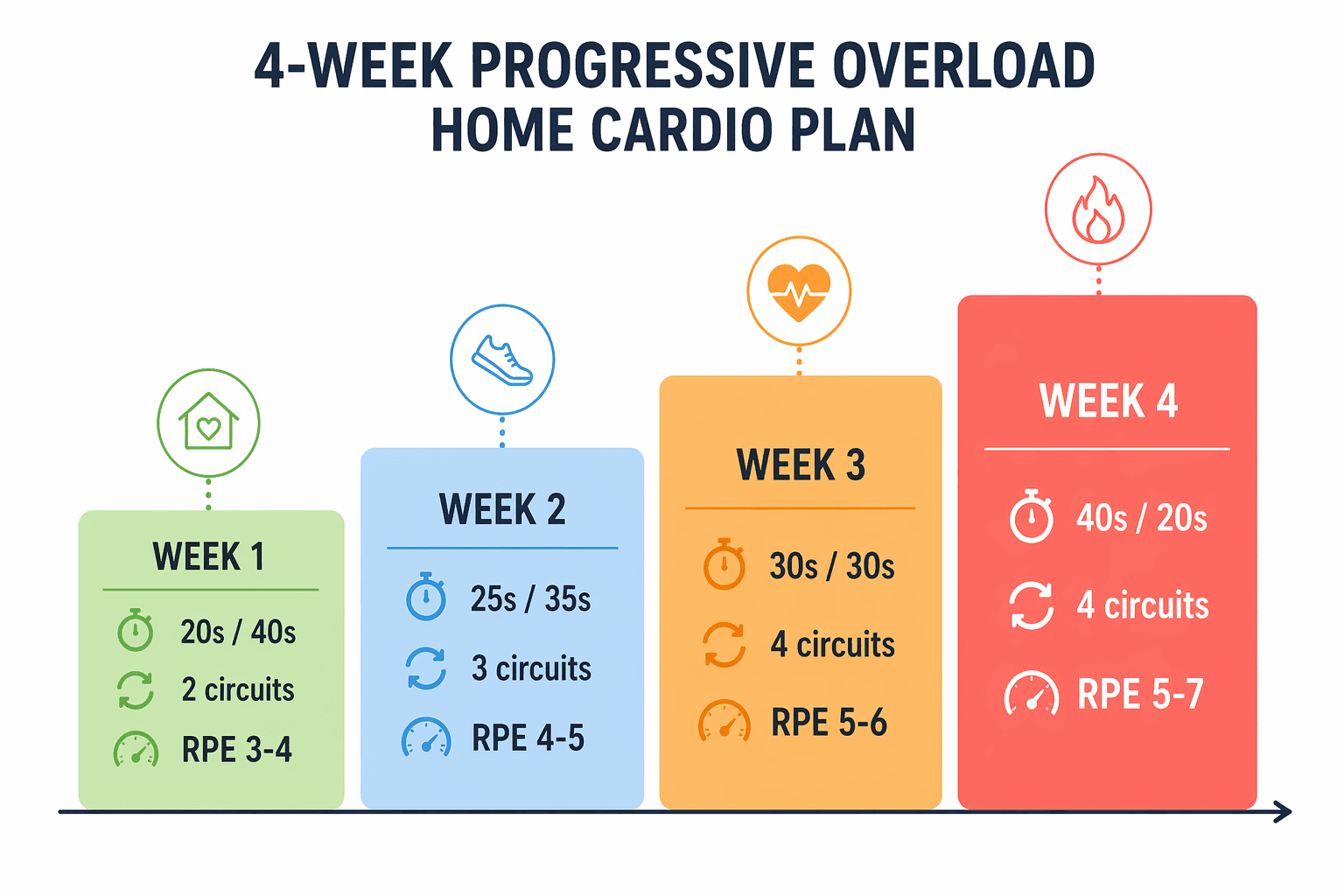
For a realistic week, three 10-minute HIIT sessions can be enough to begin improving fitness in the population studied by the short-interval research.[1] If you have more time, add easy or moderate movement instead of adding more all-out days. If you want that laid out, use How to Build a Home Cardio Week That Actually Works or a progressive plan such as Progressive Home Cardio Training Plan.
Where short cardio stops being enough
Short workouts work best as a floor. They are a way to stop waiting for the perfect 45-minute opening and start applying a dose your body can respond to. They are not proof that longer aerobic work has no value.
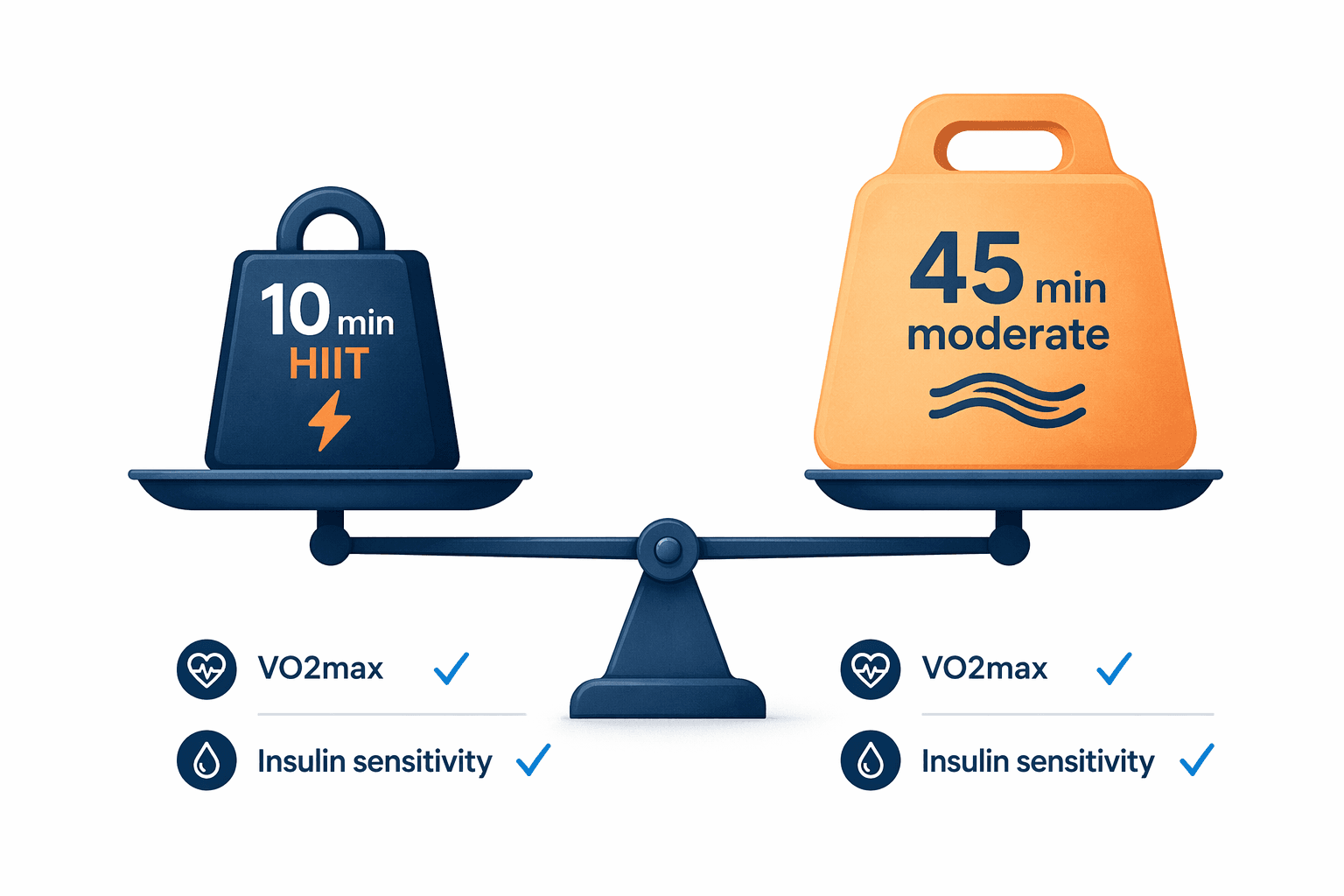
The same review that highlights time-efficient HIIT and SIT also notes that moderate-intensity continuous training may produce central cardiovascular adaptations—such as improvements in stroke volume and cardiac output—that short HIIT or SIT protocols may not fully replicate.[1] That is the tradeoff. Intervals can be remarkably efficient for VO2max and insulin sensitivity, but longer steady work still earns its place when the goal expands from “minimum effective” to “more complete aerobic development.”
So use the 10-minute session when time is the hard limit. Use the 20-minute circuit when repeatability matters more than intensity. Use the 5-minute option sparingly, when the alternative is doing nothing and your body is ready for true hard efforts. Then, when life gives you more space, let the plan grow instead of treating the minimum as the ceiling.
References
- Evidence-Based Effects of High-Intensity Interval Training on Exercise Capacity and Health: A Review with Historical Perspective, PMC
- Physical Activity Guidelines for Americans, 2nd edition, U.S. Department of Health and Human Services, 2018
- High Intensity Interval Training, Harvard T.H. Chan School of Public Health, The Nutrition Source, November 2021
Comments
Join the discussion with an anonymous comment.