
Commercial fitness equipment is worth buying for a home gym when the machine will see daily, repeated use from more than one person, when it is a high-wear category like a treadmill or cable machine, and when you plan to keep it long enough for durability and resale value to matter. If you train a few times a week, lift normal home-gym loads, or mainly want the reassurance of something labeled “club quality,” good consumer-grade equipment is usually the better buy.
The cleaner test is not commercial versus home. It is annual cost under your actual household use. A commercial treadmill that feels painfully expensive on purchase day can be cheaper over ten years than replacing lighter treadmills every few seasons. A commercial squat rack, on the other hand, may just be extra steel you never stress.
Start With the Usage-Volume Test
Before comparing motor horsepower, frame gauge, console size, or brand reputation, write down how the equipment will actually be used. The answer changes fast when one casual user becomes two daily runners, or when a cable tower goes from accessory work twice a week to the main machine for a household.
| Decision variable | Why it matters at home |
|---|---|
| Daily users | Two or more regular users can turn a “home” machine into light-commercial wear. |
| Weekly hours | A treadmill used 2 hours a week and one used 12 hours a week are not the same purchase. |
| Equipment category | Motors, belts, decks, bearings, cables, and pulleys wear differently than simple steel. |
| Ownership period | Commercial pricing only starts to make sense if you keep the machine long enough. |
| New vs. refurbished | A refurbished commercial machine can improve the math, but only if service and warranty are real. |
| Warranty risk | A cheap machine used beyond its intended duty cycle can become expensive the first time coverage is denied. |
| Space and access | Commercial equipment is larger, heavier, and less forgiving in basements, upstairs rooms, and tight garages. |
Industry comparisons commonly describe light-commercial use as roughly 4–6 hours per day and full commercial use as 12 or more hours per day, though those labels are conventions rather than universal standards across manufacturers.[2][4] Most home gyms never get close. A two-runner household using one treadmill every morning and evening can get closer than people expect.
Total Cost of Ownership Is the Real Argument
CTX Home Gyms gives a useful treadmill example: a $2,195 remanufactured commercial treadmill works out to about $146 per year over 10 years, while an $800 consumer treadmill replaced every 4 years works out to about $200 per year. In that example, the commercial path is described as 37% more economical over the long term.[1]
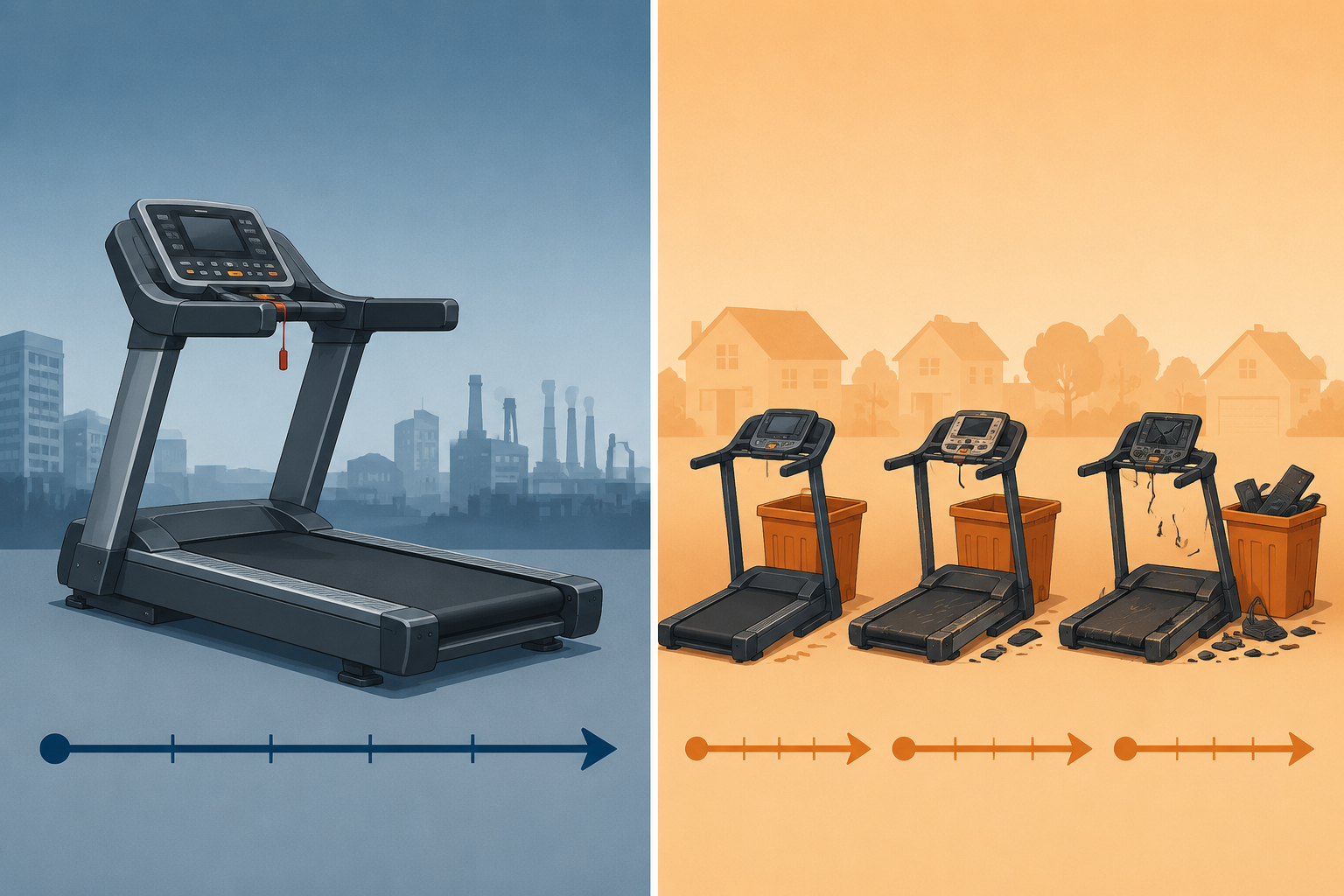
Use that as a worksheet, not a universal law. CTX sells remanufactured commercial equipment, so the example naturally favors the kind of purchase they offer. Still, the structure of the math is exactly the right structure: purchase price, replacement interval, ownership years, resale value, and the chance that a repair lands outside warranty.
The simple version looks like this:
| Ownership path | Illustrative cost | What the number is really testing |
|---|---|---|
| Remanufactured commercial treadmill | $2,195 over 10 years, about $146/year in the CTX example | Whether a higher upfront price is offset by longer service life and retained value |
| Consumer treadmill | $800 replaced every 4 years, about $200/year in the CTX example | Whether lower upfront cost is erased by earlier replacement |
Resale value is part of that equation. CTX estimates that commercial equipment retains 40–50% of original value at 5 years, while consumer equipment retains 10–20%.[1] That does not mean every used commercial treadmill is easy to sell or worth hauling across town. It means the heavier machine may still have a second buyer, while a worn consumer treadmill often has to be priced like a problem someone else is agreeing to move.
To adapt the math, avoid guessing from the sticker price alone. Estimate your annual cost this way:
(purchase price + expected repairs - resale value) / years owned = annual ownership costThen run the same formula for the consumer option, including likely replacement. If the commercial machine only wins after 12 years but you move often, dislike servicing equipment, or may change training styles, the spreadsheet is pretending to know more than it does.
Where Commercial Construction Actually Changes the Outcome
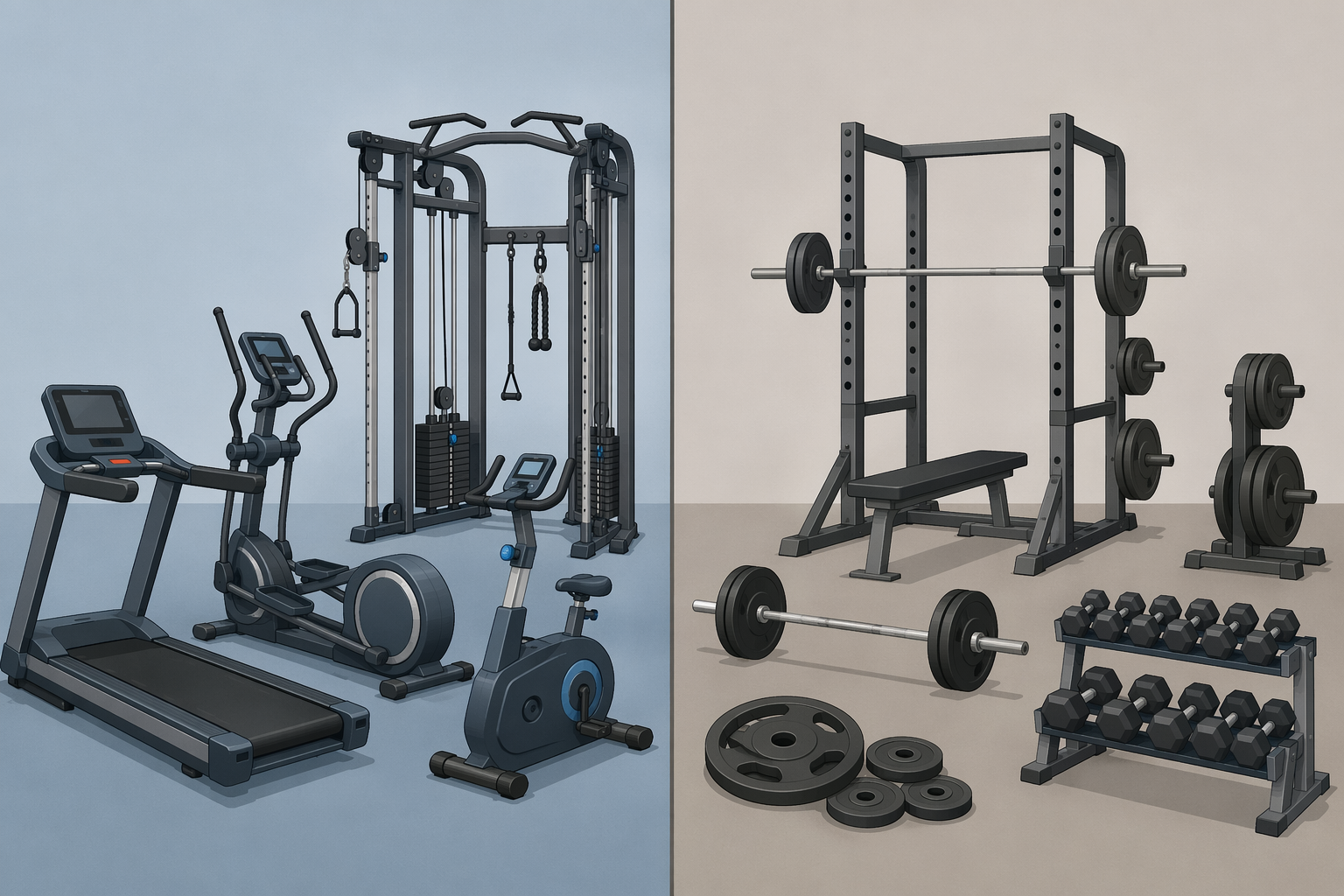
Commercial construction matters most when the equipment has parts that wear under repeated motion. That is why treadmills, functional trainers, ellipticals, stair climbers, and other motorized or cable-driven machines deserve more scrutiny than a kettlebell or flat bench.
Treadmills: the strongest case for commercial
If any home-gym category can justify commercial money, it is the treadmill. Running punishes belts, decks, rollers, bearings, motors, incline systems, and frames. Walking is easier on a machine. Daily running by multiple people is where consumer treadmills start showing why they were priced lower.
Matrix Fitness describes commercial treadmills as using heavier 11–14 gauge steel frames, while consumer models commonly use 16–18 gauge steel.[2] Commercial treadmills also commonly use 3–5 HP continuous-duty AC motors, while high-end home treadmills may use 2.5–3.5 HP peak-rated DC motors.[2] The difference is not just a bigger number on a spec sheet. Continuous-duty output matters when the belt is asked to hold pace again and again instead of surviving a short showroom test.
A single walker probably does not need that. A couple both training for endurance events on the same machine might.
Functional trainers and cable machines: look at pulleys, cables, and stacks
A functional trainer is not just a frame with handles. The feel comes from pulley alignment, cable quality, guide rods, bearings, weight-stack travel, and the way the machine behaves when someone changes direction under load. TRUE Fitness and Gtech both identify commercial-grade construction as more relevant in cable and selectorized strength machines than in many simpler strength categories.[3][4]
This is where a serious lifter or a family sharing one machine can make a commercial or light-commercial unit make sense. If the machine is the main training station, cheap pulleys and sloppy cable travel become daily irritations, not minor compromises.
Ellipticals and other cardio: bearings matter more than screens
Ellipticals do not take foot strikes like treadmills, but they still rely on bearings, rails, arms, pedals, and resistance systems repeating the same path thousands of times. Gtech identifies ellipticals as one of the categories where commercial build quality is more likely to matter for longevity.[4]
This is also where buyers get distracted. A large screen, app integration, or polished console can make a machine feel premium before the moving parts prove anything. If the budget forces a choice, put money into the parts that carry load and motion first.
Where Consumer-Grade Is Usually Enough
Basic strength gear is the place to be careful with the commercial argument. Commercial racks, benches, barbells, dumbbells, and kettlebells are often better built. That does not automatically mean the home buyer gets meaningful value from the upgrade.
Garage Gym Reviews identifies many consumer-priced barbells, squat racks, dumbbells, benches, and kettlebells as adequate for home use, while TRUE Fitness and Gtech place more emphasis on commercial construction in high-use machines and equipment with more mechanical complexity.[3][4][6] In a one- or two-person home gym, a well-rated consumer rack may never approach its failure threshold.
There are exceptions. Very strong lifters, people training high volume, households sharing one setup, and buyers who want a rack or bench to survive decades of abuse can justify heavier steel and better hardware. But the reason should be load, stability, service life, or resale—not the hope that commercial steel will make the gym feel more serious.
If you are still deciding which categories deserve space and budget at all, start with a broader equipment-selection pass before paying commercial prices. A guide like How to Choose Home Gym Equipment That Actually Fits Your Space, Budget, and Goals is the better first move when the category itself is still unsettled.
Light-Commercial and Refurbished Can Be the Middle Ground
Full commercial equipment is built for facilities, not spare rooms. That brings good things—mass, durability, serviceability—and annoying things: size, weight, delivery complexity, higher repair costs, and sometimes power or clearance needs that do not fit a normal house.
Light-commercial equipment can make more sense for a home that uses one machine heavily but not all day. It is the category to consider when your household is clearly beyond casual use but still nowhere near a public gym’s duty cycle. The definition varies by manufacturer, so read the warranty language instead of trusting the label.
Refurbished commercial equipment can also be smart, especially when the machine has been professionally serviced and comes with meaningful warranty coverage. The trap is buying a retired gym treadmill because it looks indestructible from ten feet away. A machine can have a huge frame and still hide a tired belt, worn deck, noisy bearings, failing console, or expensive motor issue.
For budget-conscious buyers, this is where a phased approach helps. Buy the categories that carry the most wear first, then add pieces as training needs become obvious. That is usually smarter than filling the room at once. The same thinking applies in a garage build; setting up a garage gym on a budget is mostly about sequencing decisions so the expensive purchases solve known problems.
Used Buying: Safer for Steel, Riskier for Motorized Cardio
Used commercial equipment is not one category. A used power rack and a used treadmill have completely different risk profiles.
USA Fitness Equipment Depot describes heavy strength equipment—racks, barbells, and plate-loaded machines—as among the safest used purchases because they have minimal electronics and designs that have changed little for more than 15 years.[5] That matches common sense: inspect welds, uprights, J-cups, safeties, sleeves, bushings, pads, and adjustment points, and there is not much mystery left.
Motorized cardio is different. USA Fitness Equipment Depot and CTX both point toward buying treadmills, stair climbers, and similar machines new or professionally refurbished with warranty rather than treating any used commercial unit as a bargain.[1][5] The expensive parts are hidden inside the machine, and the prior use may have been much harder than anything it will see in your house.
The used-market rule is plain: buy simple steel used when inspection tells you enough; buy complex moving machines only when service history, refurbishment quality, and warranty reduce the unknowns.
Warranty Language Can Undo the Spreadsheet
A low annual cost estimate assumes the machine keeps working or that warranty coverage catches major failures. That assumption deserves pressure.
TRUE Fitness notes that commercial frames may carry 5–10 year warranties, while consumer frames may carry 1–5 year warranties.[3] TRUE also notes that using consumer equipment in shared settings can void coverage, and that some consumer warranties may be voided by use as demanding as an individual running 10 or more miles daily.[3] The exact language matters more than the brochure headline.
For a home buyer, the question is not only “How long is the warranty?” It is also:
- Does the warranty allow the way your household will use the machine?
- Are labor, electronics, belts, decks, cables, and wear parts covered differently from the frame?
- Who services the machine if something fails?
- Does buying used transfer any warranty at all?
- Can parts still be sourced without turning one repair into a scavenger hunt?
This is where a bargain can fall apart. A cheaper used commercial treadmill with no warranty may be a worse financial risk than a more expensive refurbished unit from a seller who will actually support it.
Do Not Ignore Size, Weight, and Delivery
Commercial equipment often fails the home test before anyone plugs it in. Doorways, stairs, ceiling height, slab strength, flooring, electrical access, and the path from truck to room all matter. A machine that is easy to love in a showroom can be miserable in a basement with a tight turn.
Commercial equipment also tends to be less compact. That is not automatically bad; a stable footprint is part of why it feels better under load. But if the machine crowds out warm-up space, storage, or the exercises you already do consistently, the durability premium has bought the wrong thing. For tight rooms, compare the footprint against compact categories before committing; compact home gym equipment categories are often a better constraint check than another spec sheet.
A Practical Decision Rule
Buy commercial or refurbished commercial fitness equipment when three things line up: your household use is daily and heavy, the equipment category has high-wear parts, and you expect to own it long enough for annual cost to beat repeated consumer replacements.
That usually points toward commercial or light-commercial treadmills, serious cable machines, ellipticals, and other cardio equipment used by multiple people. It may also point toward commercial strength equipment for unusually strong lifters, shared household setups, or buyers who value long service life and resale enough to pay upfront.
Choose good consumer-grade equipment when use is moderate, the category is structurally simple, or the commercial premium mostly buys capacity you will never touch. A solid home rack, bench, barbell, dumbbell set, or kettlebell collection can be the right answer without pretending to be a hotel gym.
The best purchase is the one whose wear pattern matches your life. If the machine will work like a light-commercial machine, buy for that. If it will live like home equipment, do not pay a commercial tax just to feel safer on day one.
References
- Why Commercial Gym Equipment Beats Consumer Brands for Home Gyms, CTX Home Gyms
- Commercial vs Home Treadmills — What's the Difference?, Matrix Fitness
- Differences Between Commercial vs. Home Strength Machines, TRUE Fitness
- Home vs. Commercial Fitness Equipment, Gtech Fitness
- New vs. Used Commercial Gym Equipment, USA Fitness Equipment Depot
- Expert-Tested: Best Commercial Gym Equipment 2026, Garage Gym Reviews

Comments
Join the discussion with an anonymous comment.