The best elliptical for home is the one that survives the boring checks first: it fits through the room you actually have, gives your stride enough room, feels smooth enough that you will not avoid it, stays quiet enough for the people around you, and does not turn a one-time purchase into a monthly bill you resent.
That means the comparison should start before brand names. Measure the floor, door swing, and side clearance. Check stride length against the tallest regular user. Treat flywheel weight and resistance type as feel-and-noise specs, not decoration. Then price the machine as a first-year purchase, including delivery, assembly, and any app subscription. Pricing and subscriptions in this guide are reviewed for Q3 2026; machine prices move with sales, but the thresholds below are the ones that keep buyers from choosing a polished bad fit.
Start With the Room, Not the Console
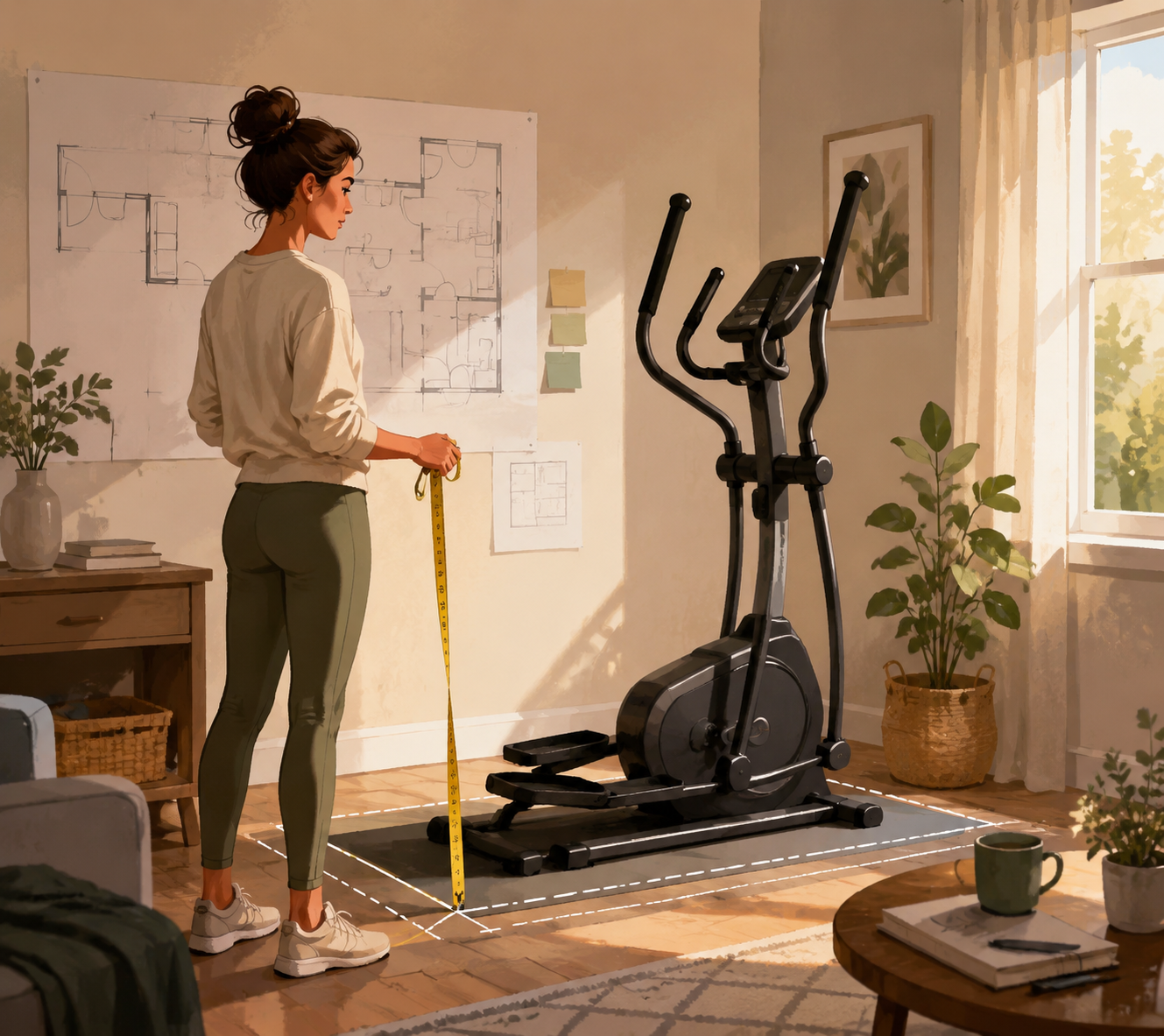
Most home elliptical mistakes are made with a tape measure, not a spec sheet. A typical elliptical is roughly 72 inches long and 30 inches wide, while the broader category can run from about 50 inches to 84 inches long depending on design.[1] Compact models can fit into about 5 to 8 square feet, but larger rear-drive machines can exceed 12 square feet.[2]
The footprint printed on a product page is only the machine’s body. It does not include the room your hips, elbows, moving handles, pedals, and mounting step need. Leave at least 20 inches of clearance on one side so you can get on and off without twisting around furniture.[1] If the elliptical sits near a closet, bed, sofa, radiator, or door, mark the real operating zone with painter’s tape before you fall in love with a model.
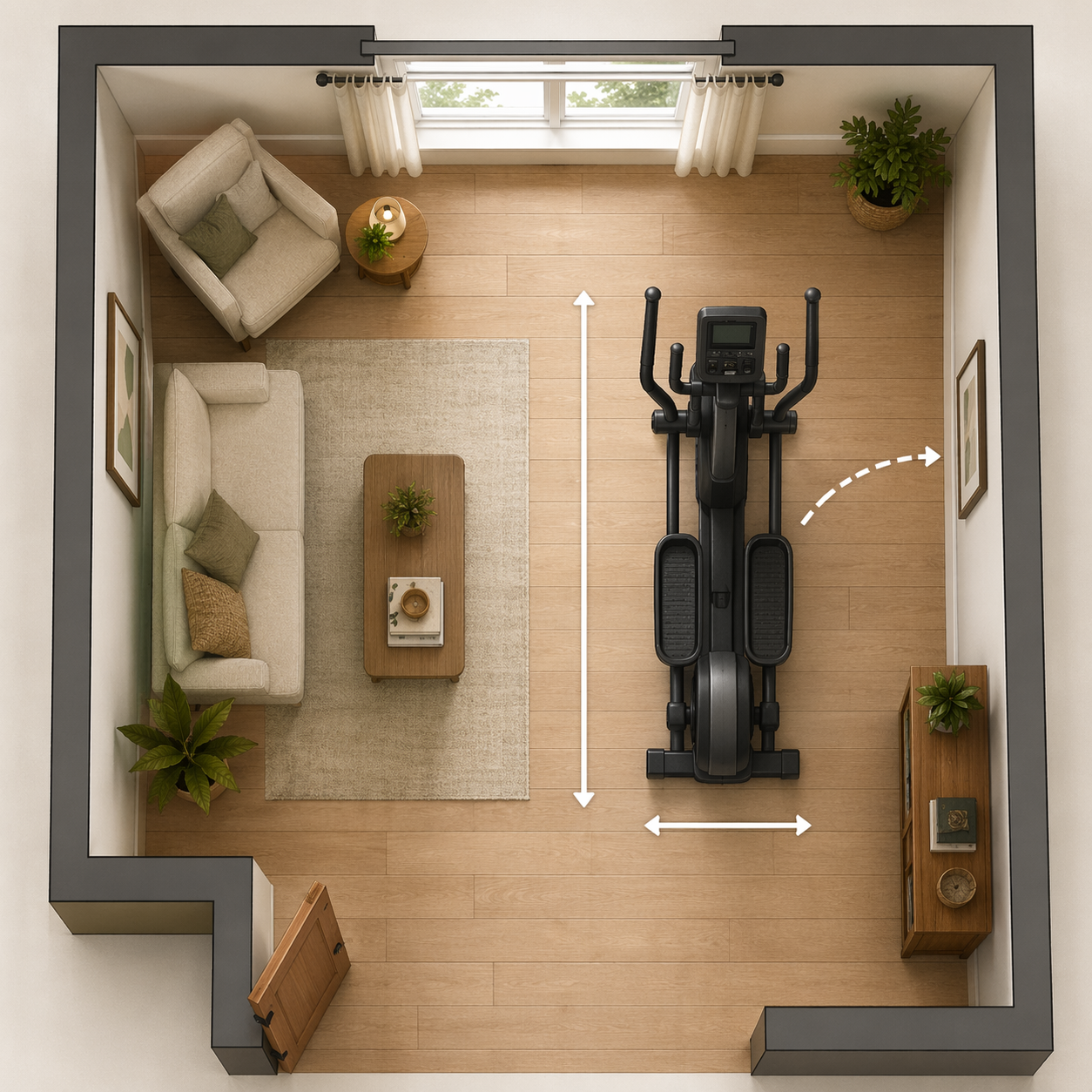
A quick room check should include the machine footprint, the side you will step in from, the ceiling height at the highest pedal point, and the path from delivery entrance to final location. A 72-inch machine may technically fit in a spare bedroom and still be the wrong machine if it blocks a closet, crowds a desk chair, or leaves no comfortable way to climb on.
- If your usable floor area is tight, start with compact or center-drive models rather than rear-drive machines.
- If you share the room with office furniture or a guest bed, tape the operating zone, not just the stated footprint.
- If the machine goes upstairs or into an apartment, check delivery dimensions and assembly location before purchase.
- If you are choosing between an elliptical and another cardio machine, compare the full room burden, not only the machine price; a broader space guide such as How to Choose the Best Home Cardio Machine for Your Space, Budget, and Noise Tolerance can help with that decision.
Match Stride Length Before You Compare Screens
Stride length is where a machine that looks premium can feel wrong in the first minute. The common home-elliptical standard is 18 to 20 inches, and Garage Gym Reviews founder Coop Mitchell says a 20-inch stride can accommodate many users from 5 feet 3 inches to 6 feet 5 inches.[3] That does not make 20 inches perfect for every body, but it is a safer default for mixed-height households than a short compact stride.
Shorter users may be comfortable with 16 to 18 inches, especially if the goal is light to moderate cardio in a small room.[2] Taller users, faster striders, and households with more than one regular user should be more cautious. A cramped stride does not just feel mildly annoying; it changes how the workout feels every time you step on the machine.
| Main user situation | Stride length to prioritize | Buying note |
|---|---|---|
| Shorter user, small room, light workouts | 16 to 18 inches may work | Test if possible; compact convenience may be worth the shorter motion. |
| Average-height user or shared household | 18 to 20 inches | This is the safer middle range for most home buyers. |
| Taller user or long natural stride | 20 inches or more | Do not trade stride comfort away for a larger screen or smaller sale price. |
This is also why showroom excitement can mislead. A machine can feel fine for two minutes while you are testing buttons, then feel clipped during a 30-minute session. If you cannot test the exact model, give more weight to stride length, return policy, and user-height comments than to console photos.
Use Flywheel Weight as a Smoothness Filter
Flywheel weight is not the whole feel of an elliptical, but it is a useful first filter. Multiple buying and testing guides converge around the same practical threshold: under 16 pounds can feel jerky, 16 to 20 pounds is more acceptable in the midrange, and 20 pounds or more is the smoother, more durable-feeling target.[3][4]
This matters most when the machine is used several times a week. A choppy pedal path makes the workout feel cheaper than the receipt, and it is one of those flaws people stop negotiating with after the return window closes. If two machines are close in price and footprint, the one with the heavier flywheel and steadier resistance curve is usually the better home bet.
Budget models deserve a little extra scrutiny here. Garage Gym Reviews’ 2026 buying data puts the average elliptical cost at $1,299, while quality sub-$1,000 options in its budget testing averaged around $625.[3][4] That does not mean an affordable machine is automatically poor. It means the buyer has to check what was reduced to hit the price: flywheel weight, frame warranty, stride length, max user weight, or console features.
Choose the Drive Type That Fits Your Constraint
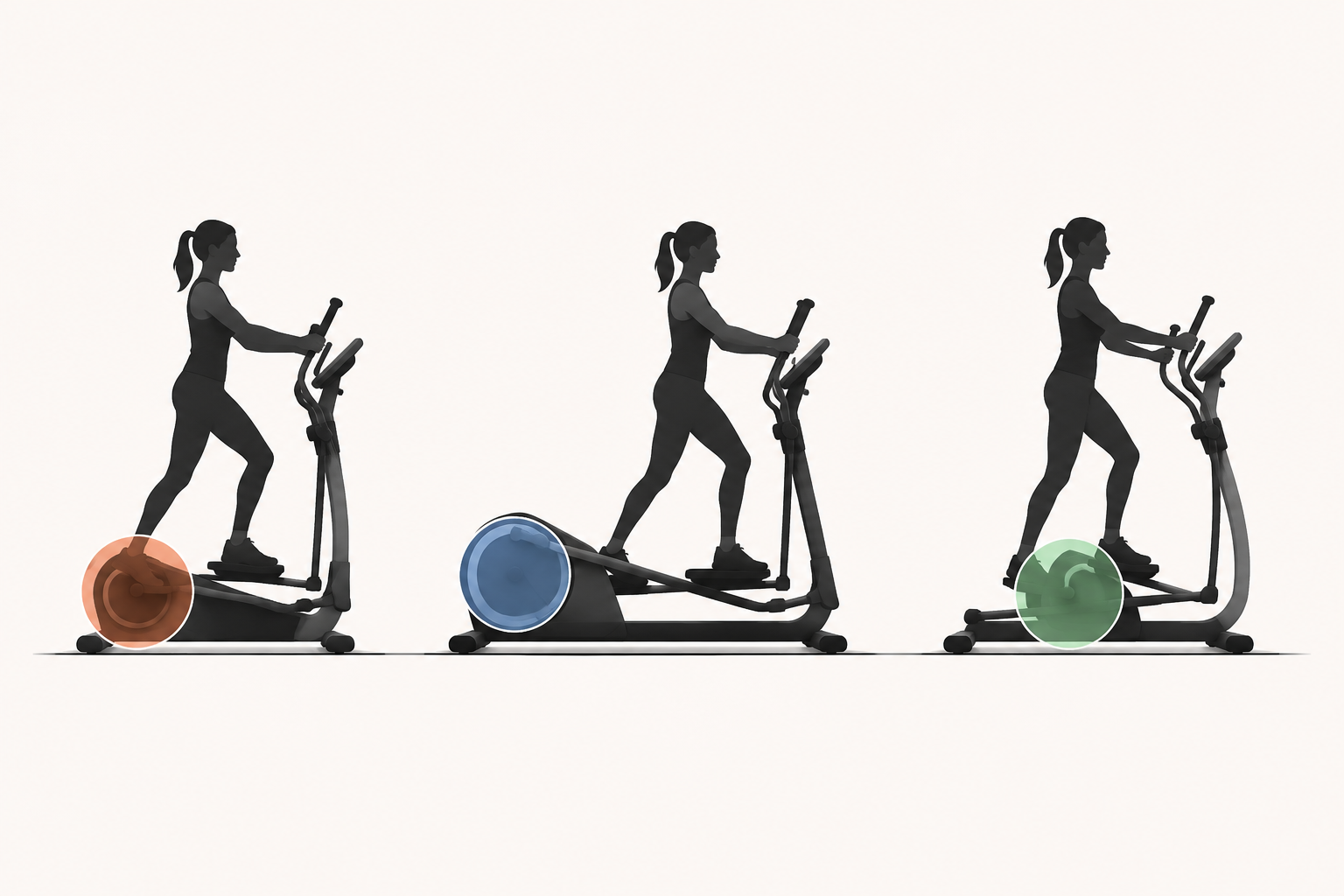
Drive type is easiest to understand when it is tied to the room and the stride you need. Front-drive ellipticals tend to be more compact and budget-friendly. Rear-drive machines usually take up more room and are often associated with a smoother, longer-feeling stride. Center-drive designs keep the user more upright and can be compact, which is useful when floor space is the main constraint.[1][3]
| Drive type | Usually best for | Tradeoff to check |
|---|---|---|
| Front-drive | Budget buyers and tighter rooms | Stride feel may vary more by model, so check flywheel and stride length carefully. |
| Rear-drive | Users prioritizing a smoother stride and a more open motion | The footprint can be larger, which may rule it out for small bedrooms. |
| Center-drive | Small spaces and upright posture | Model selection can be narrower, and the feel should be tested if possible. |
For apartment and small-room buyers, the useful question is not which drive type is theoretically best. It is which one gives you enough stride without turning the room into a machine storage area. If every rear-drive model that fits your body blocks the room, a compact center-drive or front-drive machine may be the better home elliptical even if it is not the grandest machine on paper. For more small-footprint options beyond ellipticals, see Compact Home Exercise Equipment: A Constraint-Based Guide for Apartment Dwellers.
Noise Is Mostly a Resistance and Build-Quality Question
Ellipticals are often quieter than treadmills because there is no repeated foot strike on a belt, but they are not automatically apartment-proof. Magnetic resistance is the quietest resistance type and is the better default for shared walls, downstairs neighbors, and early-morning workouts.[1]
The cheaper the frame and lighter the flywheel, the more you should think about vibration. Budget machines under $500 may use lighter flywheels and builds that transmit more wobble or mechanical noise.[3] A floor mat can help with vibration and floor protection, but it will not turn a loose, rattly machine into a quiet one.
- For apartments: prioritize magnetic resistance, a stable frame, and a mat under the full footprint.
- For shared rooms: check handlebar movement and console beeps, not only pedal noise.
- For upstairs use: treat machine weight as both a stability advantage and a delivery/placement issue.
- For very noise-sensitive homes: read owner complaints for squeaks after several months, not only first-week impressions.
Price the First Year, Not Just the Machine
A home elliptical can move into a different budget category after the subscription is counted. As of mid-2026 U.S. pricing, iFIT costs $39 per month or $396 per year, while JRNY costs $19.99 per month or $149 per year.[3][5] Depending on the billing choice and platform, that recurring layer can add roughly $120 to $468 per year to the cost of ownership.[3][5]
This is not an argument against guided workouts. Coaching, automatic resistance changes, scenic routes, and class libraries can be the reason someone actually uses the machine. The problem is buying as if the screen is free motivation when it is really a continuing service. If you would cancel the subscription in month three, judge the machine by how well it works without it.
| Purchase scenario | What to count before buying | What it changes |
|---|---|---|
| Connected machine with iFIT | Machine price plus $39 monthly or $396 annual plan | A sale-priced machine may become a higher-cost first-year purchase. |
| Connected machine with JRNY | Machine price plus $19.99 monthly or $149 annual plan | Lower annual app cost still belongs in the comparison. |
| Subscription-free setup | Machine price, tablet holder if needed, and any separate workout apps | You keep more control, but lose some built-in coaching and automation. |
The cleanest comparison is a first-year total: machine, taxes, delivery, assembly, mat, and subscription. Then do the same for year two. A $999 machine with a subscription can cost more to own than a plainer model that has a good stride, a stable frame, and a tablet shelf for DIY streaming. If you are comparing several cardio options, the same math applies in Best Home Gym Cardio Equipment: A 3-Year Total Cost Comparison.
Check Warranty, Assembly, and Delivery After the Fit Decisions
Warranty should not outrank fit, stride, and cost, but it can break a tie. A lifetime frame warranty is ideal, a 10-year frame warranty is a solid baseline in the $500 to $1,000 range, and many budget machines offer only 1 to 3 years on the frame.[4][5]
Assembly and shipping also belong in the real price. Assembly can add $100 to $300, and some brands charge shipping fees up to $199.[3][5] For a heavy elliptical, that is not a small footnote. It affects who has to move the box, where the machine can be built, and whether returning it is realistic if it feels wrong.
- Read the frame, parts, labor, and electronics warranties separately; they are often not the same length.
- Check whether in-home assembly is available in your area before assuming you can add it later.
- Look at return shipping and restocking terms, especially for online-only models.
- If the machine has a large built-in screen, check what still works if the subscription is inactive.
Shortlist by Use Case
Once the constraints are clear, the shortlist usually gets smaller fast. This is where “best elliptical for home” becomes a usable phrase instead of a vague award.
| If this describes you | Prioritize | Be careful with |
|---|---|---|
| Small apartment or shared room | Compact or center-drive design, magnetic resistance, taped clearance | Rear-drive models that look comfortable but overrun the room |
| Taller user or mixed-height household | 20-inch stride, stable frame, generous return policy | Short compact strides chosen only to save floor space |
| Budget buyer | Stride length, flywheel weight, warranty, delivery cost | Cheap consoles masking light flywheels or short warranties |
| Subscription-averse household | Good basic console, tablet holder, manual programs | Machines that lose too much function without a paid plan |
| Guided-workout motivated buyer | App quality, class library, automatic resistance, annual subscription cost | Treating the monthly fee as separate from the machine budget |
If you are still deciding whether an elliptical is the right machine category at all, start with Does a Home Elliptical Machine Fit Your Space, Budget, and Joints? before narrowing models. If you already know you want an elliptical, use the constraints in order: room, stride, smoothness, noise, total cost, then warranty and delivery. The right machine is the one left standing after those checks, not the one with the loudest spec sheet.
References
- The Best Elliptical Machines of 2026, Wirecutter (NYT)
- Best Compact Ellipticals (2026), BarBend
- Elliptical Buying Guide (2026), Garage Gym Reviews
- Expert-Tested: Best Ellipticals Under $1,000 (2026), Garage Gym Reviews
- The 8 Best Ellipticals Under $1,000 in 2026, BarBend

Comments
Join the discussion with an anonymous comment.