The fastest way to choose the best home gym equipment is to stop comparing products for a minute. A treadmill with glowing reviews can still be wrong if the belt blocks a closet door. A power rack can be a great buy and still be useless under a low basement ceiling. A smart gym can be elegant and still become expensive once the monthly subscription starts.
Start by eliminating what cannot work in your room. Then choose the category that deserves your first real purchase.

The four filters that shrink the decision
| Filter | What to check first | What it usually rules in or out |
|---|---|---|
| Square footage | Measure the usable training rectangle, not the whole room | 80–100 sq ft favors compact strength tools or one cardio machine; 100–150 sq ft can support an anchor machine plus accessories; 150+ sq ft can handle multi-category setups |
| Ceiling height | Measure from finished floor to the lowest obstruction | Sub-84-inch ceilings make many full power racks and overhead barbell work poor fits |
| Budget | Separate first purchase from total setup cost | Under $500 starts lean; $500–$1,500 usually means choosing one anchor; $1,500–$3,500 opens premium cardio or functional trainers; $3,500+ needs subscription and service scrutiny |
| Training goal | Pick the thing you will do most often | Strength points to rack, barbell, plates, or dumbbells; cardio points to treadmill, bike, or rower; hybrid points to cables, functional trainers, or all-in-one systems |
That order matters. Space and ceiling height are physical vetoes. Budget is a tradeoff. Goal is prioritization. If you start with the goal alone, it is too easy to talk yourself into a beautiful machine that cannot open, incline, swing, roll, or be used safely where you live.
Measure the room like equipment will actually move
Do not measure wall to wall and call it done. Measure the rectangle where a person can train after accounting for doors, radiators, storage shelves, car bumpers, low beams, washer-dryer access, and the corner where everyone says they will “just move the boxes later.” They usually do not move the boxes later.
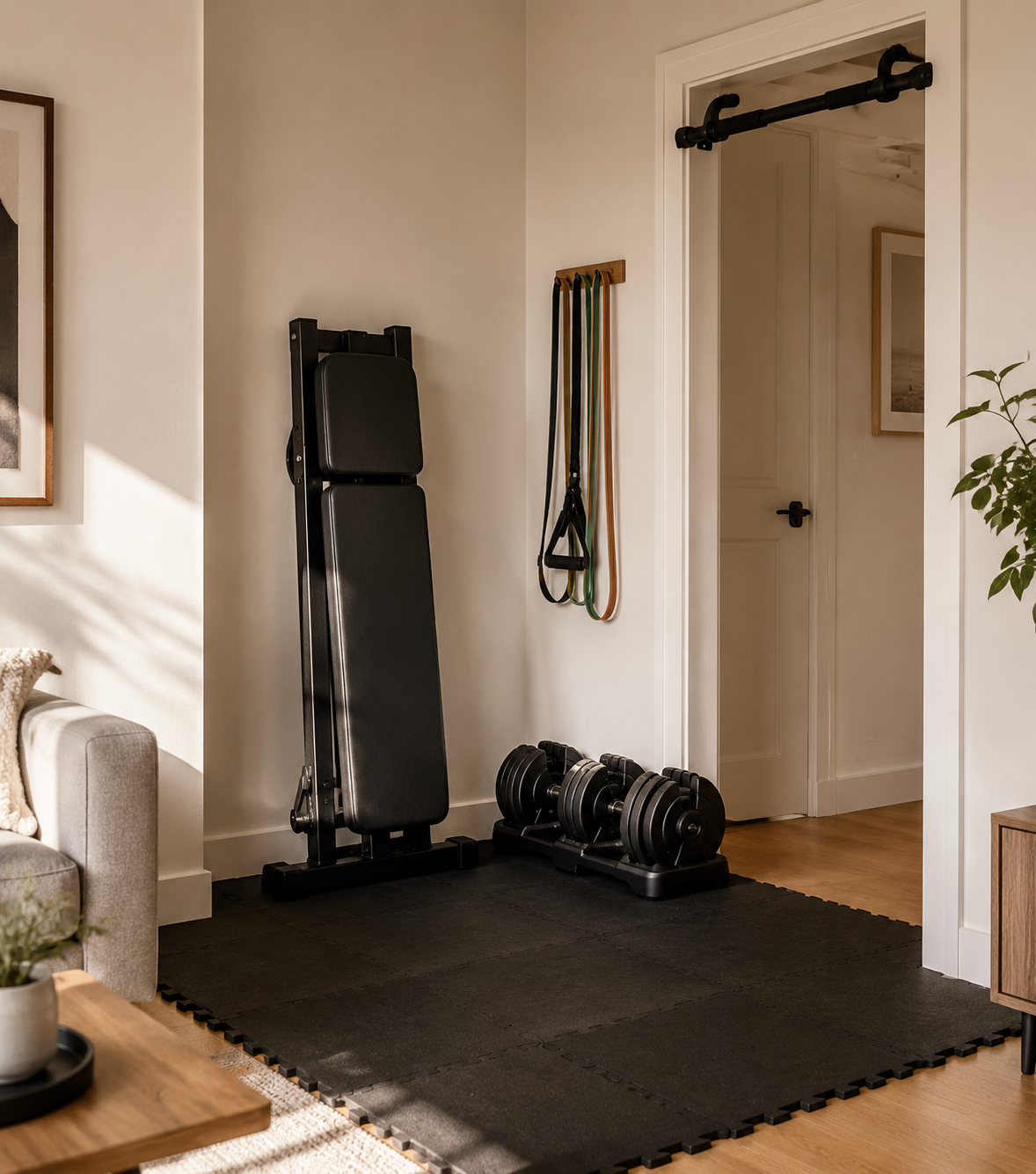
For an 80–100 sq ft space, think in singles: one serious cardio machine, or a dumbbell-and-mat setup, or a compact cable/smart system if the wall and subscription make sense. This is the spare-bedroom and apartment zone. It can work beautifully, but only when the equipment folds, stores, or stays narrow enough that the room remains usable.
At 100–150 sq ft, you get more combinations. A bike plus adjustable dumbbells is easy. A treadmill plus a small dumbbell rack can work. A functional trainer may work if you have enough depth for cable travel and enough clearance around the arms. This is where many buyers get into trouble because the floor plan looks generous until the first lateral raise or walking lunge.
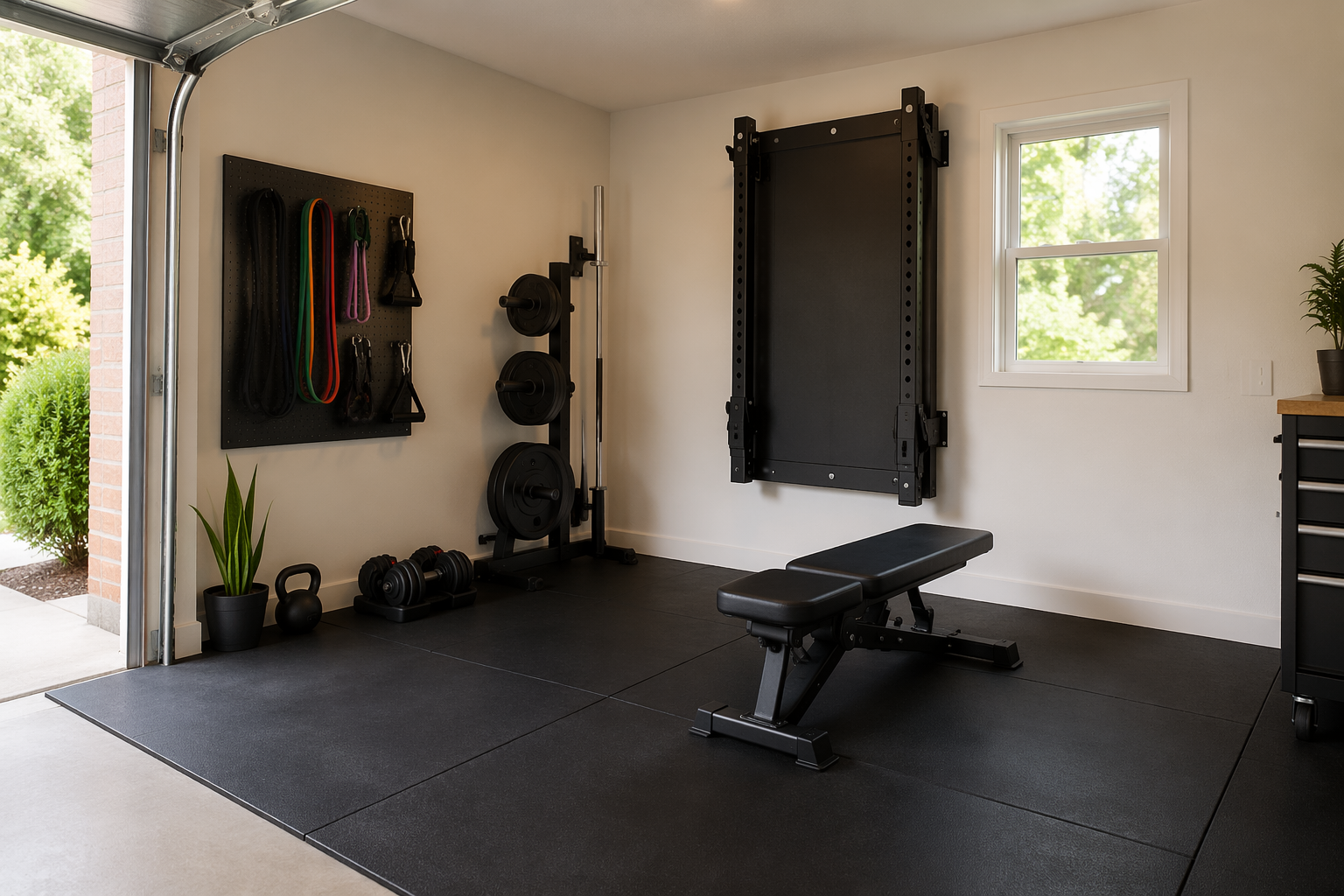
At 150+ sq ft, a complete setup becomes realistic: rack, barbell, plates, dumbbells, bench, cardio, and storage. Even then, complete does not mean crowded. A garage bay with a rack squeezed against bicycles and paint cans is not a complete gym; it is a negotiation with shin bruises.

The 84-inch ceiling check
A ceiling under about 84 inches is where many strength plans need to change. The issue is not only whether a rack technically fits. It is whether you can load plates, unrack a bar, press overhead, do pull-ups, and use safety arms without constantly editing your workout around the ceiling. Basement joists, ductwork, and garage-door tracks count. Measure the lowest point, not the prettiest point.
If the ceiling is low, the better category may be adjustable dumbbells, a flat or adjustable bench, resistance bands, a compact cable system, or a short rack designed for low clearance. That is not a downgrade if it means you will actually train without ducking every rep.
Choose a budget band, not a fantasy cart
A home gym budget has two numbers: what you can spend now and what the setup will cost once it is usable. A rack without plates is not a strength setup. A smart machine without the subscription may not be the machine you thought you bought. A treadmill that shakes after six months was not cheap; it was early replacement cost.
Fitness Avenue’s 2026 synthesis puts the average foundational home gym at $2,530, while noting that a starter setup can begin under $400 with items such as adjustable dumbbells, a jump rope, resistance bands, and a mat.[1] Treat that $2,530 figure as directional, not a promise. Flooring, delivery, plate storage, subscriptions, and replacement parts can move the real total.
| Budget band | Best use of the money | Main caution |
|---|---|---|
| Under $500 | Mat, bands, jump rope, adjustable dumbbells, or basic fixed dumbbells | Avoid pretending this band buys every category equally well |
| $500–$1,500 | One anchor: quality cardio, or rack/barbell/plates, or dumbbells plus bench | Pick the primary modality first instead of buying scattered accessories |
| $1,500–$3,500 | Premium cardio, functional trainer, or more complete strength setup | Check delivery, footprint, warranty, and clearance before choosing features |
| $3,500+ | Commercial-grade equipment or smart gym systems | Scrutinize subscriptions, service dependence, and whether the machine still works if you cancel |
The under-$500 band is real. It is not a consolation prize. For a beginner who wants strength, dumbbells, bands, a mat, and a bench can build consistency before a rack ever enters the room. For cardio, though, this band is more delicate. The Fitness Outlet’s 2026 buying guide warns that budget treadmills under $500 tend to wear out quickly, which is why this is often a better range for simple tools than for motorized cardio.[2]
The $500–$1,500 band is where the first hard choice usually happens. If strength is the goal, a rack package may beat a mid-grade treadmill. If cardio is the goal, a good bike or rower may beat a wall full of equipment you do not use. This is the band where buying one durable anchor is usually wiser than assembling a room that looks complete but trains nothing particularly well.
At $1,500–$3,500, the decision shifts from “Can I start?” to “Which machine earns the space?” Premium cardio equipment, functional trainers, and all-in-one systems begin to compete here. The feature lists get seductive. The floor tape still wins.
Above $3,500, smart gyms and commercial-grade machines can be excellent, especially in small rooms where clever engineering replaces a spread-out rack-and-plate setup. But smart gyms commonly add $40–$60 per month in subscriptions, so the purchase price is only the first line of the calculation.
Match the first purchase to the training you will repeat
A useful home gym starts with the training you are most likely to repeat when work runs late, the weather is bad, or the room is not perfectly tidy. That usually means choosing one primary lane before buying the extras.
- Strength: start with adjustable dumbbells and a bench, or move toward a power rack, barbell, plates, and safeties if the room and ceiling allow it.
- Cardio: choose the machine you will tolerate most often: treadmill for walking and running, bike for lower-impact sessions, rower for full-body conditioning.
- Hybrid: consider a functional trainer, compact cable system, smart gym, or dumbbell-plus-cardio pairing.
The market’s shape helps explain why so many people begin with cardio. Fortune Business Insights reports that cardio equipment accounts for 58.72% of the home fitness equipment market.[3] That does not mean cardio is better for every home. It means treadmills, bikes, and similar machines dominate the visible shopping field, which can make them feel like the default answer even when a person’s real goal is strength.
Younger buyers are also entering the category in large numbers. Fitness Avenue’s 2026 synthesis cites CivicScience data showing that 63% of 18- to 29-year-olds plan to buy home fitness equipment.[1] That matters because many first-time buyers are not outfitting a finished basement; they are working with apartments, shared walls, roommates, and budgets that need a cleaner first step.
Strength equipment: powerful, but space-hungry
For barbell strength, the classic path is rack, barbell, plates, bench, and flooring. It is still the most expandable home gym route for squats, presses, deadlifts, rows, and progressive loading. It is also the route most likely to expose a ceiling or total-cost mistake.
Garage Gym Reviews lists the REP PR-1100 at $380 with a 700-pound capacity, which makes it a useful anchor for understanding how inexpensive a rack itself can be.[4] But the rack is not the whole purchase. A bar, plates, collars, bench, mats, storage, and delivery can turn the “rack price” into only the opening scene.
If the room is small or the ceiling is low, do not force a rack just because a strength program online assumes one. Adjustable dumbbells and a bench may produce more actual training in a spare bedroom than a rack that makes the room feel permanently blocked.
Cardio equipment: simple decision, large footprint
Cardio machines are emotionally easy to understand: step on, pedal, row, walk, run. The hard part is the footprint. Treadmills need length, width, step-up height, and often extra rear clearance. Bikes are usually more apartment-friendly. Rowers can store upright, but they need a long working lane when in use.
For shared walls or upstairs apartments, noise matters as much as dimensions. A treadmill may technically fit and still be the wrong neighbor decision. A bike, mat-based strength kit, or compact cable system can be the better category even when your training goal includes cardio.
Functional trainers and smart gyms: versatile, not magically small
Functional trainers are appealing because one machine can cover chest presses, rows, lat pulldowns, shoulder raises, curls, and many accessory movements, according to Garage Gym Reviews’ testing and buying guidance.[4] In the right room, that versatility is not marketing fluff; it replaces several separate stations.
The catch is cable travel. You need room to stand, step back, pull across the body, set a bench, and avoid scraping a wall on every rep. A compact functional trainer against the wrong wall can feel less useful than a pair of dumbbells on a mat.
Smart gyms deserve the same treatment. They can be genuinely clever for apartments because they compress coaching, resistance, and exercise variety into a narrow footprint. Before buying, check whether the subscription is required for the workouts you want, whether the machine has a useful mode without it, and whether your wall, floor, or lease allows the installation.
Apartment readers comparing smart machines, free weights, and cable systems may want the more focused compact home gym decision guide after they finish this first filter.
Use a phased buying sequence
The cleanest sequence is not “buy everything once.” It is: start with the one piece that supports your primary training, use it long enough to prove the habit, then add the second category that removes the next real bottleneck.
| Reader profile | First purchase | Second purchase | Wait on |
|---|---|---|---|
| Apartment beginner, 80–100 sq ft | Adjustable dumbbells, mat, bands, or compact bike | Bench or compact cable/smart system | Full rack, large treadmill, bulky plate storage |
| Garage strength buyer, 150+ sq ft | Rack, barbell, plates, bench, flooring | Cardio machine or dumbbell expansion | Accessory machines before the main lifts are covered |
| Cardio-first user, 100–150 sq ft | Bike, rower, or treadmill that fits the room and noise limits | Dumbbells, mat, and basic strength accessories | Second cardio machine |
| Hybrid buyer with premium budget | Functional trainer, smart gym, or anchor cardio plus dumbbells | Bench, storage, or modality gap filler | Subscriptions that are not used often enough to justify the fee |
This sequence prevents the most common coat-rack purchase: buying the exciting machine first and then discovering that the boring support pieces were the ones that made training easy. Flooring, storage, a bench that fits, and enough open space to move are not glamorous, but they are often what decide whether the gym gets used.
The financial argument for a home gym can be real, but it is conditional. Garage Gym Reviews cites Health & Fitness Association data showing average U.S. gym dues at $69 per month; against a $2,530 foundational setup, that suggests a rough 3.5-year payback for one consistent user.[4][1] That calculation does not include maintenance, upgrades, resale value, financing, or a subscription attached to a smart machine.
If you are in the under-$500 band, move next to a specific starter-kit comparison rather than browsing premium machines. The budget home gym starter kits guide is the better next stop.
If you already know your category and only need the purchase order, use Which Home Gym Equipment Should You Buy First?. For broader product comparisons after this filtering step, open the best home exercise equipment guide.
What survives the filters
After the measuring tape, ceiling check, budget band, and training goal, the field should be much smaller. An 82-inch basement ceiling may push you away from a full rack and toward dumbbells or a short rack. An apartment with shared walls may push you away from a treadmill and toward a bike or strength setup. A $1,000 budget may make a rack package sensible for one person and a durable rower sensible for another.
That is the point. The best home gym equipment is the category that survives the room, the ceiling, the budget, the goal, and the likely second purchase. Once you know that category, product reviews become useful again.
References
- How Many People Have a Home Gym? 2026 Statistics, Fitness Avenue, 2026
- Summer 2026 Home Gym Buying Guide, The Fitness Outlet, 2026
- Home Fitness Equipment Market, Fortune Business Insights
- Best Home Gyms, Garage Gym Reviews, June 2026
Comments
Join the discussion with an anonymous comment.