
Search for the best stationary bike for home and you quickly hit the same problem: the “best” bike in a ranked list may be too loud for your apartment, too aggressive for sore knees, too large for the corner you actually have, or too expensive once the subscription is counted. A home bike is not bought in a showroom. It has to live somewhere, make noise somewhere, and keep justifying its cost after the first burst of motivation fades.
A useful choice starts with three constraints: floor space, budget ceiling, and workout goal. The average exercise bike in Garage Gym Reviews’ 2026 testing pool cost $1,409 across more than 50 tested models, which is a helpful anchor only if you do not mistake it for a target price.[1] Capable bikes can sit below $300, the $500–$1,500 band is often where the best quality-to-price compromises appear, and premium connected bikes can clear $2,700 before membership fees change the real number.[1][2]
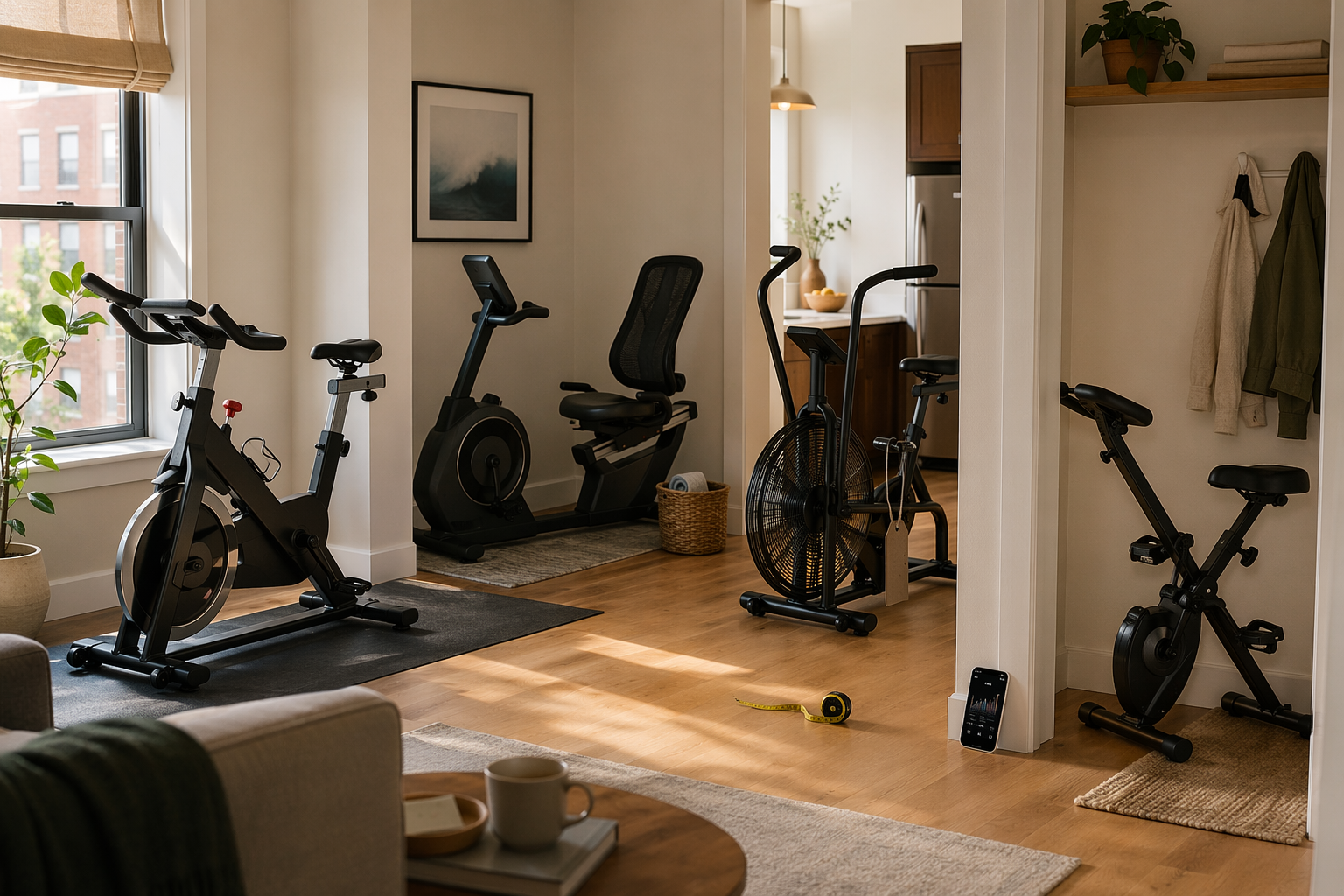
Start With the Room, the Ceiling, and the Reason You’ll Ride
Before comparing flywheels, apps, or resistance levels, decide what would make the bike fail in your house. If it blocks a walkway, wakes a downstairs neighbor, aggravates your back, or asks for a monthly fee you resent by winter, the spec sheet was never the main issue.
| Your main constraint | What it usually points toward | What to be careful about |
|---|---|---|
| Dedicated gym room or garage | Spin bike, upright bike, air bike, premium connected bike | Noise may matter less, but subscription cost and maintenance still do |
| Living-room corner or bedroom | Magnetic spin/upright bike, compact upright, folding bike | Measure clearance for getting on and off, not just the listed footprint |
| Shared apartment or second floor | Magnetic bike, folding bike, under-desk bike | Avoid assuming garage-gym noise tests translate perfectly to wood-frame floors |
| Back, hip, knee, or balance concerns | Recumbent bike or comfortable upright | A studio-style bike may be impressive and still be the wrong posture |
| HIIT and hard conditioning | Air bike or sturdy spin bike | Air resistance is effective but loud; this is rarely the apartment-friendly choice |
| App classes without a locked screen | BYO-tablet spin bike such as Schwinn IC4/BowFlex C6 | Check device compatibility and resistance conversion before assuming a perfect app match |
Published footprint comparisons place many spin and upright bikes around 3–8 square feet, recumbent bikes around 4–6 square feet, air bikes around 6–8 square feet, folding bikes around 1–4 square feet when stored, and under-desk bikes at the lowest intensity end of the category.[2] Those ranges are more useful than a single “compact” label, but they still need a tape measure. A bike that technically fits can still be miserable if your knee hits a desk or you have to drag it across carpet every ride.
Match the Bike Type to the Workout, Not the Other Way Around
Spin and Upright Bikes: Best for Most Cardio Training, With a Posture Trade-Off
Spin bikes and upright bikes cover the largest slice of home buyers because they work for steady cardio, intervals, app classes, and general fitness. They also make the fewest demands on space compared with recumbent and air bikes. If you want one bike that can handle 20-minute rides before work and longer weekend sessions, this is usually the first category to inspect.
The catch is posture. A spin bike leans you forward and rewards riders who are comfortable loading the hips, wrists, and low back more like outdoor cycling. An upright bike is more relaxed, but still places you over the pedals. If you already know a forward cycling position bothers your back or knees, do not let a studio screen talk you out of that information.
Recumbent Bikes: The Right Answer When Comfort Is the Constraint
A recumbent bike looks less intense, which is exactly why some buyers skip it and regret the upgrade. The reclined seat, back support, and easier step-through position can make it the more honest choice for low-impact cardio, recovery blocks, older riders, and anyone who needs to reduce joint or back irritation. It asks for more floor length than many upright bikes, but it may be the bike that actually gets used.
The trade-off is training style. Recumbent bikes are not the natural home for out-of-saddle climbs or studio-style choreography. If your goal is maximum sweat and leaderboard pressure, they can feel tame. If your goal is repeatable movement while protecting comfort, that is not a flaw.
Air Bikes: Excellent for HIIT, Bad at Being Polite
Air bikes use a fan, so the harder you push, the harder the resistance pushes back. That makes them excellent for HIIT, conditioning, and short brutal efforts where there is no need to tap through resistance levels. It also makes them loud. Tester data cited by Garage Gym Reviews and BarBend places air bikes around 75–83 dB at high intensity, compared with quieter magnetic systems in the 40–50 dB range.[1]
That noise number is not an abstract nuisance. It is the difference between a basement workout and an argument with someone watching TV in the next room. Decibel readings also vary with room acoustics, flooring, and measurement distance, so a bike tested in a garage may sound harsher in a second-floor apartment.
Folding Bikes: Space Solvers With Performance Limits
Folding bikes are for the buyer who does not have a permanent bike space. That is not a minor concern; it is the whole purchase. If the bike has to live behind a door, next to a sofa, or inside a closet, folding storage may matter more than flywheel weight.
Budget and compact-bike testing tends to show the expected compromises: lighter frames, less adjustability, simpler consoles, and a lower ceiling for hard efforts.[2][3] For beginners, casual cardio, and shared spaces, those compromises can be perfectly reasonable. For standing climbs, high-power intervals, or multi-rider households with very different body sizes, they become more obvious.
Under-Desk Bikes: Movement Snacks, Not a Training Bike Replacement
Under-desk bikes make sense when the goal is low-intensity movement while working or watching TV. They are not a substitute for a sturdy exercise bike if you want structured cardio progression. The buying mistake is expecting the smallest option to solve a fitness goal it was not built to carry.
Resistance Type Is Where Many Bad Recommendations Hide
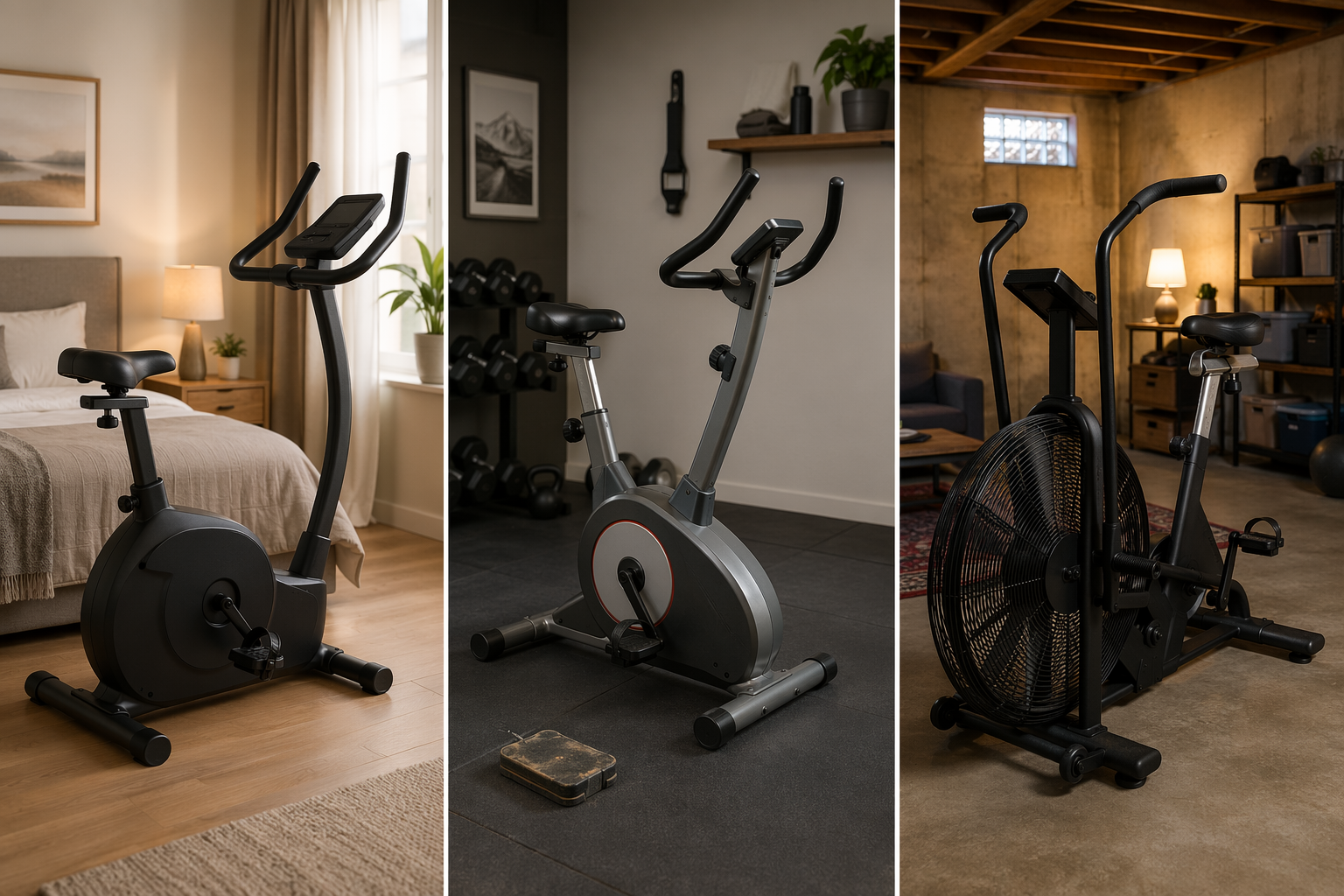
Resistance type affects noise, maintenance, ride feel, and where the bike belongs in your home. It deserves more attention than the number printed on the knob.
| Resistance type | Home-use advantage | Home-use drawback |
|---|---|---|
| Magnetic | Quiet, low-maintenance, good for apartments and shared rooms | Usually costs more; resistance calibration can vary by brand |
| Friction | Often cheaper and continuously adjustable | Pads wear over time; typical replacement cycles are around 12–18 months |
| Air | No fixed ceiling on effort; excellent for HIIT | Loud at high intensity and usually not ideal for shared walls or upstairs rooms |
Magnetic resistance is usually the safest home default because it is quieter and lower-maintenance. Friction systems can be cheaper and perfectly usable, but the pad is a wear item; Garage Gym Reviews and BarBend place typical pad replacement around 12–18 months.[1] Air resistance is wonderfully simple for effort-based training, but it is the least subtle option in a quiet home.
Be careful with “100 resistance levels.” More levels do not automatically mean better training. Outdoor Gear Lab’s testing notes that calibration and consistency matter, because one brand’s level 40 may not feel like another brand’s level 40.[4] For app riders, this matters when following instructor cues or converting resistance for platforms such as Peloton or Zwift.
Do the Subscription Math Before You Fall in Love With the Screen
A connected bike can be worth paying for. If live classes, instructor energy, tracking, and a polished interface are what keep you riding, that motivation has value. The problem is not the subscription itself; it is pretending the bike price is the total price.
Wirecutter and Garage Gym Reviews use the Peloton Bike as the cleanest example: a $1,695 bike plus a $50 monthly subscription becomes $4,695 over five years.[1][5] In that scenario, the membership costs more than the hardware. That does not make Peloton a bad purchase. It makes it a purchase that should be judged as a multi-year service commitment, not just a bike in a box.
This is where a beginner should be especially cautious. If you already love studio cycling, a premium connected bike may be exactly the right fit. If you are still testing whether indoor cycling suits you, a bike that works with multiple apps from your own tablet gives you more room to change habits without paying for a locked ecosystem. For a deeper cost breakdown, see the guide to the real cost of an exercise bike and the separate look at exercise bike subscription lock-in.
Model Recommendations by Buyer Profile
These recommendations synthesize published expert testing rather than first-hand testing for this article. Prices reflect July 2026 market conditions and can move meaningfully during seasonal sales. Before buying, verify current dimensions, weight capacity, warranty terms, and accessory compatibility on the manufacturer’s site.
Best Value for App Flexibility: Schwinn IC4 / BowFlex C6
For many home riders, the Schwinn IC4 and BowFlex C6 are the most sensible middle path: a sturdy magnetic-resistance spin bike, usually around $899–$999, with Bluetooth app compatibility and no built-in screen forcing you into one subscription. The two bikes are mechanically identical with different branding, which is why they often appear side by side in price comparisons.[1][4][5]
This is the bike type that fits the rider who wants Peloton app classes, Zwift, or general tablet-based training without buying a premium screen. It also gives beginners a safer exit ramp: if you stop liking one app, the bike does not become a monument to that app. The limitation is that you are managing the screen, resistance conversions, and device setup yourself. That is a fair trade for some households and annoying for others.
Best Premium Connected Fit: Peloton Bike or Similar Studio Ecosystem
Choose a premium connected bike when the ecosystem is the reason you will ride. The hardware matters, but the bigger purchase is the class library, interface, metrics, and routine. If you want a polished studio experience and accept the five-year subscription math, a connected bike can be more practical than a cheaper bike you ignore.
The wrong buyer is the one who mainly wants “a good exercise bike” and gets swept into a screen because the bike looks complete. If you are subscription-averse, travel often, or share the bike with someone who wants different apps, a flexible BYO-screen model deserves a harder look.
Best Budget Direction: Basic Magnetic Upright or Folding Bike Under $500
Under $500, the smart move is not chasing a premium-bike imitation. Look for the basics: a stable enough frame for your body size, a resistance system quiet enough for your room, an adjustable seat that actually fits you, and a return policy that protects you if the geometry is wrong. BarBend’s budget-bike coverage is useful here because the compromises are often practical rather than glamorous: smaller consoles, lighter frames, limited adjustability, and fewer connected features.[3]
This tier can be the right place for beginners. Spending less while you learn whether indoor cycling belongs in your routine is not a lack of ambition. It is risk control. If the habit sticks, you can upgrade with better information.
Best for Low-Impact Comfort: Recumbent Bike
If comfort determines whether you ride, start with a recumbent bike. Prioritize seat support, step-through access, smooth resistance, and reachable controls. Do not buy a spin bike because it seems more serious if the position discourages you from using it.
Recumbent bikes are especially worth considering for recovery-focused cardio, joint-sensitive riders, and households where balance or mounting height matters. They ask for more length than a compact upright, so measure the full setup area and the path to move it into place.
Best for Hard Intervals: Air Bike
Buy an air bike if you want short, hard conditioning sessions and you have a place where noise is acceptable. Garages, basements, and detached workout spaces make more sense than upstairs bedrooms. The benefit is immediate: push harder and the bike pushes back harder.
Apartment buyers should be honest here. Mats can help with vibration and floor protection, but they do not turn a fan bike into a quiet magnetic bike. If other people share the wall, floor, or room, this is often the wrong kind of impressive.
Best for Tight Spaces: Folding Bike or Compact Upright
For a shared apartment corner, a folding bike or compact upright can beat a better-performing bike that never leaves the delivery box. Look at folded dimensions, transport wheels, bike weight, and whether you can move it without scraping walls or rearranging furniture.
If space is the primary constraint, compare bikes against the room routine, not just the product page. Where does it go while you ride? Where does it go after? Can someone else still use the room? The compact home exercise equipment guide is the better next stop if the answer depends on storage more than training intensity.
The Short Version Before You Buy
- Choose a Schwinn IC4/BowFlex C6-style bike if you want app-based training, magnetic resistance, and freedom from a built-in screen ecosystem.
- Choose a premium connected bike if classes and metrics are the reason you will ride, and you accept the subscription as part of the real price.
- Choose a recumbent bike if back support, joint comfort, or easier mounting matters more than studio intensity.
- Choose an air bike if you want punishing intervals and have a room where fan noise will not become someone else’s problem.
- Choose a folding or compact bike if storage is the constraint that determines whether the bike gets used at all.
Once you know the likely bike type, the remaining details become easier to judge. For spec-level education, use the exercise bike specs for home guide. If you want a broader rider-profile comparison, the best home exercise bike by rider profile guide can help narrow the final shortlist.
References
- Best Exercise Bikes (2026) - Personally Tested — Garage Gym Reviews, 2026.
- The 7 Best Exercise Bikes for Small Spaces — BarBend.
- Best Budget Exercise Bikes of 2026 — BarBend, 2026.
- The Best Exercise Bikes of 2026 | Lab Tested & Ranked — Outdoor Gear Lab, 2026.
- The 6 Best Exercise Bikes of 2026 — Wirecutter, The New York Times, 2026.

Comments
Join the discussion with an anonymous comment.