Shopping for ab workout equipment for home gets messy fast because the products are not competing on the same problem. A $10 pair of sliders, a $20 ab wheel, a foldable Roman chair, and a full captain’s chair station all promise “core training,” but they do not ask the same thing from your floor space, wrists, shoulders, storage closet, or patience.
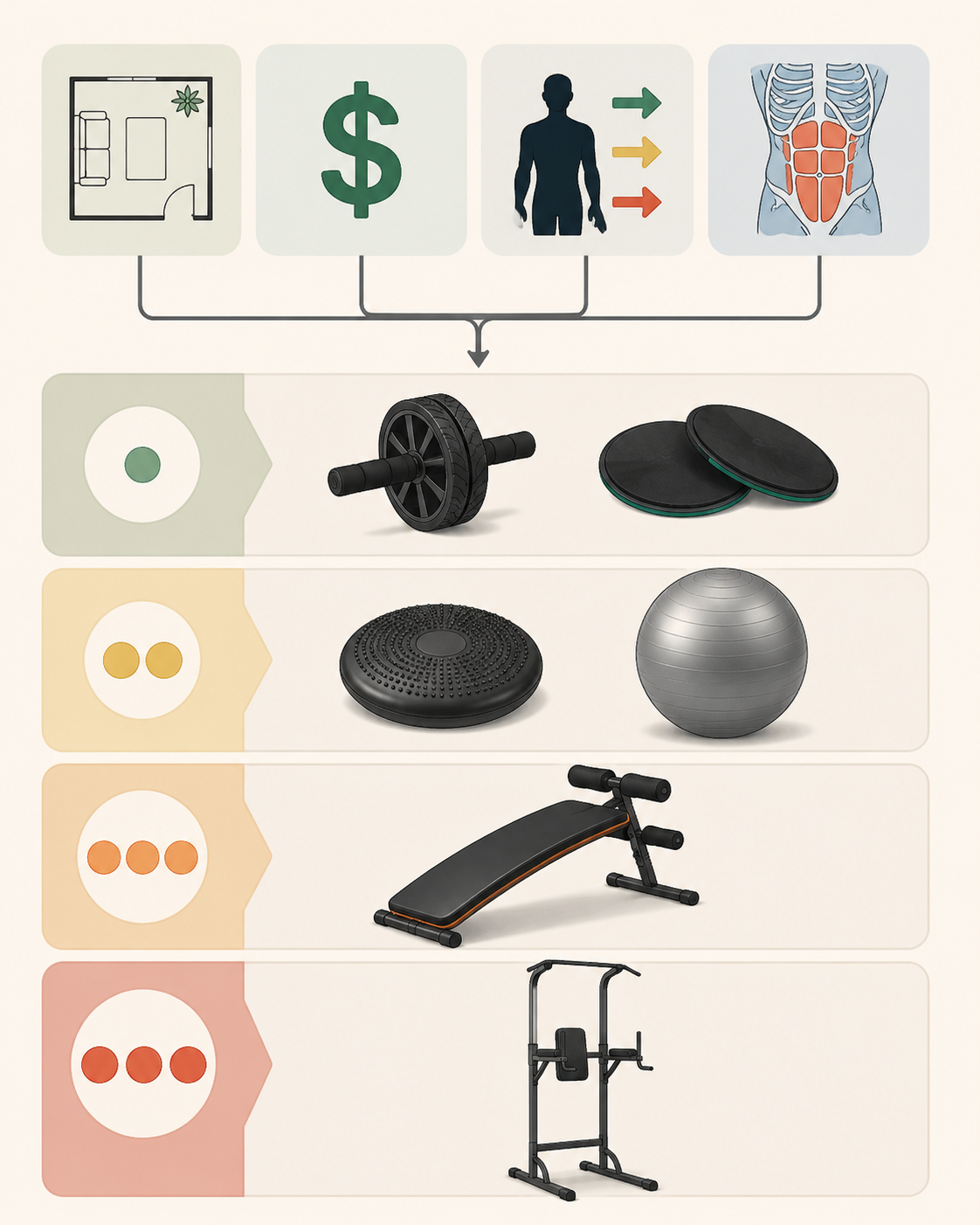
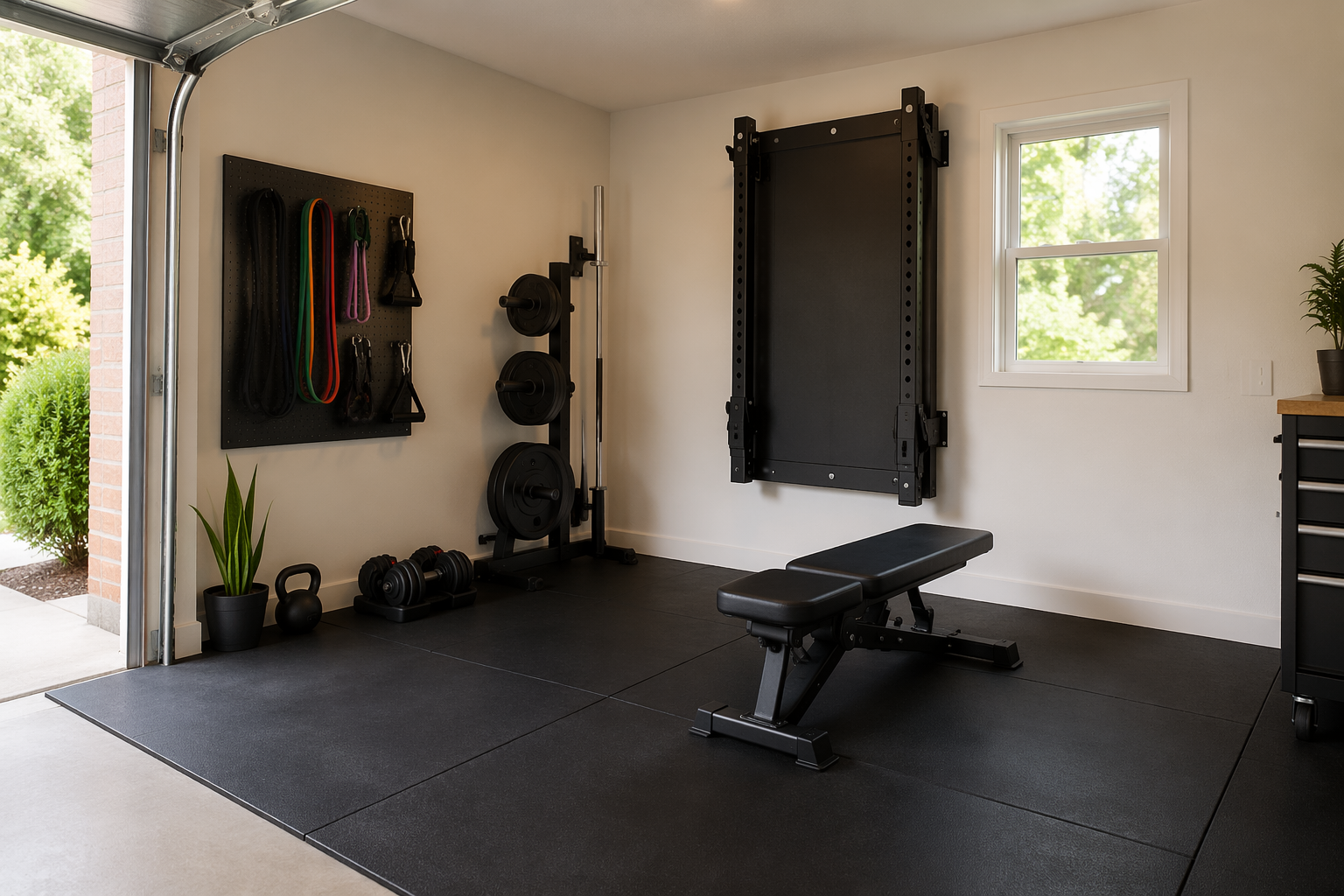
Start with four filters before looking at any winner badge: how much space the equipment can occupy, how much you want to spend, what movements your body can currently control, and which core goal actually matters to you. If you are still deciding what belongs in the whole room, not just the ab corner, it may help to step back to a broader home gym equipment framework first.
Dedicated ab equipment can be worth buying. It can make training easier to set up, add progression, and make the same small space feel less repetitive. It is not mandatory, though. A 2020 systematic review of 67 studies with 1,247 participants found that the highest rectus abdominis and external oblique activation appeared in free-weight and suspension exercises such as squats, deadlifts, and suspended roll-out planks, not automatically in dedicated ab machines.[1] That matters because the right purchase is often the smallest tool that helps you train consistently, not the largest machine with the most dramatic product page.
Use Constraints Before Rankings
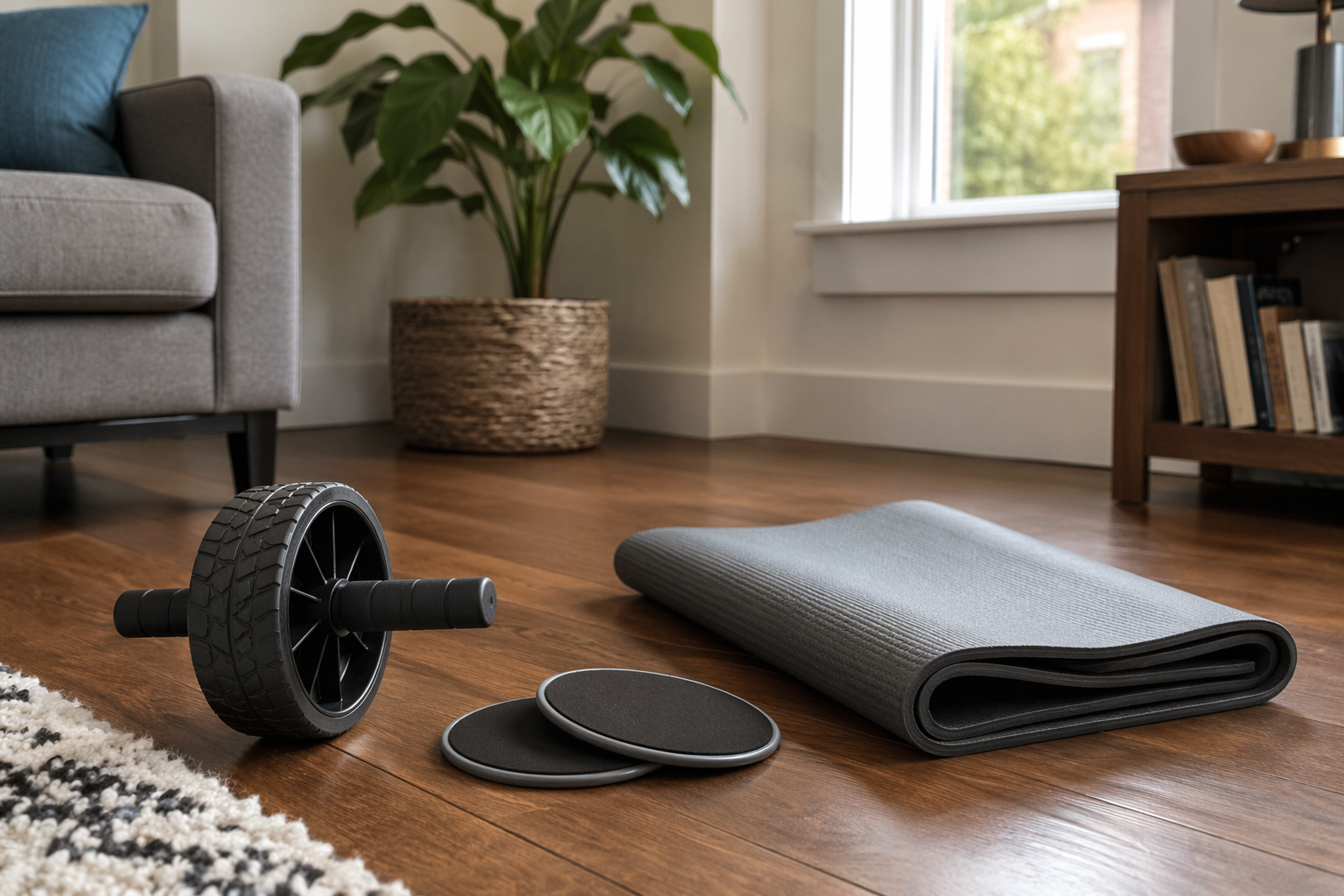
A flat “best ab machine” list tends to hide the first buying decision: whether you can live with the object after the workout ends. For a renter, “fits in a drawer” may beat “has six exercise modes.” For a beginner, an aggressive rollout tool may be less useful than a ball or sliders that allow shorter ranges of motion. For a heavier user, the most important specification may be a verified weight capacity, not the exercise library.
| Constraint | What to Ask Before Buying | Usually Points Toward |
|---|---|---|
| Space | Can it disappear after training, or can it keep a permanent footprint? | Sliders, ab rollers, exercise balls, foldable benches, or power towers |
| Budget | Is this an experiment, a repeat-use tool, or a permanent station? | Under-$30 tools first, then versatile or larger equipment only if justified |
| Experience level | Can you brace, control your pelvis, and stop before your low back takes over? | Beginner-friendly instability tools or short-range movements before full rollouts |
| Core goal | Are you training upper abs, lower abs, obliques, or total core stability? | Crunch variations, leg-raise setups, rotation/anti-rotation tools, or rollout patterns |
Those filters also prevent a common mistake: treating muscle activation as the whole purchase decision. EMG findings can show that a movement challenges abdominal muscles, but they do not tell you whether your apartment has space for the station, whether your shoulders tolerate the setup, or whether you will use it three months from now.
Under $30: The Drawer Tools
This is the strongest tier for most home buyers because the downside is small. Ab rollers are commonly listed around $10 to $24, core sliders around $10, and doorway sit-up bars around $12.[2] None of them needs a permanent footprint. All of them can be stored in the kind of home where the “gym” is also the living room.
Ab rollers: cheap, compact, and not automatically beginner-friendly
An ab roller is best for total core stability: rectus abdominis, obliques, lats, shoulders, and anti-extension control all have to cooperate. That is why it gets so much attention despite being one of the cheapest options. In a 2006 EMG study of 21 adults, Escamilla and colleagues found the Power Wheel more effective among the tested devices for activating abdominal muscles, though that result came from a specific roller-style product and should not be stretched to every wheel design on the market.[3]
The catch is that high activation is not the same as a good first movement. Full rollouts punish poor bracing. If your hips sag, your low back usually pays the bill. A safer progression is to start from the knees, roll only as far as you can return with control, and treat the first few weeks as skill practice rather than an ab-burning contest.
Look for a double-wheel design if you want more lateral stability, padded handles if your hands fatigue quickly, and a stated capacity of at least 300 lb if that applies to your body or anyone else using the tool.[2] Readers over 200 lb should be especially careful with weight ratings on inexpensive frames and wheels because many products under $200 sit somewhere in the 250–400 lb rated-capacity range.[2]
Core sliders: the quietest way to make bodyweight work harder
Sliders are the better under-$30 pick if you want compact equipment without committing to rollout strength yet. They work for mountain climbers, body saws, plank reaches, knee tucks, hamstring curls, and controlled oblique work. Synergee Core Sliders earned a 4.7 out of 5 rating from Verywell Fit, and the practical appeal is obvious: no assembly, no frame, and no storage problem beyond a drawer.[2]
Sliders are also easier to scale. Move one limb instead of two. Shorten the range. Slow the tempo. Use them on carpet or hard flooring depending on the product surface. They are not glamorous, but they solve the real home-gym problem: making familiar bodyweight training more adjustable without asking you to reserve a corner of the room forever.
Doorway sit-up bars: useful only if the doorway and setup are trustworthy
Doorway sit-up bars are cheap, but they are not as universally simple as sliders. They can anchor the feet for sit-ups and, depending on design and setup, may support hanging-leg-raise-style training in a home doorway. That movement category deserves attention because the ACE-sponsored EMG study of 30 healthy adults ranked captain’s chair crunches second among 13 tested ab exercises for abdominal muscle activation.[4]
The home version is where caution enters. A commercial captain’s chair and a doorway-mounted tool are not the same object. If the bar does not fit securely, if the trim is weak, or if your bodyweight approaches the product limit, skip it. For many people, a floor-based tool is less exciting and much less annoying.
- Best under-$30 match for total core stability: ab roller, if you can brace and progress patiently.
- Best under-$30 match for beginners and renters: core sliders.
- Best under-$30 match for lower-ab emphasis: doorway setup only if the mount and capacity are genuinely safe.
$30–$100: Versatile Tools That Need Some Storage
The middle tier is for buyers who want more movement variety without buying a permanent station. Balance discs, exercise balls, and Roman chairs are not interchangeable. One adds instability, one changes leverage and support, and one gives you a small bench-style station for back extensions and leg raises.
Exercise balls: useful if you will actually keep them inflated
An exercise ball is often listed around $27 and has a better evidence story than many louder ab gadgets.[2] The ACE-sponsored study ranked exercise-ball crunches third among the tested exercises, and the 2020 systematic review also found that unstable surfaces can increase abdominal EMG activity in certain movements.[1][4]
The practical objection is not performance; it is storage. A ball that lives inflated in a hallway becomes furniture with commitment issues. If you have a corner for it and want upper-ab crunch variations, dead bugs, stir-the-pot patterns, and beginner-friendly stability work, it earns the space. If you need everything to disappear into a drawer, sliders do a better job.
Balance discs: small instability, limited loading
Balance discs, listed around $26 in the research set, are a niche but reasonable choice for stabilizer-focused training.[2] Women’s Health selected them as an expert pick for stabilizer activation, which fits their actual role: they make planks, seated work, and balance drills less stable rather than turning into a complete ab station.[5]
Buy one if you want subtle instability, ankle and hip control work, or a compact add-on for warmups. Do not buy one expecting the same progression path as an ab roller, Roman chair, or hanging-leg-raise station.
Roman chairs: more useful when back extensions matter too
Roman chairs move the decision from “ab gadget” to “small strength station.” The verified range in the research set puts them around $72 to $99, with a Sunny Health & Fitness foldable model listed at $72 and rated for 300 lb.[2] That price can be sensible if you want back extensions, hip-extension work, and some leg-raise or side-bend options from one frame.
They are less appealing if your only goal is basic ab training. A Roman chair takes more setup room than sliders or a wheel, and it does not automatically train the deep bracing skill that makes rollouts and planks productive. It is a better match for someone building a broader posterior-chain and core station than for someone trying to sneak ten minutes of abs between dinner and the couch.
$100–$200: Foldable Equipment With Real Footprints
This tier is where buyers often overestimate how much folding solves. Foldable still has to be unfolded, moved, and stored somewhere. The question is not whether the device technically collapses. It is whether you will bother setting it up often enough to justify the room it occupies between sessions.
Wonder Core 2: a compact station, not a drawer tool
Wonder Core 2 sits roughly in the $99 to $149 range in the research set and folds to 104×52×34 cm, about large-suitcase size.[6] That is compact compared with a power tower, but it is still a piece of equipment you have to store. Treat brand-owned comparison material carefully here because Wonder Core manufactures the product it discusses; useful dimensions and product claims are not the same as independent testing.[6]
Its best buyer is someone who wants supported crunch-style movement and a more guided station than a wheel or sliders. Its weaker buyer is the person who already skips workouts when setup takes two minutes. If friction is your enemy, a clever folding machine can still lose to a cheap tool that is already on the mat.
Basic power towers: only semi-compact on paper
A basic power tower can be found around $140 and up, and captain’s-chair or power-tower-style options may require a permanent footprint around 49×25 inches.[2] That space can be worth it if your main goal is lower-ab and hip-flexor-heavy work through knee raises, leg raises, and supported captain’s-chair crunches.
The ACE result makes the movement category hard to ignore, but it does not make a power tower the right home purchase for everyone. A Tom’s Guide journalist who did 50 captain’s chair crunches per day for a week reported stronger abs and notable oblique activation, which is useful as a real-user account, not proof that every buyer needs a tower.[7] The more grounded takeaway is that supported hanging-knee-raise work can be productive if you have safe equipment and enough room to use it.
$200 and Up: Permanent Stations Need a Permanent Reason
Once you cross into permanent equipment, the purchase should serve more than a vague desire to “do abs.” Captain’s chairs, cable machines, premium decline benches, and larger multi-use stations can be excellent in a garage gym or spare room. In a shared apartment, they can become expensive obstacles.
The best case for a permanent station is repeated use of movements that smaller tools cannot provide well: hanging knee raises, supported dips, pull-up-adjacent training, cable crunches, loaded chops, back extensions, or decline sit-ups. If the station gives you several movements you already know you will use, the footprint may be rational. If it exists only to make ab training feel more serious, the smaller tools deserve another look.
This is also where weight capacity becomes non-negotiable. Many sub-$200 products fall in the 250–400 lb rating range, and larger equipment can vary widely by frame design.[2] Verify the current manufacturer specification before buying, especially for hanging, supported, or inverted movements where failure is more than an inconvenience.
How the Evidence Should Change the Purchase
The evidence does not hand you one universal winner. It does something more useful: it keeps expensive machines from getting automatic authority. In the ACE-sponsored study, captain’s chair crunches ranked second, exercise-ball crunches ranked third, the ab roller ranked ninth and was described as no more effective than the traditional crunch, and the ab rocker ranked thirteenth, up to 80% less effective than a traditional crunch.[4] The sample was 30 healthy adults, so the exact ranking should be treated as directional rather than final.
Put beside the Escamilla Power Wheel finding, the picture gets more interesting rather than cleaner. One study makes roller-style work look very strong among tested devices; another puts an ab roller below several bodyweight or station-based exercises.[3][4] That disagreement is not a reason to ignore the tool. It is a reason to stop buying from activation claims alone.
The practical reading is simple enough: ab rollers and sliders deserve serious attention because they are cheap, compact, and can be progressed. Captain’s-chair-style training deserves attention because the movement can be highly demanding. Ab rockers and similar guided gadgets deserve skepticism unless they solve a specific comfort or accessibility problem for you.
Match the Tool to the Core Goal
Most people say they want “abs,” but the equipment choice changes depending on what kind of core training they mean. Upper-ab crunch emphasis, lower-ab leg-raise work, oblique training, and total-core stability each point toward different tools.
| Primary Goal | Best-Fit Home Equipment | Who Should Be Careful |
|---|---|---|
| Upper abs and crunch patterns | Exercise ball, Wonder Core-style guided station, decline bench if space allows | Anyone buying a large station just for basic crunches |
| Lower abs and leg raises | Captain’s-chair station, power tower, safe doorway option | Renters with weak door frames or anyone near the product capacity limit |
| Obliques | Core sliders, ab roller progressions, captain’s-chair knee raises with rotation | Beginners who cannot keep the pelvis controlled during twisting or rollout patterns |
| Total core stability | Ab roller, sliders, suspension-style alternatives, free-weight training | Anyone with shoulder, wrist, or low-back issues that flare during loaded bracing |
If that table makes you question whether you need equipment at all, that is a valid outcome. Bodyweight and free-weight core training remain credible options, especially if you already own dumbbells, a pull-up bar, or suspension straps. For the evidence side of that decision, see the science of bodyweight training or the 2026 bodyweight training evidence guide.
A Shortlist by Real Home Constraint
If you need the equipment to vanish after training, choose sliders first or an ab roller if you already have decent bracing control. That is the cleanest answer for renters, small apartments, and anyone building a compact setup. Readers still mapping a tight room can use compact home gym equipment categories to avoid buying one awkward object at a time.
If your budget ceiling is low, do not apologize for staying under $30. The cheap tier is unusually strong here. Sliders, an ab wheel, and a mat can support months of progressive training if the movements are chosen well. For broader low-cost planning, compare the ab purchase against a budget home gym under $500 or budget home gym starter kits before spending the same money on a single-purpose machine.
If you are a beginner, buy the tool that lets you stop a rep before form collapses. Sliders, an exercise ball, and short-range ab-wheel work are easier to scale than hanging leg raises or aggressive rollout programs. A Fit&Well journalist using an ab roller two to three times per week reported oblique definition within the first few weeks and progressed from 2×10 to 3×15 rollouts over 18 months, which is a useful reminder that the wheel rewards gradual progression rather than heroic first sessions.[8]
If you are intermediate and already train consistently, choose based on the movement you cannot currently do well at home. For rollout strength, buy a better ab wheel. For lower-ab and hanging-knee-raise work, consider a captain’s-chair or power-tower setup if the footprint is realistic. For back extensions plus core accessories, a foldable Roman chair may earn its space. For guided crunch work, a foldable station can make sense, but only if setup friction will not quietly kill usage.
After the purchase, the equipment still needs a plan. A wheel left under the couch is not more effective than bodyweight training done three times a week. If you want the ab tool to fit into a broader routine, use a home gym workout plan that grows with your equipment instead of inventing a random finisher every few days.
Before You Buy
Measure the floor space where the movement happens, not just the storage space. A folded machine may fit beside a closet, but a rollout, leg raise, or Roman-chair extension needs clearance while your body is moving. Check current pricing because product prices cited in buyer guides can shift. Verify weight capacity from the manufacturer, not only from a marketplace description. If a doorway, frame, or wall is part of the setup, treat the mount as part of the equipment.
The most defensible choice is the smallest, safest, most usable tool that advances your current level and goal. Upgrade only when your space, budget, and training consistency make the larger purchase useful rather than decorative.
References
- Electromyographic activity in abdominal muscles during abdominal exercises: a systematic review, Journal of Strength and Conditioning Research, 2020, https://pmc.ncbi.nlm.nih.gov/articles/PMC7345922/
- The Best Ab Machines, According to Trainers, Verywell Fit, https://www.verywellfit.com/
- Core muscle activation during Swiss ball and traditional abdominal exercises, Journal of Orthopaedic & Sports Physical Therapy, 2006, https://pubmed.ncbi.nlm.nih.gov/16649890/
- ACE-sponsored ab exercise study cited in Runner’s World, Runner’s World, https://www.runnersworld.com/
- Best ab machines and core equipment expert picks, Women’s Health, https://www.womenshealthmag.com/
- Wonder Core 2 product and comparison information, Wonder Core, https://www.wondercore.com/
- I did 50 captain’s chair crunches every day for a week, Tom’s Guide, https://www.tomsguide.com/
- I used an ab roller 2-3 times a week for 18 months, Fit&Well, https://www.fitandwell.com/
Comments
Join the discussion with an anonymous comment.