
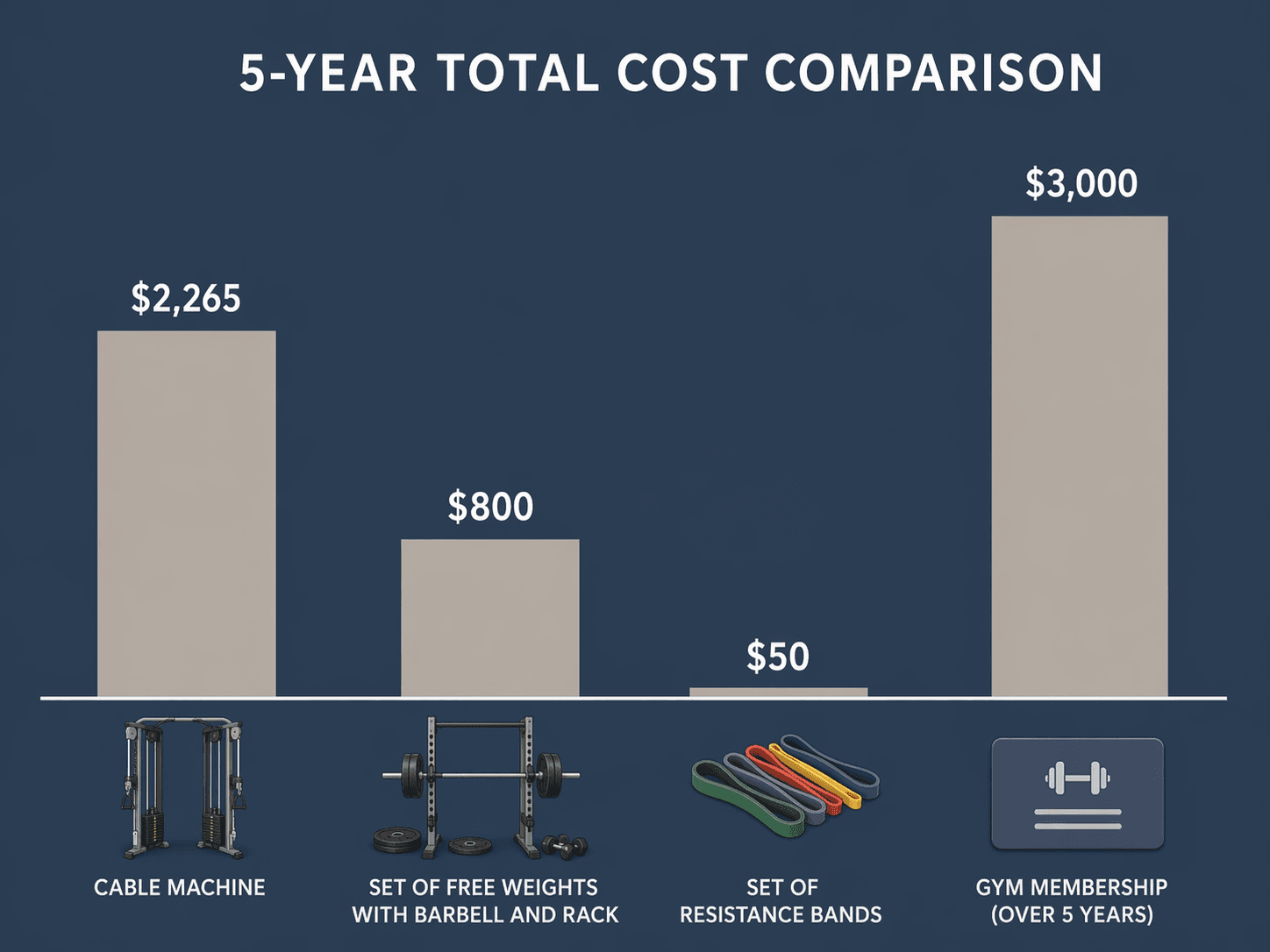
A cable machine costs, on average, $2,265. A set of resistance bands costs $10–$50. A basic free-weight setup with a bar, plates, and a squat stand runs $200–$800. A gym membership is $50–$100 a month.
That 45x difference between the cable machine and the bands — using the high end of band prices — is not merely a price gap. It is the central question of this article: does the cable machine produce a result that the cheaper options cannot? If the answer is no, the price is too high. If the answer is yes, the question becomes whether that result matters to you.
How much does a cable machine actually cost?
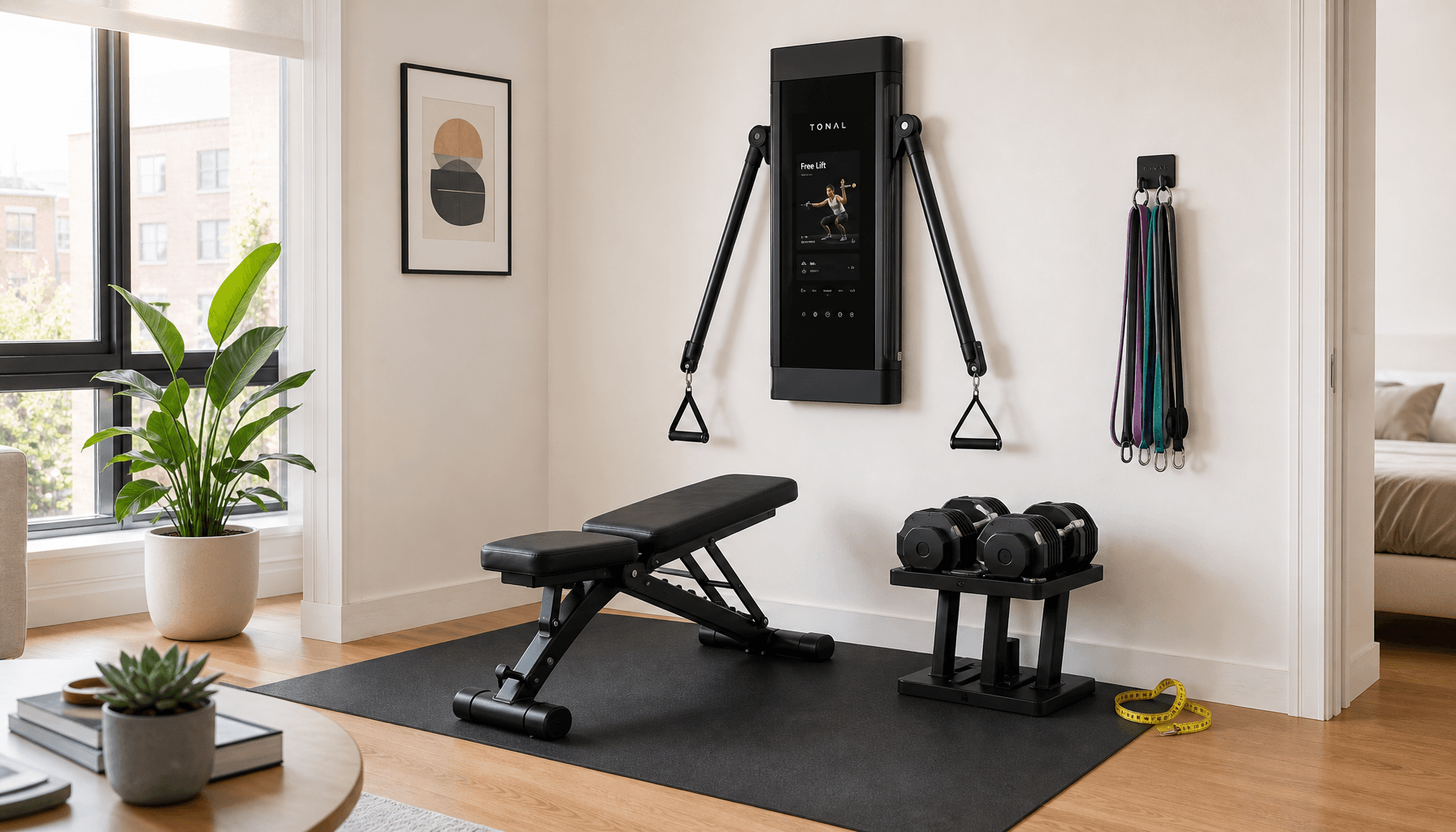
The average figure of $2,265 comes from Garage Gym Reviews’ testing of over 30 cable machines. That is the midpoint of a wide range. A plate-loaded cable tower like Bells of Steel’s runs $419 if you already own plates. A wall-mounted unit like Torque ANKER 3 starts at $1,199. A smart machine like Tonal 2 hits $4,295 plus $59 a month. The cheap options exist, but they tend to sacrifice something — stability, range of motion, or smoothness.
Here is the five-year picture for each option:
| Option | Upfront cost | Monthly cost | 5-year total |
|---|---|---|---|
| Cable machine (average) | $2,265 | $0 | $2,265 |
| Free weights (basic set) | $500 | $0 | $500 |
| Resistance bands | $30 | $0 | $30 |
| Gym membership | $0 (initiation fee waived) | $50 | $3,000 |
| Gym membership | $0 | $100 | $6,000 |
The cable machine hits breakeven against a $50 membership in about 3.8 years. That is a useful number, but I would not treat it as a formula. It assumes you keep using the machine. The behavioral risk is real: a membership that gets cancelled is cheaper than a cable machine that gathers dust.
For a broader look at total cost of ownership across compact home gym systems, see our full comparison of smart gyms, all-in-one units, foldable racks, and portable systems.
Where does a cable machine fit in your room?
A standard functional trainer needs roughly a 5-by-5-foot footprint plus 3 to 4 feet of forward clearance for cable crossovers and rows. That is the number from GXMMat’s guide. The industry standard dimensions for the frame itself are 25.6 inches long by 31.8 inches wide by 49.4 inches tall. But the clearance is what eats your room.
Let me put it in apartment terms. A typical 10-by-10-foot spare bedroom is 100 square feet. A cable machine with clearance needs about 45 square feet — almost half the room. You can still fit a yoga mat and a small dumbbell rack, but you are not also adding a bench, a barbell, and a rack. Free weights require less than half that footprint. Bands take up a drawer.
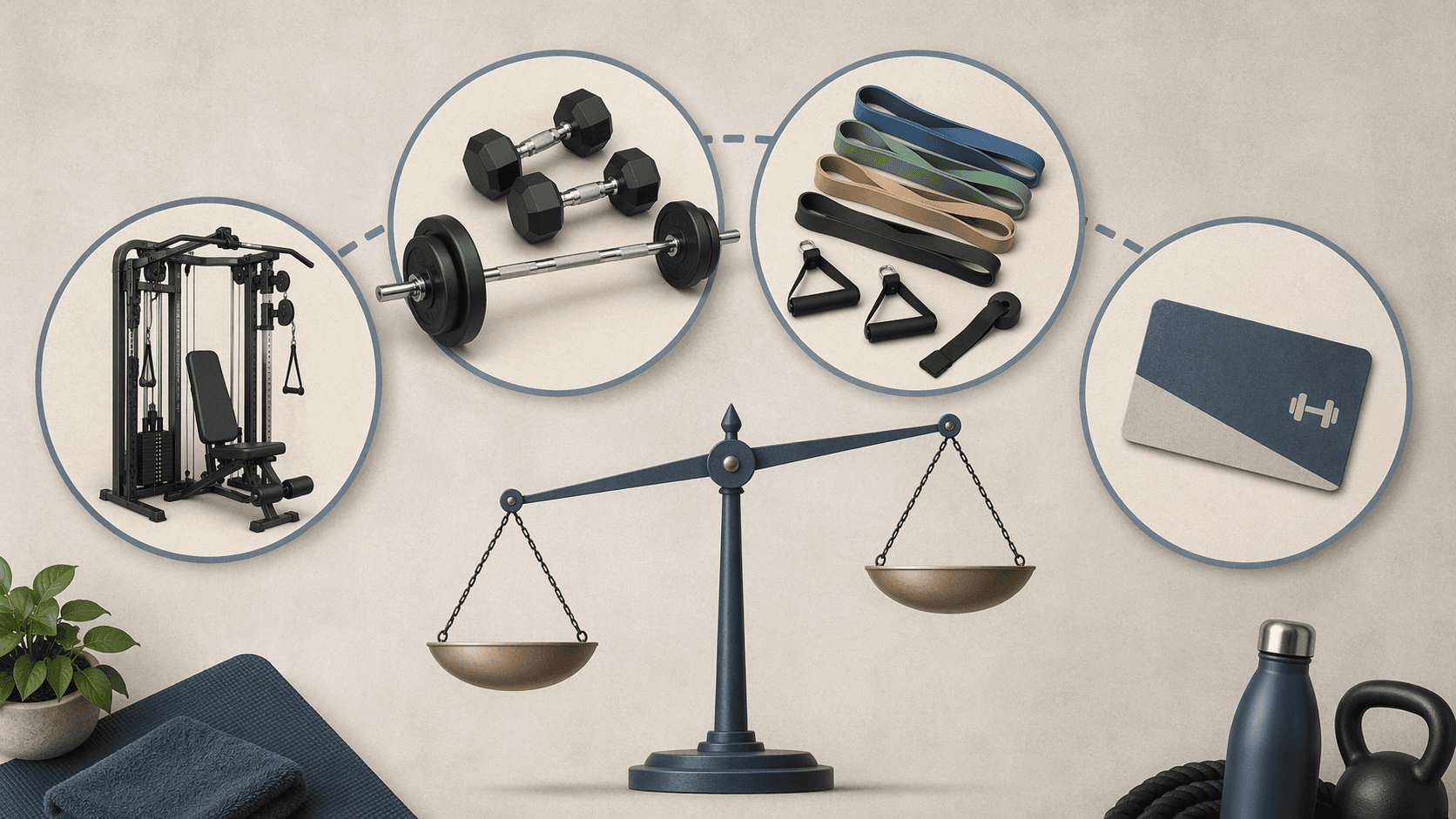
Do cables build more muscle? The 2023 meta-analysis says no.
The most common justification for paying a premium for cables is “constant tension builds more muscle.” A 2023 meta-analysis published in BMC Sports Science, Medicine & Rehabilitation examined exactly that question. It found no significant difference in hypertrophy between free-weight and machine-based training when volume was equated.
The caveat — “when volume was equated” — matters. It means that for the same number of hard sets, the muscle growth is similar. The advantage of cables is not that they produce better growth per set, but that they may make it easier to do more volume safely. That is a real benefit, but it is a safety and convenience benefit, not a biology benefit.
If your primary goal is maximal strength, free weights are still superior. You cannot progressively overload a cable machine the way you can add 5 pounds to a barbell squat or deadlift. The heaviest cable stacks top out at around 200–250 pounds per side, which is not enough for serious leg or back work.
What cables actually give you: safety and solo training to failure
After the meta-analysis, you might think cables have no benefit. They do — just not the one most people claim.
- Safer solo training to failure. Drop a cable handle; it clangs harmlessly. Drop a dumbbell near failure, and you risk your foot, your floor, or your neighbor’s ceiling.
- Constant tension through the range of motion. For isolation exercises like triceps pushdowns, cable flyes, or face pulls, the tension does not drop at the top or bottom the way it does with free weights.
- Exercise variety in one footprint. One cable machine can replace a lat pulldown, a low row, a cross‑over, and a dozen smaller movements. You still need a barbell for heavy compounds, but the cable machine condenses the isolation work.
For a beginner who never trains to failure, these advantages are small. For someone who trains alone and likes high‑intensity dropsets, they are significant.
The budget bridge: DIY pulleys for under $100
If the average price still seems steep but you want to test the cable experience, the DIY route exists. Gray Matter Lifting outlines a build for around $100 using pulleys, a cable, and a loading pin. You hang it from a pull‑up bar or rack. It works — but not as well as a commercial machine.
The trade‑offs are real: poor smoothness, limited stability, and usually no low‑pulley capability. If you have never used a smooth cable machine, you may not mind the roughness. If you have, you will be disappointed. The DIY option is a trial, not a long‑term solution.
A middle ground is the plate‑loaded cable tower. The Bells of Steel unit costs $419 and weighs 85 pounds. It gives you a smoother feel than a DIY rig and a lower entry price than a loaded functional trainer. But you still need plates, and the weight stack is not as convenient as a selectorized stack.
For a step‑by‑step guide on building a home gym on a budget, see our beginner’s phased equipment guide.
Who should buy — and who should skip
After the cost, space, evidence, and trade‑offs, the decision narrows to two profiles.
Buy if:
- You train alone most of the time and want to push sets to failure without a spotter.
- Isolation work (cable flyes, triceps pushdowns, face pulls) is a priority in your program.
- You have the budget and floor space (at least 5×5 ft plus clearance).
- You value the exercise variety that a single machine can provide.
Skip if:
- Your primary goal is maximal strength or hypertrophy on a budget. Free weights give far better value per dollar.
- You have a 10×10 room and need it for living space. Half the room is too much.
- You are unsure how often you will train. A membership that gets cancelled is cheaper than a machine that gathers dust.
- You already own a barbell, plates, and a rack. A cable attachment or bands can fill most gaps for far less.
So what should you do?
The conditional thesis stands. If you train alone to failure, want constant tension for isolations, have the space and budget, buy one. If strength or hypertrophy on a budget is your goal, free weights win. If you are not sure, start with bands or a DIY pulley to test the waters.
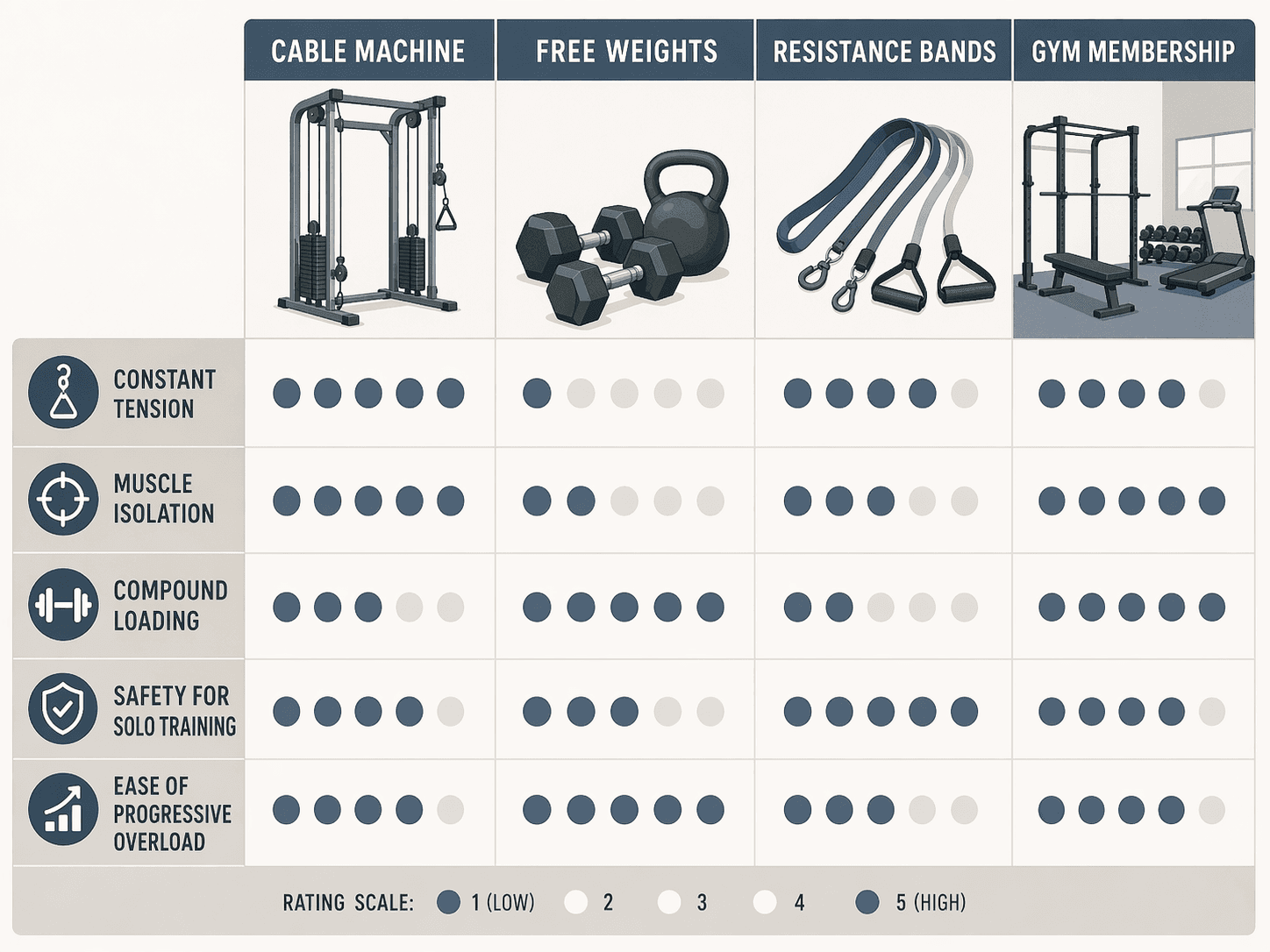
The weighted decision matrix below scores each option on the factors that matter most for the typical home gym buyer. Scores are 1–5.
| Factor | Cable machine | Free weights | Bands | Gym membership |
|---|---|---|---|---|
| Cost (lower = higher score) | 3 | 4 | 5 | 2 |
| Space required | 2 | 3 | 5 | 5 |
| Strength development | 3 | 5 | 2 | 5 |
| Hypertrophy potential | 4 | 4 | 2 | 4 |
| Safety alone | 5 | 2 | 4 | 5 |
| Exercise variety | 5 | 3 | 2 | 5 |
| Convenience at home | 5 | 5 | 5 | 1 |
If the cable machine scores highest for your personal priorities, buy one. If not, you have cheaper and equally effective alternatives.
If you decide to buy and are torn between an all‑in‑one machine and a modular setup, our cost comparison over five years can help.
Comments
Join the discussion with an anonymous comment.