Home Gym Equipment Mistakes: What First-Time Buyers Regret Most and How to Avoid Them
Most first-time home gym buyers waste money on equipment they don't use, can't fit, or soon replace. This article breaks down the five most common regret patterns—with real cost consequences and a pre-purchase checklist to help you buy right the first time.
Eight thousand six hundred and eighty-five dollars. That is what a Tonal 2 costs you after five years — $4,295 for the hardware plus $60 a month for the subscription. A comparable machine from Speediance, the Gym Monster 2, runs $3,689 with a free lifetime membership. The five-year difference is $4,996.
That is more than a down payment on a car. And it is what ignoring the subscription trap looks like in real numbers.
I wanted to know whether this kind of regret was the exception or the rule. The numbers I found suggest it is the rule — and the mistake pattern repeats across nearly every first-time buyer. But I will tell you up front: some of the numbers behind this article are stronger than others. The Tonal vs. Speediance comparison uses current pricing from mid-2025 and early 2026; I will call out where my confidence drops.
| Time Period | Tonal 2 | Speediance Gym Monster 2 |
|---|---|---|
| Upfront | $4,295 + $295–550 installation | $3,749 (includes free lifetime membership) |
| 2 years | $6,525 | $3,749 |
| 5 years | $8,685 | $3,749 |
| 10 years | $12,285 | $3,749 |
The $4,996 difference at five years is entirely the subscription. And that is assuming you keep paying. Chestpressmachine.com, aggregating industry sources, estimates that 40% of connected equipment owners cancel their content subscription within 12 months. I treat that 40% as an industry estimate, not a verified statistic — the original surveys are not published. Even a 25% cancellation rate would change the math significantly. The lesson: before you buy any smart gym, calculate the total cost at 2, 5, and 10 years. Subscription pricing in this category changes frequently; the figures above are based on publicly available pricing from mid-2025 to early 2026. Verify current rates.
So how common is this kind of miscalculation? A 2019–2020 survey of Garage Gym Experiment Instagram followers — skewed toward passionate owners, not a general population sample — found that 73% believe in the saying 'Buy once, cry once'. Yet among 400+ open-ended responses about the single biggest home gym regret, the second most common answer was 'not buying quality equipment in the first place'. The first was 'not starting sooner.' The belief is there; the follow-through is missing. These are self-reported, open-ended responses — indicative, not precise. But when the same two answers keep surfacing across hundreds of responses, you pay attention.
The Mistake That Costs $500–$2,000 Before You Lift a Weight
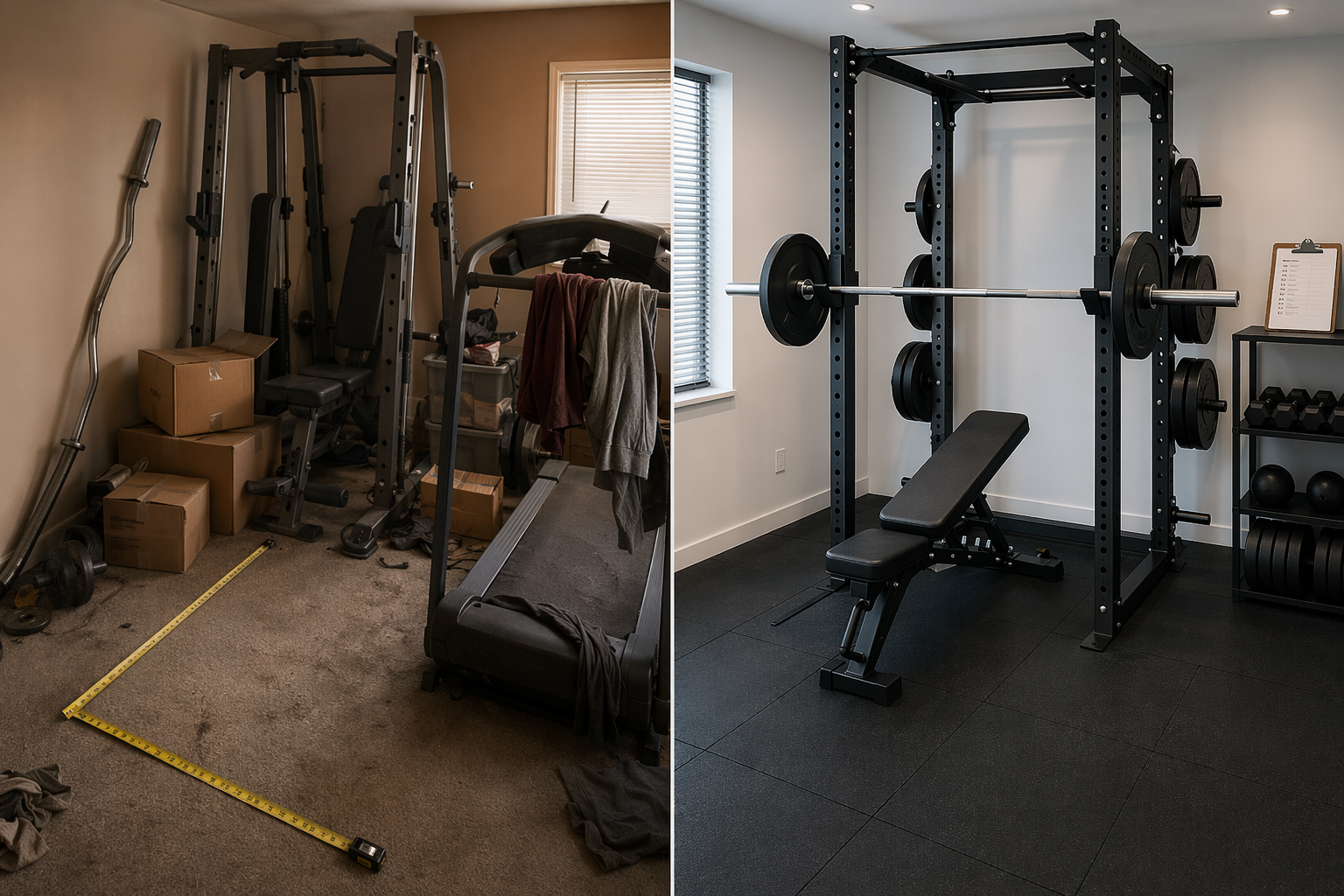
You think you know your space. You have a spare bedroom, a corner of the basement, half the garage. It looks big enough. So you order a power rack, a bench, a barbell, plates — the works. Then it arrives and the rack is two inches taller than your ceiling. Or it fits on the floor but you cannot load plates because the bar hits the wall.
That scenario plays out often enough that 52% of Garage Gym Experiment respondents reported ceiling height as an issue. Poor measurements, according to CTX Home Gyms — a commercial seller — cost buyers $500–$2,000 in shipping fees, restocking charges, and replacement purchases. That's a number I can work with. The fix is simple: measure everything. Floor space, ceiling height, doorway width, clearance for a loaded barbell on a bench press. Write it down. Compare against the equipment's specs before you click buy.
The Barbell That Bends
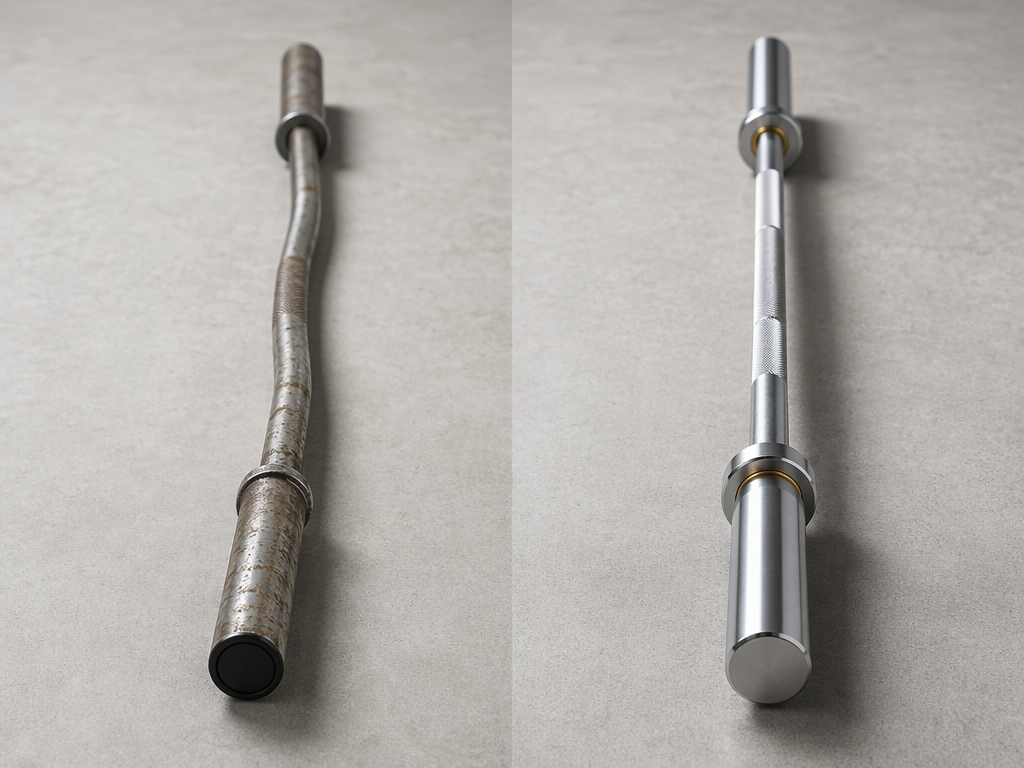
A barbell looks like a barbell. It is a long steel shaft with some knurling. The cheap one costs $100–150; the quality one costs $300–400. The difference is invisible in a product photo but measurable in the steel.
Texas Power Bars explains the threshold clearly: barbells with tensile strength below 150,000 PSI (pounds per square inch) are prone to bending under load. At 190k PSI, the bar is strong and reliable. At 200k+, it is high-performance. Cheap bars often skip or rush heat treatment, creating weak spots that fail early.
A bent bar is not just annoying — it is dangerous. The sleeve stops spinning properly, the load becomes uneven. You replace it, spending more than you would have if you had bought the quality bar upfront. The regret of 'not buying a decent barbell sooner' appears repeatedly in the Garage Gym Experiment responses. If you are building a home gym for strength training, budget at least $300 for the barbell. That is the price of a bar with 190k+ PSI tensile strength and a solid warranty. It will outlast everything else in the room.
The Machine You Outgrow Fast
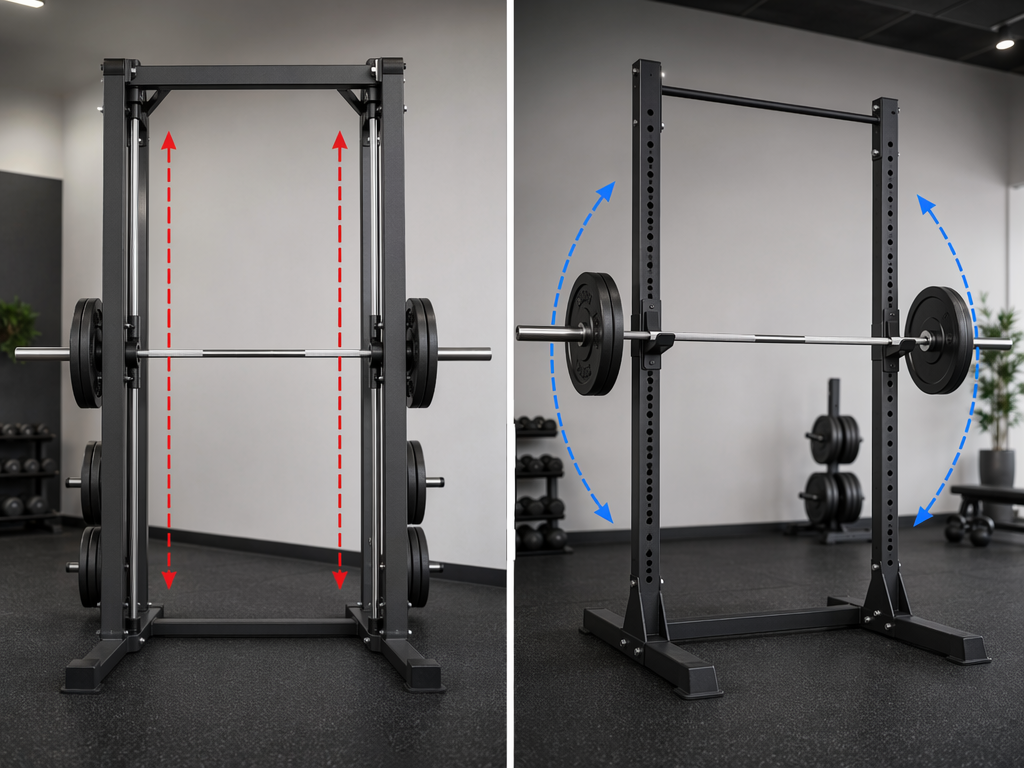
The Smith machine looks beginner-friendly: a barbell fixed on vertical rails, no risk of tipping, spotter arms built in. But it comes with a hidden cost: you outgrow it fast. The fixed bar path prevents natural movement, reduces stabilizer engagement, and limits exercise variety. A power rack, by contrast, allows free bar path and supports a full ecosystem of attachments.
Fitness Superstore summarizes the trade-off plainly: a Smith machine reduces stabilizer demand and is easier for solo training, but a power rack offers better free-weight carryover and long-term versatility. For a barbell-first garage gym, the power rack is the better foundation.
The regret data backs this up. Multiple respondents in the Garage Gym Experiment survey specifically cited 'not starting with a power rack' as a regret. That is a strong qualitative signal — when people name a specific piece of equipment they wish they had bought instead, you should listen.
Buying Everything at Once
There is an understandable impulse to get the whole setup in one order. You imagine the garage transformed overnight. So you max out the credit card on a treadmill, a cable machine, a lat pulldown, a leg press attachment, a rower, and a set of adjustable dumbbells.
Then you discover you actually use only the squat rack, the barbell, and the bench. The rest becomes an expensive clothes rack.
CTX Home Gyms claims that the average owner uses only 30% of purchased equipment regularly. That number comes from a commercial seller, so treat it with caution — their customer base may self-select for regret. But even if the real number is 40% or 50%, the pattern holds: a significant chunk of what people buy sits unused.
Meanwhile, 84% of experienced owners in the Garage Gym Experiment survey built their gym one piece at a time. That figure comes from a survey of Instagram followers of a home gym enthusiast account — not a random sample — but it is directionally consistent with the idea that experienced buyers learn to add incrementally. They buy a rack, use it, figure out what they need next, and add incrementally.
If you are starting fresh, buy a power rack, a quality barbell, a set of plates, and an adjustable bench. That is enough to run a full-body strength program for months. Add equipment only when you can identify a movement you genuinely cannot do with what you have. This approach not only saves money but also helps you understand what you actually need. For a broader look at what fits different constraints, the Best Home Exercise Equipment: A Constraint-Based Buying Guide for 2026 is worth reading alongside this.
A Pre-Purchase Checklist
Every mistake above shares a single root cause: the buyer jumped straight to product selection without first diagnosing their space, budget, usage patterns, and long-term costs. Here is a short checklist that operationalizes what the numbers tell us. Go through it before you buy anything.
- Measure your space with exact dimensions: floor area, ceiling height, doorway width, clearance for a loaded barbell on bench press. Write down the numbers and compare them against the equipment specs.
- Set a budget that allocates at least $300–400 for a quality barbell (190k+ PSI tensile strength, solid warranty). Do not compromise here.
- For any smart gym or subscription-based equipment, calculate the total cost of ownership at 2, 5, and 10 years. Factor in cancellation likelihood. If you are not sure you will use guided workouts for years, prioritize hardware with a free or low-cost membership option.
- Plan to build incrementally. Start with a power rack, barbell, bench, and plates. Add equipment one piece at a time as you identify actual gaps in your training.
If you are completely new to home workouts, the How to Start Working Out at Home: A Beginner's Guide is a good next step. For a structured way to match equipment to your specific constraints, the Home Gym Equipment Decision Framework provides a more detailed path.
The numbers are clear. The regret is predictable. The only step that truly matters is the one you take before you open your wallet.
This result comes from one real apartment under the stated conditions — it is a strong signal, not a guarantee your space will measure identically.
Builds this evidence supports
Cable Machine Alternatives That Save Space and Money
Compare the best cable machine alternatives for home gyms – from resistance bands and pulley systems to suspension trainers and compact digital units – and find the right option for your space and budget.
How to Choose a Compact Home Gym That Works for Your Space, Budget, and Noise Tolerance
This article provides a structured decision framework for apartment dwellers and small-space residents to match their specific floor footprint, noise sensitivity, and budget to the most suitable compact home gym strategy — whether that's an all-in-one machine, modular build, smart digital system, or band/bodyweight setup.
The Garage Gym Reality Check: What Equipment Actually Fits in a Single-Car Garage
Most garage gym guides assume a two-car space. This article uses real dimensions, real equipment footprints, and three layout templates to show what fits—and what doesn't—in a single-car garage (10x20 to 12x20 ft).
Spot something off?
If this result didn't match your own space, let us know — floor-damage and noise claims carry real deposit-risk consequences if we get them wrong.