
Search for a home gym machine and the results look as if they belong in the same aisle. They do not. A wall-mounted smart gym, a dual-stack cable trainer, a Smith-machine combo, a rack-mounted cable system, and a 17-pound band kit can all be sold under that phrase, even though they solve different problems and create different ones.
That matters before brand, before attachments, and before the product photo that somehow always shows a spare room with perfect lighting. Garage Gym Reviews’ 2026 testing pool puts the average price across more than 50 home gym machines at roughly $1,855, but that average mixes a $549 band-based system with a $4,200 all-in-one machine and several smart gyms whose real cost depends on years of subscription payments.[1] The midpoint is less useful than the spread.
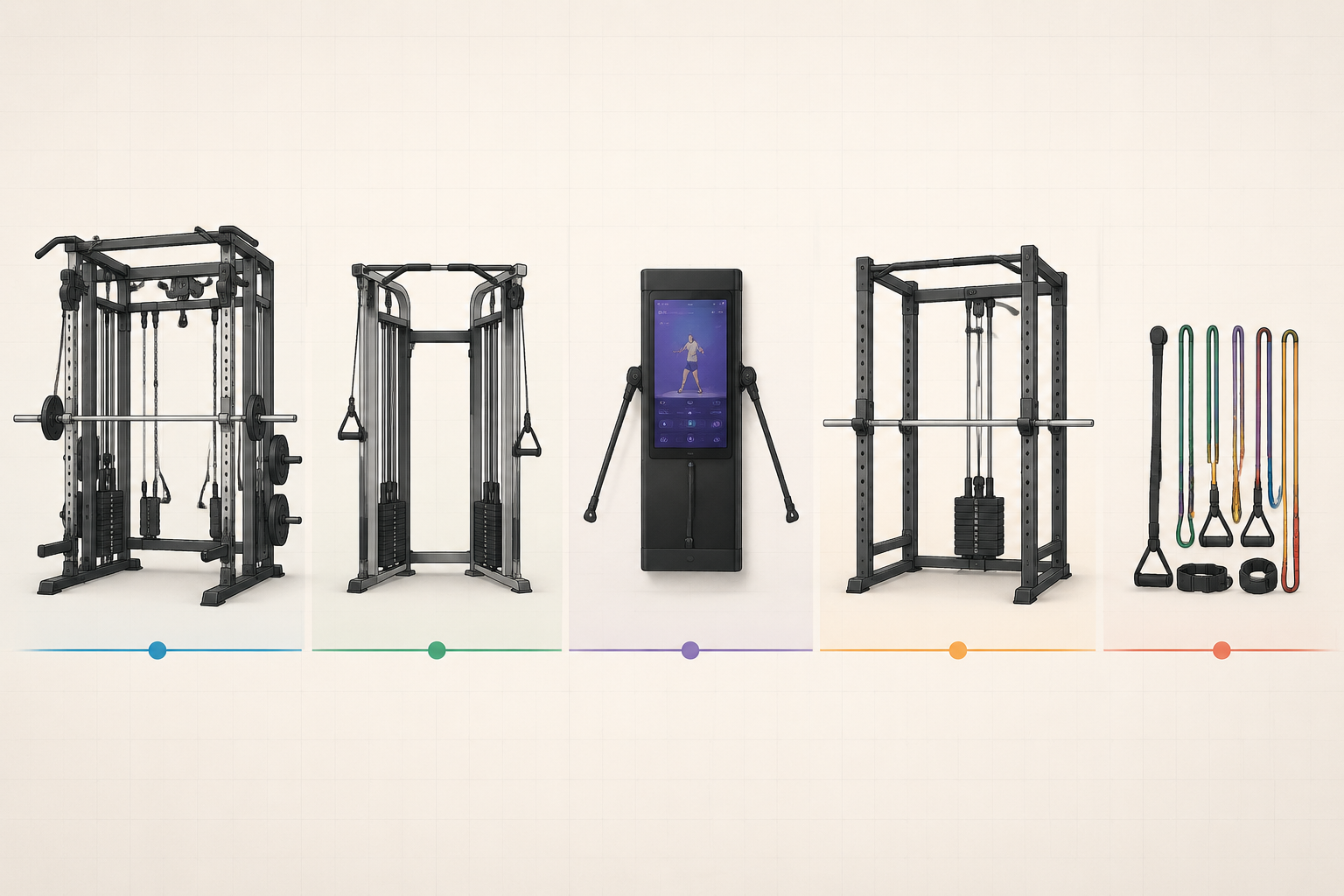
The five machines hiding inside one search term
The fastest way to shop better is to stop comparing unlike machines. A deeper systems-level comparison can help once you know the lane, but the first cut is simpler: identify the constraint you actually need the machine to solve.
| Category | What it solves best | What it tends to make worse |
|---|---|---|
| All-in-one combo | Lots of exercise stations in one footprint, often with Smith-style pressing and cable work | High upfront cost, complicated assembly, shorter warranty exposure on some models |
| Functional trainer | Smooth cable training with a commercial-gym feel and no subscription | Large floor footprint and fewer barbell or rack functions unless paired with other gear |
| Smart or digital resistance gym | Guided programming, compact storage, and resistance without weight stacks | Recurring fees, lower max resistance than heavier stack or rack systems, mounting or moving friction |
| Power rack plus cable hybrid | Long-term strength training, upgrades, resale value, and rack-based expansion | Requires a compatible rack and more commitment to a dedicated setup |
| Band-based system | Low cost, portability, and storage in almost no space | Elastic resistance feels different from stacks, plates, and digital motors |
Nearly every category can claim “full-body training.” That phrase does not decide much. The better questions are more physical: does the resistance pull from a cable, stretch from a band, or come from a motor? Does the machine stay useful when you get stronger? Can it move with you? Does it need a wall, a rack, a subscription, or all three?
Resistance feel decides more than the exercise list
Exercise menus are easy to inflate. Resistance feel is harder to hide. A cable stack lets you pull through a line of force with familiar weight increments. A Smith-machine combo gives you a fixed bar path, which can make pressing and squatting feel more controlled but less free than a barbell. A digital gym can make 100 pounds feel surprisingly heavy because there is no weight-stack momentum helping the rep. A band system gets harder as the band stretches, so the hardest point may arrive near the top of the movement rather than at the same place it would with plates.
None of those is automatically better. They just favor different users. Someone who wants a cable row, triceps pressdown, face pull, lateral raise, and controlled single-leg work may be happier with a functional trainer than with a compact smart screen. Someone who wants guided sessions and very little visible hardware may accept the feel of digital resistance because the machine actually gets used. Someone building toward heavy barbell work should be careful with any category that cannot grow with the lifts they care about.
All-in-one combos: versatile, heavy, and not always forgiving
All-in-one machines are the category that most closely matches the old idea of a home gym station: one large frame, several training zones, and enough attachments to make the product page look reassuring. Modern versions often combine a Smith machine, cable pulleys, pull-up handles, storage, and sometimes plate-loaded or selectorized resistance. The appeal is obvious in a garage or spare room where one footprint has to cover pressing, pulling, squatting patterns, and accessory work.
The trade-off is that these machines are not small decisions. Garage Gym Reviews lists the Major Fitness B17 at $4,200 with a 1-year warranty, which puts it near the expensive end of the tested home gym machine range and also makes the warranty worth noticing.[1] A machine this large can still be the right buy, but it should not be treated as a casual upgrade from dumbbells.
This category fits best when the room is already committed to training and the buyer wants one central structure rather than a growing collection of separate pieces. It fits less well when the home situation is temporary, when assembly help is uncertain, or when the buyer is mainly attracted to the number of listed exercises. More stations are only useful if the frame, cable path, and resistance setup match how you actually train.
If this is the lane you are considering, use an all-in-one exercise machine buyer’s guide after you have measured the room, checked ceiling height, and decided whether a fixed Smith path is something you want rather than something you are merely tolerating.
Functional trainers: the cleanest cable choice, if the room can take it
A functional trainer is less theatrical than an all-in-one combo and often easier to understand: two adjustable cable columns, weight stacks, handles, and a lot of usable training angles. For people who like cable machines at a commercial gym, this category has the least translation cost. You already know what a cable fly, row, pulldown variation, rotation, curl, or pressdown should feel like.
The Titan Fitness example in the 2026 comparison data costs $2,999 and uses dual 200-pound stacks with a 2:1 ratio, meaning the felt resistance at the handle is lower than the number printed on the stack.[1] That ratio is not a flaw by itself; it can make cable travel smoother and more usable for accessory movements. It does mean a buyer should read stack weight and pulley ratio together, not as separate bragging points.
Functional trainers make the most sense for someone who wants cable variety without a coaching screen and without recurring software costs. They make less sense for a tiny room, a renter who may move soon, or a lifter whose main goal is barbell progression. They can sit at the center of a very good home gym, but they are not a rack replacement unless the rest of the setup covers that work.
For buyers stuck between a cable column, dual-stack trainer, and bigger multi-station frame, a cable machine format breakdown is more useful than another list of exercises.
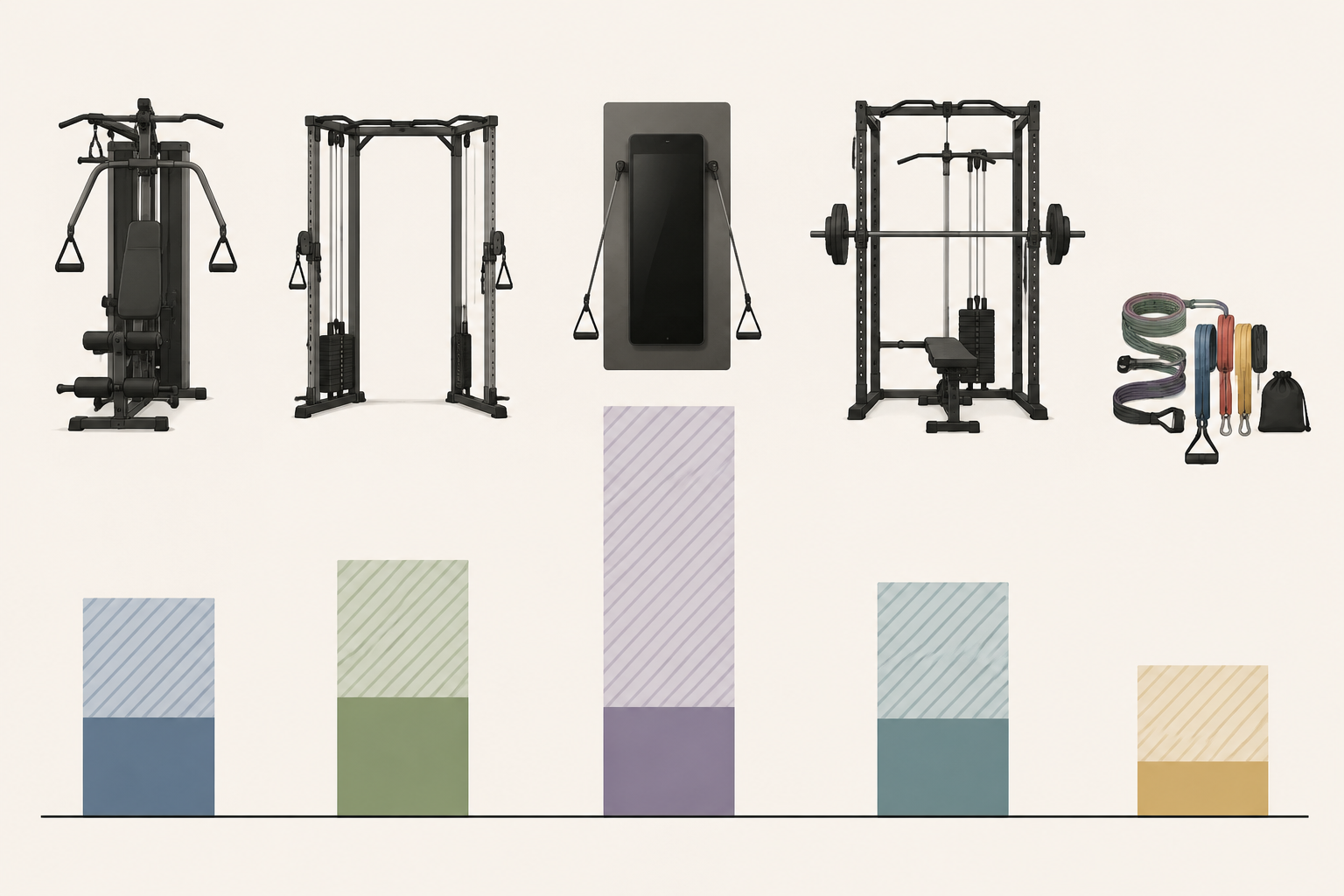
Smart gyms: compact hardware, complicated ownership
Smart and digital resistance gyms deserve the extra scrutiny because they are easy to admire for the right reasons and buy for the wrong ones. They can reduce visible clutter, guide workouts, track progress, and remove the intimidation of programming. PCMag’s 2026 smart home gym coverage includes Tonal 2 at $4,295 plus a $59.95 monthly membership, with up to 250 pounds of digital resistance.[2] CNET’s 2026 smart gym coverage lists Speediance Gym Monster at $3,199, with 220 pounds of resistance and no required subscription.[3]
Those two examples show why this category should not be treated as one thing. A wall-mounted machine and a freestanding digital gym can both save space compared with a large cable station, but they do not create the same ownership problem. Wall mounting raises installation, wall suitability, landlord, and moving questions. A freestanding unit avoids some of that friction, though it still asks the buyer to accept digital resistance and a lower resistance ceiling than many heavy stack or rack-based setups.
The subscription line is where the math changes fastest. A machine with a $39 to $60 monthly fee can add more than $3,000 over five years compared with a non-subscription machine.[2] That does not make it a bad purchase. It means the screen, coaching, classes, metrics, and software support are part of the product, not a bonus floating above the price tag.
There is also a training-style ceiling. Digital resistance can feel heavier per pound because it does not behave like a moving stack or barbell, but max resistance in the 220- to 250-pound range changes the conversation for heavy lower-body work.[2][3] A beginner may not care. An intermediate lifter who expects to keep loading squats, deadlifts, or barbell-style pulls should care before the machine is bolted to the wall.
Industry-cited preference numbers point toward real interest in connected training, but they should be read carefully. Speediance cites research saying 63% of users prefer smart or connected equipment and 48% use AI tracking; the original report was not available in the research materials, so those figures are better treated as industry-cited attitude signals rather than independent proof that smart gyms produce better training outcomes.[4]
This category is strongest for someone who wants instruction, low clutter, and a machine that reduces the planning burden. It is weaker for someone who dislikes subscriptions, moves often, wants easy resale, or expects the machine to behave like a traditional weight room. If your living situation is the main variable, compare smart gyms by apartment, house, wall, and moving constraints rather than by the sleekness of the interface; a smart gym living-situation guide is the more honest filter.
Power rack cable hybrids reward the buyer who is already building
A power rack plus cable attachment hybrid is not the friendliest first answer for someone who just wants a machine. It assumes the rack matters. It assumes the room can hold the rack. It assumes you are comfortable with a setup that grows in pieces rather than arriving as one polished appliance.
For the right buyer, that is exactly the point. REP’s Ares 2.0 is listed at $2,999 with dual 260-pound stacks, an upgrade path to 310-pound stacks, and a lifetime warranty.[1] Those details pull in a different direction from the smart-gym pitch. Instead of minimizing hardware, the rack hybrid turns the rack into the base of the system and makes future upgrades part of the plan.
This is the category for someone who values heavier long-term strength training, repairability, accessory compatibility, and resale. It is not the category for a buyer hoping a machine will make training decisions feel effortless. The machine may be versatile, but the owner still has to know why the rack exists, which attachments matter, and how much room the barbell needs outside the rack footprint.
The compatibility requirement is the catch that should stop casual cross-shopping. A rack-mounted cable system is not merely a cheaper functional trainer or a more serious smart gym. It is an expansion path for a rack-centered home gym. If you do not want the rack, the hybrid loses much of its logic.
Band-based systems are not toys, but they are different
Band-based systems invite lazy dismissal because they look small next to steel frames and digital screens. That is a mistake. Garage Gym Reviews’ compact equipment coverage lists the X3 Bar at $549 and 17 pounds, which is a completely different ownership proposition from a multi-thousand-dollar machine that arrives on a pallet.[5] It can fit in an apartment, travel, or disappear into a closet.
The evidence does not support treating elastic resistance as useless. A 2019 systematic review and meta-analysis in SAGE Open Medicine found that elastic resistance training produced strength gains comparable to conventional resistance training in many movements.[6] That finding supports a narrower point: bands can build strength when programmed seriously. It does not mean a band system feels like a weight stack, replaces every barbell lift, or suits every progression goal.
Elastic resistance changes across the rep. Depending on the movement, that can be useful, awkward, or simply unfamiliar. A band chest press, squat pattern, row, or deadlift variation will not load the body in the same way as a cable stack or barbell. The buyer who understands that difference may be very happy; the buyer expecting a compact version of a commercial machine may feel misled.
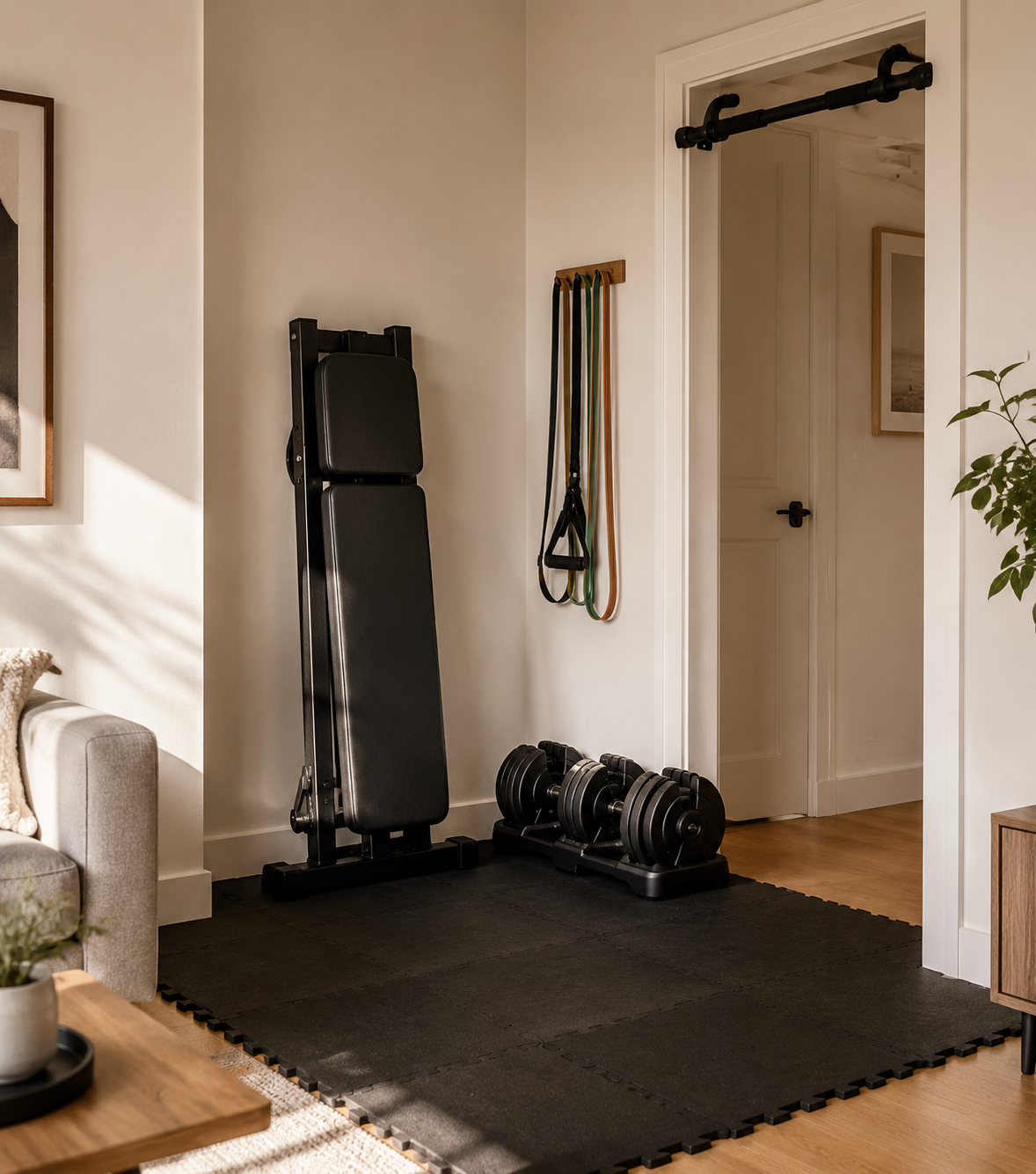
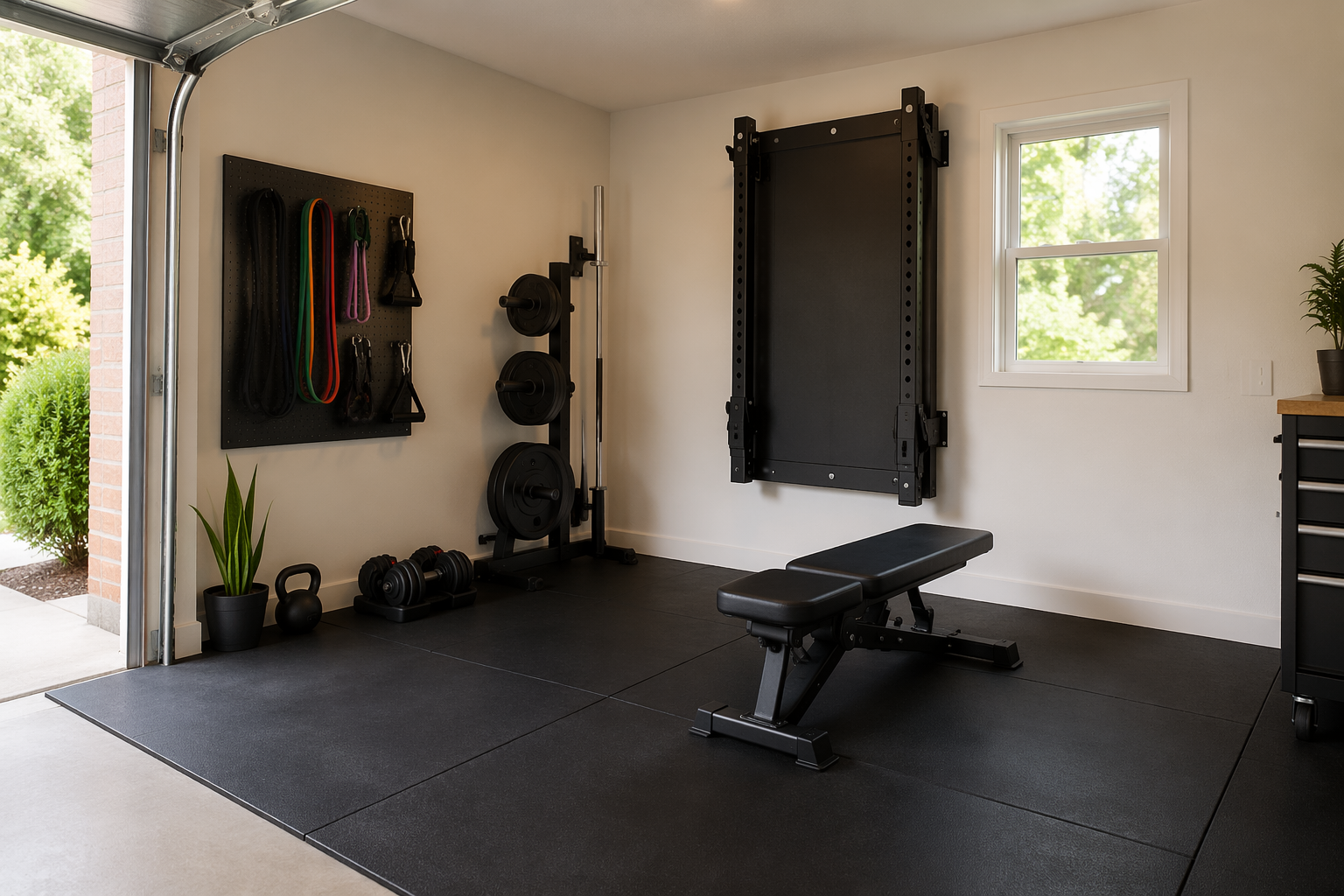
This category is strongest when budget, storage, and portability are the true constraints. It is weakest when the buyer wants the feel, stability, and upgrade path of a fixed machine. For a small room, it belongs in the conversation alongside compact benches, adjustable dumbbells, cable towers, and smart gyms, not beneath them by default.
The cost that does not fit on the product card
Upfront price is only the first bill. Delivery, assembly, wall installation, floor protection, attachments, replacement parts, app access, and the cost of moving the machine can all change whether a home gym machine still feels like a good decision after the first month.
The cleanest split is subscription exposure. A traditional functional trainer, rack hybrid, all-in-one machine, or band system may still need attachments, but it does not usually ask for a monthly fee to preserve its core use. A subscription smart gym may be less expensive than a full rack build on day one, then become more expensive over a five-year window if the fee is required or central to the experience.[2]
Warranty and resale also deserve more attention than they usually get. A lifetime-warranty rack attachment and a 1-year-warranty all-in-one do not carry the same risk profile, even if both look sturdy in a showroom image.[1] A machine that can be disassembled, repaired, upgraded, and sold into a known rack ecosystem is different from a machine whose value depends on software, service continuity, or a buyer who has the right wall for it.
For readers comparing cable-based options specifically, a five-year cable machine cost model is a better next step than comparing only the sale price.
Use your constraint to eliminate categories
A good home gym machine is not the one with the longest feature list. It is the one that leaves the fewest serious mismatches between your room, training style, budget, and tolerance for ownership friction. Start by naming the constraint that would actually ruin the purchase.
- If space and visual clutter are the hardest limits, look first at smart gyms, compact cable formats, and band-based systems.
- If guided programming is what keeps you consistent, smart gyms deserve serious consideration even when the subscription math is inconvenient.
- If cable feel matters more than coaching, start with functional trainers or rack-mounted cable systems.
- If long-term strength progression and upgrades matter most, focus on a rack hybrid or rack-centered build.
- If budget, storage, and portability dominate the decision, do not skip band-based systems just because they look less permanent.
- If you want one large station and have a committed room for it, compare all-in-one combos by frame, resistance path, warranty, and assembly demands.
This usually eliminates at least two categories quickly. A renter who moves every year should be cautious with wall-mounted smart hardware and massive all-in-one frames. A lifter who already owns a rack should not ignore cable attachments just because standalone functional trainers look cleaner. A beginner who needs instruction may get more from a smart gym than from a heavier machine that sits unused. A buyer trying to stay near the lowest possible budget should not pretend a subscription machine and a portable band system are competing on the same cost basis.
Once the category is right, model comparisons become much easier. Within that narrower lane, compare resistance capacity, footprint, warranty, delivery path, attachment ecosystem, software dependence, and whether the machine can survive the next version of your home.
References
- The Best Home Gym Machines in 2026: Tested for Versatility, Durability, and Performance — Garage Gym Reviews
- The Best Home Gym Equipment We've Tested for 2026 — PCMag
- Fitness Expert-Approved Smart Home Gyms Worth Splurging On (2026) — CNET
- 2026 Multi-Function Home Gym Comparison — Speediance
- Expert-Tested: The Best Compact Exercise Equipment (2026) — Garage Gym Reviews
- Effects of training with elastic resistance versus conventional resistance on muscular strength: A systematic review and meta-analysis — SAGE Open Medicine, 2019
Comments
Join the discussion with an anonymous comment.