
The awkward moment comes right before checkout, when the machine looks affordable enough on the product page and expensive enough to make you hesitate. If you are trying to choose the best workout machine for home use, the sticker price is only the first bill. Over five years, the real cost depends on whether the machine needs a paid app to feel complete, how long the hardware is likely to last, what upkeep it needs, and whether someone else would still want to buy it from you later.
For a budget-conscious buyer, that changes the comparison. A compact smart gym may look easier to live with than a rack. A traditional all-in-one may look old-fashioned next to a screen. A power rack may look cheap until you remember the barbell, plates, bench, flooring, and the fact that nobody inside the rack is going to coach your squat. The useful question is not which one looks most impressive on day one. It is which one still makes financial and training sense in year five.
The Five-Year Cost Model
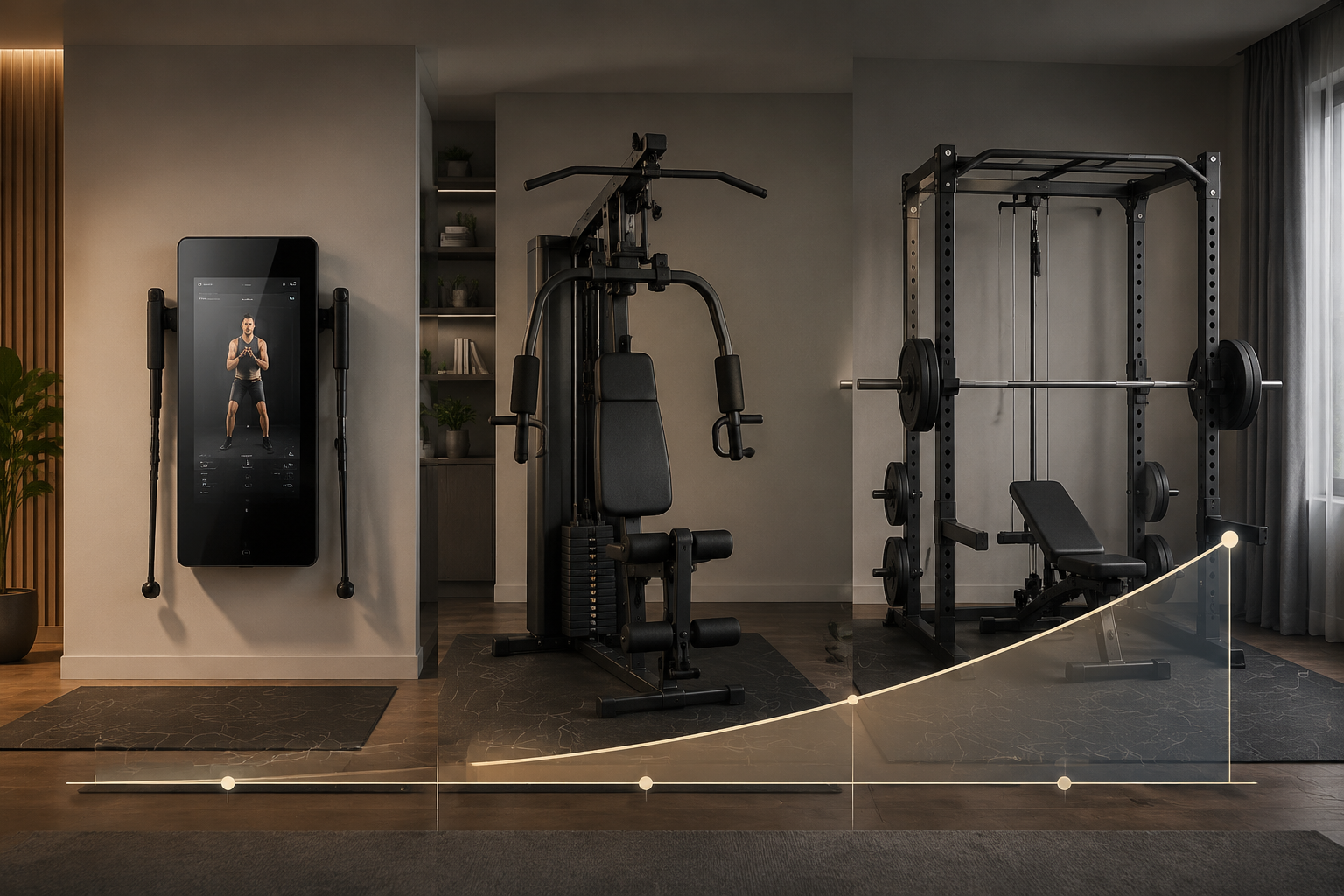
The model below compares three equipment categories: smart home gyms, traditional all-in-one machines, and power rack setups. It uses current category examples from tested home-gym pricing and specs, including Tonal 2 from $4,295 plus $59.95 per month, Speediance Gym Monster around $3,200, and Major Fitness B17 Flying Fortress around $4,200.[1] Product prices move with sales, so the table is better read as a decision frame than a quote.
| Category | Typical upfront cost | Subscription over 5 years | Lifespan and resale modifier | Likely 5-year value judgment |
|---|---|---|---|---|
| Smart home gym | About $3,200-$4,295+ for common examples | $780-$3,597 if the subscription runs $12.99-$59.95/month | Electronic-heavy equipment tends to depreciate faster; usefulness can depend on continued platform support | Highest risk-adjusted cost unless coaching and compactness keep you paying |
| Traditional all-in-one machine | About $1,500-$4,200 | $0 required | Strength machines commonly fall in a 10-15 year lifespan range, with quality strength equipment retaining about 50-70% in resale value | Usually strong long-term value if you have room and like the movement options |
| Power rack setup | About $1,000-$2,000 to start, before optional upgrades | $0 required | Often the longest useful life, with simple parts and strong used-market demand | Often the lowest long-term cost, but only if you can train safely and have the space |
The subscription line is the one people tend to mentally shrink. A monthly fee from $12.99 to $59.95 becomes about $156 to $719 per year, and $780 to $3,597 over five years before any hardware repair, accessory upgrade, or resale adjustment.[2] That math is not automatically a deal-breaker. It is a deal-breaker only when the subscription is not the thing that keeps you training.
A traditional all-in-one machine has a different failure mode. It can become a coat rack, absolutely. But if you stop using it for six months and come back, the lat pulldown, press arms, cables, and weight stack do not ask for a login. A power rack is even blunter: if the frame is sound, the barbell is straight, and the plates are usable, the system still works.
What the Sticker Price Leaves Out
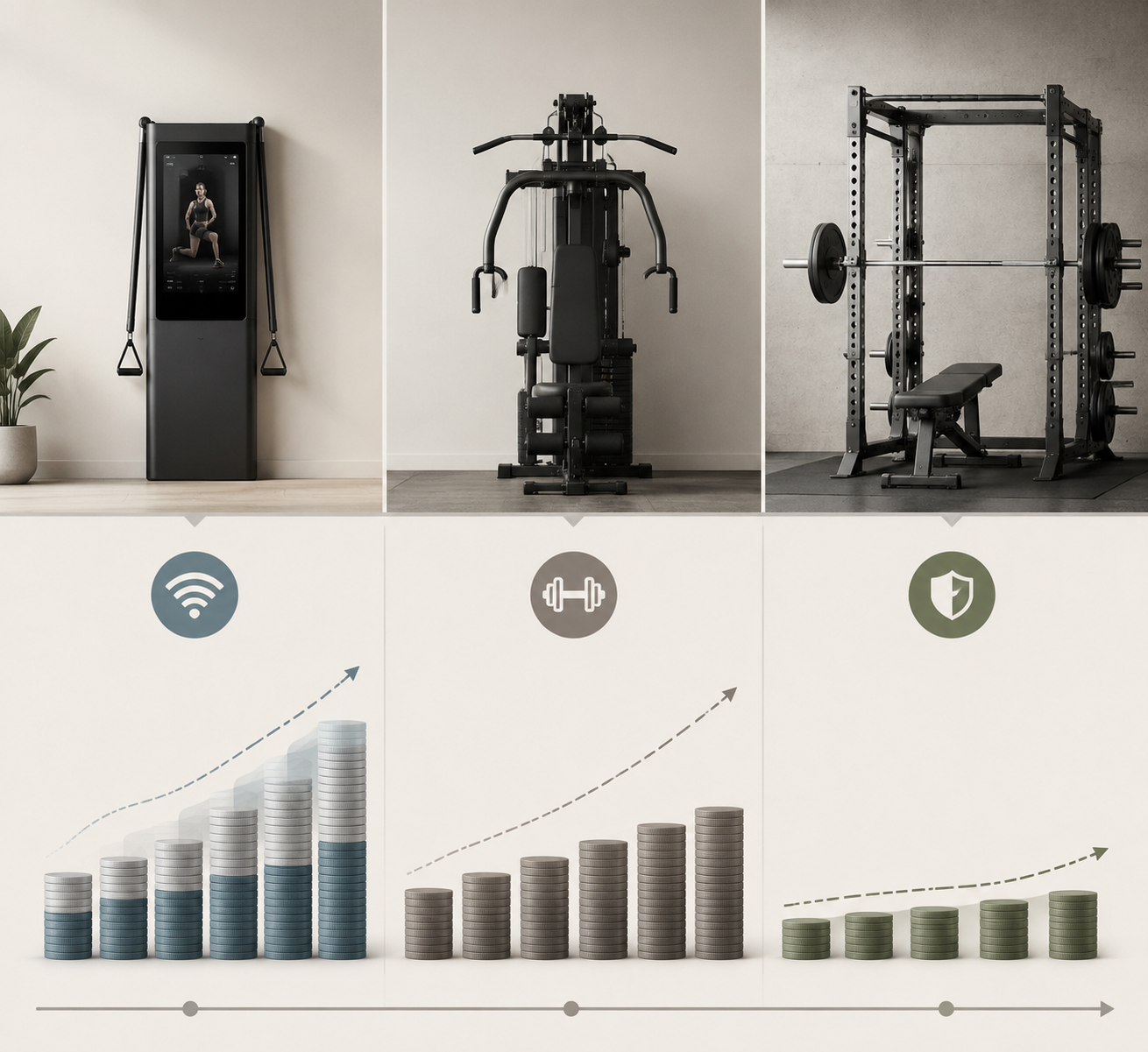
A home gym setup averages $2,837, while a budget starter setup can land around $500-$1,000.[3] That broad range is why a single “best” machine answer is usually slippery. A buyer comparing a $3,200 compact smart gym with a $4,200 all-in-one machine is making a different decision than someone comparing a starter rack package with a premium digital resistance system.
Still, the cost categories are predictable:
- Upfront equipment cost: the machine, rack, bench, bar, plates, attachments, delivery, and installation where relevant.
- Required software: the recurring subscription that unlocks classes, tracking, coaching, form feedback, or guided programs.
- Maintenance and wear: cables, pulleys, upholstery, bolts, lubrication, batteries, sensors, screens, and ordinary inspection.
- Useful lifespan: how many years the equipment can reasonably keep doing its job.
- Resale value: what the used market is likely to pay after several years of ownership.
That last line matters more than it gets credit for. Used fitness equipment is not worthless by default. General resale observations put exercise equipment around 40-60% of original price after three years, while quality strength equipment can retain about 50-70%; electronic-heavy equipment tends to depreciate faster.[1] The exact number depends on condition, location, brand reputation, and whether there are buyers nearby who can move the thing.
Smart Gyms: Compact Hardware, Expensive Continuity
Smart gyms solve real problems. They reduce the visual mess of a home gym. They can make strength training feel less intimidating. They can put programming, tracking, tempo cues, resistance changes, and video instruction in one place. For someone in a small apartment who does not know how to build a program, that can be the difference between training and not training.
The financial problem is that many smart gyms are not just machines. They are machines attached to ongoing software value. Tonal 2, for example, is listed at $4,295 plus a $59.95 monthly membership, with a wall-mounted footprint of 5.25 inches deep, 21.5 inches wide, and 50.9 inches high.[1] That footprint is genuinely impressive. The five-year subscription bill is also genuinely material.
This is where a smart gym buyer needs to be unusually honest. If you love coached sessions, tracking, and a polished interface, the monthly fee may buy consistency. If you are buying the machine because it looks clean and promising, but you usually cancel apps after the novelty fades, the risk is not theoretical.
The Cancellation Test
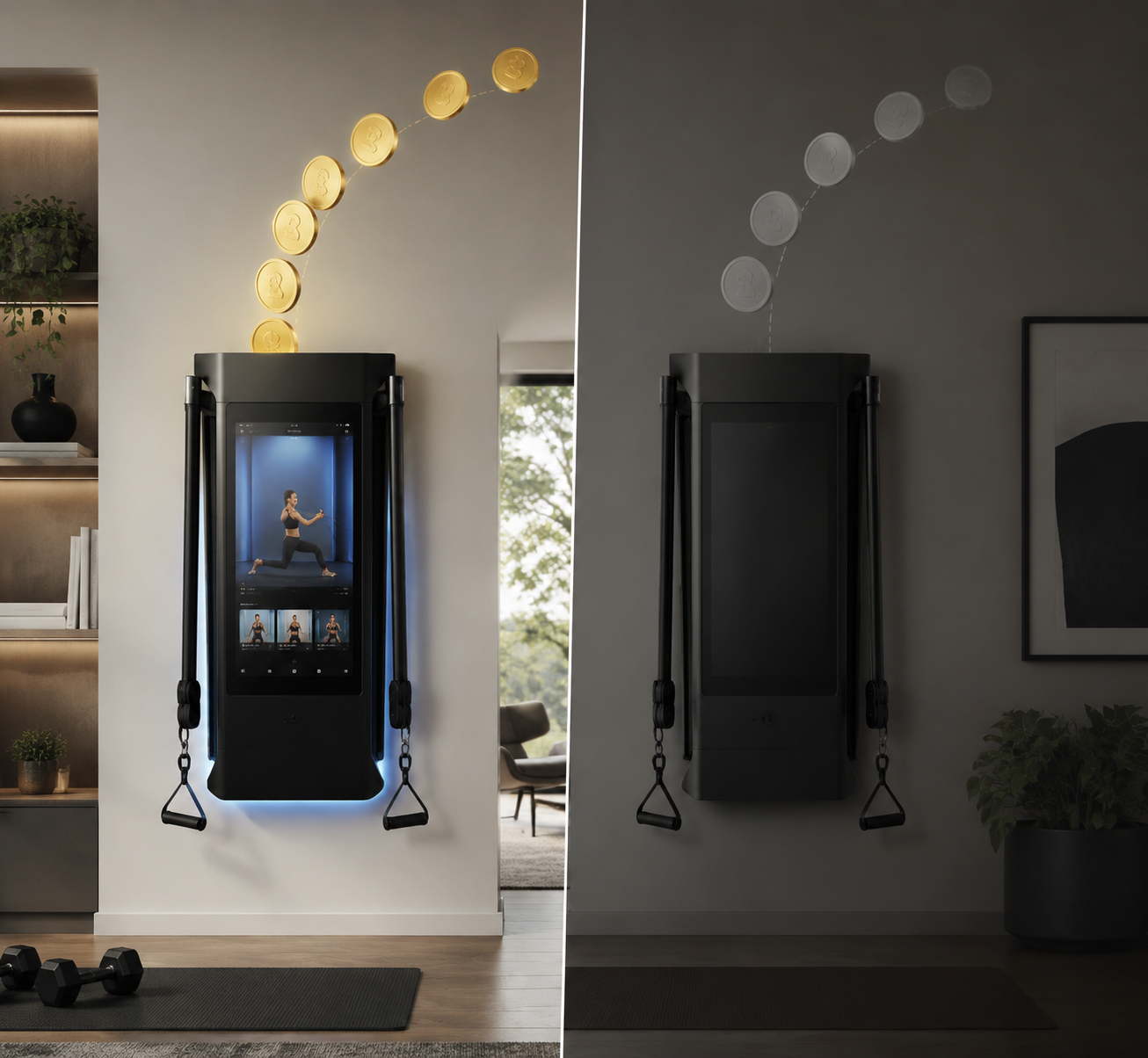
The most important number in this comparison is not the highest monthly fee. It is the reported 40% of connected equipment owners who cancel their subscription within 12 months.[4] That figure should make every smart gym buyer pause, because the hardware stays in the room after the service stops.
A canceled subscription does not affect every product in the same way. Some machines may retain basic resistance functions, while others lose the guided content, tracking, recommendations, or features that made the product feel worth buying. The narrower conclusion is the useful one: the more a machine’s value depends on paid software, the more cancellation changes the ownership economics.
Before buying a smart gym, ask one plain question: would this still be a good purchase if the subscription were canceled after the first year? If the answer is no, then the subscription is not an accessory. It is part of the machine.
That does not make smart gyms bad purchases. It makes them behavior-dependent purchases. A buyer who trains three or four times a week because the screen removes decision fatigue may get more value from a smart gym than from a cheaper rack they avoid. But the person who wants durable hardware first and coaching second should price the machine as a five-year service commitment, not as a one-time equipment buy.
Traditional All-in-One Machines: Less Glamorous, Easier to Own
Traditional all-in-one machines sit in the middle of this comparison. They cost more upfront than a bare-bones rack setup, take more floor space than a wall-mounted smart gym, and do not deliver the same coached experience. But they have one very attractive trait: their value is mostly mechanical.
The Major Fitness B17 Flying Fortress is a useful anchor because it is not a tiny machine. Tested specs list it around $4,200, with a footprint of 68.1 inches deep, 78.7 inches wide, and 88.1 inches high.[1] That is not apartment-friendly for most people. It is, however, the kind of purchase where the owner can keep training without wondering whether a membership renewal changes the machine’s core purpose.
Strength machines are generally placed in a 10-15 year lifespan range, while regular maintenance can extend equipment lifespan by 30-50%.[5] Those are category-level ranges, not promises for every model. A budget unit with thin components, rough cable routing, or poor parts availability should not be treated like a commercial-grade station. But the basic ownership logic is still favorable: inspect it, tighten it, replace wear items when needed, and the machine can remain useful long after a five-year cost window closes.
There is also a reason plate-loaded machines have appeal in the home market. Plate-loaded machines are reported to outsell selectorized machines 3:1 in the home segment because they tend to cost less and are simpler to maintain.[6] That does not mean they are better for everyone. A selectorized stack is faster to adjust and often friendlier for beginners. But it explains why simpler mechanical systems keep showing up in garages and spare rooms: there is less to subscribe to, less to update, and less to strand.
Power Rack Setups: Usually the Best Long-Term Math, Not Always the Best Fit
If the only question were long-term cost, a power rack setup would win many home-gym comparisons. A starter setup can begin around $1,000-$2,000, has no required subscription, uses standardized pieces, and can be upgraded slowly. The frame, bench, barbell, plates, safeties, and attachments are not locked to a content library.
That is the nice version. The less convenient version is that a rack asks more of the owner. You need space around it. You need appropriate flooring. You need to know how to set safeties, load a bar, choose exercises, and progress without a machine telling you what comes next. For a beginner who is nervous about free weights, that learning curve is not a small detail.
A rack is also not a single compact machine in the way a wall-mounted smart gym is. Once you add plates, a bar, storage, bench clearance, and walking room, the footprint can become the deciding factor. If the rack makes your living space annoying every day, its theoretical value will not matter much.
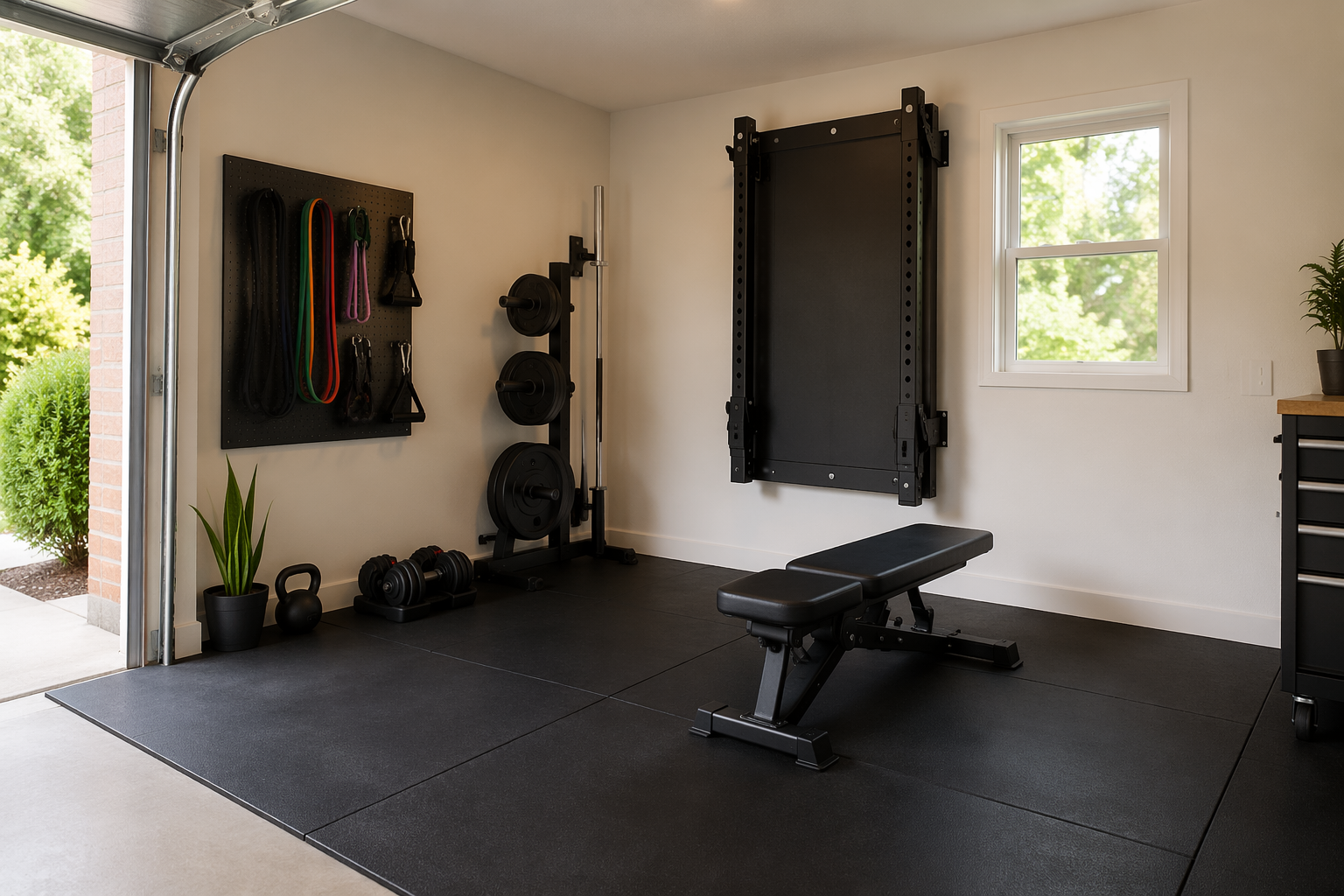
For someone with a garage, basement, or dedicated room, though, the rack’s durability is hard to beat. It can support barbell strength work, cable attachments if added, landmine work, pull-ups, benching, squatting, and accessory lifts. It also resells well because buyers understand what they are getting: steel, holes, hardware, and known dimensions.
Space, Skill, and Coaching Change the Answer
The market context points in the same general direction: multi-station home gyms are reported as growing at more than 8% annually, and strength training equipment is described as the fastest-growing category at a 5.97% CAGR.[3] That supports the obvious part of the story: more people want strength equipment at home. It does not prove that any one category is best for a particular buyer.
The practical sorting starts with constraints, not preferences. A small apartment buyer may reasonably pay more for a smart gym because a full rack setup is physically unrealistic. A beginner who needs guided programming may also get more real training from a subscription-based system than from a cheaper mechanical machine. The cost per workout can look good if the coaching removes enough friction.
On the other hand, a buyer with space, basic lifting knowledge, and a dislike of recurring bills should be careful about paying smart-gym prices for convenience they may not need. If you already know how to train, and you are comfortable following a program from a book, coach, spreadsheet, or app that is not tied to one machine, the subscription advantage shrinks.
For a broader category primer, it can help to compare weight-stack, smart, and modular home gym systems before narrowing to a specific model. If flooring and room protection are part of the budget, home gym flooring thickness belongs in the same cost conversation.
A Simple Decision Rule
Choose a smart home gym if the subscription is central to why you will train, not just something you tolerate. The strongest case is a buyer with limited space, a high need for coaching, and a realistic belief that they will keep paying for the service. In that case, the higher five-year cost can be defensible because the machine is buying consistency, not just resistance.
Choose a traditional all-in-one machine if you want guided movement paths, multiple exercises, and no required software payment. It is often the safer middle choice for someone who wants a machine-like experience but does not want the machine’s core value tied to an app.
Choose a power rack setup if you have the room, know or are willing to learn the lifts, and care most about long-term value. It is usually the strongest five-year financial choice, but it is not automatically the best home workout machine for a beginner who needs structure or a renter with tight space.
The cleanest rule is this: if canceling the subscription would make you regret the purchase, price the smart gym as a five-year subscription bundle from the beginning. If you want equipment that remains almost the same after five years of ordinary use, a traditional all-in-one or power rack setup usually gives you the better long-term value.
References
- Garage Gym Reviews tested specs, pricing, and resale observations — Garage Gym Reviews
- Subscription pricing pages — Tonal, Peloton, NordicTrack, Speediance, Tempo
- Home gym equipment statistics compilation — chestpressmachine.com
- Connected fitness subscription cancellation analysis — Bloomberg / Industry Analysis
- Fitness equipment lifespan and maintenance guidance — Treadmill Doctor / Consumer Reports
- Home fitness equipment market analysis — Custom Market Insights
Comments
Join the discussion with an anonymous comment.