
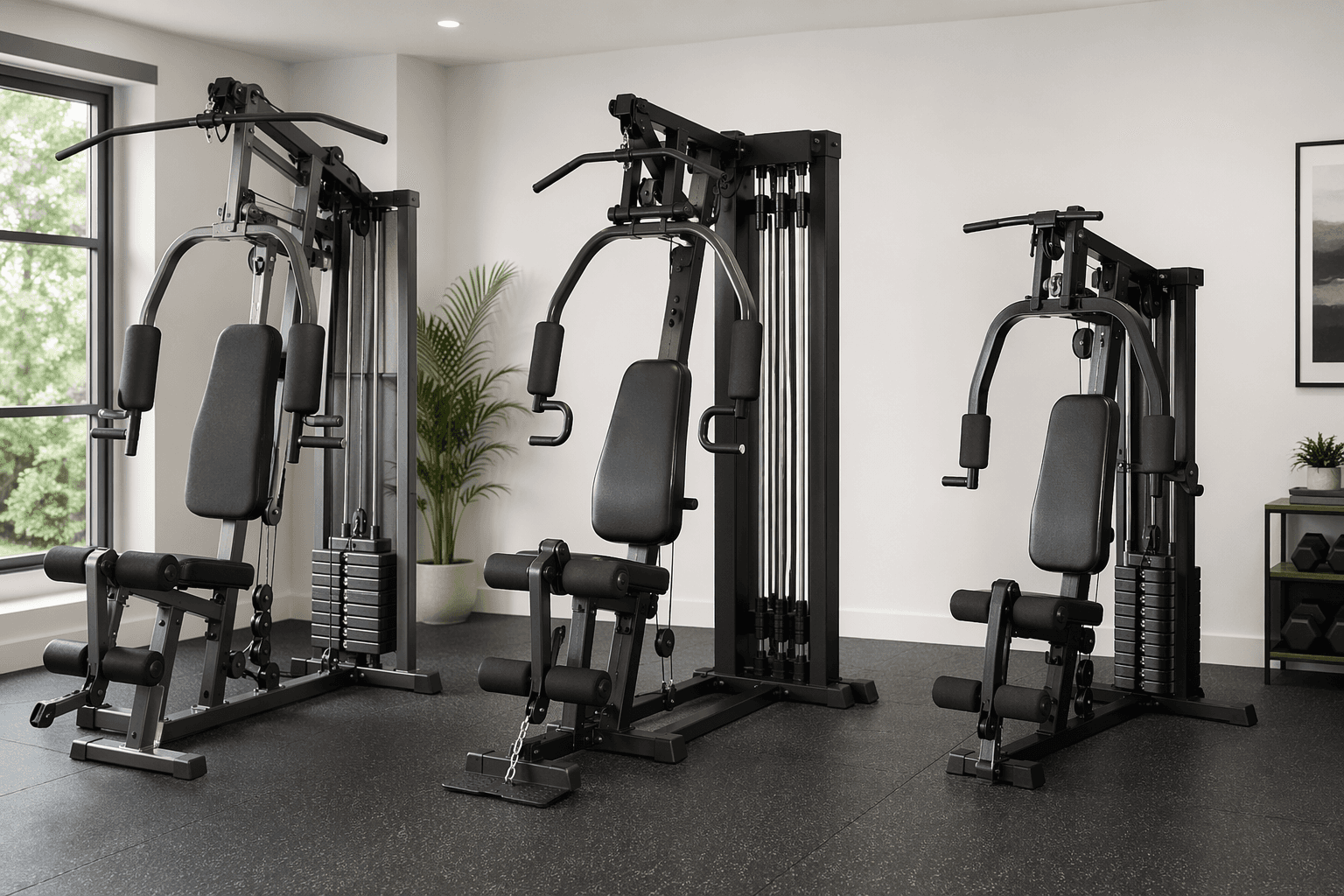
The tricky part of buying a marcy home gym, a Bowflex, or a newer Sportsroyals stack machine is that all three can look like the same promise from ten feet away: one frame, one seat, a handful of cables, and enough stations to replace a room full of equipment. Up close, they are not solving the same problem. Marcy is selling familiar weight-stack resistance at a price that often beats its own MSRP. Bowflex is selling a higher resistance ceiling and more exercise variety through power rods. Sportsroyals is selling a low entry price and a compact stack setup, with less long-term evidence behind it.
If you are still deciding whether a multi-gym is the right category at all, start with a broader workout machines for home comparison before comparing these three. If you already want an all-in-one cable machine under roughly $1,000, the useful question is narrower: which compromise will you still tolerate after the new-machine excitement wears off?
| Machine | Typical Price Range | Resistance Type | Resistance Ceiling | Upgrade Path | Exercise Count | Footprint / Compactness | Assembly Range | Warranty / Availability Caveats |
|---|---|---|---|---|---|---|---|---|
| Marcy MWM-990 | MSRP $749.99; commonly seen around $449-$550 at some retailers, with BarBend noting a roughly $500-$750 range | Traditional selectorized weight stack | 150lb stack; 2:1 pulley ratio can make felt resistance at the handles closer to about 75lb | No meaningful stack upgrade path | 30+ exercises | 37.5 in x 68 in footprint | User-reported 4-8 hours | 5-year frame warranty; widely stocked through MarcyPro, Sam's Club, Amazon, and DICK'S |
| Bowflex Xtreme 2 SE / Blaze | Roughly $550-$1,000 depending on model, sales, and availability | Power Rod resistance | Ships with 210lb resistance; upgradeable to 410lb with rod kits | Strongest upgrade path in this group | 70+ exercises | Generally compact for the amount of exercise variety; model-specific dimensions vary | User-reported 2-5 hours | Garage Gym Reviews lists a 15-year frame warranty and 2-year electronics warranty; Blaze availability is more limited as Xtreme 2 SE takes priority |
| Sportsroyals 154lb Stack Home Gym | Around $489 on Amazon in 2026 | Traditional weight stack | 154lb stack | No established upgrade path found | Varies by listing; should be treated as a feature claim rather than the main decision point | Compact budget stack machine | User-reported 2-4 hours | More Amazon-dependent; fewer long-term ownership reports than Marcy or Bowflex |
Those price ranges are deliberately written as ranges. MarcyPro lists the MWM-990 at $749.99, while BarBend's 2026 update notes that Sam's Club and Amazon often sell it around $449-$550, creating a swing large enough to change the buying decision by itself.[1] FitnessVolt lists Bowflex's Xtreme 2 SE as shipping with 210lb resistance and upgradeable to 410lb, while Garage Gym Reviews reports Sportsroyals at $489 on Amazon with a 154lb stack.[2][3] The numbers matter, but only after you understand what kind of resistance those dollars are buying.
Start With The Resistance You Actually Want To Use
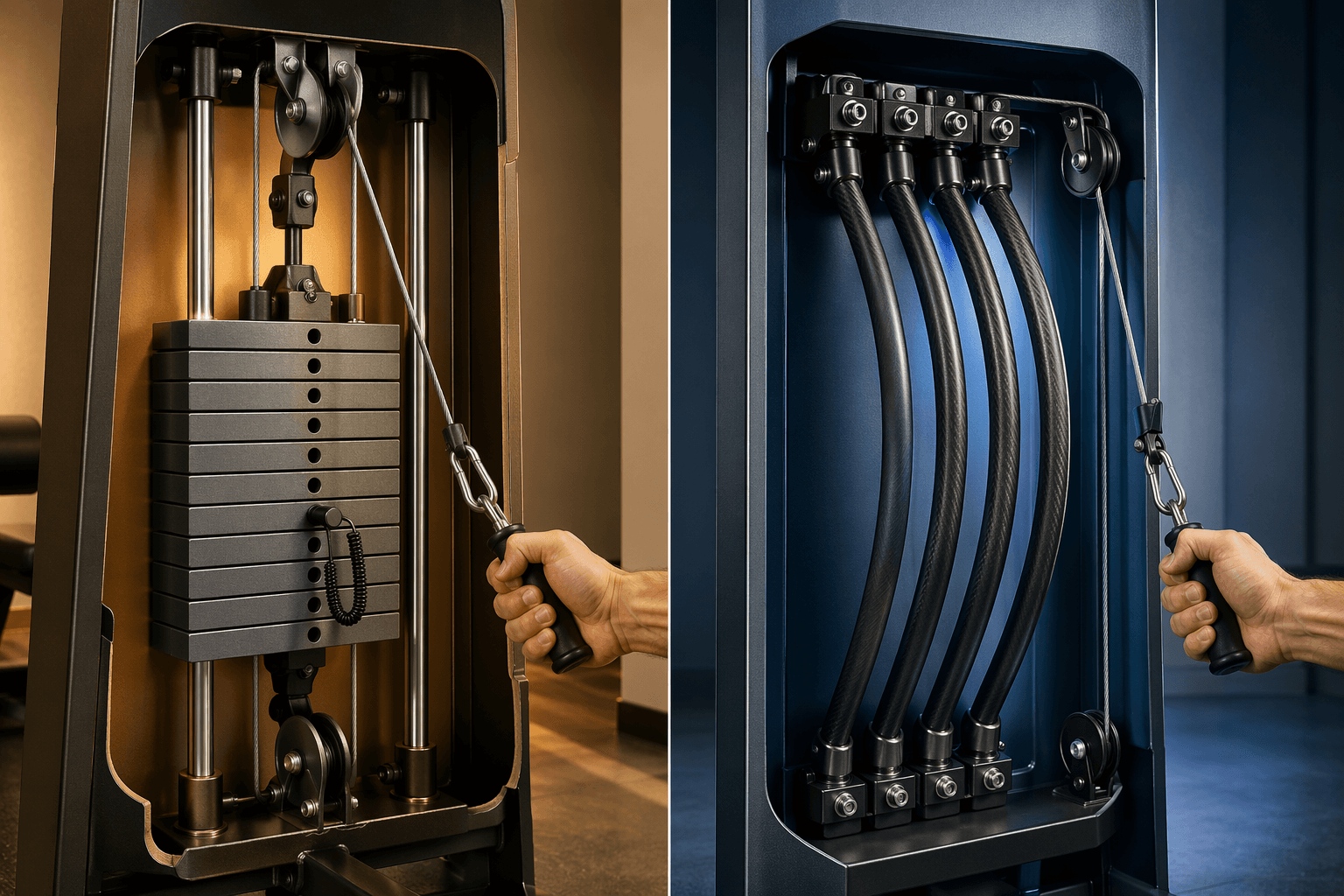
The first split is not Marcy versus Bowflex versus Sportsroyals. It is stack versus rod. Marcy and Sportsroyals use weight stacks: plates move up and down, the cable pulls through pulleys, and the resistance feels familiar if you have used a basic gym machine. Bowflex uses Power Rods: flexible rods bend as you pull, so the resistance changes through the movement instead of behaving exactly like a stack.
That difference is easy to underestimate while shopping because product pages turn everything into a maximum number. A 150lb stack, 154lb stack, and 210lb rod setup do not feel interchangeable at the handles. Marcy's own MWM-990 product page lists a 150lb selectorized stack, 30+ exercises, and a 37.5-inch by 68-inch footprint; the same spec set also uses a 2:1 pulley ratio, which reduces the felt load at the handles to roughly half the selected stack weight.[4] That does not make the machine useless. It means a buyer should not read “150lb stack” as “150lb cable curl.”
For many first-time home gym buyers, that kind of stack honesty is a benefit. You sit down, move the pin, and feel a predictable cable path. The MWM-990 is not a commercial cable station, and GXMMAT notes that Marcy's 14-gauge steel frame is lighter than the 11-gauge construction often found on commercial units, with some wobble at higher loads.[5] Still, the basic interaction is simple. If a beginner wants to train chest press, lat pulldown, rows, leg extensions, and cable accessories without learning a different resistance curve, Marcy is the easiest of the three to understand.
Bowflex asks for a different bargain. The Xtreme 2 SE's 210lb starting resistance is higher on paper than Marcy's stack, and the upgrade path to 410lb is real, not just marketing language.[2] The rods also create variable resistance: the movement often feels lighter earlier and harder as the rods bend farther. Some lifters like that because the top of a movement feels challenging. Others miss the steadier pull of plates moving on guide rods. If your mental model for strength training is “add a little load and repeat the same movement next week,” the Bowflex feel is worth trying before buying if you can.
Sportsroyals sits closer to Marcy in feel because it is also a stack machine, and Garage Gym Reviews lists the model at $489 with a 154lb stack.[3] The problem is not the basic concept. A compact stack machine at that price is obviously tempting. The problem is confidence: the research available for Sportsroyals does not give the same long ownership trail as Marcy or Bowflex. Without a stronger record of one-year-plus use, failure patterns, parts support, and warranty handling, the safer conclusion is narrow: Sportsroyals may be the cheapest way into this style of machine, but the long-term risk is less settled.
If you want to think through the mechanism before the brand, this resistance-type guide for small-space home gyms is the more useful detour than another exercise-count list.
Marcy MWM-990: Best If 150lb Is Enough And You Want Stack Simplicity
The Marcy MWM-990 makes the most sense for the buyer who wants a recognizable home version of the machines found in apartment gyms, hotel gyms, and older school weight rooms. Its 150lb stack, 30+ exercise claim, and 37.5-inch by 68-inch footprint put it squarely in budget all-in-one territory.[4] It is not trying to be endlessly expandable. It is trying to be affordable, understandable, and available.
The non-upgradeable stack is the detail to respect. If you are a beginner, returning from a layoff, training for general strength, or sharing the machine with family members, the MWM-990 may cover enough useful work for a long time. But if you already press, row, or pulldown near the top of what a budget home gym can offer, Marcy gives you nowhere clean to go. You cannot turn it into a heavier stack machine later in the way Bowflex can be upgraded with rods.
The 2:1 pulley effect is where many buyers get surprised. Selecting the full stack is not the same as feeling the full stack at every handle position. On cable movements, the effective resistance can be closer to about half the selected stack weight.[4] That is not a defect hidden in one brand; pulley ratios are part of how cable machines create smoother movement and manageable travel. It only becomes a bad purchase when the buyer thought “150lb” meant every exercise would feel like lifting a 150lb free weight.
Price is where Marcy keeps pulling people back in. At $749.99 MSRP, the MWM-990 competes differently than it does at $449-$550 through club or marketplace pricing.[1] At the lower end of that street-price range, the machine becomes a strong value for someone who wants traditional stack resistance and accepts the ceiling. At the higher end, Bowflex's upgrade path starts to deserve a harder look.
For a deeper Marcy-only decision, compare a dedicated Marcy 150lb stack home gym review with a Marcy 150lb stack model comparison before assuming every Marcy frame has the same cable layout and buyer fit.
Bowflex: Best If The Ceiling Matters More Than Stack Feel
Bowflex is the easiest machine here to misjudge from both directions. People who love iron stacks sometimes dismiss rod resistance too quickly. Product pages can also make Bowflex sound as if more exercises automatically means a better home gym. The useful middle position is this: Bowflex is the strongest choice in this group if you care about future resistance ceiling and exercise variety, and the weaker choice if you specifically want constant stack resistance.
FitnessVolt reports that the Bowflex Xtreme 2 SE ships with 210lb resistance and can be upgraded to 410lb through rod kits.[2] That upgradeability is not a small footnote. It is the main reason to pay attention to Bowflex when comparing it with a Marcy MWM-990 or Sportsroyals stack. A first-time buyer who becomes consistent can outgrow a fixed stack. Bowflex at least gives that buyer a path to spend more later instead of replacing the whole machine.
The Xtreme 2 SE and Blaze also claim 70+ exercises, which is more than Marcy's 30+ exercise claim.[2][4] That difference matters less than it looks if you only plan to do the same six movements every week. It matters more if several people will share the machine, if you want more cable angles, or if novelty helps you keep training. Exercise count should be treated as a variety signal, not proof that every listed movement is equally useful.
The trade-off is feel and construction. Bowflex rods do not mimic a selectorized stack. GXMMAT also notes long-term concerns around plastic pulley shrouds and pivot bushings on Bowflex-style machines.[5] That does not mean the machine is fragile in normal use, but it does mean the buyer should not interpret a higher resistance ceiling as “more commercial.” Bowflex is a different home-gym system with a better upgrade path, not a heavier-duty stack machine in disguise.
Sportsroyals: The Low Upfront Price Comes With A Shorter Track Record
Sportsroyals is the machine that creates the most spreadsheet temptation. A 154lb stack around $489 undercuts Marcy by roughly $60-$260 depending on the Marcy retail channel being compared, and it lands far below many Bowflex configurations.[3] For a buyer trying to stay under $500, that is not a trivial difference. It may decide whether the machine happens now or never.
The practical concern is that the lower price is doing more work than the evidence. Sportsroyals appears more Amazon-dependent, and the available research does not establish the same long-term ownership pattern as Marcy or Bowflex. There was no strong primary source found showing failure rates or durability after one year or more of regular Sportsroyals use. That leaves buyers judging from listing details, review patterns, and general brand confidence rather than a deep service history.
That uncertainty does not make Sportsroyals a bad buy by default. It makes it a price-led buy. The fit is clearest when the buyer wants a compact weight-stack machine, accepts that the brand record is thinner, and would rather save the money now than pay for Marcy's broader retail presence or Bowflex's upgrade path.
The Checkout Price Is Not The Whole Cost
Budget multi-gyms are especially sensitive to timing. Marcy is the cleanest example: a $749.99 MSRP and a $449-$550 common street price do not describe the same bargain.[1] If you only compare current tabs on one afternoon, Marcy can look either overpriced or unbeatable. The smarter move is to check several channels before deciding, especially club retailers and major marketplaces.
Bowflex has a different total-cost problem. The base resistance may be enough for some buyers, but the reason Bowflex beats fixed-stack machines on ceiling is the rod upgrade path to 410lb.[2] If you already suspect you will want that headroom, the upgrade kit belongs in the mental purchase price. A Bowflex bought near the top of the $550-$1,000 range and upgraded later is no longer competing with a $500 stack machine in any simple way.
Sportsroyals is the opposite. The low checkout number is the attraction, and Garage Gym Reviews' $489 Amazon price explains why it keeps entering the conversation.[3] The extra cost is less visible: less certainty about parts, support, and long-term durability. That is not a made-up failure prediction. It is the cost of buying a newer, less-proven option where the public evidence is thinner.
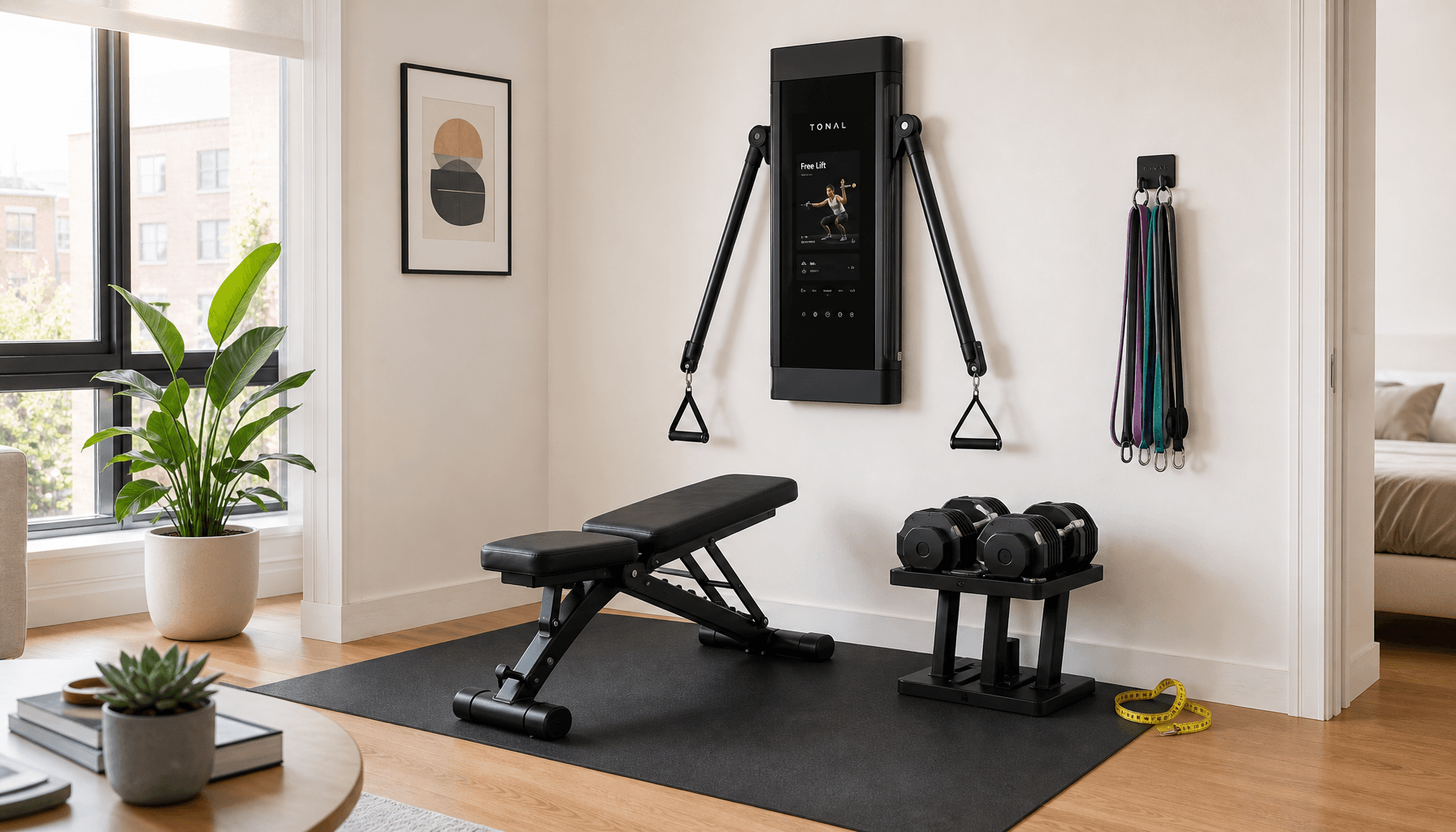
If the machine is only one piece of a larger room, this is where a broader under-$1,000 home gym guide helps. Spending $650 on the wrong all-in-one machine can be worse than spending less on a smaller setup you will actually use.
Assembly, Footprint, And Warranty Are Tie-Breakers, Not The Main Event
Assembly should not be ignored, but it should not be over-ranked with fake precision either. The user-reported ranges are broad: Marcy is commonly reported around 4-8 hours, Bowflex around 2-5 hours, and Sportsroyals around 2-4 hours.[1][5] Those are not controlled lab measurements. They are a reminder that the person who says “we'll put it together Saturday morning” may still be sorting bolts after lunch.
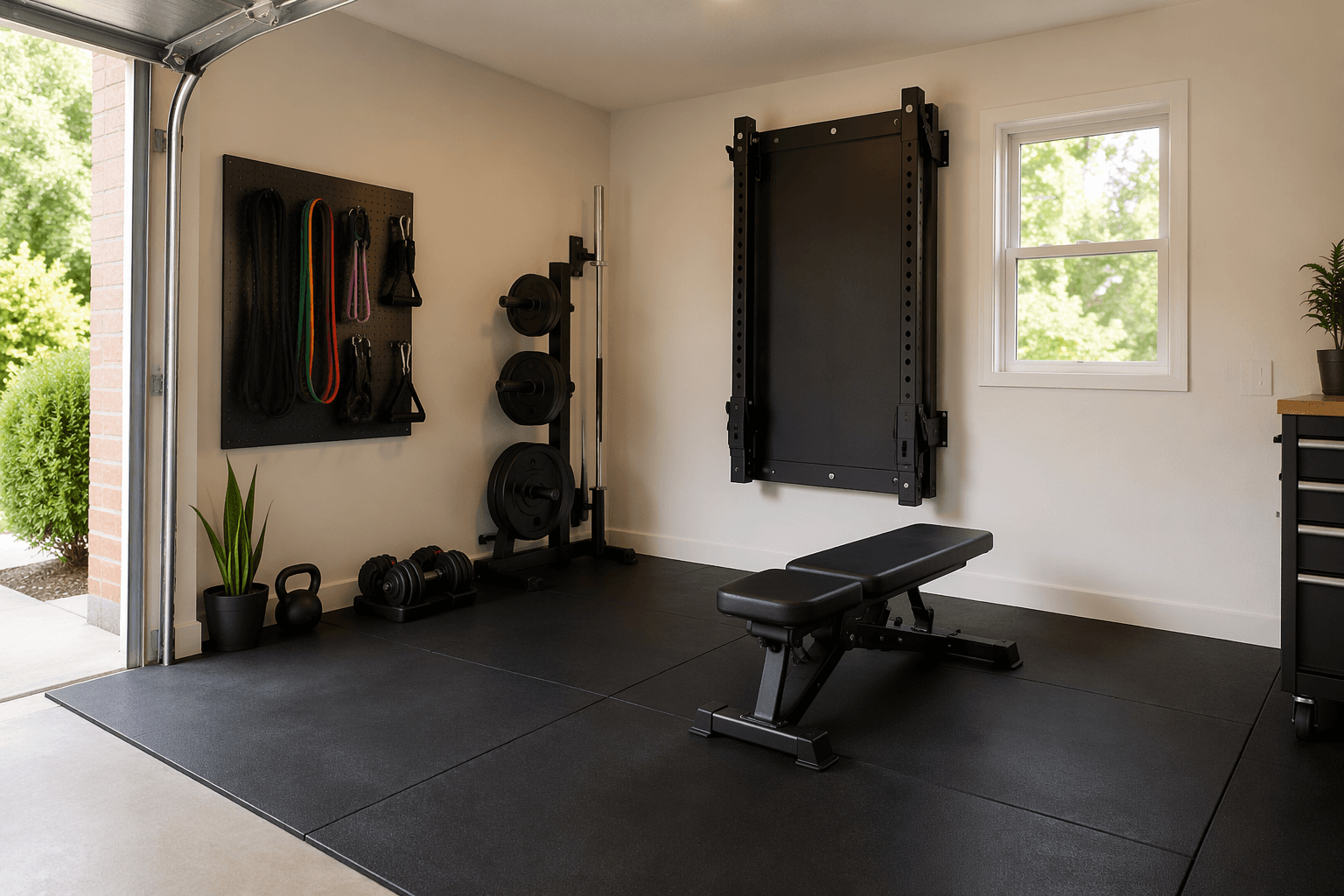
Footprint matters more if the machine will live in a spare bedroom, basement corner, or garage bay that still has to hold a car. Marcy gives a concrete 37.5-inch by 68-inch footprint on its product page.[4] Bowflex and Sportsroyals can be compact relative to their exercise claims, but the practical rule is the same for all three: measure the machine, then measure the working space around the machine. Cable stations become annoying when every pulldown, press, or leg extension requires moving storage bins first.
Warranty and availability are credibility checks. Garage Gym Reviews lists Bowflex with a 15-year frame warranty and 2-year electronics warranty, while Marcy lists a 5-year frame warranty for the MWM-990.[3][4] Marcy also benefits from broad retail availability through familiar channels. Sportsroyals, by contrast, appears more dependent on Amazon listings. None of that automatically makes one machine the right choice, but it changes how much uncertainty you are accepting after the box arrives.
Which One Should You Buy?
Buy the Marcy MWM-990 if you want traditional weight-stack feel, a familiar selectorized setup, and strong street-price value, and if the 150lb non-upgradeable stack is enough for your training. This is the easiest recommendation for a first-time buyer who values simplicity over future expansion.
Buy the Bowflex Xtreme 2 SE or Blaze if the resistance ceiling and exercise variety matter more than stack feel. The 210lb starting resistance, 410lb upgrade path, and 70+ exercise range give it the most room to grow, but the rod curve and plastic-component concerns mean it should be chosen because you want Bowflex's system, not because you think it is a heavier Marcy.
Buy the Sportsroyals 154lb stack only if the lowest upfront price and compact stack format outweigh the uncertainty of a newer, less-proven brand. At around $489, it is hard to ignore. It is also the one where a cautious buyer should be most honest about what is known and what is still guesswork.
References
- Marcy MWM-990 Home Gym Review (2026 Update), BarBend
- 8 Best Home Gym Machines of 2026, FitnessVolt
- The Best Home Gym Machines in 2026, Garage Gym Reviews
- Marcy 150-lb Multifunctional Home Gym Station for Total Body Training MWM-990, MarcyPro
- Is a Marcy At Home Gym Worth the Investment?, GXMMAT
Comments
Join the discussion with an anonymous comment.