
The rower that looks best online is not always the rower that survives contact with your room. Full-size rowing machines commonly ask for roughly 86 to 96 inches of length and about 24 inches of width, and a safer planning zone is closer to 8 feet by 3 feet once you account for mounting, dismounting, and the handle path. Compact or folding designs can shrink storage dramatically, with some folding footprints reported around 22 by 58 inches, but storage size and workout size are not the same measurement.[1][2]
So the useful question is not “What is the best rowing machine for home?” It is: which machine clears the constraint you cannot change? If shared-wall noise is the hard limit, start with magnetic resistance. If training feel and performance data matter most and noise is acceptable, air deserves the first look. If you want the pull and look of a water rower and accept tank care, water makes sense. If price and storage dominate everything else, hydraulic is the compromise, not a secret bargain.
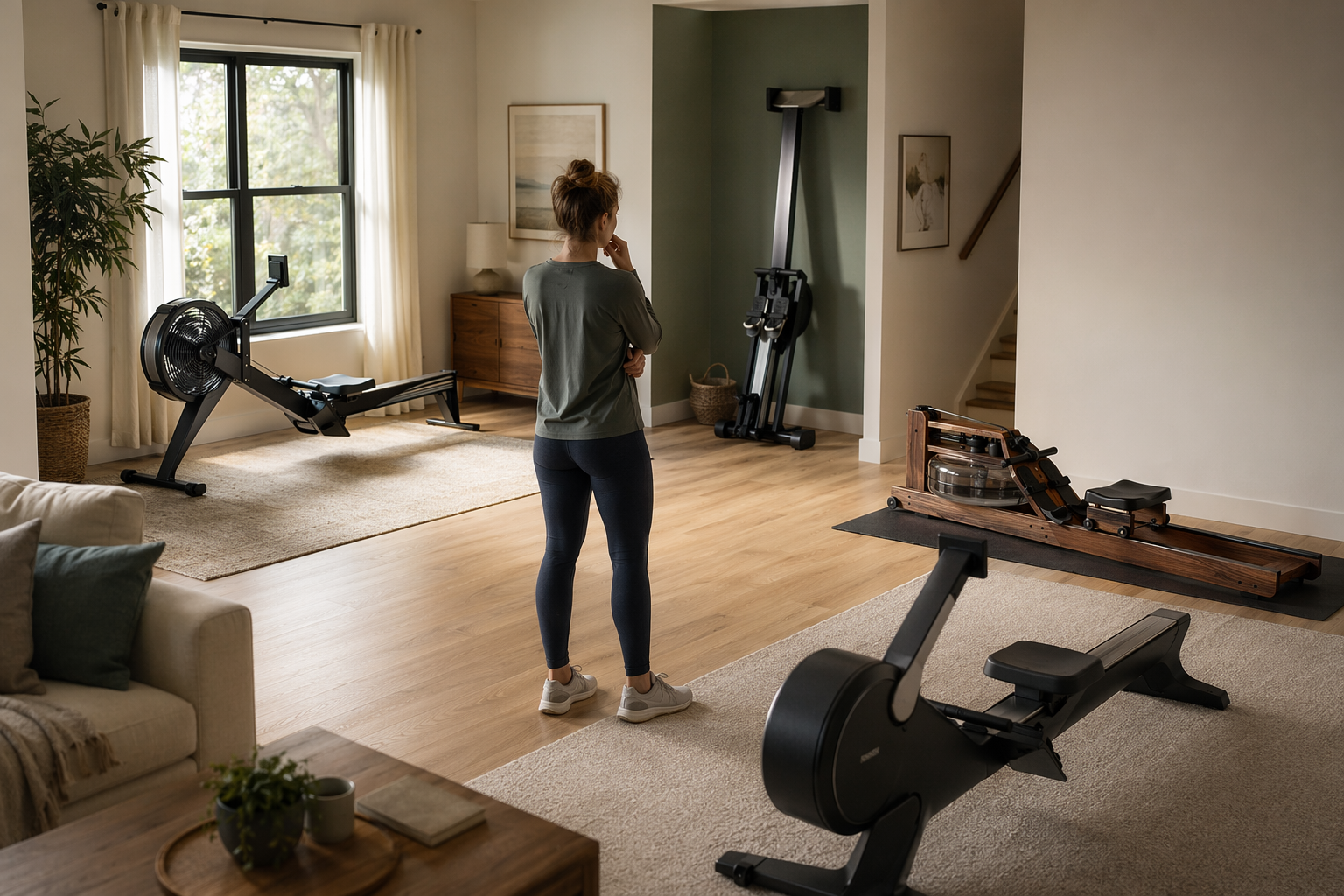
Start With the Constraint, Not the Brand
A rowing machine is long because the stroke is long. The seat has to travel, the handle has to move, and the user’s legs have to extend without turning every workout into a wall-kicking exercise. That is why a full-size rower can be easy to recommend in a basement and maddening in a spare bedroom where the door swing, radiator, closet, and walkway all want the same floor.
Measure the workout footprint first. Then measure where the rower goes when you are not using it. Folding can solve the second problem without solving the first. Vertical storage can help, but only if the machine is stable when tipped, not too heavy for the person moving it, and not blocking the one path through the room.
If you are still deciding whether a rower belongs in the same room as dumbbells, a bench, or a bike, it may be worth stepping back into a broader small-space equipment plan. A rower can be a smart single piece, but it is rarely a small object while you are actually rowing.
| Hard constraint | Start here | Be careful about |
|---|---|---|
| Shared walls, sleeping household, upstairs apartment | Magnetic rower | Subscription upsells and short rails on compact models |
| Performance training, intervals, race-style metrics | Air rower | Fan noise that rises with effort |
| Living-room placement, realistic stroke feel, furniture-like appearance | Water rower | Tank care, weight, and moving difficulty |
| Lowest budget, smallest storage demand | Hydraulic rower | Lower smoothness, shorter rails, and lower weight capacity |
How the Four Resistance Types Actually Behave at Home
Resistance type is not a technical footnote. It decides the sound your neighbor hears, the maintenance you inherit, the smoothness of the stroke, and often the price tier you are entering. This is where most “best overall” lists move too fast.
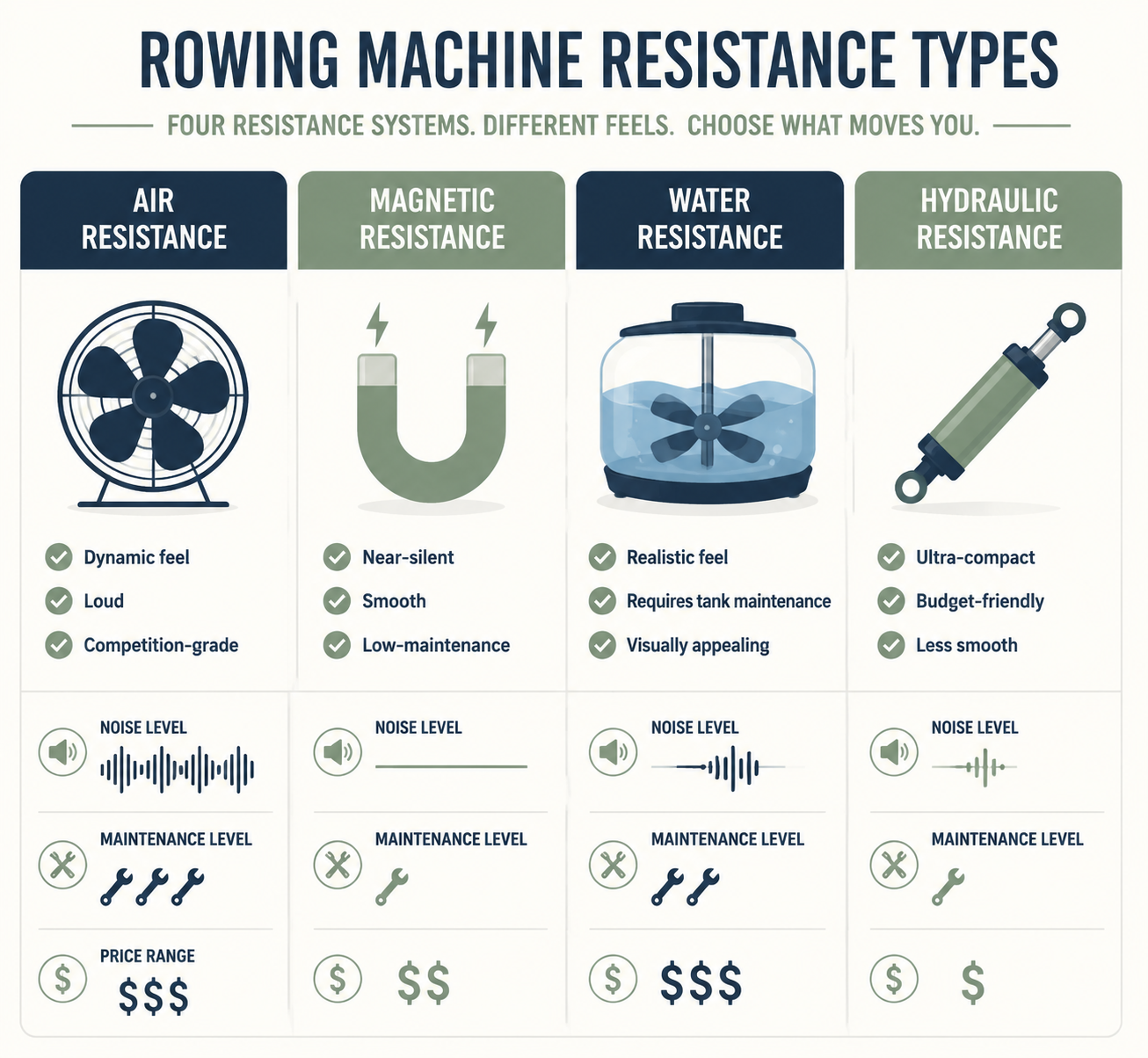
Magnetic: the apartment-safe default
Magnetic rowers use magnets to create resistance, which is why they are commonly described as virtually silent and low-maintenance compared with air and water machines.[2][3] That does not mean every magnetic rower feels luxurious. It means the resistance system is the least likely to punish you for rowing before work in a shared-wall apartment.
The trade-off is feel. Many magnetic rowers provide a controlled, steady pull rather than the more dynamic response of air or water. For general fitness, that can be perfectly fine. For someone trying to mimic race pacing or chase performance metrics, it can feel a little sealed off from the effort you are putting in.
Air: honest, durable, and loud when you work
Air rowers create resistance with a flywheel and fan. Pull harder and the fan moves more air. That is the appeal: the machine responds to effort in a way that feels natural for intervals, power pieces, and structured training. It is also the noise problem. Wirecutter’s testers described the relationship plainly: “the louder it gets, the harder you’re working.”[4]
That whoosh is not a defect if the machine lives in a garage, basement, or tolerant household. It is a real drawback if it sits against a nursery wall or below a downstairs neighbor. The mistake is treating air-rower noise as a universal flaw or a harmless detail. It is neither. It is a placement question.
Water: the nicest pull for people who accept the chores
Water rowers earn their following honestly. The resistance feels closer to moving a blade through water, and many models look more at home in a living room than a steel-and-plastic machine. Appearance is not a silly reason if the rower has to stay visible. A machine you do not hate looking at is less likely to be folded, rolled, and forgotten.
But the tank is not decoration. WaterRower maintenance guidance cited by Wirecutter says purification tablets are needed every 3 to 6 months, and water machines tend to be the heaviest to move.[4] If you are already annoyed by humidifiers, filters, and anything that needs a calendar reminder, do not pretend tank care will become charming after delivery.
Hydraulic: the small, cheap compromise
Hydraulic rowers belong in the conversation because some homes cannot absorb a full-size machine and some budgets cannot stretch into the mid-tier. Sunny Health’s SF-RW1205SMART, for example, is listed at 58.1 inches long by 20.1 inches wide and 22.4 pounds, and the broader hydraulic entry tier often sits around $130 to $250 with lower capacities around 220 pounds.[2]
That is a meaningful answer for a buyer in a studio apartment or for someone testing whether rowing will stick. It is not the best answer for a larger user, a household sharing one machine, or anyone expecting the smoothness of a gym rower. Hydraulic earns its place by being small and affordable, not by beating the other resistance types at their own jobs.
Budget Tells You What Trade-Offs You Are Buying
The price bands are useful because they usually reveal the compromise before the product page does. Under $300, you are mostly looking at entry hydraulic machines. From about $300 to $800, magnetic and some value air rowers become realistic. From $800 to $1,500, better air and water machines dominate. Above $1,500, connected screens, coaching platforms, and subscription ecosystems become a much bigger part of the purchase.[2][5]
The middle and upper tiers are not automatically wasteful. A well-built rower can be a long ownership purchase. Columbia University rowing director Tom Terhaar told Wirecutter that well-built machines at the mid-tier and above typically last 10 to 15 years.[4] That changes the math. A higher upfront price can be rational if the frame, rail, chain or strap system, monitor, and parts supply keep the machine useful instead of disposable.
This is where the Concept2 RowErg keeps showing up for good reasons rather than brand inertia. Wirecutter highlights its durable nickel-plated steel chain, 500-pound weight capacity, and readily available replacement parts, all of which matter if you are spreading the purchase over a decade or more.[4] Garage Gym Reviews places the RowErg around $990 in its current market coverage, while Verywell Fit lists Concept2 pricing around $1,300, a reminder that retailer, bundle, and accessory differences can blur price comparisons.[5][6]
If your budget is also competing with dumbbells, flooring, a bench, or storage, compare the rower against the whole room, not just against other rowers. A single machine can be efficient, but a modular setup sometimes fits a cramped room and a staged budget better. That broader trade-off is the same one behind an all-in-one versus modular home gym decision.
When Smart Rowers Are Worth the Subscription
Connected rowers can be excellent for the person who wants instruction, scenic sessions, live or recorded classes, and a screen that makes training feel less solitary. They can also turn a rowing machine into an ongoing bill. Hydrow’s membership is cited at $44 per month, Ergatta’s at $32 per month, and iFIT’s at $39 per month in the available market data.[5]
The subscription question should come after the resistance question. If you need quiet, a loud connected air-style experience is still the wrong fit. If you hate tank maintenance, a beautiful connected water rower will not fix that. If you already follow your own plan, a subscription-free performance rower may be a cleaner long-term purchase.
For buyers who know coaching is the missing piece, connected fitness can be the difference between owning equipment and actually using it. If the app ecosystem matters as much as the machine, compare rowing platforms alongside broader fitness apps for home workouts before assuming the biggest screen is the best value.
Shortlist by Fit, Not by Trophy
These are not ranked from best to worst. They are mapped to the problem each rower is most likely to solve. Before choosing any model, recheck current dimensions, delivered weight, warranty, return policy, and whether the listed price includes accessories or a required membership.
| Best fit | Models or model family to compare | Why it belongs on that shortlist |
|---|---|---|
| Performance training with acceptable noise | Concept2 RowErg | Air resistance, strong parts ecosystem, 500-pound capacity, and long-service logic make it the safest serious-training default.[4] |
| Garage or basement air-rower alternative | Rogue Echo Rower | Another air-resistance option for buyers prioritizing hard training over quiet operation; compare current size, monitor, and price against Concept2.[5] |
| Apartment or shared-wall use | A magnetic rower from a tested mid-price line | Magnetic resistance is the first filter when noise is the constraint; prioritize rail length, folded size, and user capacity over screen size.[2][3] |
| Quiet general fitness under a tighter budget | Sunny or Merach magnetic options | These brands are useful comparison points in the value magnetic tier, but manufacturer claims should be checked against independent reviews where possible.[2][3][5] |
| Living-room-friendly water feel | WaterRower | The appeal is realistic resistance and furniture-like presence; the cost is tank treatment every 3 to 6 months and more moving effort.[4] |
| Connected scenic rowing | Hydrow | Worth considering when coaching and immersive sessions are central to adherence, with the monthly membership treated as part of the real price.[5] |
| Connected water-rower experience | Ergatta | A better fit for buyers drawn to water resistance and gamified training, provided the subscription and tank care are acceptable.[5] |
| iFIT-centered household | An iFIT-compatible rower | Makes sense when the household already uses iFIT or wants one coaching ecosystem across equipment, but the subscription should be counted from day one.[5] |
| Smallest budget and easiest moving | Sunny Health SF-RW1205SMART hydraulic rower | At 58.1 inches long, 20.1 inches wide, and 22.4 pounds, it solves storage and price before it solves stroke feel.[2] |
A buyer with a quiet apartment and a $600 ceiling should not be talked into an air rower because athletes like it. A garage owner who wants hard interval work should not overpay for silence they do not need. A living-room buyer may reasonably value a handsome water rower, but only after accepting tank maintenance and moving weight. A budget buyer may be right to start hydraulic, as long as the lower ceiling on smoothness and capacity is understood up front.
If the decision still feels tangled, use the same constraint-matching method you would use for a full small-space home gym decision: eliminate what cannot physically, financially, or socially work in the room before comparing features.
The Final Filter
Buy the resistance system that matches the constraint you cannot change. Then choose the model whose footprint, stored size, noise, maintenance, capacity, subscription cost, and long-term parts support fit around that constraint. That is a less glamorous answer than naming one winner, but it is the answer that keeps a rowing machine in use instead of parked upright with laundry on the handle.
References
- Best Compact Rowing Machines, BarBend, 2026.
- How to Choose the Best Rowing Machine: 2026 Buying Guide, Sunny Health & Fitness, 2026.
- Air vs Water vs Magnetic Rowing Machine, Merach Fit.
- The Best Rowing Machine, Wirecutter, 2026.
- The Best Rowing Machine, Garage Gym Reviews, July 2026.
- The Best Rowing Machines, Verywell Fit, June 2026.

Comments
Join the discussion with an anonymous comment.