
If you search for “best treadmill for home,” you’ll find lists of machines with bigger motors and longer decks. The message is clear: a treadmill is the default home cardio machine. But before you rearrange your living room around a 6-foot slab of steel, ask yourself: will you actually use it three times a week for the next two years? Because a $2,000 treadmill that collects dust is a worse investment than a $500 bike you ride regularly.
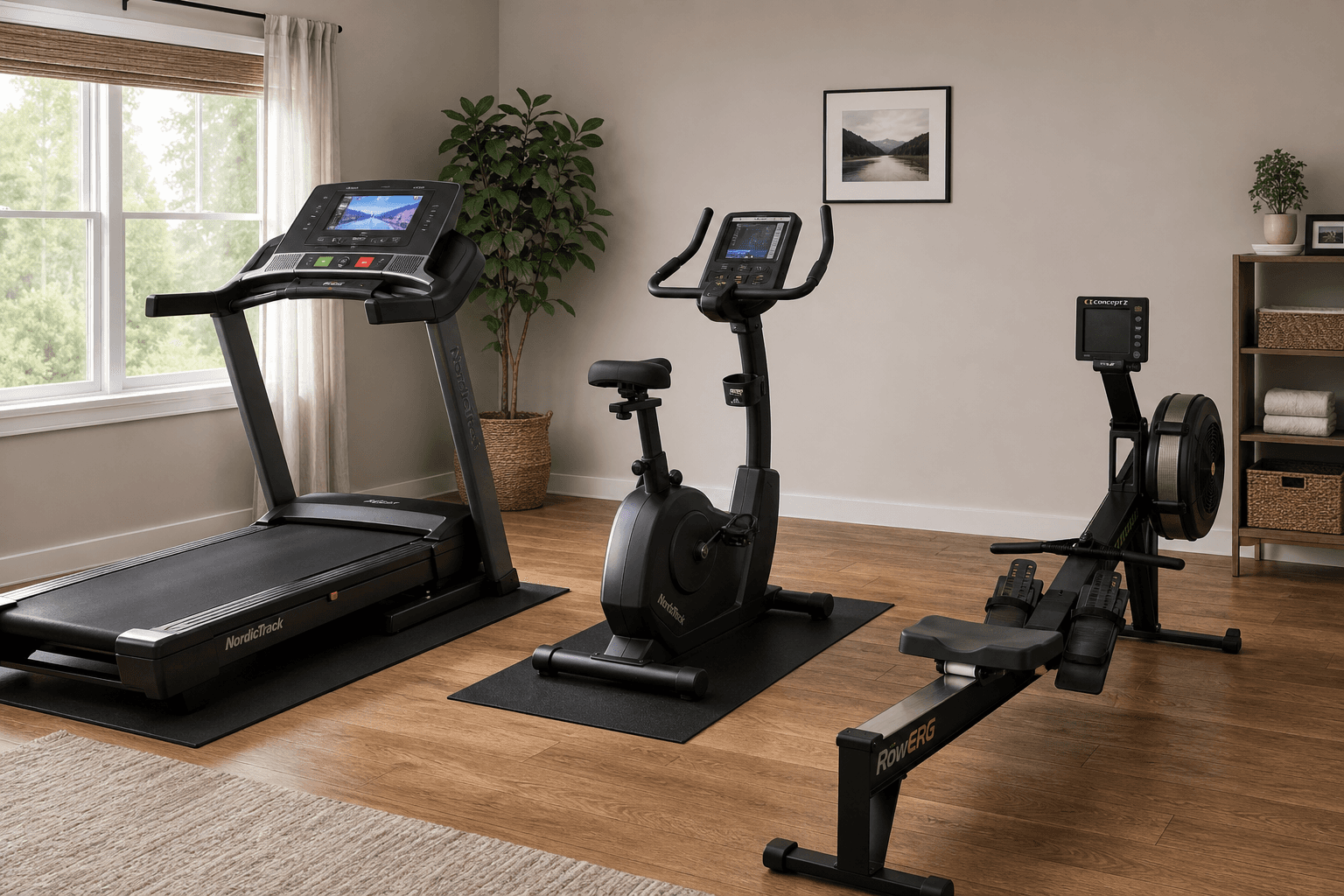
A Quick Comparison
Here’s how the three machines stack up on the dimensions that matter for a home buyer. The numbers come from specific sources — I’ll note where they’re directional.
| Dimension | Treadmill | Exercise Bike | Rowing Machine |
|---|---|---|---|
| Impact on joints | High (weight-bearing) | Low (non-weight-bearing) | Low (non-weight-bearing) |
| Primary muscles | Legs, glutes, core | Legs, glutes | Full body (legs, back, arms, core) |
| Typical price range | $500 – $3,000+ (avg. ~$1,900) | $300 – $2,500 | $250 – $3,000 |
| Subscription required? | Optional (iFIT $39/mo, Peloton $44/mo, JRNY $20/mo, Zwift $15/mo) | Optional (Peloton $44/mo, many work without) | Optional (usually free app or low-cost) |
| Floor footprint | ~6' x 3' (plus clearance behind) | ~4' x 2' | ~8' x 2' |
| Noise level | Moderate (Sole F80 measured at 53.8 dB at walk — quieter than a fridge, but that is one model) | Low (belt-driven ≈45–55 dB) | Moderate (air rowers ≈55–65 dB, water ≈ similar) |
| Calorie burn ceiling | Very high (running > cycling) | Medium-high (HIIT can match) | High (comparable to running per The Conversation) |
| Bone density benefit | Yes (weight-bearing) | No | No |
| Technique barrier | Low | Low | Moderate (learning curve for efficient stroke) |
A few notes on that table: the average treadmill price of about $1,900 comes from Garage Gym Reviews, and it reflects the segment that gets reviewed — not the cheapest walking pads. The subscription costs listed are for premium interactive content; most machines work perfectly well without a subscription. The Sole F80’s 53.8 dB reading came from a single tester with a digital sound meter, so treat it as an example, not an industry standard.
The Treadmill: Real Bone Benefits, Real Trade-Offs
A treadmill offers something the other two cannot: weight-bearing exercise that builds and maintains bone density. As The Conversation explains, citing NIH research on general weight-bearing exercise, this matters most for people at risk of osteoporosis — especially women over 50. That is a real, physiology-level advantage that a bike or rower cannot match. Running and even brisk walking also use most major muscle groups and produce higher heart rate and energy expenditure than cycling, per the same source.
But the weight-bearing nature can be a problem for some. The same article notes that it may exacerbate pain and swelling in people with osteoarthritis. And treadmill running specifically increases loading on the Achilles tendon compared with overground running, according to physical therapist Allison Greer interviewed by Runner’s World. That is a real caveat — not a reason to avoid treadmills, but a reason to be aware if you have Achilles issues.
Then there is the space and installation friction. Minimum footprint is about 6 by 3 feet, plus you need at least three feet of clearance behind it (per Runner’s World) and a dedicated electrical circuit — sharing a circuit with other appliances can cause shutdowns. Ceiling height matters: add 15 inches to the tallest user's height, plus the deck height, and you get the minimum. A 55-inch deck is too short for a full running stride; TreadmillReviews.net recommends 60 inches for most runners. A motor of at least 3.0 CHP is the minimum for running.
If you decide a treadmill is right for you, see our full treadmill decision framework for walkers, joggers, and runners or the constraint-based guide for serious runners for model-level advice.
The Bike: Easier on Joints, Smaller Footprint
Cycling is non-weight-bearing, which is the whole point if you have knee, hip, or lower back issues. The joints are spared, and you can still get an excellent cardiovascular workout — indoor cycling classes regularly push heart rates into the same zone as running intervals. The trade-off is that non-weight-bearing exercise provides less bone health benefit, as The Conversation notes.
Bikes also win on space and noise. A typical bike footprint is about 4 by 2 feet — half the floor real estate of a treadmill — and even the noisiest magnetic resistance bike is quieter than most treadmills. Price entry is lower: you can get a solid spin bike for $300–$500, though premium connected bikes like the Peloton push into the $2,000+ range. Subscription costs follow the same pattern: Peloton All-Access is $44/month, but you can use the bike without it.
For readers who want to dive deeper into bike types — upright vs. recumbent vs. indoor — we have a full bike type decision framework and a decision-matrix guide by budget, space, resistance, and subscription. The true five-year cost of an exercise bike article is worth reading if subscription costs are a primary concern.
The Rower: Full-Body Workout, But You Need Technique
Rowing engages upper and lower body simultaneously, with energy expenditure comparable to running and greater than cycling, according to The Conversation. That full-body engagement is the rower’s headline advantage: in a 20-minute session, you work legs, core, back, arms, and shoulders. For someone who wants the most muscle activation per minute, a rowing machine is tough to beat.
But it is also non-weight-bearing, so it does not contribute to bone density. And it has a real technique barrier. The same source notes that rowing has a greater learning curve than running or cycling. Many people sit down, pull with their arms, and wonder why their lower back hurts. Efficient rowing requires sequencing: legs first, then back, then arms. Without instruction, the machine gets used wrong or abandoned. That is a genuine adoption risk.
Space-wise, rowers are around 8 feet long — longer than a treadmill when stored upright but with a much narrower footprint. Many fold or stand vertically, which helps. Noise is moderate; air rowers produce a whooshing sound that some find pleasant, others annoying.
The rower’s best fit is someone who wants a full-body workout, is willing to invest in learning proper form, and does not need bone-density stimulus. It is also a great secondary machine — many people pair a rower with a bike or treadmill for variety.
The 40% Use Problem — an Old Number That Still Rings True
According to Wirecutter, citing a 2009 New York Times estimate, about 40% of home gym equipment is not used as often as expected. I’d be wary of treating a 2009 figure as current truth — the home fitness market has changed enormously — but the underlying insight survives: buying a machine is not the same as using one.
The treadmill, with its higher purchase price, larger footprint, electrical requirements, and moderate noise, has a higher barrier to consistent use than a bike or rower. If you have any doubt about your commitment, the lower-friction option is the smarter bet. A $500 exercise bike that gets used three times a week is a better investment than a $2,000 treadmill that collects dust after month two.
Which One Fits You?
Let’s summarize the choice by your primary goal:
- Bone density / osteoporosis prevention: treadmill. Weight-bearing exercise builds bone; bike and rower do not.
- Joint-friendly cardio (knee, hip, back issues): exercise bike or rowing machine. Non-weight-bearing; bike is lowest impact, rower is full-body.
- Full-body muscle engagement in short sessions: rowing machine. Rowing recruits legs, core, back, arms; higher energy per minute.
- Small apartment / limited floor space: exercise bike. Smallest footprint (about 4x2 feet); can store in closet.
- Lowest possible cost entry: exercise bike (basic spin bike) or rower (starting ~$250 but more technique).
- Noise-sensitive environment (shared walls): exercise bike. Quietest option; magnetic resistance nearly silent.
- Maximum calorie burn (weight loss focus): treadmill or rowing machine. Both top energy expenditure chart; treadmill has higher impact.
- Recovery / low-intensity days: exercise bike or rower. Easy to control intensity; bike is especially forgiving.
Assuming you will actually use the machine. If you are unsure about commitment, the bike or rower is the lower-risk bet.
If you are still unsure about your overall home gym direction — not just cardio, but strength equipment and space planning — start with the first-time home gym buyer's decision framework. For apartment dwellers specifically, the compact home gym equipment guide covers footprint, storage, and noise across all equipment types.
The Bottom Line
A treadmill is genuinely the best machine for weight-bearing cardio and bone density — that is a physiological fact. But that benefit disappears if you stop using it after three months. The exercise bike and rowing machine are non-weight-bearing, which means less bone stimulus, but for most people they are more likely to be used consistently, especially those with joint concerns or limited space.
Pick the treadmill only if you are prepared for the space, noise, and relatively high barrier to regular use. Otherwise, the bike or rower is the smarter bet. The right answer is not the one with the highest calorie burn on paper — it is the one you will still be using a year from now.
Comments
Join the discussion with an anonymous comment.