
A lot of runners land on the phrase "best home treadmill for running" after reading the same promise in a dozen different forms: softer deck, lower impact, easier on the joints. The problem is that "soft" is doing too much work. Treadmill cushioning is not one simple hardness scale. It can mean a zone-based deck that changes under different parts of the stride, an adjustable firmness system, a thicker belt over a conventional frame, or a slatted running surface that changes the whole belt-to-deck relationship.
The most useful biomechanical anchor here is a 2019 study by Shi and colleagues. It found that cushioned treadmill decks reduced peak plantar force at the forefoot at 8 and 10 km/h, while rearfoot impact did not necessarily change, and the effect scaled with speed [1]. That is a real clue, but it is not the same as proving lower injury risk over months of training. It says cushioning can change where and how force shows up, especially for faster running and for runners who load the front of the foot.
What the main cushioning systems are actually doing
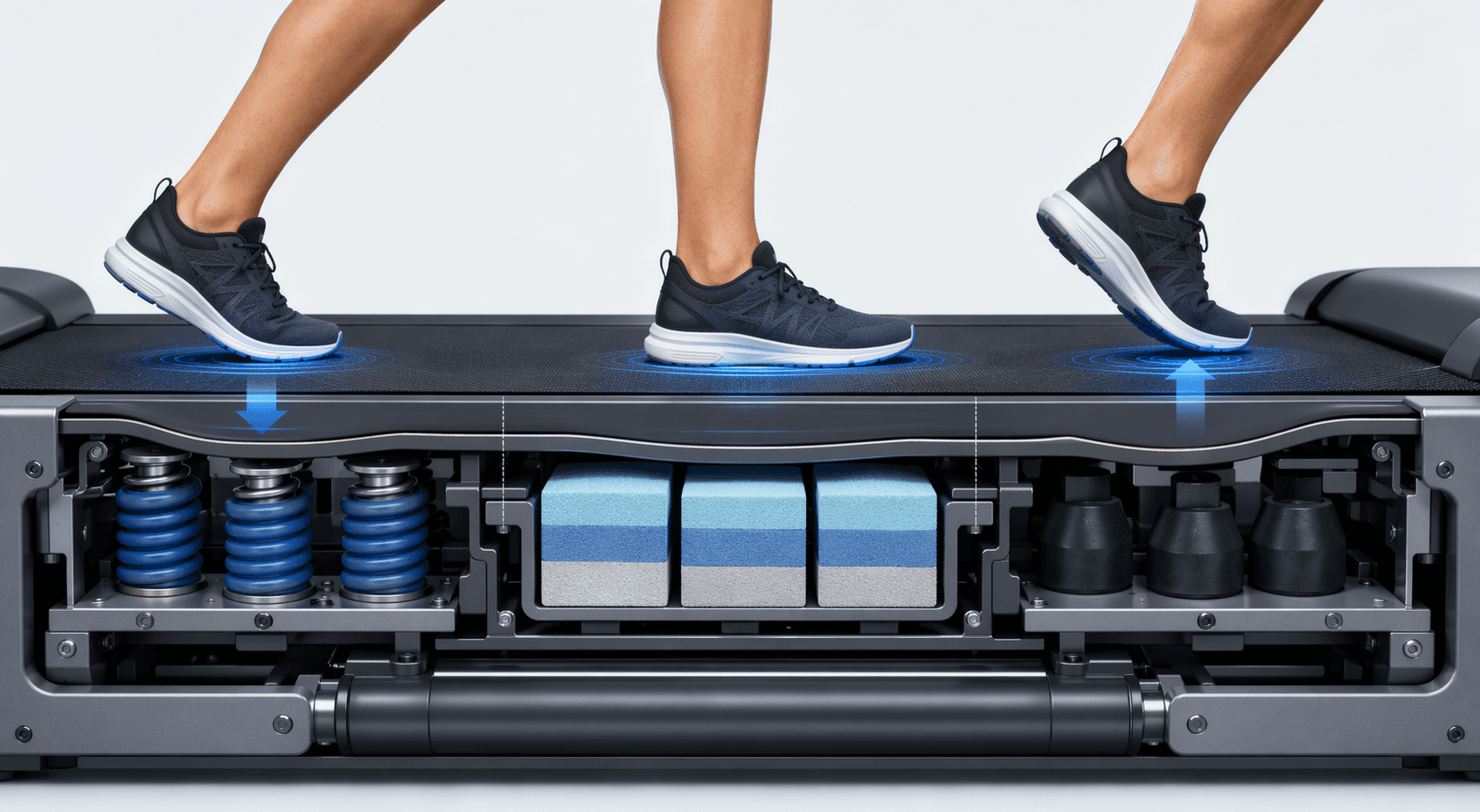
The brands that matter here are not really competing on the same axis. They are solving different parts of the stride. Horizon’s 3-Zone Variable Response deck is the clearest example of that logic: the impact zone is softer, the transition zone is more neutral, and the push-off zone is firmer. That maps cleanly to heel strike, mid-stance, and toe-off instead of pretending the whole deck should feel identical under every phase of the gait cycle. Horizon pairs that system with a 1.6 mm 2-ply silicone belt, but the zoning is the more important design choice [2].
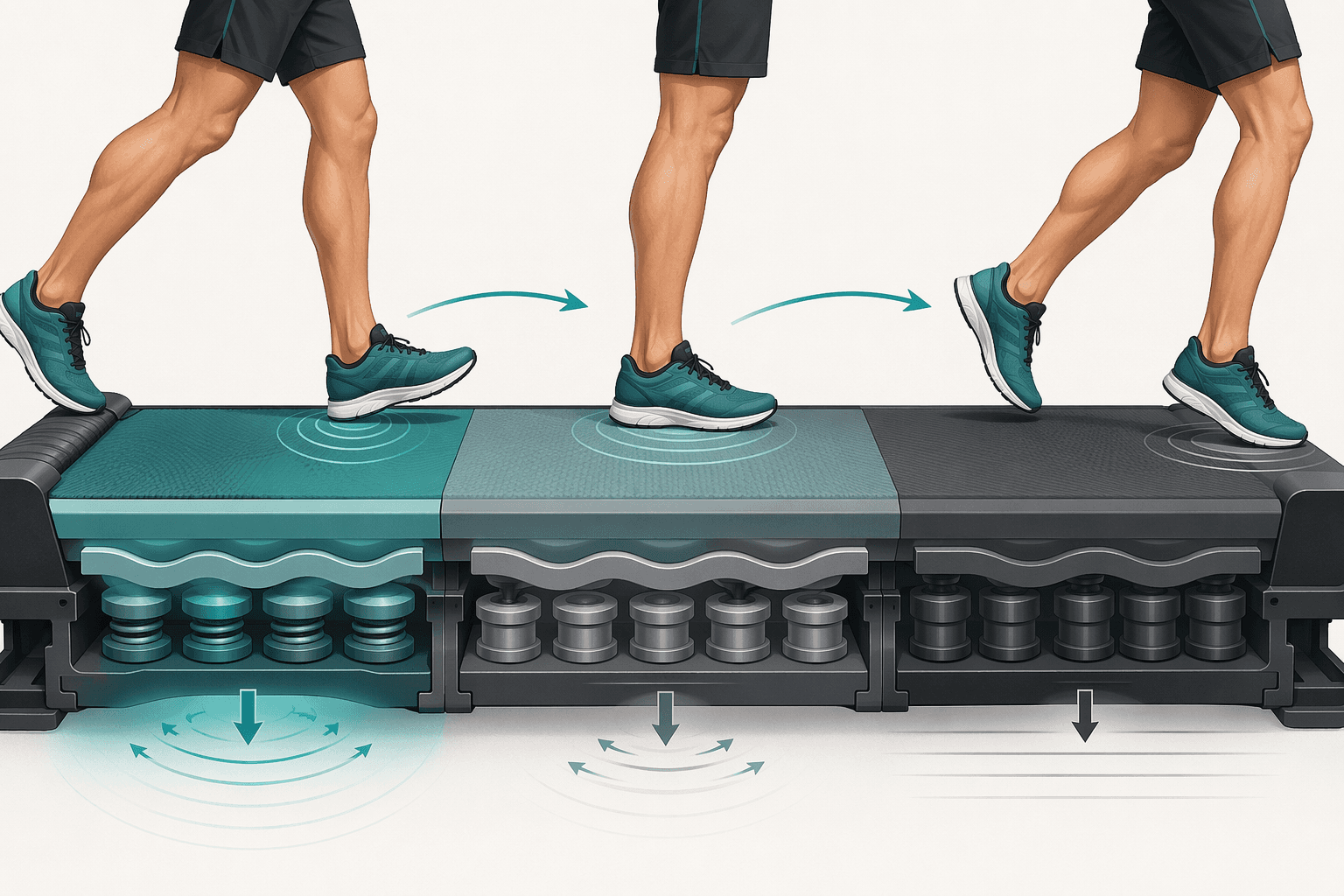
- Sole’s Cushion Flex Whisper Deck is a useful cautionary case. The brand claims about 40% impact reduction, but that comparison is against outdoor running rather than against another treadmill deck [2]. GGR’s testers also said they did not notice a dramatic difference versus other decks, which is a good reminder that a marketing percentage and a runner’s lived feel are not the same thing. Sole also pairs the deck with a 2.3 mm 2-ply belt, but belt thickness by itself is not the story.
- NordicTrack does something more confusing but also more interesting. RunFlex is a fixed responsive setup, SelectFlex lets the runner switch between soft and firm with a dial, and SpringFlex is the plushest of the three, aimed more at longer and more comfortable runs. RunFlex is also paired with a 2.8 mm 2-ply belt, the thickest traditional belt GGR tested. The brand points to a biomechanics meta-analysis saying treadmill and overground running are broadly comparable, with sagittal-plane footstrike differences, but that does not translate directly into injury prevention [3]. The point is not that one NordicTrack deck is best in general; it is that these are three different running feels, not one cushioning family.
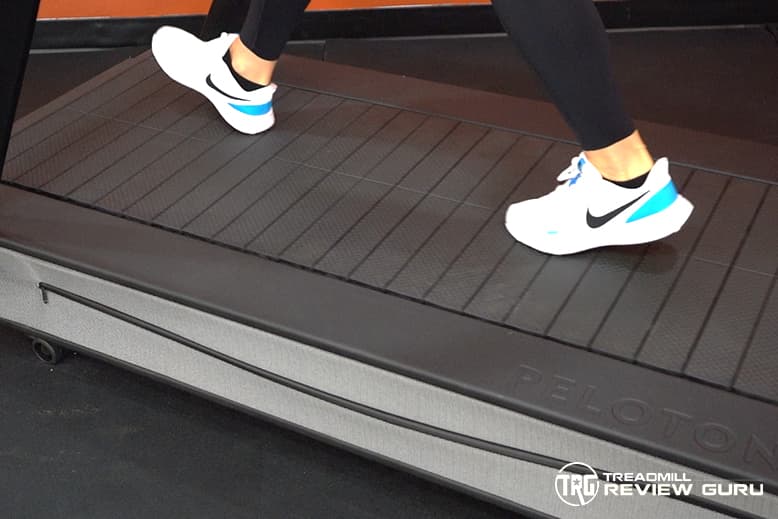
- Peloton Tread+ stands apart because it does not use a traditional continuous belt in the usual sense. It uses 59 rubberized slats on a 67-inch deck, which changes how the running surface moves underfoot and is part of why users often describe it as unusually smooth or cloud-like [6]. The tradeoff is that this is a different category of machine: the Tread+ is listed at $5,995 and weighs 455 lb. That slatted design is not just a thicker belt. It is a different running surface entirely.
- Life Fitness and TRUE sit closer to the commercial-grade end of the discussion. Life Fitness’s FlexDeck uses Lifespring shock absorbers and is commonly described as reducing joint stress by about 30% versus non-cushioned surfaces, though that number is presented as a manufacturer claim rather than as a widely verified independent lab result [4]. TRUE’s Soft Select system takes a different route: it lets the runner adjust deck firmness with a dial, which makes the deck a variable tool rather than a fixed one [5].
Seen this way, the deck conversation is really about three engineering questions: where the force is absorbed, when support firms up again, and whether the runner gets to change that behavior. Horizon answers with zones. NordicTrack answers with tiers and adjustability. Peloton answers by replacing the belt itself. Sole and Life Fitness lean on impact-reduction language. TRUE gives the runner the dial. Those are different mechanical ideas, and they are not interchangeable just because every product page uses the word "cushion."
Which runners benefit from which deck behavior
Forefoot and midfoot strikers have the clearest reason to care about cushioning claims, because Shi et al. found the clearest forefoot force reduction there, and at faster speeds [1]. That still does not mean the treadmill will prevent injuries, but it does mean the underfoot feel is not just a comfort preference. For this runner, a deck that softens landing without getting mushy on push-off is usually more useful than the plushest possible ride.
Rearfoot strikers get a weaker signal from the research. If heel impact is your main concern, advertised softness may not solve the problem as cleanly as the spec sheet suggests [1]. In practice, stability and repeatability matter a lot here. A deck that feels predictable from run to run can be more valuable than one that chases the largest impact-reduction percentage.
Heavier runners often care less about whether a deck feels luxurious and more about whether it stays supportive under load. That is where firmer push-off zones, adjustable firmness, or a commercial-style shock absorber system can make more sense than a very soft surface that collapses too much. A deck that bottoms out quickly can feel worse than a firmer one that holds its shape.
High-mileage runners usually think in terms of cumulative stress. For easy runs, recovery days, and long steady mileage, a more forgiving deck can make repeated treadmill work feel less punishing. For interval sessions, though, too much softness can get in the way of quick turnover and clean push-off. That is why adjustable systems matter: what helps on a 90-minute aerobic run is not necessarily what helps during repeats.
That leaves the simplest judgment: cushioning is worth paying attention to, but only if the mechanism matches the runner's stride and training use. A zone-based deck is not the same thing as an adjustable deck. A slatted belt is not just a thicker belt. A percentage reduction in impact is not a promise of lower injury risk. The runner trying to stay consistent without turning every run into rehab math usually gets the most from the deck that behaves the right way under their foot, at their pace, for their kind of week.
If the next decision is broader than cushioning, the same runner can move on to the fuller running-style framework, the joint-concern guide, the small-space guide, or the total-cost article once deck feel is no longer the only thing that matters.
References
- Effects of treadmill cushion and running speed on plantar force and metabolic energy consumption in running — PubMed
- Best Cushioned Treadmill (2026) — Garage Gym Reviews
- Treadmill Cushioning & Impact — NordicTrack
- Life Fitness FlexDeck Worth the Investment — gxmmat.us
- S.O.F.T. System / Soft Select Orthopedically Correct Treadmills — TRUE Fitness
- Slat Belt Treadmill vs Regular Belt — Treadmill Reviews
Comments
Join the discussion with an anonymous comment.