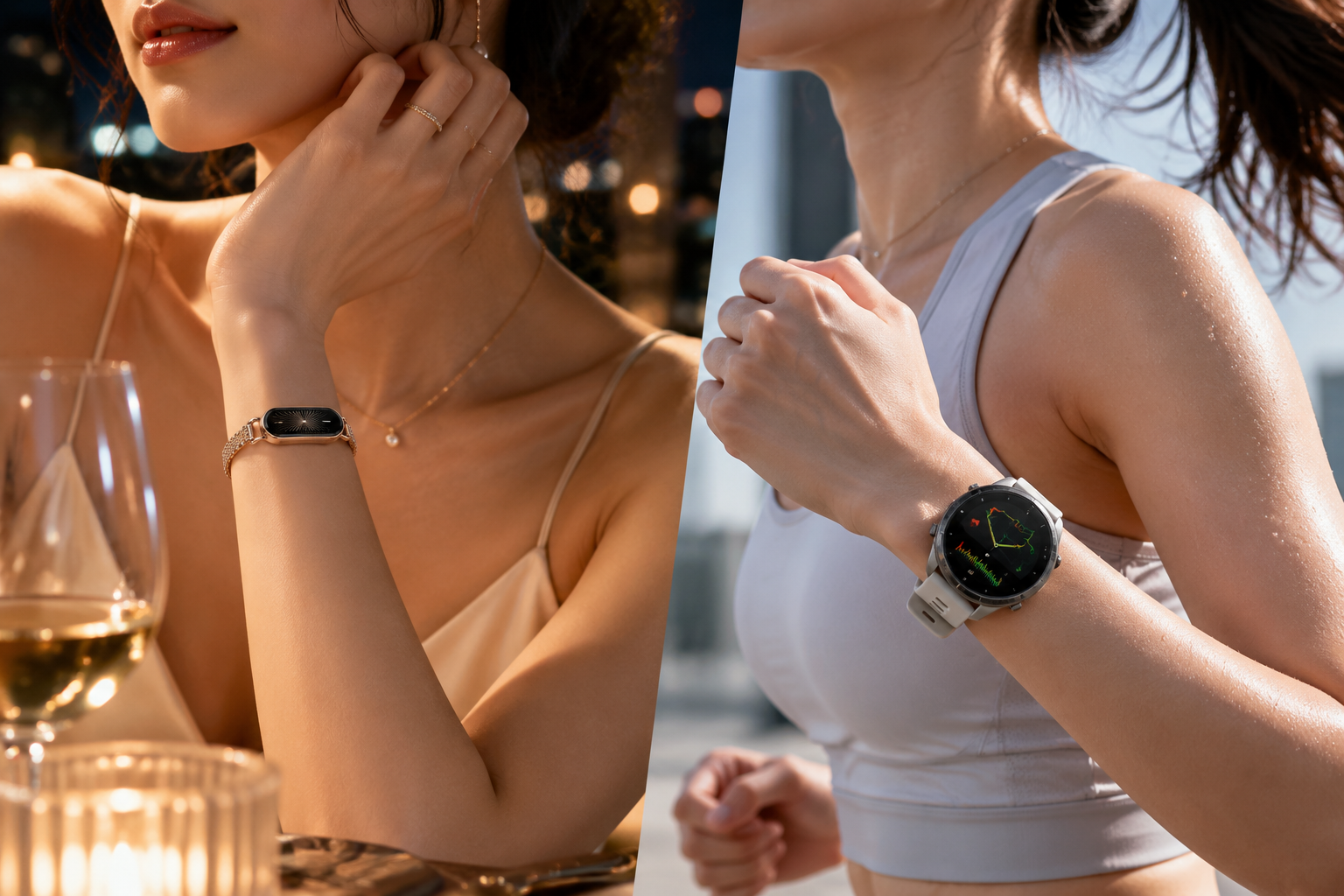
The hard part of buying a fitness tracker watch for women is not finding one with enough sensors. It is finding one you will still want on your wrist after the workout ends. A tiny patterned tracker may look right with a sweater, a bracelet stack, or a dress sleeve, then become frustrating the moment you start a run and realize it has no built-in GPS or useful workout screen. A sport watch solves that problem, but it also announces itself at dinner, in bed, and on a smaller wrist.
That trade-off is more useful than the usual “best for women” ranking. Jewelry-like trackers are built to disappear into the day; full-feature watches are built to show data while you are moving. The Garmin Lily 2 Active is interesting because it tries to occupy the narrow space between those categories: it keeps the Lily line’s 34mm case while adding built-in GPS, a feature the base Lily 2 does not have.[1][2]
| Device family | What it tends to get right | What you give up |
|---|---|---|
| Jewelry-like trackers: Garmin Lily 2, Withings ScanWatch Light, Oura Ring 4, Fitbit Luxe | Lower visual weight, easier 24/7 wear, better chance of passing as an accessory | Built-in GPS is often missing, workout screens are small or absent, training metrics are lighter |
| Full-feature watches: Apple Watch Series 11, Garmin Venu 4, Samsung Galaxy Watch 8 | Readable workout data, stronger app ecosystems, richer health and training features | More bulk, more obvious tech styling, more charging friction |
| Middle-path devices: Garmin Lily 2 Active, Fitbit Charge 6, Google Pixel Watch 4 | Some serious tracking features in smaller or narrower hardware | Still compromised: smaller screens, platform limits, or less jewelry-like styling |
The pretty tracker problem shows up during exercise
A tracker can be elegant in a product photo and still be the wrong object for your workouts. The base Garmin Lily 2 is a good example of the tension. Its 34mm case and 26g weight make sense on smaller wrists, and its patterned lens is exactly the sort of design choice that keeps a wearable from looking like a miniature phone strapped to your arm.[1] But the base model does not include built-in GPS, so outdoor pace and route tracking depend on carrying a phone.[1]
That may be fine if your exercise is mostly walking, Pilates, dance class, strength training, or casual runs where the phone is coming anyway. It is less fine if you want to glance down mid-run and adjust pace without negotiating a tiny display. This is the buried cost in many slim trackers: the device looks more wearable because it has fewer things to show you while you are working.
Withings ScanWatch Light takes the accessory idea even further. Its analog face and manufacturer-rated 35-day battery life make it feel closer to a traditional watch than a screen-first wearable.[3] The compromise is that its grayscale OLED window can only show limited workout data, so it works best for someone who wants health and activity tracking quietly in the background, not someone who wants a live training dashboard on the wrist.
Oura Ring 4 moves the tracking off the wrist entirely. That is its charm and its limitation. It is strong for sleep and recovery, and PCMag describes its sleep tracking as clinically validated; it also supports cycle-related tracking, while a Women’s Health tester reported that the ring’s temperature trends helped flag pregnancy.[4][5] But it has no GPS, no screen for real-time stats, and a $5.99 monthly subscription.[4] It can also be awkward during gripping workouts such as heavy lifting or pull-ups, where a ring is not just invisible tech but a physical object under pressure.
If you are still deciding whether your body and routine want a ring, band, or watch, the broader fitness tracker form-factor comparison for women is the more useful detour than another spec chart. The shape of the device decides which compromises you will feel every day.
Why the Lily 2 Active changes the middle
The Garmin Lily 2 Active matters because it fixes the most obvious flaw in the base Lily 2 without turning the watch into a large sport model. It adds built-in GPS at $280 while keeping the 34mm case size.[2] That combination is rare enough to deserve attention, especially for women who like the Lily’s scale but do not want to bring a phone for every outdoor workout.
It is still not a full sport watch. The screen remains small, and the device is too new to have the same depth of long-term independent testing as more established models. But it moves the most painful compromise. A slim watch with GPS is different from a slim watch that only estimates outdoor effort through a connected phone.
The other middle-path device worth taking seriously is Fitbit Charge 6. It is not jewelry in the same way a Lily or ScanWatch Light tries to be, but its physical footprint is unusually wearable: 30g, a narrow 26.4mm case, built-in GPS, and 40 workout modes.[6] Women’s Health editors described it as “so lightweight and thin that I barely notice it” during sleep, which is the kind of sentence that matters more than another feature badge if you are trying to collect consistent recovery data.[6]
The Charge 6 also has independent accuracy support that many pretty trackers lack. Wirecutter measured a 1.3% step-count error for the device, while also identifying the Fitbit Inspire 3 as the lightest mainstream tracker at 17g.[7] The Inspire 3 is the comfort extreme; the Charge 6 is the more capable compromise.
Comfort is not a soft metric on a smaller wrist
Average female wrist circumference is reported at 5.7 to 6.2 inches, which makes case size and case width more than a style preference.[8] A watch that looks moderate on a larger wrist can span the top of a smaller one, catch on sleeves, or press into the wrist during sleep. That discomfort changes behavior. If the tracker comes off at night, sleep and recovery data get thinner. If it comes off for dinner, habit and health trends become patchier. If it is too bulky for the office, it becomes a workout-only device by accident.
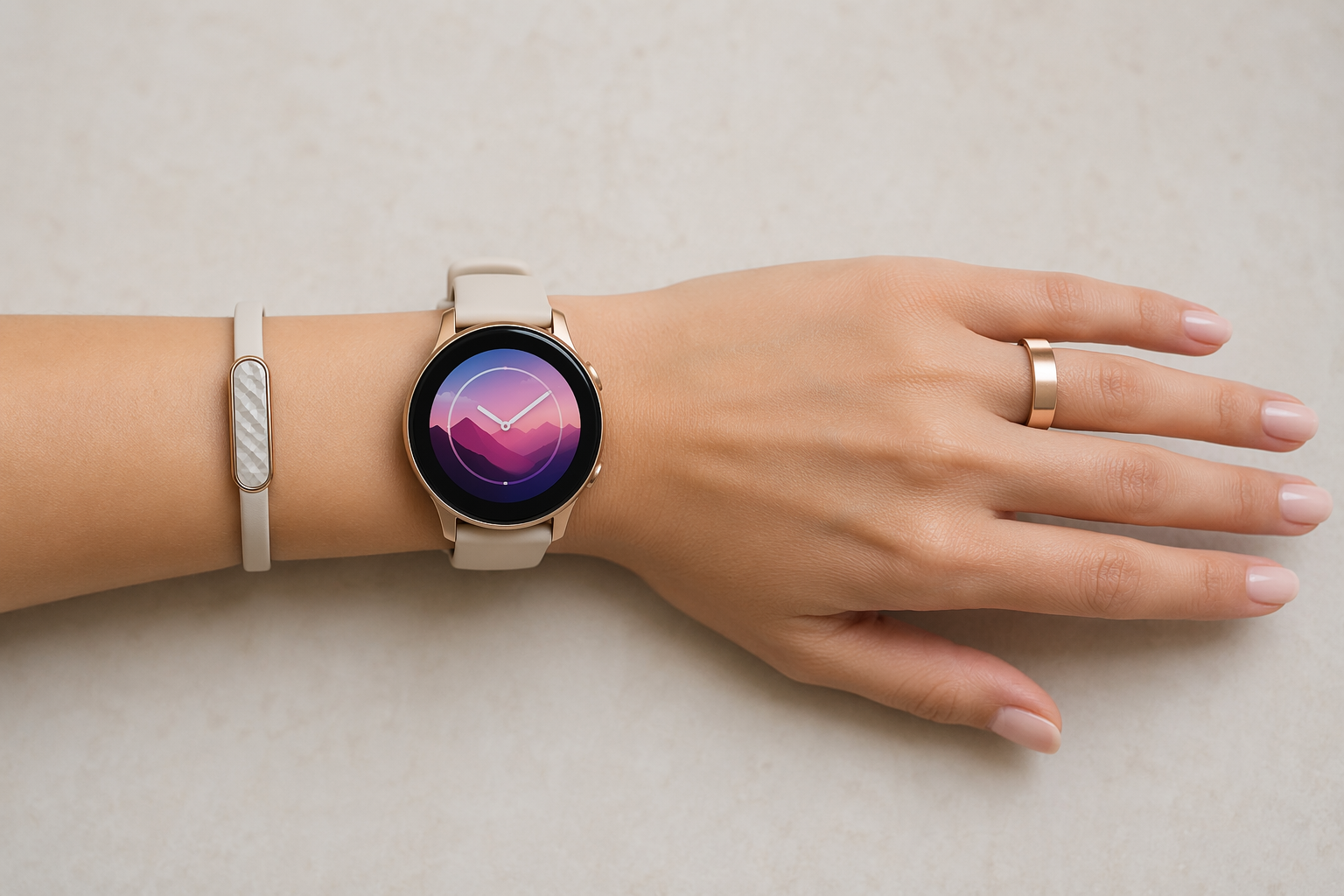
This is where the numbers become tactile. Garmin Lily 2 at 34mm and 26g reads very differently from a 42mm or 46mm Apple Watch Series 11, even before software enters the conversation.[1][9] Fitbit Charge 6’s 26.4mm case is narrow enough to behave more like a band than a watch, even though it includes GPS.[6] Fitbit Inspire 3’s 17g weight explains why it can be easy to forget, but it also explains why it is not the device to choose if you want a richer screen experience.[7]
For readers whose first filter is fit, the small-wrist fitness tracker guide is worth reading before falling in love with a feature list. A watch that technically fits and a watch that feels wearable for 23 hours are not the same thing.
What full-feature watches earn with their bulk
The case for a sport watch is strongest when you need information while the workout is happening. A larger display makes intervals, pace, heart-rate zones, maps, timers, and strength sessions easier to manage without stopping. Built-in GPS is expected rather than exceptional. Buttons, brighter screens, and richer workout modes are not aesthetic virtues, but they can reduce friction when you are sweaty, outside, or trying not to touch your phone.
Apple Watch Series 11 makes its argument through the broader health ecosystem as much as through workouts. It is available in 42mm and 46mm sizes, is limited to iPhone users, and adds FDA-cleared hypertension notifications and sleep apnea detection.[9] The trade is familiar: a more capable screen and notification system, but daily charging and an unmistakable smartwatch look.[9]
Samsung Galaxy Watch 8 makes more sense for Android users who want smartwatch depth and body composition sensors. It comes in 40mm and 44mm sizes and is Android-only.[10] The 40mm option helps, but it is still a screen-first watch, not a bracelet-like tracker. Its appeal depends on whether body composition and Android integration are worth wearing something that reads as technology in almost every setting.
Garmin Venu 4 belongs in this group for a different reason: it brings Garmin’s sport-watch capability into a more lifestyle-friendly shape. It is still not trying to pass as jewelry. Its value is for someone who wants better training tools and a longer Garmin-style fitness arc than a slim tracker can offer. If that is the priority, the bulk has a job.
For a wider split between smartwatch and tracker ownership, the 2026 smartwatch vs. fitness tracker decision framework can help if the question has expanded beyond women’s fit and style into app ecosystems, notifications, and phone replacement.
Sleep, battery, and the quiet math of actually wearing it
Sleep tracking rewards boring hardware. A device that is light, low-profile, and not glowing under the sheets has an advantage before algorithms enter the conversation. That is why the Charge 6 sleep comment from Women’s Health is useful: “so lightweight and thin that I barely notice it” describes the condition required for sleep data to exist in the first place.[6]
Oura Ring 4 is strongest here because it avoids the wrist entirely and is designed around sleep and recovery rather than live workouts. Its appeal is clearest for someone who wants readiness, sleep, and cycle signals without a screen. The Oura recovery-first tracker guide is the better next read if the main question is recovery rather than wrist-based training control.
Battery life needs a little skepticism. Manufacturer ratings are useful for comparison, but real-world use changes quickly with GPS, always-on displays, notifications, sleep tracking, and workout frequency. Garmin lists the Lily 2 at up to 5 days, while Withings’ ScanWatch Light claim is up to 35 days.[1][3] Fitbit Charge 6 is rated up to 7 days, but real-world use is often closer to 4 to 5 days depending on settings and GPS use.[6]
That difference affects ownership more than people expect. A tracker charged every few days can still become routine. A watch that needs daily charging has to fit into a morning or evening ritual. A hybrid watch that lasts weeks is easier to trust on a trip, but it may be the one that shows you the least while you exercise.
Cycle tracking is useful, but the device shape still matters
Women’s health tracking often gets treated as a software feature that can be added to any device. In practice, it depends on wear consistency, temperature data where available, sleep capture, and whether the app makes trends understandable. Oura Ring 4’s cycle-related strengths are tied to its recovery and temperature-trend orientation, while wrist devices vary more in what they measure and how they present it.[4][5]
The important distinction is that cycle predictions, symptom logging, temperature trends, and medical conclusions are not interchangeable. A device can be helpful for noticing patterns without being a diagnostic tool. If cycle tracking is a deciding feature rather than a nice extra, compare models directly in the women’s health tracking comparison before choosing mainly by case size.
Subscriptions and phone ecosystems can decide the purchase late
Hardware gets the attention because it sits on the body, but ownership cost and phone compatibility decide whether the device keeps making sense. Oura Ring 4’s $5.99 monthly subscription is part of the real price, not an accessory fee to think about later.[4] Apple Watch Series 11 is iPhone-only, while Samsung Galaxy Watch 8 is Android-only.[9][10] Those limits are not small if you plan to change phones or share a family ecosystem.
Garmin’s appeal is partly that its watches are less dependent on becoming a phone-on-wrist, but buyers should still understand which features live in the standard experience and which sit behind newer paid ecosystem layers. The Garmin Connect Plus ownership guide is worth checking if you are choosing between Lily 2, Lily 2 Active, and Venu 4 and want the cost picture to stay boring after checkout.
How to choose without pretending one category wins
Choose the jewelry-like tracker if constant wear matters more than live workout control. Garmin Lily 2, Withings ScanWatch Light, Oura Ring 4, and Fitbit Luxe make the most sense when the device has to survive sleep, work, errands, and dinner without feeling like a costume change. The cost is that you may carry your phone for GPS, accept smaller or missing workout screens, and rely more on after-the-fact trends than mid-session feedback.
Choose the full-feature sport watch if training feedback matters more than subtle styling. Apple Watch Series 11, Garmin Venu 4, and Samsung Galaxy Watch 8 earn their size when you actually use the screen, GPS, workout modes, health notifications, or platform integration. If those features are mostly aspirational, the bulk will feel expensive in every ordinary hour.
Look hardest at Garmin Lily 2 Active, Fitbit Charge 6, or Pixel Watch 4 if you want a middle path. Lily 2 Active is the cleanest style-forward bridge because it keeps the 34mm Lily case and adds built-in GPS.[2] Charge 6 is the practical narrow band with GPS and strong everyday wearability.[6] Pixel Watch 4’s 41mm option and 31g weight put it in the smaller smartwatch conversation, though it still looks like a smartwatch rather than jewelry.[11]
References
- Garmin Lily 2 Review — PCMag
- Garmin Lily 2 Active specifications — Garmin
- Withings ScanWatch Light review — Wareable
- Oura Ring 4 Review — PCMag
- Oura Ring 4 review and pregnancy detection testing — Women’s Health
- Fitbit Charge 6 review — Women’s Health
- The Best Fitness Trackers — Wirecutter
- Average female wrist circumference data — La Petite Poire
- Apple Watch Series 11 health features and specifications — Apple
- Samsung Galaxy Watch 8 specifications — Samsung
- Google Pixel Watch 4 specifications — Google
Comments
Join the discussion with an anonymous comment.