
A normal training week is where this comparison gets useful. If your week is three easy runs, a few walks, and some general movement, Samsung has a stronger case than its small workout menu suggests. If your week jumps from cycling to elliptical to swimming to dance cardio to bodyweight circuits, Oura Ring 4 is much more likely to notice what you actually did. If your week includes heavy pulls, kettlebell work, barbell rows, or hard intervals, neither ring should be treated as the workout tracker of record.
The first cut is not even about training. Samsung Galaxy Ring is Android-only, while Oura Ring 4 works across platforms, so iPhone users do not have a real two-way choice here.[1] Android users still have to make a more specific decision: Samsung is better aligned with running and steady-state cardio; Oura is better aligned with varied automatic activity logging; both are compromised for serious strength training and high-intensity work.
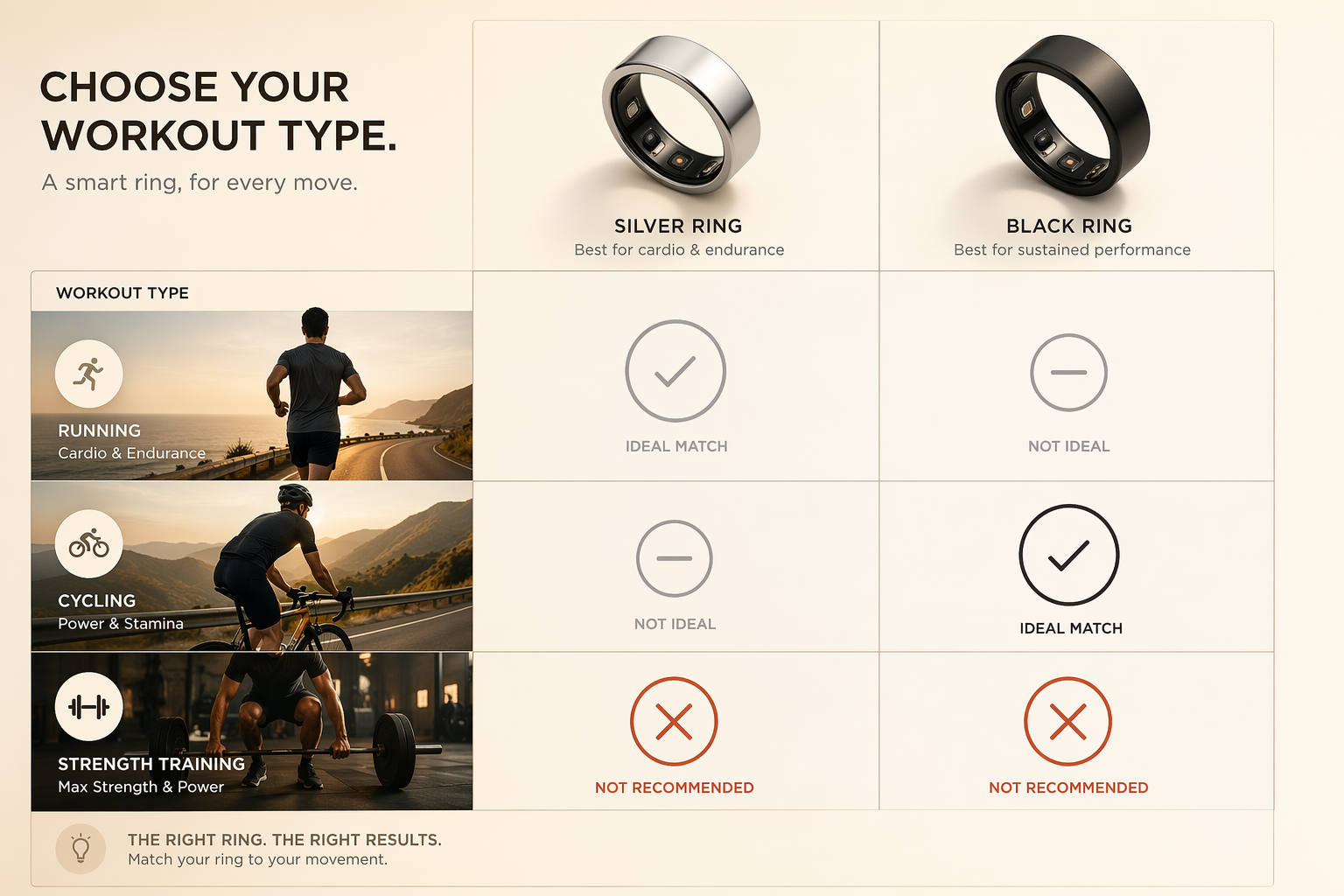
| Workout priority | Better fit | Why it matters |
|---|---|---|
| Easy running and steady cardio | Samsung Galaxy Ring | Reviewer testing found strong heart-rate agreement with a chest strap during easy runs, though this is not a lab guarantee.[2] |
| Varied auto-detected workouts | Oura Ring 4 | Oura recognizes a much broader menu of activities, while Samsung auto-detects only walking and running.[1] |
| Strength training with weights or bars | Neither | Grip pressure and metal equipment create both sensor and durability problems.[3] |
| HIIT and fast-changing intensity | Neither | Ring-based optical heart-rate tracking is weakest when effort changes quickly.[4] |
| Training by live pace, distance, or heart rate | Use a watch, chest strap, or dedicated tracker | Neither ring has built-in GPS or a display for real-time workout feedback.[1][5] |
Running and Steady Cardio: Samsung Has the Cleaner Fitness Case
For easy running, the Samsung Galaxy Ring has the most convincing workout-specific evidence in this comparison. In Runner’s World testing, Samsung’s heart-rate data tracked a Garmin chest strap closely on easy runs: average heart rate was 108 BPM on both devices, while max heart rate was 129 BPM on the Galaxy Ring and 131 BPM on the chest strap.[2] That is a useful result, especially for a ring, and it is the kind of performance that makes steady Zone 2 running a realistic use case rather than a marketing stretch.
It still needs a narrow reading. That test does not prove every runner will see the same result, and it does not turn the Galaxy Ring into a Garmin replacement. Finger fit, skin contact, temperature, arm swing, and intensity all change the signal problem. But for a runner who wants a low-profile ring to capture easy sessions and general cardio load, Samsung’s tested steady-state result matters more than a long list of workout icons.
Samsung also benefits from the fact that its automatic workout detection matches the workouts it is best positioned to handle. The Galaxy Ring auto-detects walking and running, so the person who forgets to start an easy run is less likely to lose the session entirely.[1] That is a limited feature set, but it is at least pointed at a common, sensor-friendly pattern: repeated motion, relatively stable effort, and no crushed ring against a barbell.
The limitations show up as soon as running becomes more serious. Neither Samsung Galaxy Ring nor Oura Ring 4 has built-in GPS, so route and distance depend on phone-connected GPS.[1][5] Neither ring shows pace, distance, or heart rate on your finger during the session. If you pace workouts by live splits, heart-rate caps, power, or interval targets, the ring can log context after the fact, but it cannot guide the workout while it is happening.
That distinction is easy to underrate. A tracker that confirms you ran is different from a tracker that helps you run correctly. For a 40-minute aerobic run, Samsung’s ring can be useful. For a structured workout where you need to know whether you are drifting above target in minute 12, a screenless ring is the wrong tool.
Cycling, Elliptical, Swimming, and Mixed Home Workouts: Oura Notices More
Oura Ring 4 makes more sense when the week is messy. Wareable’s head-to-head comparison lists Oura’s automatic activity detection at more than 40 activities, including cycling, swimming, dancing, household chores, and elliptical, while Samsung’s automatic detection is limited to walking and running.[1] For mixed home fitness, that gap changes the daily experience.
A cycling session is the cleanest example. If you ride indoors before work, the Samsung ring may still contribute heart-rate and activity context, but it is not built around automatically recognizing that ride. Oura is more likely to classify the session without you turning every workout into an app chore. The same logic applies to an elliptical session, a swim, or a low-equipment conditioning workout that does not look like walking or running.
Automatic detection is not the same thing as accuracy. A ring can correctly label “cycling” and still be less useful than a bike computer, watch, or chest strap for training metrics. But recognition matters for people who are using a smart ring as a continuity device: something that keeps the week from disappearing into unlogged fragments. In that role, Oura’s wider detection menu is not cosmetic. It reduces the number of workouts that require manual cleanup.
This is where Oura’s fitness case is strongest. It is not that Oura Ring 4 becomes a better running instrument than Samsung on the evidence available here. It is that Oura is less narrowly tied to running and walking. For the person who does one run, one ride, one swim, one elliptical session, and two bodyweight workouts in a week, broader recognition can be more valuable than one stronger steady-run result.
Strength Training Is Where the Ring Comes Off
The strength-training answer is blunt: do not buy either ring because you expect it to be good under a barbell. Reviewers have called out the same practical problem with weights: gripping barbells, dumbbells, and pull-up bars compresses the optical sensors and risks scratching the titanium surface.[3] That is not a small edge case for home training. It is the movement pattern.
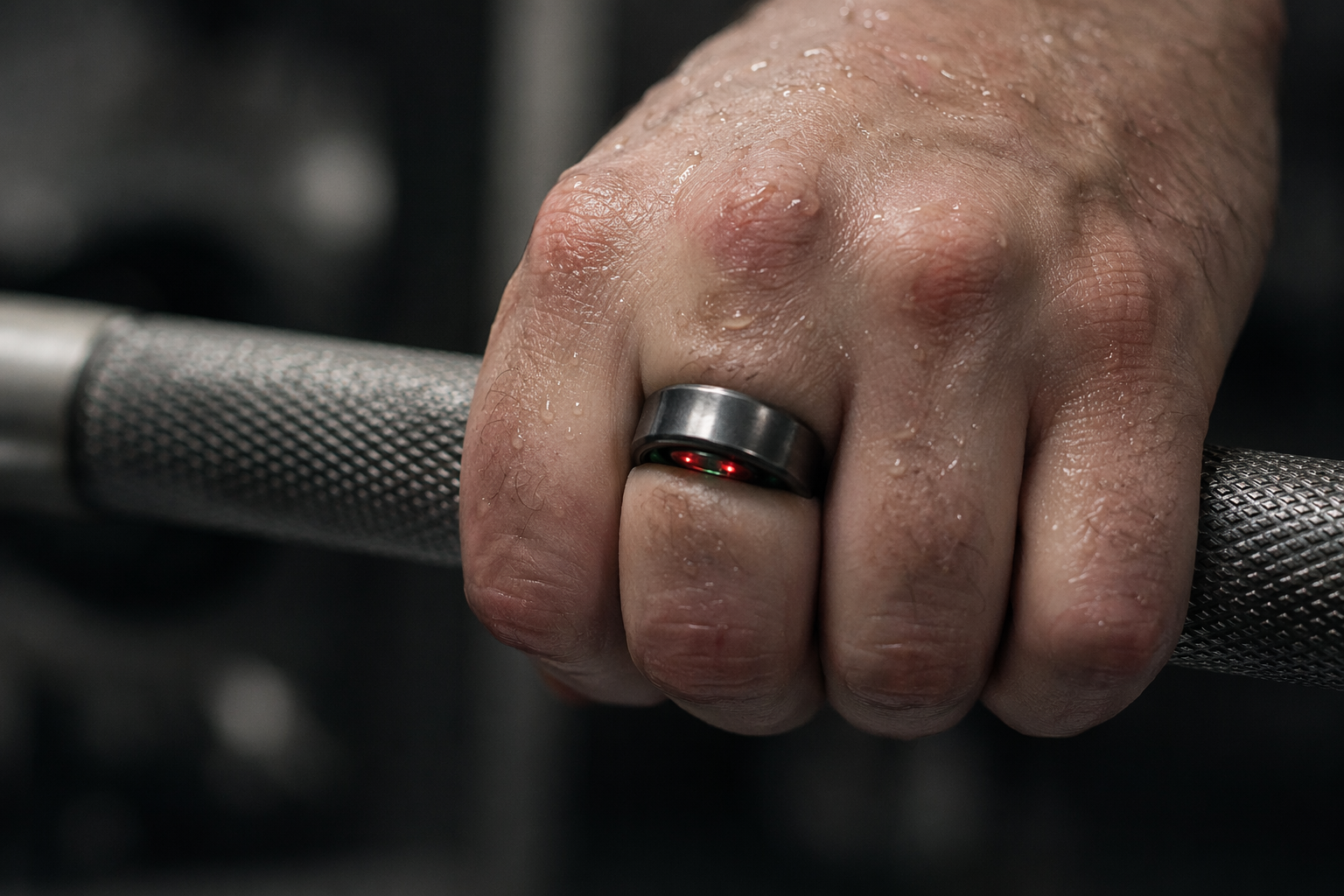
Deadlifts, rows, pull-ups, kettlebell swings, farmer’s carries, and dumbbell presses all create some version of the same conflict. The hand has to close hard around metal. The ring sits exactly where pressure, rotation, and friction are happening. Even if the device survives, the signal quality is suspect because the sensor is being squeezed and shifted instead of resting cleanly against the skin.
This is also a safety and comfort issue, not just a data issue. Many lifters already remove ordinary rings before lifting. A smart ring adds sensors, a polished surface, and a price tag, but it does not change the mechanics of grip. For serious strength work, the sensible setup is to take the ring off, log the session another way if needed, and let the ring return to what it does better afterward: sleep, recovery, readiness, and daily activity context.
If your strength training is mostly bodyweight work without gripping metal, the answer becomes less absolute. Squats, lunges, mobility flows, push-ups, and floor-based core work are less hostile to a ring. But once the session depends on a bar, bell, handle, or suspension grip, the ring is no longer disappearing into the background. It is in the way.
HIIT Is a Different Problem Than Easy Cardio
The Samsung running result should not be carried over to interval training. Easy running and HIIT are different sensor problems. During steady cardio, the device has time to follow a smoother heart-rate curve. During hard intervals, the signal has to track sharp rises, partial recoveries, arm movement, sweat, and inconsistent contact.
Cross-device testing reported substantial divergence from chest-strap readings during hard efforts, and the same testing context treated high-intensity work as a weak point for smart rings rather than a strength.[4] Runner’s World also framed the Galaxy Ring as good but not a Garmin killer, with high-intensity reliability separate from the easy-run result.[2] That is the right split: Samsung can impress on easy runs and still be the wrong device for intervals.
For HIIT, the consequence is practical. If you only want credit for having trained, either ring may contribute broad activity context. If you are judging work-rest quality, comparing peak heart rates, or using heart rate to decide when to start the next round, use a chest strap or a capable watch. A delayed or smoothed ring reading can make a hard interval look cleaner than it felt, or miss the peak that made the session hard in the first place.
Swimming, Bodyweight, and Recovery Context
Swimming sits closer to Oura’s side of the comparison because it appears in Oura’s broader automatic activity detection set.[1] That does not make Oura a swim watch. There is no finger display for live pace, and the research materials here do not support treating either ring as a serious swim-training instrument. For someone who wants a swim counted in the week’s activity picture, Oura has the better fit. For someone training sets, intervals, or stroke-specific metrics, a dedicated swim-capable watch remains the better tool.
Bodyweight training depends on the movement selection. A floor circuit with squats, lunges, push-ups, dead bugs, and mobility work is far friendlier to a ring than a pull-up bar session. The closer the workout gets to gripping, hanging, or explosive intervals, the less confidence either ring deserves as a workout tracker. The closer it stays to steady movement and low grip stress, the more reasonable it is to leave the ring on and treat the data as general activity context.
Recovery is the side of this comparison where Oura deserves a separate nod. Taylored Health’s testing reported that Oura Ring 4 eliminated earlier signal dropout issues and showed strong correlation with clinical EEG headband testing for sleep staging; the same comparison noted Samsung sleep scores that could be inconsistent against Oura and Ultrahuman on the same night.[4] That matters for training because sleep quality changes how hard a home workout feels the next day.
Still, recovery strength should not be quietly converted into workout-tracking strength. Oura can be the better recovery ring and the more flexible mixed-activity logger while still being limited during heavy lifting and HIIT. Readers who care more about readiness than rep-by-rep tracking may want a recovery-focused comparison such as Best Fitness Tracker Rings for Recovery in 2026.
The App and Ecosystem Details That Actually Affect Workouts
Subscription and ecosystem questions matter, but only after the workout fit is clear. Samsung’s no-subscription appeal is real for Android users, and some features and battery-life advantages are stronger when the ring is used inside Samsung’s Galaxy ecosystem rather than as a standalone ring.[5] Oura, by contrast, has the broader platform fit and the more mature recovery-centered experience, but its value depends partly on whether you are willing to live with its subscription model.[6]
The bigger workout limitation is shared: neither device gives you the live feedback that a watch gives you. If you are choosing between a smart ring and a wrist tracker for home training, the cleanest dividing line is whether you need data during the session or after it. A ring is better when you want passive context. A watch, bike computer, or chest strap is better when the data changes what you do mid-workout. For that form-factor decision, see Smart Ring vs. Smartwatch: Which Fitness Tracker Belongs in Your Home Gym?.
Which One Should You Buy for Fitness?
Pick Samsung Galaxy Ring if you are an Android user whose fitness week is mostly walking, running, and steady cardio. Its automatic detection is narrow, but that narrowness lines up with its best-supported workout case. The easy-run heart-rate result against a chest strap is the strongest cardio-specific data point in this comparison, as long as you treat it as reviewer evidence rather than a universal guarantee.[2]
Pick Oura Ring 4 if your workouts are varied and you care about automatic recognition across more of the week. Cycling, swimming, elliptical, dancing, and other non-running activities are where Oura’s broader detection menu becomes more useful than Samsung’s tighter activity scope.[1] Oura also has the stronger recovery story in the materials available here, which can matter if you are using the ring to decide how hard to train rather than to measure every set.
Do not pick either ring as your main tracker if strength training, HIIT, live pacing, cycling metrics, or serious cardio intervals drive your training. Keep the ring for sleep, readiness, and daily context, then use a watch, chest strap, bike computer, or dedicated tracker for the workout itself. If you are still comparing the broader category, the Best Fitness Tracker Rings 2026 roundup is the better next stop.
References
- Oura Ring 4 vs Samsung Galaxy Ring, Wareable
- Samsung Galaxy Ring review 2026: Good, but no Garmin killer, Runner's World
- Expert-Tested: Samsung Galaxy Ring Review (2026), Garage Gym Reviews
- The Ultimate Smart Ring Showdown: Oura vs. Ultrahuman vs. Samsung, Taylored Health, April 14, 2025
- Samsung Galaxy Ring vs. Oura Ring: Which Ring Rules Them All?, PCMag
- Oura Ring 4 vs Samsung Galaxy Ring: Which is the Best Smart Ring?, Tech Advisor
Comments
Join the discussion with an anonymous comment.