
Search for the best fitness tracker for women and you usually get a wall of winners: best overall, best budget, best ring, best smartwatch, best for sleep, best for runners. That sounds helpful until the “best” watch is too wide for your wrist, locked to the wrong phone, missing the health feature you actually wanted, or cheap only until the subscription starts.
A better way to shop is to eliminate first. Ask four questions, in this order: will it fit your wrist, will it work properly with your phone, does it track the women’s health features you care about, and what will it cost after subscriptions. Most models fall away before you ever need to compare sleep scores or workout animations.
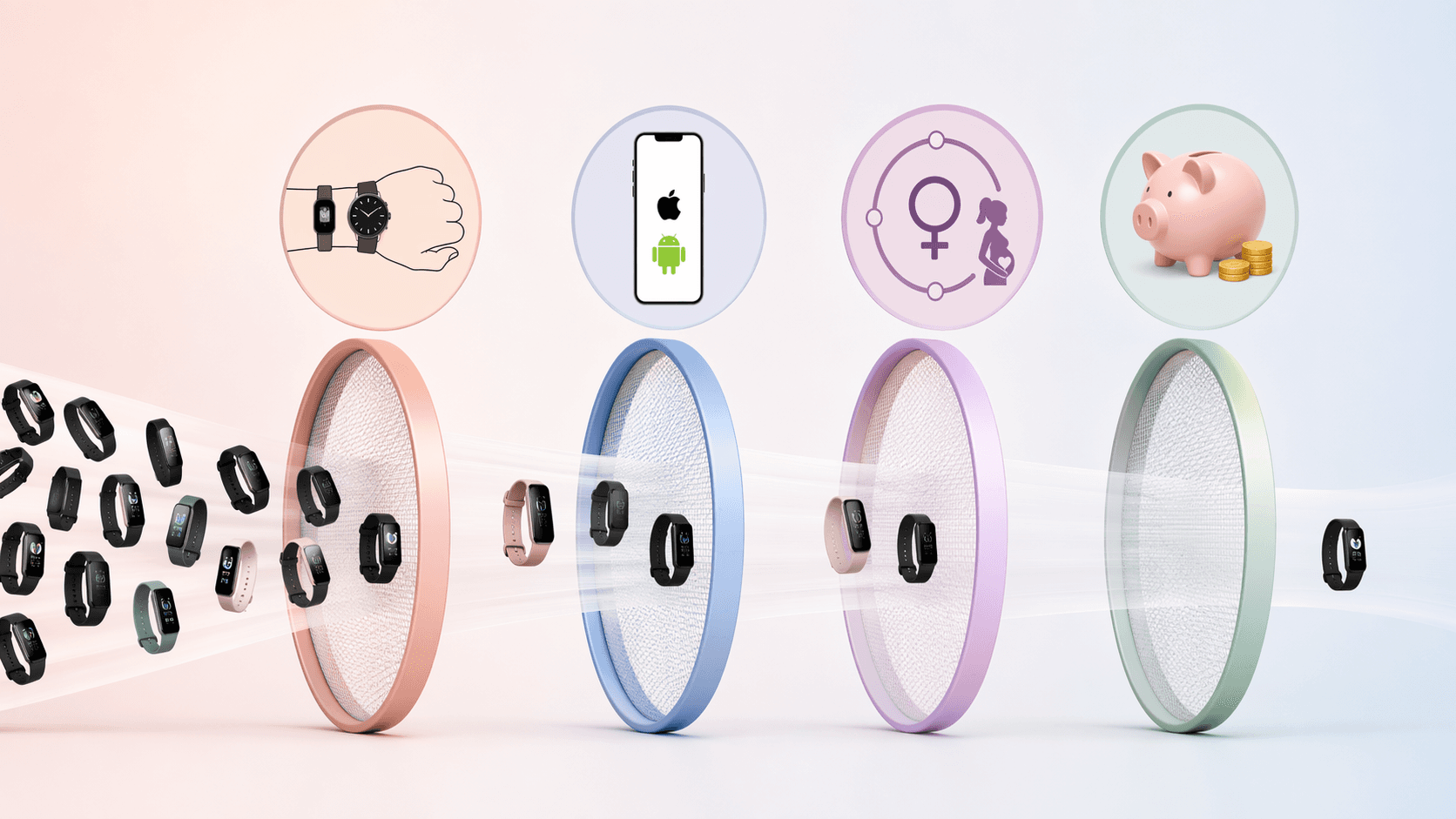
Start with the wrist that has to wear it all day
Wrist fit deserves to be the first filter because it is the fastest way for a technically excellent tracker to become drawer clutter. The average female wrist is about 5.7 to 6.2 inches, while many mainstream smartwatch cases sit in the 44mm to 46mm range and are often more proportionate on larger wrists in the 6.5 to 7.2 inch range.[1] That gap is not vanity sizing. A case that overhangs your wrist can shift during workouts, break sensor contact, catch on sleeves, and feel heavy enough that you stop wearing it to sleep.
This is where “women’s fitness tracker” should mean more than a rose-gold color option. The Garmin Lily 2 Active is a 34mm watch and weighs 28g, making it one of the more realistic round-watch options for smaller wrists.[2] The Fitbit Inspire 3 is even lighter at 17g and has been singled out in long-term tracker testing for comfort, especially for people who do not want a full smartwatch on their arm.[3] Those numbers matter more than another product photo showing a tracker on a model whose wrist size you do not know.
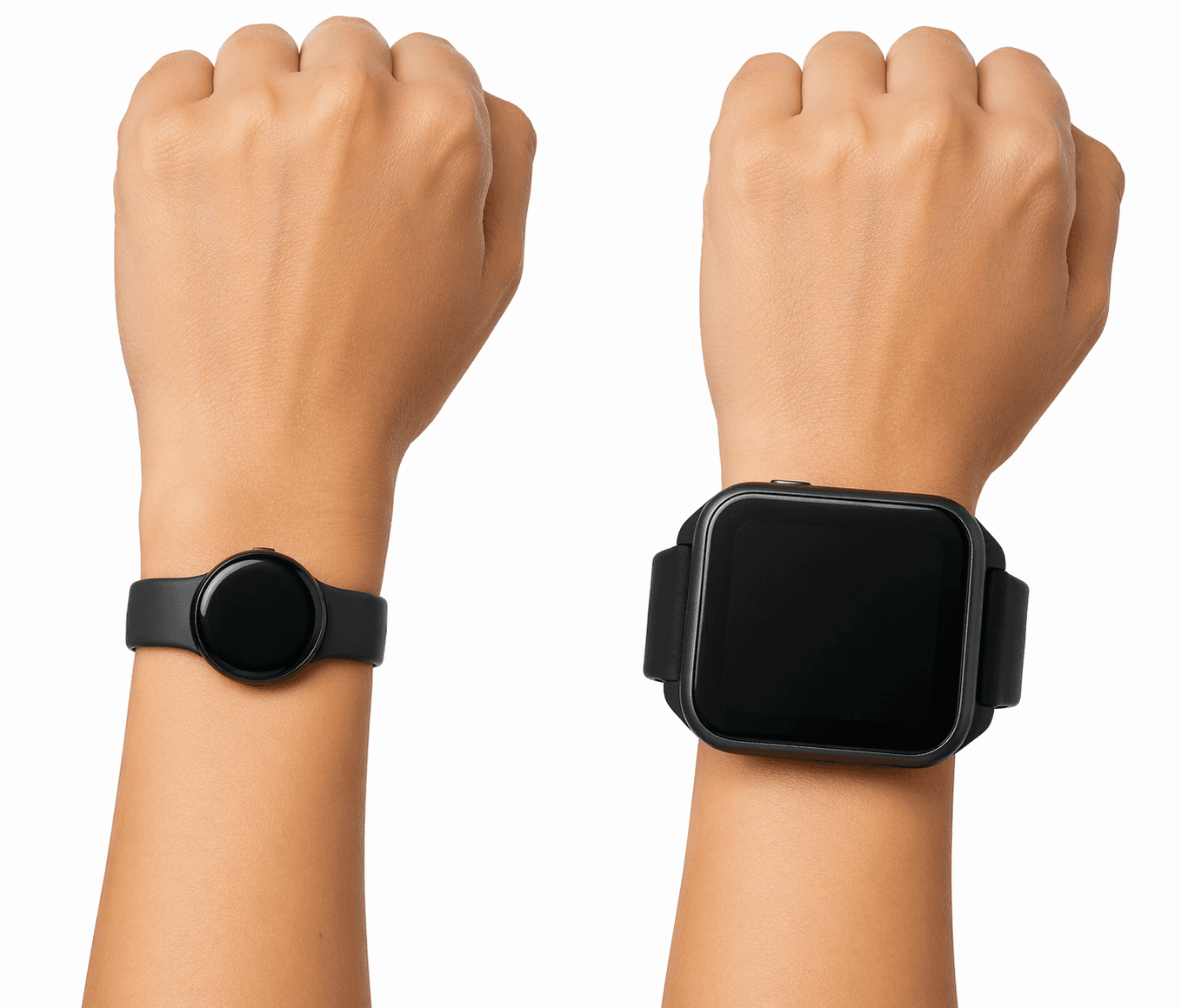
Large watches are not automatically bad. A 44mm or 46mm smartwatch can be perfectly comfortable on the right wrist, and a larger screen can be easier to read during runs, strength sessions, or outdoor walks. The problem is treating that size as neutral. If you already know big watches slide around, leave marks, or make sleep tracking miserable, do not keep them on your shortlist just because they won a general ranking.
| If your wrist concern is… | Start here | Be cautious with… |
|---|---|---|
| Very small wrist or dislike of bulky watches | Fitbit Inspire 3, Garmin Lily 2 Active | 44–46mm smartwatches unless you can try them on |
| Want a watch face but not a huge smartwatch | Garmin Lily 2 Active, Garmin Venu 3S | Large Galaxy Watch or Apple Watch sizes |
| Want the least noticeable form factor | Fitbit Inspire 3 or a ring-style tracker | Full smartwatches for sleep tracking |
| Need a large screen for readability | Apple Watch or Galaxy Watch in a size that fits | Tiny bands that make notifications hard to use |
If wrist fit is your main worry, pause here and use a dedicated small-wrist fitness tracker guide before falling in love with a spec sheet. Comfort is not a minor preference when the device is supposed to be worn through workouts, sleep, showers, desk work, and errands.
Then remove anything that does not work with your phone
Phone compatibility is less emotional than wrist fit, but it is just as decisive. An Apple Watch works only with an iPhone. The Pixel Watch 4 requires Android. Samsung Galaxy Watch models work with Android but are most complete with Samsung phones. Garmin, Fitbit, and Whoop are more cross-platform choices for shoppers who do not want their tracker decision tied as tightly to one phone brand.[4]
That means an Android user does not need to keep reading Apple Watch praise unless she is also planning to switch phones. An iPhone user who wants the deepest notification, app, and smartwatch integration should take the Apple Watch seriously, but she still has to ask whether she wants a smartwatch-sized device and whether daily charging fits her routine. A Samsung user can get more out of a Galaxy Watch than a non-Samsung Android user, but that advantage only matters if the watch actually feels wearable.
| Your phone | Strongest practical options | Options to remove early |
|---|---|---|
| iPhone | Apple Watch, Garmin, Fitbit, Oura, Whoop | Pixel Watch 4; Android-only choices |
| Samsung Android | Samsung Galaxy Watch, Garmin, Fitbit, Oura, Whoop | Apple Watch |
| Non-Samsung Android | Pixel Watch 4, Garmin, Fitbit, Oura, Whoop | Apple Watch; Galaxy Watch if you want every Samsung-specific feature |
| Likely to switch phone brands | Garmin, Fitbit, Oura, Whoop | Watch platforms tightly tied to one ecosystem |
Women’s health tracking is not one feature
Cycle tracking, fertility tracking, temperature trends, pregnancy adjustments, and symptom logging are often bundled under one label, but they do not do the same job. A simple period prediction calendar may be enough if you only want reminders. It is not the same as temperature-supported retrospective ovulation estimates, a fertility app integration, or pregnancy-aware adjustments to recovery metrics.
Garmin is the standout if pregnancy-aware wellness tracking is a priority because its women’s health features include a pregnancy mode on compatible devices, with pregnancy-related logging and adjustments to health insights such as heart rate, sleep, HRV status, and Body Battery.[5] That does not make it medical monitoring. It does make Garmin more useful than a tracker that keeps treating pregnancy as if nothing has changed physiologically.
Oura is the more relevant name for readers focused on fertility tracking because it integrates with Natural Cycles, an FDA-cleared birth control app.[6] That distinction matters: Oura itself is a wellness ring, while Natural Cycles is the regulated contraception product in that pairing. Reviewers and user communities also flag the limitation that cycle and fertility predictions are less reliable for irregular cycles, which is exactly the caveat that tends to disappear in polished product copy.[6]
Apple Watch Series 11 offers retrospective ovulation estimates using temperature sensing, while Fitbit offers cycle predictions but no dedicated pregnancy mode in the research materials reviewed for this guide.[4][5] The practical split is simple: Apple may suit an iPhone user who wants smartwatch features plus retrospective cycle insights; Fitbit may suit someone who wants basic period prediction in a lighter, lower-cost device; Garmin is stronger when pregnancy-specific adjustments matter; Oura is more compelling when fertility tracking and ring form factor are the reason for buying.
None of these devices should be treated as a certainty machine for ovulation, fertility, sleep stages, calorie burn, or pregnancy health. Wearables estimate from indirect signals. Peer-reviewed sleep-tracker research has found that consumer devices can vary meaningfully in accuracy across sleep metrics, which is a useful reminder not to overread any single readiness score or sleep-stage chart.[7] If cycles are irregular, if you are trying to conceive, avoiding pregnancy, pregnant, postpartum, or managing a medical condition, use wearable data as a log and conversation aid, not as a standalone medical decision tool.
For a deeper feature-by-feature comparison, use a dedicated cycle tracking fitness tracker comparison or a broader women’s health tracking comparison after you have already narrowed by wrist and phone.
The real price is the three-year price
Upfront price is where tracker shopping gets slippery. A device can look affordable at checkout and become expensive if the features you actually want sit behind a paid membership. The fairest comparison is not “Which one is cheapest today?” It is “What will this cost over the next three years if I use it the way the brand expects me to?”
| Device | Upfront price used in this guide | Subscription assumption | Approx. three-year total |
|---|---|---|---|
| Garmin Venu 3S | $355 | $0 required; Garmin Connect+ optional at $4.99/month | $355 without optional add-on |
| Fitbit Charge 6 | $160 | Free tier or Fitbit Premium at about $80/year | $160 free tier; about $400 with Premium |
| Oura Ring 4 | $349 | About $69.99/year membership | About $559 |
| Whoop 5.0 | Often presented with no separate device price; membership required | $199/year minimum | $597 |
| Apple Watch | Varies by model | $0 required fitness subscription for core watch features | Device price only |
| Samsung Galaxy Watch | Varies by model | $0 required fitness subscription for core watch features | Device price only |
This table changes the shape of the decision. A Fitbit Charge 6 can remain a good budget pick if the free tier gives you what you need. If the features you care about require Premium, the three-year cost moves much closer to higher-end devices. Oura’s ring form factor may be worth paying for if you hate watches or want its fertility ecosystem, but the membership belongs in the first calculation, not as a surprise after sizing. Whoop is easiest to justify when recovery coaching is the point of the purchase and the subscription model does not bother you.
Garmin, Apple Watch, and Samsung Galaxy Watch look more expensive up front in many comparisons, but their core fitness tracking does not depend on a required subscription in the same way. Garmin Connect+ exists as an optional add-on at $4.99 per month, but the basic Garmin value proposition is still unusually strong for people who dislike recurring fees.[8]
If subscriptions are a dealbreaker, do not negotiate with yourself later. Use a fitness tracker subscription cost guide or a women’s fitness tracker cost comparison before buying the cheaper-looking device.
Accuracy helps, but it should not override fit
There is useful accuracy testing in the tracker world, and it should count. In CNET testing, the Apple Watch Series 11 averaged 0.98% error, about 1.40 BPM, against a Polar H10 chest strap over more than 30 miles of running.[9] CNET also validated the Fitbit Charge 6 during HIIT-style heart-rate changes from about 160 BPM down to 120 BPM against a Polar H10.[9] Garmin Venu 3S testing cited in the research brief found heart rate within ±1 BPM of a doctor-measured reading.[4]
Those results are reassuring, not universal law. A test on one runner, one wrist, or one workout style cannot promise the same performance for every skin tone, wrist shape, strap tightness, sweat level, tattoo placement, workout type, or pregnancy stage. Optical sensors need stable contact. If a large watch bounces because it is too big, its impressive lab result may matter less on your wrist than a smaller device with steadier contact.
Shortlists by real buyer profile
Once wrist, phone, health features, and cost have done their work, the field gets much smaller. These are not universal rankings. They are sensible starting points for different constraints.
Small wrist, basic budget
Start with Fitbit Inspire 3 if you want the lightest, least watch-like option and can live with simpler health features. Consider Garmin Lily 2 Active if you want a more watch-like look in a genuinely small 34mm case, especially if built-in GPS matters. Avoid beginning with a 44mm or 46mm smartwatch unless you have tried on similar sizes and know they do not bother you.
iPhone user with no subscription tolerance
Apple Watch is the cleanest ecosystem choice if you want smartwatch features, strong heart-rate performance in available testing, and no required subscription for core fitness features. If watch size, battery routine, or sleep comfort is the problem, compare Garmin Venu 3S or Garmin Lily 2 Active instead. The better choice depends less on brand prestige than on whether you want a smartwatch on your wrist every night.
Android or Samsung user
Samsung users should look at Galaxy Watch models if they want the fullest Samsung ecosystem experience and are comfortable with the case size. Non-Samsung Android users should compare Pixel Watch 4, Garmin, Fitbit, Oura, and Whoop depending on whether smartwatch features, battery life, form factor, or recovery coaching matters most. Apple Watch should be removed unless a phone switch is already happening.
Fertility-focused reader
Oura Ring 4 plus Natural Cycles is the most specific path if fertility tracking is the reason you are buying and the ring form factor appeals to you. Put the membership cost into the first comparison, and be extra cautious if your cycles are irregular. Apple Watch may be a better fit for iPhone users who want broader smartwatch features and retrospective ovulation estimates rather than a ring-based setup.
Pregnancy-aware tracking need
Start with compatible Garmin devices if pregnancy mode is a priority. The value is not that Garmin can tell you everything happening in pregnancy; it is that the device is at least designed to acknowledge pregnancy in its wellness tracking instead of continuing with generic cycle assumptions. Confirm current device support before buying, because compatibility and regional availability can change.
Recovery-focused subscription buyer
Whoop 5.0 makes the most sense for someone who actively wants recovery coaching, strain guidance, and a subscription-based service. It is not the sneaky budget pick; it is a recurring-fee product. If that makes you annoyed before you even buy it, choose Garmin, Apple Watch, or Samsung instead.
Lowest real three-year cost
Fitbit Charge 6 on the free tier and Garmin Venu 3S without optional add-ons are the clearer contenders, depending on whether you want the lower upfront price or the broader no-required-subscription training platform. Apple Watch and Samsung Galaxy Watch can also be cost-stable after purchase, but only if their device price and size make sense for you.
If you want to keep comparing after this filter, use a broader tiered fitness tracker comparison for women, a form-factor guide, or workout-specific guidance for yoga, Pilates, HIIT, and strength training. At that point, the comparison is finally useful because the obviously wrong devices are already gone.
The best pick is the one that survives your filters
A tracker that fits your wrist, works with your phone, supports the health features you actually care about, and costs what you are willing to pay over three years is a stronger “best” than a higher-ranked device built for someone else’s body, phone, and budget. Start there, and your shortlist usually becomes two or three devices instead of a crowded page of winners.
References
- The 9 Best Fitness Trackers for Women of 2026, Tested by Experts — Good Housekeeping.
- Garmin Lily 2 Review — PCMag.
- The 3 Best Fitness Trackers of 2026 — Wirecutter, The New York Times.
- Best Fitness Trackers of 2026 — CNET.
- Women’s Health — Garmin.
- Best Fertility Trackers of 2026, Tested and Reviewed by a Mom Who Tested 10 — What to Expect.
- Accuracy of 11 Wearable Sleep Trackers — PMC.
- Garmin vs. Fitbit: Compare devices — Wareable.
- I Ran 30 Miles With 5 Smartwatches — CNET.
Comments
Join the discussion with an anonymous comment.