
The problem with choosing a fitness tracker ring for a home gym is not that rings are too small, too quiet, or too minimalist. Those are often the reasons people want one. The problem shows up when the workout gets messy: a kettlebell set, a treadmill climb, burpees, rowing intervals, or dumbbell circuits where your fingers are gripping hard and your heart rate is moving fast.
In Android Central’s smart ring heart-rate testing, the Oura Ring 4 showed a 60–70 bpm gap against a Garmin Venu 3 during the same high-intensity workout. The Samsung Galaxy Ring averaged under 150 bpm during a Spartan Race while wrist-worn devices registered 169–170 bpm. RingConn Gen 2 averaged 88 bpm in one workout while Garmin showed 151 bpm, a 63 bpm gap. Amazfit Helio Ring was the standout among the tested rings, staying close to Garmin and Pixel Watch 3 at moderate intensities.[1]
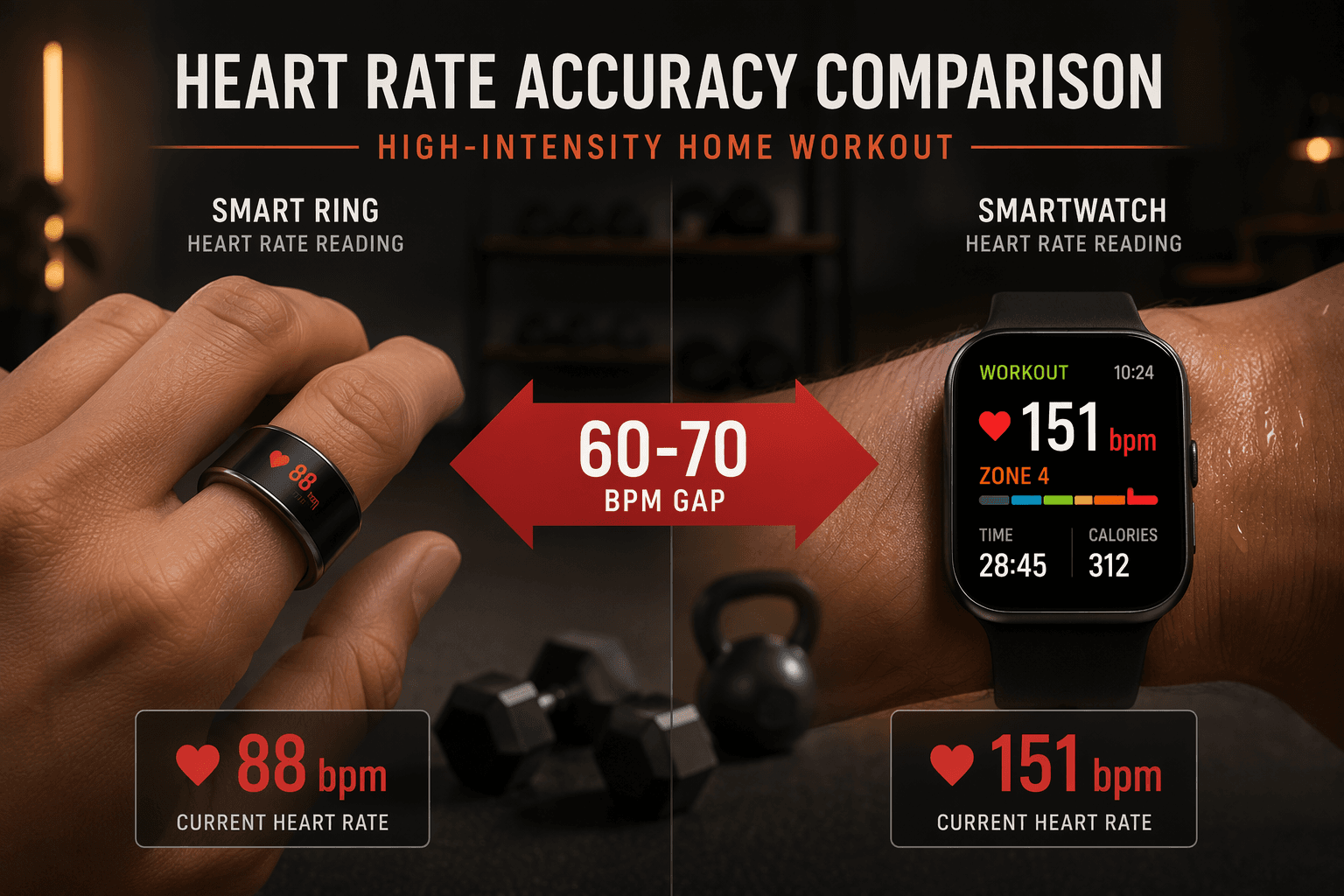
That does not mean every ring reading is wrong, or that every smartwatch is automatically perfect. The Android Central test used one subject and two wrist devices, not a medical ECG chest strap, so the exact gaps should not be treated as universal. But for a person training at home, the practical takeaway is hard to dodge: if a ring loses the plot when intensity rises, it may be excellent for your recovery dashboard and still be the wrong tool for the workout itself.
The home-gym question is what you need the wearable to do during the session
A home gym asks different things from a wearable than a normal day does. During sleep, the device needs to stay comfortable and consistent. During a workout, it needs to follow rapid heart-rate changes, stay connected to the skin, and avoid being confused by grip pressure, finger movement, sweat, and irregular motion.
That is why the ring-versus-watch decision should start with the kind of training you actually do, not the cleaner product category.
| Your main use | Better fit | Why |
|---|---|---|
| Sleep, recovery, resting heart rate, HRV, temperature trends | Smart ring | More comfortable overnight and easier to wear passively |
| Walking, mobility, low-intensity exercise | Smart ring can be enough | Workout precision matters less if you are mainly watching broad trends |
| Treadmill intervals, rowing, HIIT, kettlebells, dumbbells, zone training | Smartwatch | Wrist devices are more reliable for exercise heart-rate tracking and real-time feedback |
| Best sleep compliance plus best workout data | Ring plus smartwatch | Useful, but expensive and redundant unless you will actually use both data streams |
If you want the wider, more general version of this comparison, our fitness tracker ring vs. watch guide covers the basic form-factor trade-offs. This piece is narrower: it is about whether a ring can be trusted when the home workout is no longer gentle.
Where rings struggle: intensity, grip, and fast heart-rate changes
Smart rings read from the finger, which is a convenient place for all-day wear but a complicated place during training. A dumbbell set changes finger pressure. A kettlebell swing loads the hand differently on each rep. A rowing handle and a treadmill incline session create very different motion patterns. Even bodyweight work can make the ring shift, press, or lose a clean optical signal.
The brand-by-brand results from Android Central matter because they match the kinds of failures a home user would actually notice. Oura Ring 4’s 60–70 bpm gap during high intensity is not a tiny calibration issue if you are trying to stay in a heart-rate zone. Samsung Galaxy Ring staying below 150 bpm while wrist devices averaged 169–170 bpm is the difference between a hard aerobic effort and something that looks much easier on paper. RingConn Gen 2’s 88 bpm average against Garmin’s 151 bpm in one workout would make a demanding session look like a casual one.[1]
Amazfit Helio Ring deserves a more favorable note here. In the same testing, it was the most reliable exercise heart-rate performer among the rings tested, especially at moderate intensity.[1] That still does not turn the whole category into a smartwatch replacement for interval work. It means one ring looked better under that test setup, while the broader pattern still favors wrist devices once heart rate climbs and movement becomes less predictable.
For zone-based training, that gap has consequences. If your ring underreports a hard interval, you may think you need to push harder. If it misses the peak of a treadmill climb, your workout history looks easier than it was. If it smooths over a kettlebell circuit, your recovery score the next morning may be interpreting incomplete strain.
For a deeper technical look at where these readings tend to break down, see our fitness tracker ring accuracy guide.
Where rings earn their place: sleep and passive recovery
The strongest case for a ring is not the workout screen it does not have. It is the night after the workout.
Rings are easier to sleep in than watches, and that matters more than spec sheets admit. Wearable compliance data cited in smart-ring buying coverage puts consistent overnight wear at 98% for ring users versus 67% for smartwatch users.[2] A sleep tracker sitting on a charger is not tracking anything. A slightly less capable device that stays on your hand every night can produce a more useful recovery history than a more powerful watch you keep removing at bedtime.
This is where a smart ring can be genuinely valuable for a home gym: sleep duration, sleep consistency, resting heart rate, HRV, temperature trends, and recovery context. Those signals do not require you to tap a screen between sets or remember to start a workout mode before a quick mobility session. They reward boring consistency.
The mistake is letting that sleep-and-recovery strength spill into a training claim. Wellness tracking and workout tracking are adjacent, but they are not interchangeable. A ring can tell you whether your overnight patterns look strained after a week of hard workouts. That is different from telling you accurately, in the moment, whether your treadmill interval is sitting in the heart-rate zone you planned.
Step counts are a secondary signal, not the deciding factor
Step counting is one of the few areas where the ring-versus-watch debate can get more attention than it deserves. Rings can be good enough for casual movement trends, but they do not have the same arm-swing signal that wrist devices use. Available accuracy estimates put rings around 88–92% for step counts, compared with 96–98% for wrist devices.[2]
For most home fitness buyers, that should not be the deciding factor. If you are trying to increase daily movement, a ring can show whether your baseline is moving up or down. If you care about structured training load, interval intensity, or pace-linked cardio sessions, heart-rate behavior matters much more.
How the main rings look through a home-training lens
Oura Ring 4 remains the best-known option and one of the most developed recovery platforms, but its high-intensity heart-rate result in Android Central’s testing is exactly the kind of miss that matters if you lift, sprint, row, or run treadmill climbs at home.[1] It is easier to recommend as a sleep-and-recovery tracker than as the only wearable for serious workout tracking. If you are specifically weighing Oura as a replacement for a conventional tracker, our Oura replacement analysis goes deeper on that trade-off.
Oura Ring 5 needs a cautious mention, not a victory lap. Current roundup data lists it at $399 and up, with a $5.99/month subscription, a thinner design, and up to 10.5 days of battery life.[2] But as of June 2026, long-term review conclusions were still emerging: PCMag noted ongoing testing, and CNET had not yet completed its own testing.[3][4] Better hardware claims may turn into better training performance, but that is not the same as settled evidence.
Samsung Galaxy Ring has the appeal of no subscription and tight Samsung ecosystem integration, but Android Central’s race data makes it hard to treat as a dependable intensity tracker for demanding workouts.[1] It can make sense for someone already living inside Samsung Health who mainly wants passive health data, but the ecosystem lock-in matters if your home gym already runs through another watch, app, or phone platform.
RingConn Gen 2 Air is attractive on price at $199 with no subscription, and that matters for buyers trying to avoid yet another monthly charge.[2] But the RingConn Gen 2 workout result cited above — 88 bpm against Garmin’s 151 bpm — is a useful warning against buying a low-cost ring and expecting it to act like a training watch.[1]
Amazfit Helio Ring is the pleasant complication. At $150 with no subscription, and with the strongest exercise heart-rate showing among the rings in Android Central’s test, it deserves attention from ring-leaning buyers who still want some workout tracking.[1][2] The narrower recommendation still applies: it looks better for moderate exercise than for replacing a dedicated training watch across hard home workouts.
Ultrahuman is harder to place for U.S. buyers. The Ultrahuman Ring Air has been unavailable in the U.S. because of a patent dispute with Oura, while the Ring Pro has been listed for pre-order at $479.[2] That makes it less useful as a straightforward recommendation for someone trying to buy a ring now.
If you have already decided a ring fits your priorities, our best fitness tracker rings for 2026 guide is the better next stop for model-by-model shopping.
The cost split changes the recommendation
Once the functional split is clear, price becomes less abstract. A cheap ring that does the wrong job is not a bargain. A watch you hate sleeping in may still be the right training tool. And buying both only makes sense if you will look at both types of data instead of letting one device become an expensive drawer resident.
| Option | Known cost structure | Home-gym implication |
|---|---|---|
| RingConn Gen 2 Air | $199, no subscription | Low-cost passive tracking, but do not buy it mainly for hard workout HR |
| Amazfit Helio Ring | $150, no subscription | Most promising ring in the cited workout HR test, especially at moderate intensity |
| Oura Ring 4 | $349 plus $5.99/month | Strong recovery platform; subscription adds $216 over three years |
| Oura Ring 5 | $399+ plus $5.99/month | Promising specs, but long-term testing was still ongoing as of June 2026 |
| Samsung Galaxy Ring | $399, no subscription | No monthly fee, but Android-only and ecosystem-limited |
| Ring plus smartwatch | $600–900 total in many setups | Best split of sleep/recovery and workout tracking, but only if you use both |
The Oura subscription is the clearest example of why total ownership cost matters. At $5.99/month, the membership adds $216 over three years on top of the ring price.[2] That may be acceptable if Oura becomes your nightly recovery habit. It is harder to justify if you still need a watch for every serious workout.
For more on avoiding wearable costs that creep up after checkout, see our fitness tracker subscription trap guide and our Oura Ring 4 total cost breakdown.
Which one should you buy?
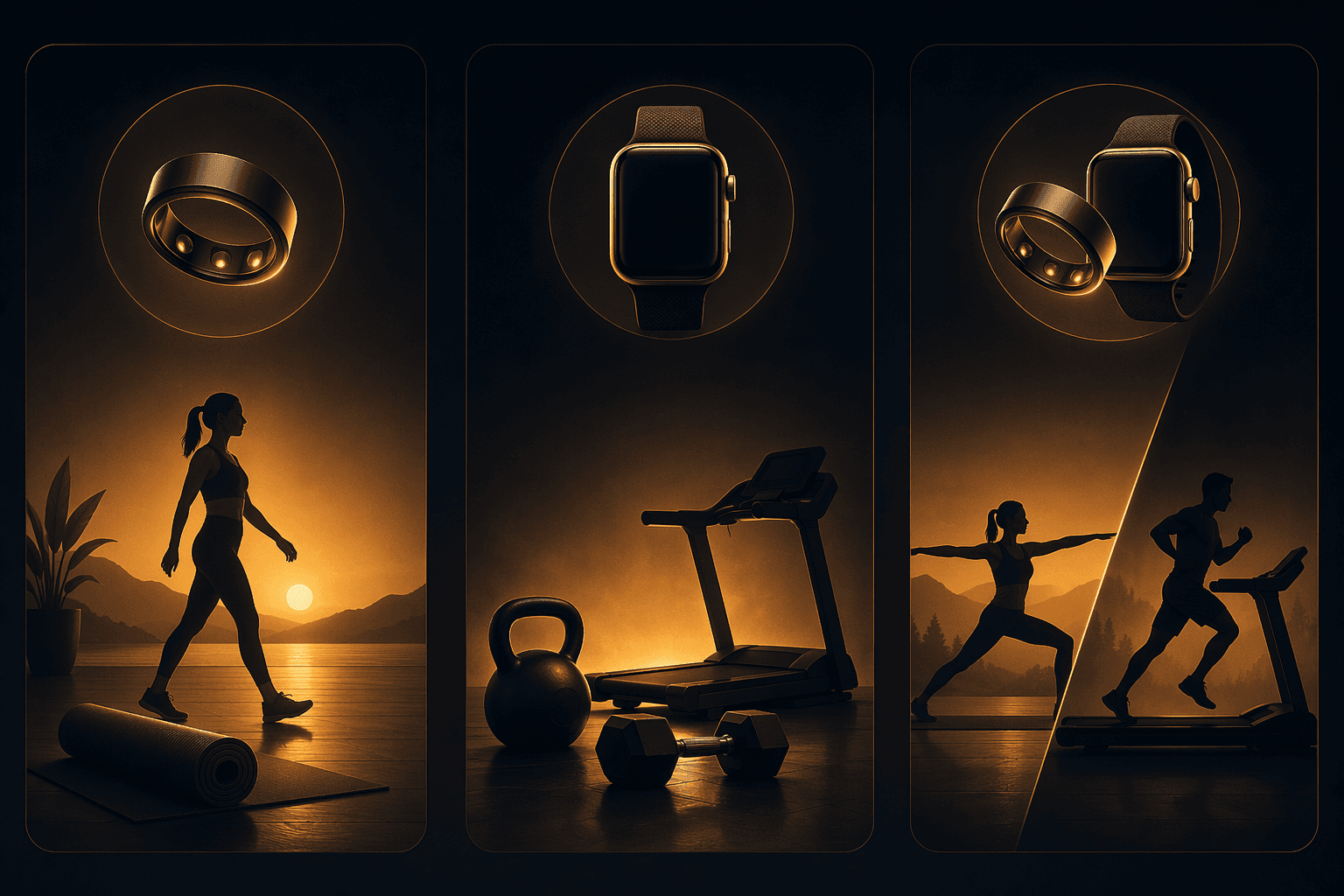
Buy a smart ring if your home fitness work is mostly walking, mobility, stretching, light strength training, sleep improvement, and recovery awareness. In that use case, the lack of a screen is a feature. The ring stays out of the way, collects quiet data, and is more likely to remain on your body overnight.
Buy a smartwatch if your home gym includes cardio machines, HIIT, kettlebell intervals, dumbbell circuits, rowing, treadmill climbs, or heart-rate-zone conditioning. You get more reliable exercise heart-rate tracking, real-time feedback, workout controls, and a display you can check without waiting for an app sync.
Consider both only if you genuinely want two different things: a ring for overnight recovery and passive health trends, and a watch for workouts. That setup can be excellent, but it is not automatically the smart premium answer. It costs more, duplicates some metrics, and asks you to manage two devices instead of one.
Smart rings belong on the recovery side of the home gym. Smartwatches belong in the training session. If you can only buy one and your workouts are the reason you are shopping, choose the device that will be accurate when you are sweating, gripping, climbing, pressing, and breathing hard.
Comments
Join the discussion with an anonymous comment.