
There is no single best fitness tracker ring in 2026. The right one depends on three things that matter more than the finish color: what phone you use, whether you are willing to pay a subscription, and whether you expect accurate heart-rate tracking during hard workouts.
If you want the short version: Oura Ring 4 is still the most polished health and recovery ring, but its $5.99 monthly subscription changes the real price. RingConn Gen 2 Air is the value pick because it costs $199, has no subscription, and has tested battery life around 10.5 days. Samsung Galaxy Ring makes the most sense for Samsung phone users, not iPhone users and not even all Android users equally. Amazfit Helio Ring is the one to look at if workout heart-rate accuracy matters most, but it has only three size options and roughly four-day battery life.
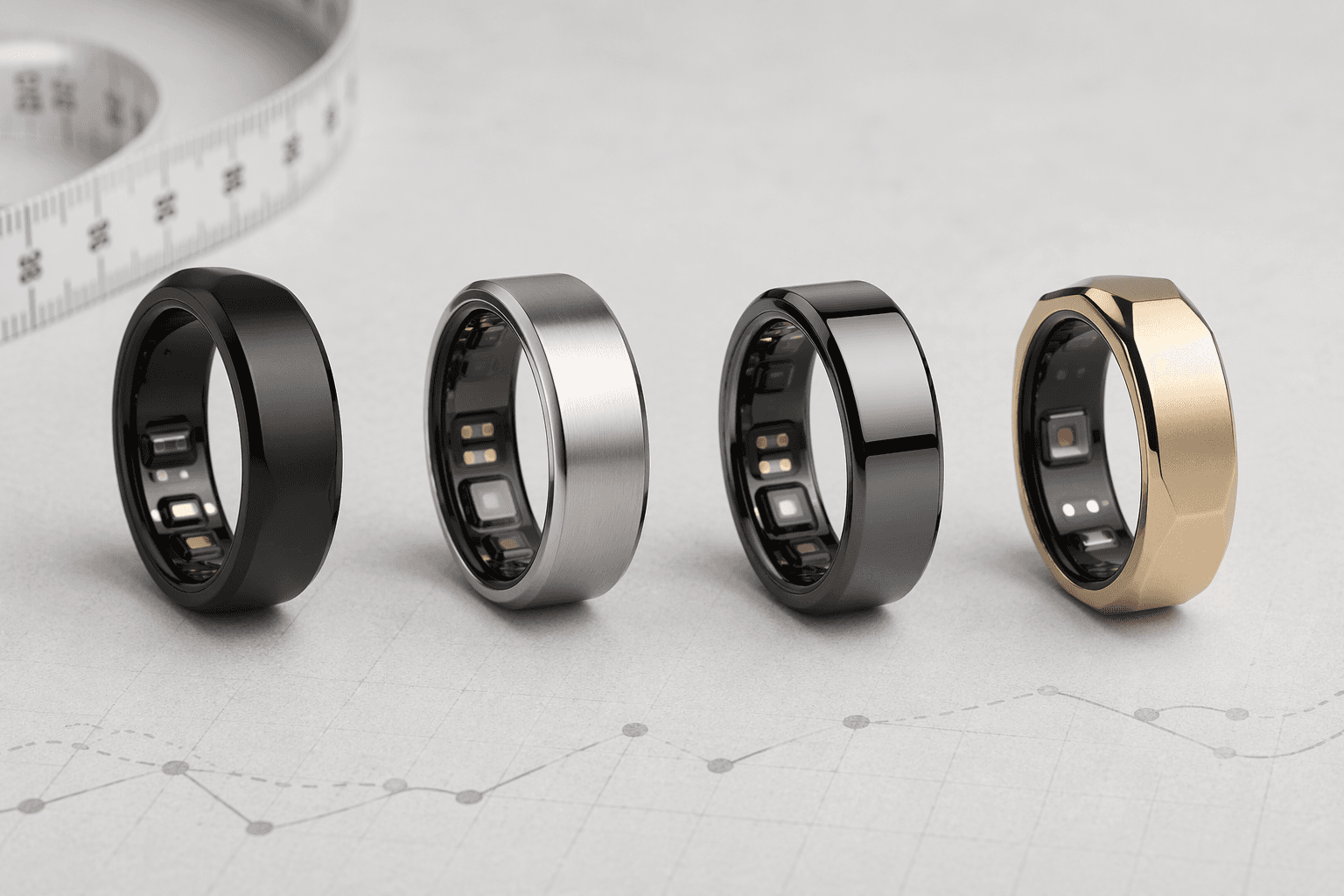
Quick picks: the ring to buy depends on the constraint you cannot ignore
| If this is your priority | Start here | Why | Do not ignore |
|---|---|---|---|
| Best overall health and recovery experience | Oura Ring 4 | Most mature app experience and strongest recovery/sleep positioning among the main options | $5.99/month subscription adds up over time |
| Best value with no subscription | RingConn Gen 2 Air | $199 upfront, no monthly fee, and tested battery life around 10.5 days | Workout heart-rate performance can lag badly at higher intensity |
| Best for Samsung phone users | Samsung Galaxy Ring | No subscription and tight Samsung Health/Galaxy ecosystem integration | Android-only; some AI and control features require a Samsung phone |
| Best bet for workout heart-rate accuracy | Amazfit Helio Ring | Android Central’s workout comparison found it stayed closest to wrist-based sensors | Only three sizes and about four days of battery life |
That map is more useful than ranking every ring from one to ten. Smart rings are unusually constraint-driven. A great iPhone recommendation cannot be Android-only. A cheap ring is not cheap if essential features sit behind a monthly bill. And a ring that nails sleep tracking can still be the wrong device for treadmill intervals, burpees, kettlebell circuits, or anything else that makes your hands move, grip, sweat, and flex.
Comparison table: price, battery, compatibility, and true cost
The table below uses currently discussed 2026 pricing and published testing from the sources in the references. Prices can move with sales, but the subscription math does not disappear when a ring gets discounted.
| Ring | Upfront price | Subscription | Approx. 12-month cost | Approx. 24-month cost | Approx. 36-month cost | Battery life | Phone compatibility | Best use case | Major limitation |
|---|---|---|---|---|---|---|---|---|---|
| Oura Ring 4 | $349 | $5.99/month | $420.88 | $492.76 | $564.64 | 4–7 days | iOS and Android | Polished sleep, readiness, recovery, and health insights | Highest long-term cost among these picks; high-intensity workout HR gaps in testing |
| RingConn Gen 2 Air | $199 | No | $199 | $199 | $199 | Tested around 10.5 days | iOS and Android | Low-friction passive tracking and best no-subscription value | Workout HR can show large gaps during harder sessions |
| Samsung Galaxy Ring | $399 | No | $399 | $399 | $399 | 5–7 days | Android only | Samsung phone owners who want ring data inside Samsung Health | Not for iPhone; Samsung-exclusive AI/control features require a Samsung phone |
| Amazfit Helio Ring | $149–$199 | No required subscription in the cited comparison set | $149–$199 | $149–$199 | $149–$199 | About 4 days | iOS and Android support depends on Zepp app/device setup | Workout HR accuracy among smart rings | Only three size options and shorter battery life |
Oura’s subscription is the line item most likely to get mentally rounded away. At $5.99 per month, it adds $71.88 per year. Over three years, that turns a $349 Oura Ring 4 into roughly a $565 purchase. A $199 RingConn Gen 2 Air is still $199 over that same ownership window, assuming no optional add-ons or replacements. That does not automatically make RingConn better, but it does make the comparison more honest.
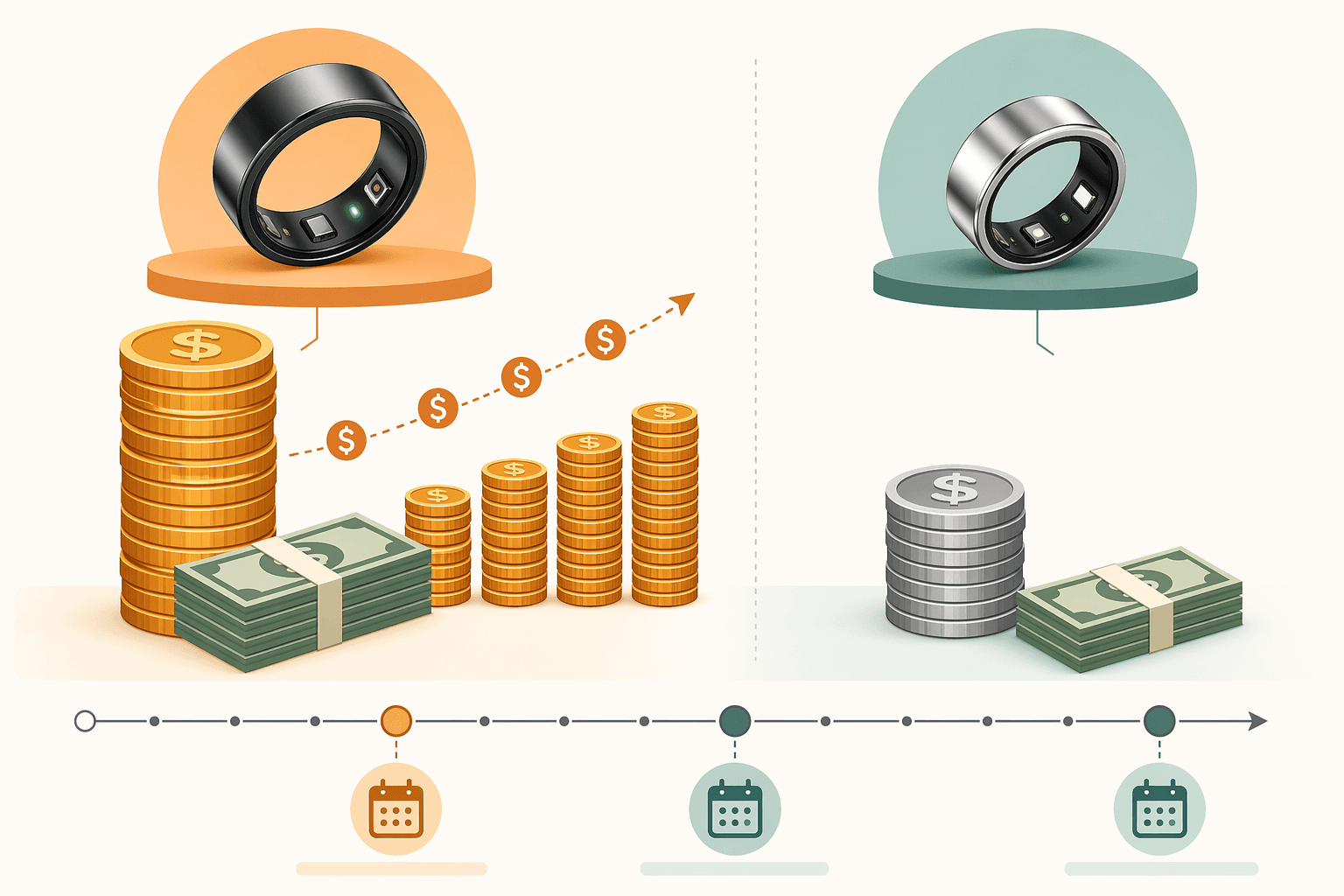
If you already pay for a training app, a recovery platform, or something like Whoop, the question is not whether subscriptions are morally bad. It is whether the interpretation layer earns its place. For more on that kind of trade-off, see Is the Whoop Subscription Worth It for Home Fitness?.
How to read the testing evidence
This comparison gives the most weight to constraints that change the buying decision: current availability, phone compatibility, required subscriptions, battery life, and observed heart-rate behavior during exercise. It does not give much weight to vague wellness language or jewelry styling unless those things affect actual use.
The workout-accuracy section leans heavily on Android Central’s five-workout comparison because it directly tested the rings against wrist-based optical sensors during exercise. That is useful evidence, not a final laboratory verdict. A single tester, ring fit, finger size, temperature, grip pressure, workout mode, and exercise type can all affect optical heart-rate readings on the finger. Still, the gaps reported were large enough to matter for anyone who trains by zones or uses heart-rate peaks to judge effort.
Workout heart-rate accuracy is where smart rings still get exposed
A fitness tracker ring sits in a tougher position than a watch during hard training. Fingers move, bend, swell, cool down, and grip equipment. Optical sensors need stable contact and clean blood-flow readings. That is easier during sleep than during a conditioning session where the hand is wrapped around dumbbells or pumping through a run interval.
In Android Central’s five-workout test, the Amazfit Helio Ring was the only smart ring that maintained workout heart-rate accuracy close to wrist-based optical sensors. Oura Ring 4 showed a 60–70 bpm gap at high intensity. Samsung Galaxy Ring averaged 150 bpm during a Spartan Race where watches recorded 169–170 bpm. RingConn showed 60+ bpm gaps in the same comparison set.[1]
That does not mean every Oura, RingConn, or Samsung workout will be wrong by that amount. It means a buyer should not treat a smart ring as a drop-in replacement for a sports watch if high-intensity heart-rate tracking is central to training. For steady walks, general activity, sleep, readiness, resting heart rate, and overnight recovery trends, rings make much more sense. For intervals, races, HIIT, and strength circuits, a wrist-based tracker or chest strap still has the cleaner job.
This is the category’s most important distinction: a ring can be excellent at passive health tracking and still be mediocre as a workout tracker. If you are trying to decide whether the form factor can replace your watch, read Can a Smart Ring Replace Your Fitness Watch for Workout Tracking? before buying.
Oura Ring 4: the most polished health ring, with the clearest subscription penalty
Oura remains the easiest ring to recommend for someone who wants the best overall health-insight experience. Its strengths are the things rings are naturally good at: sleep, recovery, readiness, resting trends, and an app that turns passive data into something readable. PCMag, CNET, ZDNet, Forbes Vetted, and Wareable all continue to place Oura near the top of the smart-ring category in 2026 buying guides, especially for overall health tracking and app quality.[2][3][4][5][6]
For a home-fitness user, Oura makes the most sense when training decisions are recovery-led. If you want a ring to tell you whether poor sleep, elevated resting heart rate, or a rough overnight trend should make today a lighter lift or an easier treadmill day, Oura is the most convincing option here. For a deeper recovery-specific comparison, see Oura Ring vs. Fitness Trackers for Recovery.
The catch is not hidden in the hardware. It is the ownership model. Oura Ring 4 starts at $349 and requires a $5.99 monthly membership for the full experience, bringing the approximate three-year cost to $564.64. That is a very different purchase from a $199 no-subscription ring, even if both look similar on a product grid.[2]
The other catch is exercise. Android Central’s testing reported a 60–70 bpm gap for Oura Ring 4 at high intensity, which is too large to ignore if heart-rate zones guide your training.[1] Oura can still be the best ring for recovery without being the best fitness tracker ring for hard workouts.
There is also timing friction in mid-2026: Oura Ring 5 has launched and is still being tested by reviewers, while much of the independent recommendation base still rests on Oura Ring 4. That does not make Ring 4 obsolete, but it does mean buyers should check current Ring 5 testing before paying full price if they are not in a hurry.[3]
RingConn Gen 2 Air: the cleanest value argument
RingConn Gen 2 Air has the simplest pitch in this group: $199, no subscription, and tested battery life around 10.5 days.[2] That combination matters more in daily use than another small app animation or a slightly more dramatic readiness card.
The battery life is not just a spec-sheet brag. A ring that lasts more than a week is easier to live with because it can track more nights without turning charging into another routine. That is especially useful for people buying a ring mostly for passive recovery and sleep trends. If the device spends every third night on a charger, the recovery story gets thinner.
The trade-off is workout tracking. In Android Central’s comparison, RingConn showed 60+ bpm gaps during harder exercise.[1] If your main training question is whether your interval peaks hit the right zone, RingConn is not the ring I would trust first. If your main question is whether you can get unobtrusive health tracking without renting your own data back through a subscription, it is the most direct answer.
RingConn Gen 3 is expected later in 2026, but it is not the current product you can judge from the cited testing. For now, Gen 2 Air is the practical recommendation in the RingConn line.
Samsung Galaxy Ring: good hardware, narrow buyer profile
Samsung Galaxy Ring is not a general-purpose recommendation in the same way Oura or RingConn can be. It is Android-only, and some of the features that make it feel like a Galaxy product—such as Energy Score and double-pinch camera control—require a Samsung phone.[7]
For a Samsung phone user, that lock-in can feel less like a trap and more like convenience. The ring drops into Samsung Health, avoids a monthly subscription, and fits the broader Galaxy wearable ecosystem. If you already use Samsung Health for steps, sleep, body composition data from a Galaxy Watch, or general activity trends, keeping the ring in the same app has real value.
For an iPhone user, it is effectively off the table. For a non-Samsung Android user, it becomes a harder sell because the price remains high while some ecosystem advantages disappear. Garage Gym Reviews’ Samsung Ring vs. Oura comparison also frames the Samsung option as strongest for users already inside the Samsung ecosystem rather than as a universal Oura replacement.[8]
Workout heart rate is the other brake. In Android Central’s Spartan Race comparison, Galaxy Ring averaged 150 bpm while watches recorded 169–170 bpm.[1] If you only want general activity and recovery data inside Samsung Health, that may be acceptable. If you want a race or conditioning-session tracker, it is a problem.
Amazfit Helio Ring: the workout-accuracy pick with obvious compromises
Amazfit Helio Ring is the odd one here because its biggest strength is the category’s biggest weakness. Android Central’s five-workout test found it stayed closest to wrist-based optical sensors during exercise, making it the most interesting choice for buyers who came here specifically looking for a fitness tracker ring rather than a sleep-first wellness ring.[1]
The cost is also attractive at roughly $149–$199 in the cited buying-guide range, with no required subscription in this comparison set.[2] If the ring fits your finger and your expectations, that is a strong starting point.
The phrase “if the ring fits” is doing real work. Helio Ring has only three size options, which is a serious limitation for a sensor that depends on consistent contact. Battery life is also around four days, well behind RingConn Gen 2 Air and shorter than Samsung’s 5–7 day range.[2] For some buyers, better workout readings will be worth that. For others, poor sizing alone will end the conversation.
What about Ultrahuman?
Ultrahuman is worth mentioning, but not as a main pick right now. Ultrahuman Ring AIR is unavailable in the US because of Oura’s patent dispute and import ban. Ultrahuman Ring Pro was announced at $479 in February 2026, but it has not yet been independently tested by the sources used for this guide.[3][6]
That combination—availability uncertainty for one product and insufficient independent testing for the newer one—is enough to keep Ultrahuman out of the main recommendations. A ring that cannot be bought easily, or cannot yet be judged against the same evidence standard, should not be slipped into a buyer’s shortlist just because the category needs another name.
Smart rings are now mainstream enough to take seriously
The category is no longer a niche gadget shelf. Oura says lifetime sales have surpassed 5.5 million rings, with 2.5 million sold since June 2024 alone, and its 2024 revenue exceeded $500 million.[9] Wareable also reported Circana data indicating smart rings accounted for 75% of US fitness tracker revenue, though that figure may reflect a narrower revenue definition and the higher average price of rings compared with simpler bands.[9]
That market context explains why more people are shopping for a ring instead of a band or watch. It does not prove the leading ring is the right one for every buyer who wants to avoid a watch. Smart rings are serious wearables now, but they are still specialized wearables.
If you are still unsure whether you want a ring at all, the cleaner comparison may be form factor rather than brand. Start with Fitness Tracker Ring vs. Smartwatch vs. Fitness Band, or look at Best Fitness Trackers for Home Gym Users if workout tracking is the priority.
Which fitness tracker ring should you buy?
Choose Oura Ring 4 if you want the most polished health, sleep, readiness, and recovery experience and you accept the subscription as part of the product. It is the safest pick for passive health insight, not the safest pick for high-intensity workout heart rate.
Choose RingConn Gen 2 Air if you want a low-maintenance ring with excellent tested battery life, no subscription, and the cleanest long-term cost. Do not choose it expecting watch-like performance during hard workouts.
Choose Samsung Galaxy Ring if you use a Samsung phone and want Samsung Health integration without a monthly fee. Skip it if you use an iPhone, and think carefully if you use a non-Samsung Android phone.
Consider Amazfit Helio Ring if workout heart-rate accuracy is your main reason for buying a ring and its limited sizes and shorter battery life work for you. It is the most interesting exercise-focused option in the available testing, but the fit constraint is not a small detail.
If you want deeper evidence before deciding, start with How Accurate Are Fitness Tracker Rings? What the Research Reveals. The honest answer for 2026 is still constraint-based: pick the ring that matches your phone, your budget, and your tolerance for imperfect workout data.
References
- Only one smart ring's workout HR is reliable, Android Central
- Best Smart Rings 2026, PCMag
- Best smart rings 2026, Wareable
- Best Smart Rings for 2026, CNET
- Best smart rings of 2026, ZDNet
- Best Smart Rings 2026, Forbes Vetted
- Samsung Galaxy Ring, Samsung
- Samsung Ring Vs Oura, Garage Gym Reviews
- Oura sales boom to 5.5 million as smart rings dominate, Wareable
Comments
Join the discussion with an anonymous comment.