
If your workouts are mostly running, HIIT, lifting, or swimming, a fitness watch is still the safer workout device in 2026. If your activity is mostly walking, easy cycling, yoga, steady cardio, and recovery logging, a smart ring can be enough—especially if you care more about sleep and readiness than pace, laps, or live heart-rate feedback.
That sounds blunt because the buying decision gets muddy fast. Smart rings are comfortable, discreet, and genuinely good at the parts of health tracking that happen when you are not asking the device to react in real time. Workouts are different. The device has to record the thing you need during the session, not just produce a tidy score afterward.
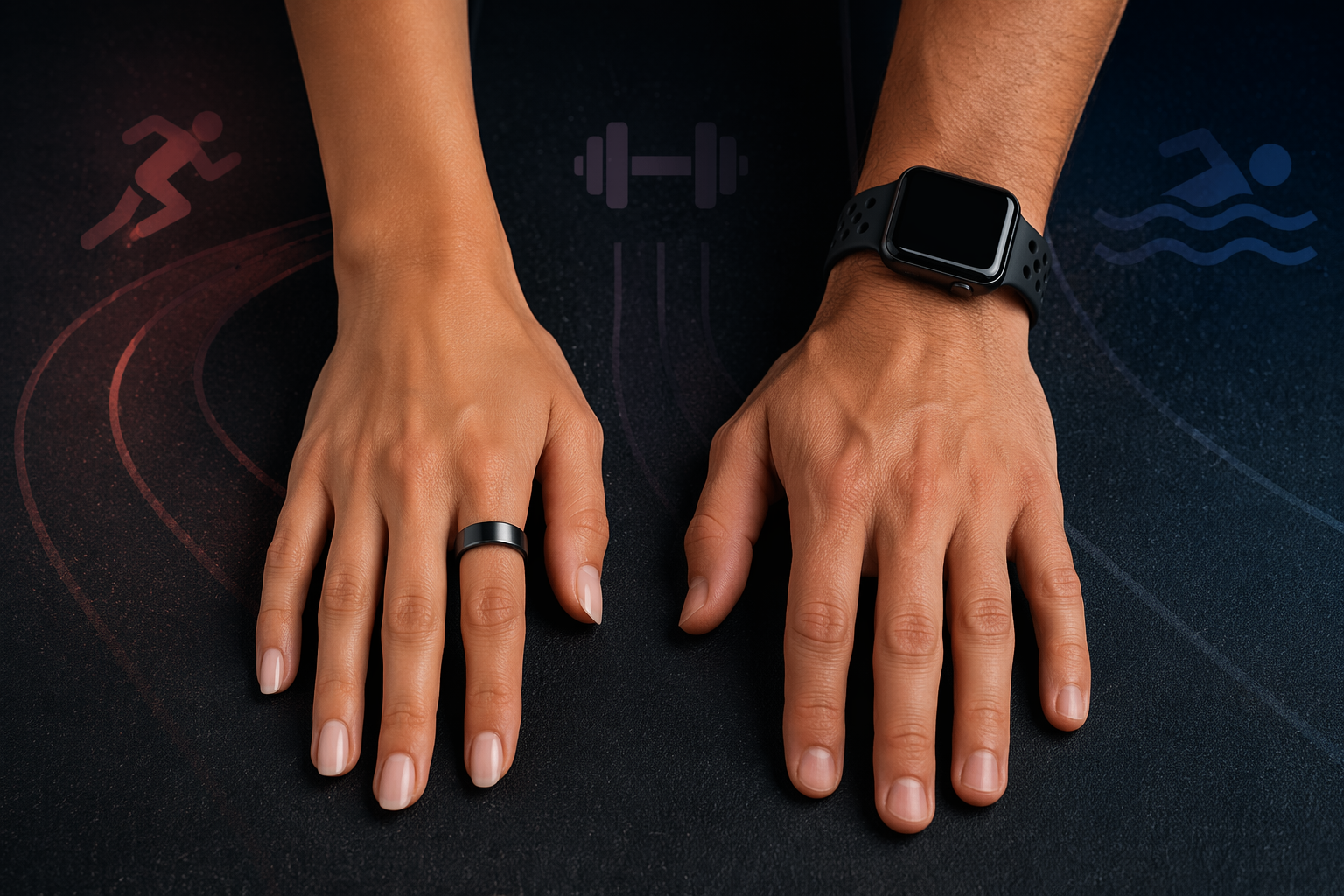
| Primary workout type | Better choice in 2026 | Why it matters |
|---|---|---|
| Outdoor running | Fitness watch | Standalone GPS, pace display, auto-pause, laps, and live heart-rate feedback |
| Strength training | Fitness watch or chest strap | Rings sit on the gripping surface, can shift under load, and do not count reps |
| HIIT and interval classes | Fitness watch, ideally with chest strap for serious HR work | Rapid heart-rate changes expose ring sensor limits |
| Swimming | Fitness watch | Water resistance is not the same as lap count, stroke detection, or SWOLF |
| Yoga, walking, easy cardio | Smart ring can work | Trend data matters more than glancing at metrics mid-session |
| Sleep and recovery | Smart ring | Comfort and overnight wear are the ring’s strongest case |
Running Is Where “Close Enough” Starts to Break
For running, distance accuracy is only one part of the job. A device can finish with the right mileage and still be frustrating if it misses stops, delays pace feedback, or needs another sensor before it can show live heart rate.
That is exactly the useful lesson from a June 2026 hands-on test of Oura Ring 5 Live Activity Tracking against a Garmin Forerunner 170 over a 5K run. The ring matched the Garmin on distance within the test’s margin, but it recorded 9:02 per mile while the Garmin recorded 8:32 per mile. The reported difference came from Oura missing auto-pause at stops and traffic lights, not from a huge GPS distance failure.[1]
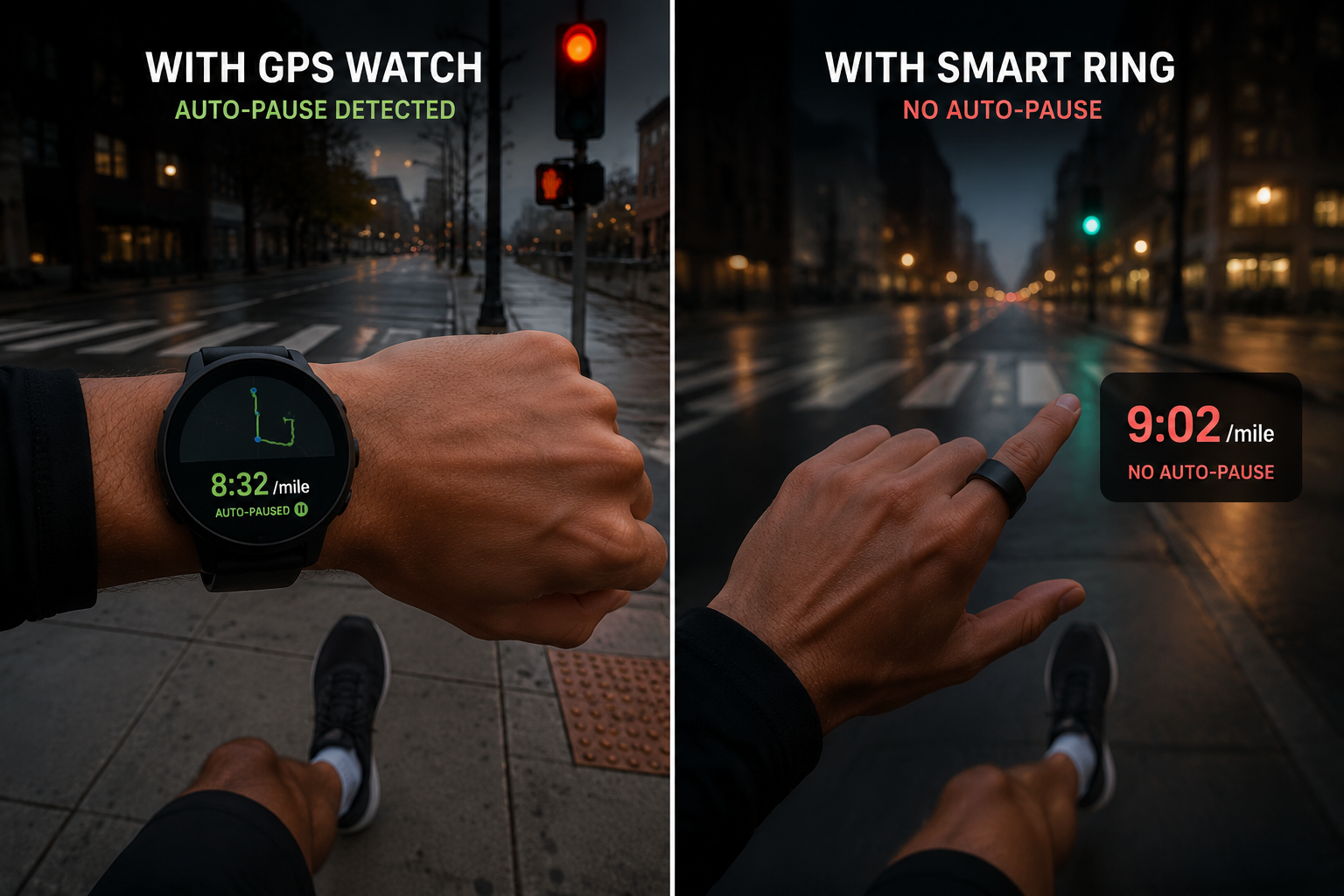
That distinction matters if you run outside in normal conditions. Traffic lights, dog walkers, uneven crossings, and quick shoe-tie stops all become part of the file unless the device handles them cleanly. If your training plan says tempo, intervals, or easy pace, the pace number is not decorative. It changes how hard you run.
Oura’s 2026 upgrade narrows the gap for runners who already carry a phone. It does not make the ring a watch replacement. The Oura Ring 5 still relies on a phone for GPS, and the tested setup required a separate Bluetooth heart-rate source—such as a Polar chest strap, Garmin watch, or AirPods Pro 3—for live heart-rate display.[1]
There is also a hardware ceiling here, not just a missing software feature. The same analysis noted that fitting standalone GPS into a consumer ring would cut the multi-day battery expectation down to only a few hours, which is why phone-tethered GPS remains the practical compromise for rings in 2026.[1]
So the running decision is fairly clean. If your runs are casual jogs where you only want a route, duration, and general effort afterward, a ring can be acceptable if you bring your phone. If you train by pace, use intervals, care about auto-pause, or want to glance at heart rate without carrying a second device ecosystem on your body, a fitness watch is still the better tool.
Strength Training Exposes the Ring’s Awkward Placement
A smart ring is elegant at a desk and annoying on a dumbbell handle. During strength work, the sensor sits exactly where grip pressure, metal, chalk, sweat, and wrist position are least friendly. The issue is not only whether the ring can survive a workout. It is whether the ring can stay correctly positioned while your hand is squeezing a kettlebell, barbell, pull-up bar, or cable handle.
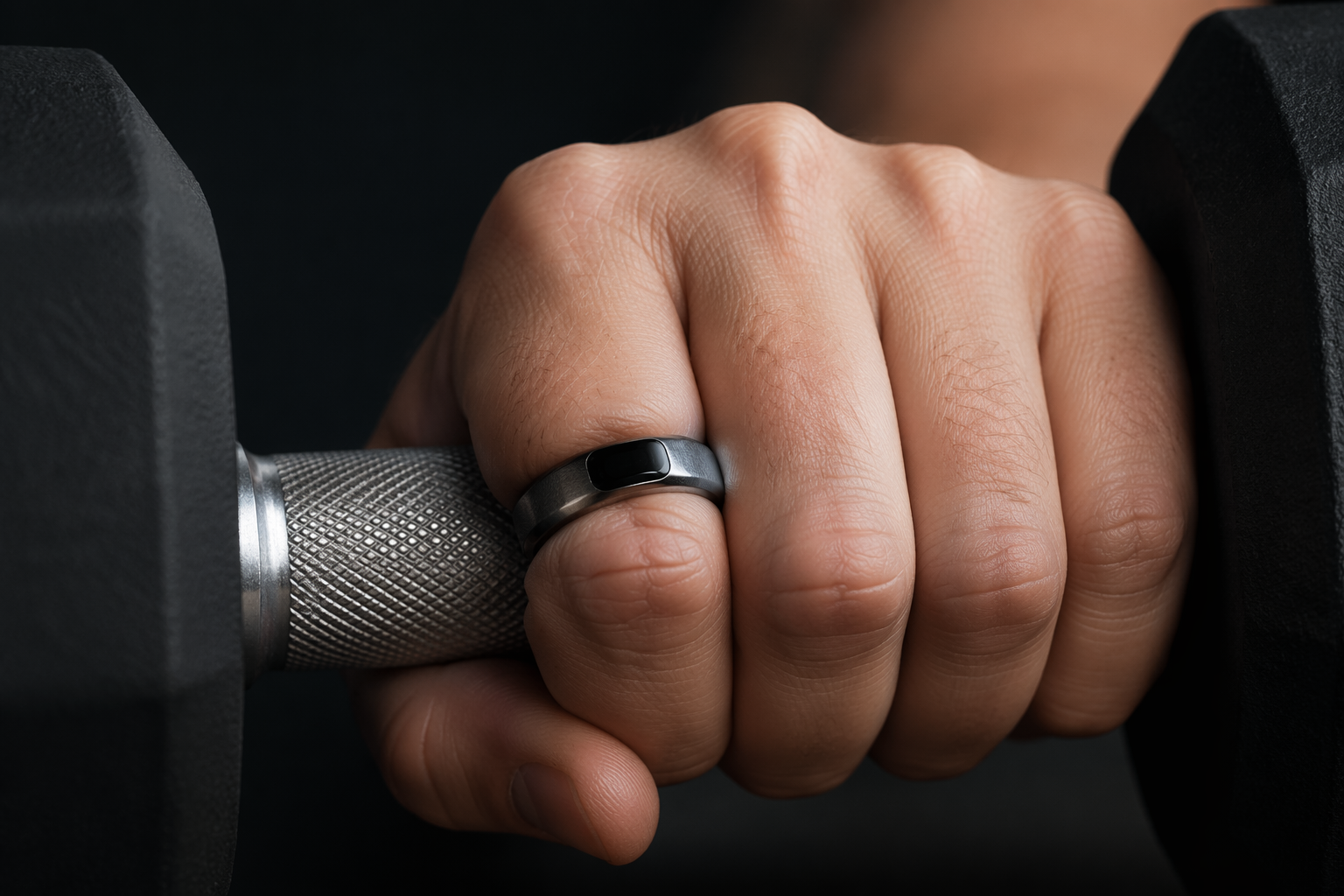
Android Central’s smart-ring heart-rate testing found a sharp version of this problem. In gym workouts, the Oura Ring 4 underestimated heart rate by 60 to 70 bpm compared with a Garmin Venu 3 and Pixel Watch 3.[2]
That result should not be inflated into a universal law. The Android Central test covered five workouts on one tester across three rings, and ring fit, finger anatomy, skin temperature, and movement pattern can all affect optical heart-rate readings.[2] But the failure mode is believable because strength training gives rings several problems at once: compression, rotation, interrupted blood-flow signal, and physical interference with the thing you are holding.
There is also the workout-detail problem. Rings do not count reps in the way strength-focused athletes usually mean it. They may label an activity, estimate strain, or log a session duration, but they are not reliably telling you that your third set of goblet squats had twelve reps, that your rests are drifting too long, or that your heavy set looked different from your warmup.
A watch is not perfect for lifting either. Wrist optical heart rate can lag during sets, and a chest strap is still the cleaner option if heart-rate precision matters. But the watch is at least not trapped between your finger and the bar. It can time sets, show rest periods, accept manual lap presses, and stay readable between movements. For home dumbbells and kettlebells, that is usually more useful than a ring silently guessing from a compromised signal.
HIIT Makes Slow Heart-Rate Response More Obvious
HIIT and interval classes are rough on every optical sensor. Heart rate rises quickly, drops during short rests, and rises again before the device has fully caught up. This is where a wearable that looks acceptable during an easy ride can suddenly make a hard session look suspiciously flat.
The available 2026 comparison is not flattering to rings at higher intensities. Android Central’s multi-ring test showed gaps as large as 60 to 70 bpm during harder efforts.[2] Wrist-based watches are not immune to lag, but available comparison ranges put them closer to chest straps during steady cardio and still stronger during high-intensity intervals than the tested rings.
For a casual class, that may not ruin anything. You can still log that you did the workout, see a rough calorie estimate, and keep the habit visible. For training decisions, it is weaker. If the device misses the peak of a hard interval or underreads the recovery between rounds, it changes the story of the workout.
The practical split is simple: use a watch for HIIT if you want live feedback, zones, timers, and a better chance at catching fast changes. Use a ring only if your main goal is post-workout logging and you are comfortable treating the intensity data as approximate.
Swimming: Surviving Water Is Not Swim Tracking
Smart rings and fitness watches can both be water-resistant, but that does not make them equal in the pool. The useful swimming features are swim-specific: lap counting, stroke detection, pace by interval, and SWOLF. Watches offer those metrics. Rings are basically passive in the water.
If you only want your daily activity record to know that you moved, a ring surviving a swim may be enough. If you actually swim for fitness, the missing metrics are the point. A pool workout without lap count or stroke recognition becomes another manually interpreted session.
Where Smart Rings Actually Make Sense
The case for a smart ring gets much stronger once the workout stops demanding real-time decisions. Walking, yoga, mobility, easy cycling, zone-2-style cardio, and recovery sessions are friendlier to a ring because the consequences of delayed or imperfect feedback are lower. You are not checking pace at a traffic light, gripping a knurled handle, or expecting the device to catch repeated heart-rate spikes.
This is also where comfort matters. A ring is easier to wear overnight than a bulky sports watch, and sleep tracking is one of the few areas where rings have a credible form-factor advantage. Peer-reviewed work on consumer sleep trackers has found that wearables can estimate sleep-wake patterns with useful but imperfect agreement against clinical sleep measures, with ring-style devices often discussed favorably for overnight comfort and continuous wear.[3][4]
That does not mean sleep accuracy transfers to workout accuracy. A sensor can be good when your hand is still under a blanket and much worse when your finger is squeezed around a kettlebell handle. The evidence problems are different, and the buying decision should keep them separate.
For a deeper Oura-specific breakdown, see our assessment of Oura Ring as a fitness tracker. For a broader accuracy discussion across wearables, our data-driven look at fitness tracker accuracy is the better companion piece.
The Cost Check Comes After the Workout Check
Price only becomes meaningful after you know what job the device has to do. If your workouts need GPS, pace, lap controls, rest timers, and visible heart-rate feedback, a cheaper ring is not a bargain. In 2026, the comparison can run the other way: Oura Ring 5 costs $399 plus a $5.99 monthly membership, or $71.88 per year, while the Garmin Forerunner 170 is listed at $299.99 with no subscription.[1]
That is not a reason to dismiss the ring. It is a reason to be honest about what you are buying. With Oura, the strongest value is the low-friction recovery device you keep on all day and overnight. With a Forerunner-style watch, the strongest value is the training device you can use without your phone, without a second heart-rate source, and without a recurring fee for the core experience.
If subscription cost is part of the decision, our guide to the real cost of screenless fitness trackers digs into that ownership math.
When Wearing Both Is Sensible
The cleanest answer for mixed training is also the least minimalist one: ring for sleep and recovery, watch for workouts. That setup lets each device do the job its shape is good at. The ring disappears during sleep. The watch handles GPS, pace, timers, swim metrics, and readable workout feedback.
The trade-off is cost and management overhead. A dual-device setup can push ownership into the $600 to $900-plus range, and a commercial dual-device analysis from Vora frames the combined approach as increasingly practical for people who want recovery and training data together.[5] That view is useful, but it also comes from a health-app platform, so it should not be treated as neutral proof that everyone needs two devices.
Two devices also mean two batteries, two apps, occasional data conflicts, and the small annoyance of deciding which device owns which workout. Some people will happily pay that tax to avoid sleeping in a watch. Others will prefer one watch and accept that it is less elegant the other 23 hours of the day.
Decision Rule by Workout Mix
- Choose a fitness watch if you run outdoors regularly, train by pace, use intervals, swim for fitness, lift with dumbbells or barbells, or want live workout feedback without carrying your phone.
- Choose a smart ring if your workouts are mostly walking, yoga, easy cardio, mobility, and recovery sessions, and your priority is sleep, readiness, and comfort outside workouts.
- Choose both if you dislike sleeping in a watch but still want credible workout tools for running, lifting, HIIT, or swimming.
- Do not choose a ring as your only device if you expect standalone GPS, reliable auto-pause, rep counting, swim metrics, or accurate high-intensity heart-rate response.
The 2026 smart ring market is moving quickly, with new models and updates arriving within quarters. Device-specific claims need regular review. The form-factor problem is slower to change: a ring can be a great recovery wearable and a limited workout tracker at the same time.
References
- Oura Ring 5 Live Workout Tracking Tested: Matches Garmin on Distance, Falls Short on Live Heart Rate, TechTimes, June 20, 2026
- Only one smart ring's workout HR is reliable — and not the one you'd expect, Android Central
- A validation of six wearable devices for estimating sleep, heart rate and heart rate variability in healthy adults, Sensors, 2024
- Accuracy of Wearable Sleep Trackers in Comparison With Polysomnography in Sleep Disorder Patients: A Systematic Review and Meta-analysis, JMIR, 2022
- Smart Rings vs Smartwatches 2026, Vora Blog
Comments
Join the discussion with an anonymous comment.