
Can You Build Muscle at Home on Less Protein?
Worried eating less protein will stall muscle growth at home? The evidence says training drives most of the gain and protein only needs to be adequate — with a few specific situations, like calorie deficits and older age, where protein matters more.
- Citation source
- Other: peer-reviewed meta-analyses
- Evidence level
- Restrained inference
- Recommended frequency
- Three consistent strength sessions per week
Yes, you can build muscle at home while eating less protein than the fitness internet keeps implying you need. The catch is that “less” still has to mean adequate enough to recover from training, not chronically underfed, crash-dieting, or skipping protein by accident for weeks.
The bigger answer is more useful: resistance training is the main muscle-building signal. Protein supports that signal. It supplies amino acids and helps recovery, but it does not replace the hard part — making your muscles repeatedly do work they are not already adapted to do.
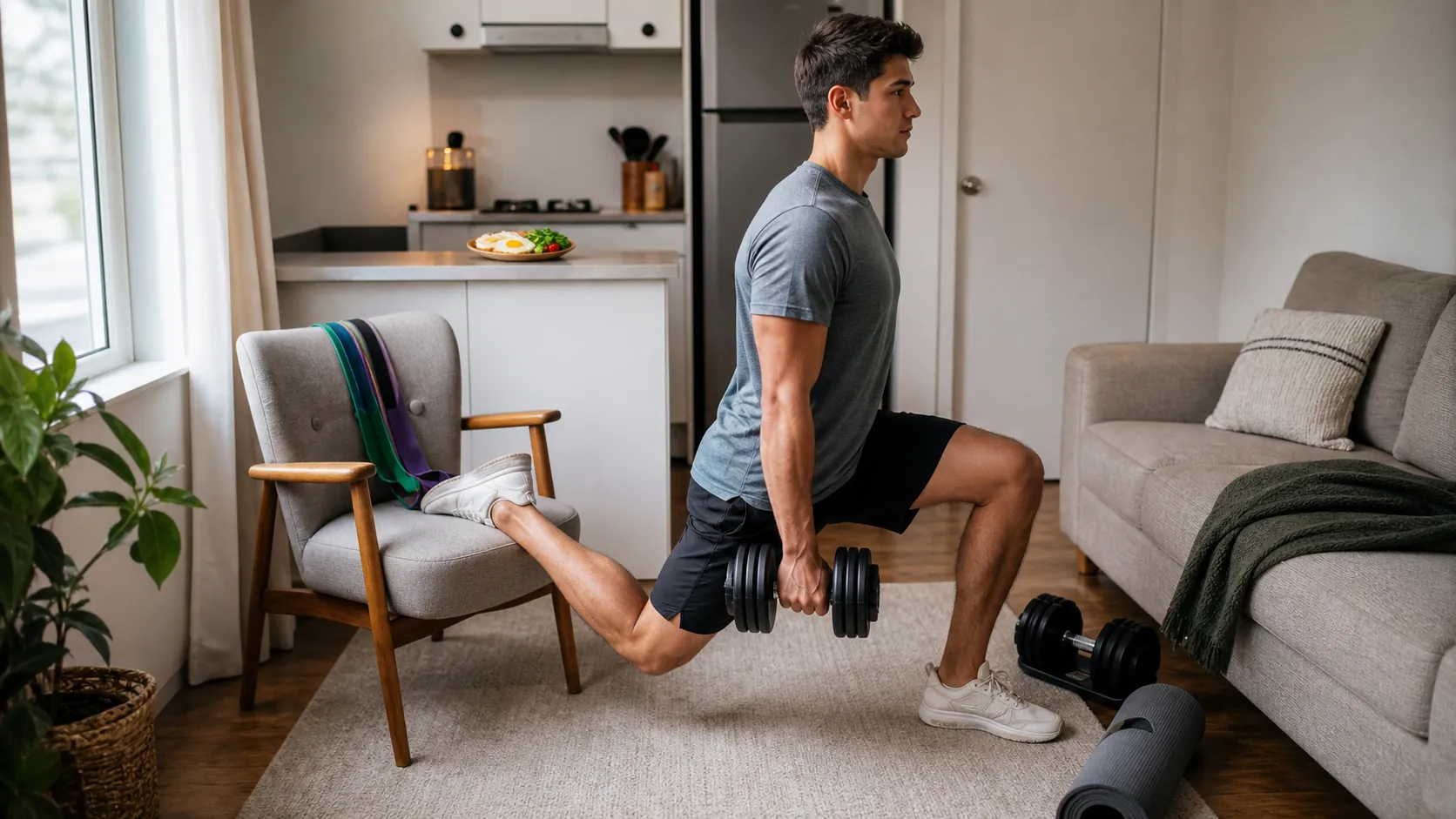
That hierarchy is not just gym folklore. A 2018 systematic review and meta-analysis of 49 randomized controlled trials with 1,863 participants found that resistance training alone produced about 1.1 kg of fat-free-mass gain, while protein supplementation added about 0.30 kg on top. The authors explicitly described resistance training as “the much more potent stimulus” for gains in muscle mass and strength [1].
So if you are doing split squats beside a couch, push-ups with your hands on a coffee table, band rows in a doorway, or dumbbell Romanian deadlifts in a hallway, the first question is not whether your shake has enough grams. It is whether your training is creating a reason for your body to keep or build muscle.
Protein is not the switch. Training is.
Muscle growth is an adaptation to repeated mechanical stress. A set taken close enough to failure, loaded heavily enough for your current level, repeated often enough, tells the body that the existing muscle is not quite enough for the job. Protein helps provide the material and recovery conditions for that adaptation. It does not create the training signal by itself.
This is where a lot of home trainees get talked into the wrong anxiety. They hear “protein builds muscle,” then assume a lower-protein week has made their workouts meaningless. But the evidence points in the other direction: training is doing most of the work, and extra protein adds a smaller benefit when training is already in place.

A 2022 systematic review and meta-analysis makes the contrast sharper. Across 74 randomized controlled trials, additional protein intake supported lean mass and function more clearly when paired with resistance exercise. In the small subset of studies without resistance exercise, extra protein produced only a small, non-significant effect on lean mass [2].
That finding should be boring, which is exactly why it matters. If protein alone were the heroic variable, adding more of it would reliably build muscle even without training. It does not seem to work that way. The body still needs the stimulus.
The same caution shows up in older-adult research, though it should not be lazily pasted onto every younger person training at home. Harvard Health summarized a JAMA Internal Medicine trial of 92 men with an average age of 73: over 6 months, eating 1.3 g/kg/day of protein instead of 0.8 g/kg/day did not significantly improve lean body mass, muscle performance, or physical function [3].
The lesson is not that protein is useless. The lesson is that “more protein” is not automatically “more muscle,” especially when the training stimulus, total energy intake, age, sleep, and recovery are all part of the result.
What counts as “training” when the gym is your living room?
There is an important limitation here: the main trials were not designed around apartment workouts with bands, bodyweight exercises, and adjustable dumbbells. Much of the evidence comes from structured resistance training that looks more like a gym program than a renter’s Tuesday night routine.
But the underlying question transfers reasonably well if the home routine still produces the same training ingredients: progressive overload, sufficient effort, enough weekly volume, and consistency. A band row that never gets harder is not the same stimulus as a band row where the trainee gradually uses a stronger band, slows the eccentric, adds reps, reduces assistance, or takes working sets closer to failure.
At home, the muscle-building signal usually comes from a few unglamorous progressions:
- Adding reps while keeping form honest.
- Adding load when dumbbells allow it.
- Moving from easier to harder exercise variations, such as elevated push-ups to floor push-ups.
- Using slower tempo or pauses when load is limited.
- Training close enough to failure that the last few reps noticeably slow down.
- Repeating the plan long enough to measure whether work capacity is improving.
This is why the protein debate can become a hiding place. If the dumbbells are too light, every set stops 8 reps before failure, and the program changes whenever boredom arrives, a higher-protein grocery cart will not fix the missing overload. For a practical look at this training lever, FitAtHome’s guide to the home strength principle behind progressive overload is more relevant than another supplement comparison.
A simple home test is whether something in your log is moving over time. If your split squat went from 3 sets of 8 controlled reps to 3 sets of 12, then to the same reps with a heavier dumbbell, the routine is asking for adaptation. If your push-up setup, range of motion, tempo, and effort never change, the signal is weaker no matter how neatly the day’s protein total is arranged.
Less protein can still be enough protein
“Eating less protein” can mean several very different things. It can mean eating less than a bodybuilder on social media. It can mean eating less than a strict optimization target. It can mean eating a modest, ordinary diet with protein at each meal. Or it can mean running a genuine shortage while also training hard.
Those are not the same situation.
For most home trainees, the useful distinction is adequate versus inadequate, not maximal versus submaximal. Once protein is adequate enough to support recovery and normal adaptation, the next practical bottleneck is often training quality. More protein can add a small edge, especially in certain contexts, but it does not outrank the work itself.
This is also where supplement marketing quietly changes the standard. Adequacy gets treated like failure because it is not optimization. Optimization gets treated like the minimum because it sells clean rules. Then the person with a small kitchen, expensive groceries, or a plant-based diet is left thinking their home workouts barely count unless they add powder.
They count if they are progressive. They count if they are hard enough. They count if you keep showing up and recover well enough to repeat useful work.
The low-protein evidence is interesting, but easy to misuse
One older USDA Agricultural Research Service report is often tempting because it sounds like a clean win for training. In a 12-week study led by Carmen Castaneda, adults with moderate renal insufficiency followed a low-protein diet of 0.64 g/kg/day. Those who performed resistance training increased muscle fiber size by about 23% and strength by about 32%, while the no-exercise group lost about 13% strength [4].
That is a useful reminder that training has real force even under imperfect nutrition conditions. It is not permission to deliberately under-eat protein. The population was clinical, the diet was prescribed for a medical context, and the report is an archived 2002 research news page. The responsible takeaway is narrow: resistance training can partially offset some muscle and strength losses when protein is low. It does not prove that low protein is ideal for healthy home trainees trying to gain muscle.
That narrow takeaway still matters. If your protein intake is lower than influencer norms because food costs are real, you eat mostly plants, or you do not want tubs of powder in a studio apartment, the situation is not automatically hopeless. The first thing to protect is the training signal. The second is making your everyday diet adequate enough that the signal has material to work with.
When protein becomes the limiter
There are situations where protein deserves more attention than the average beginner or intermediate home trainee wants to give it. Not because protein suddenly becomes magic, but because the margin for recovery and muscle retention gets smaller.
A calorie deficit changes the risk
Trying to lose weight while building or preserving muscle is a different problem from eating at maintenance. During weight loss, the body has less incoming energy, and muscle retention has to be defended through training, protein, and recovery.
A 2024 study on weight-loss contexts reported that protein intake below about 1.0 g/kg/day was associated with higher risk of muscle-mass decline, while intake above about 1.3 g/kg/day was associated with muscle gain [5]. That does not make those numbers universal prescriptions for every home trainee, but it does show why “less protein” is more delicate when calories are also lower.
This matters even more during rapid weight loss or appetite suppression, where people can accidentally reduce both calories and protein. FitAtHome’s GLP-1 home fitness warning is the better place to think through that specific lean-mass risk.
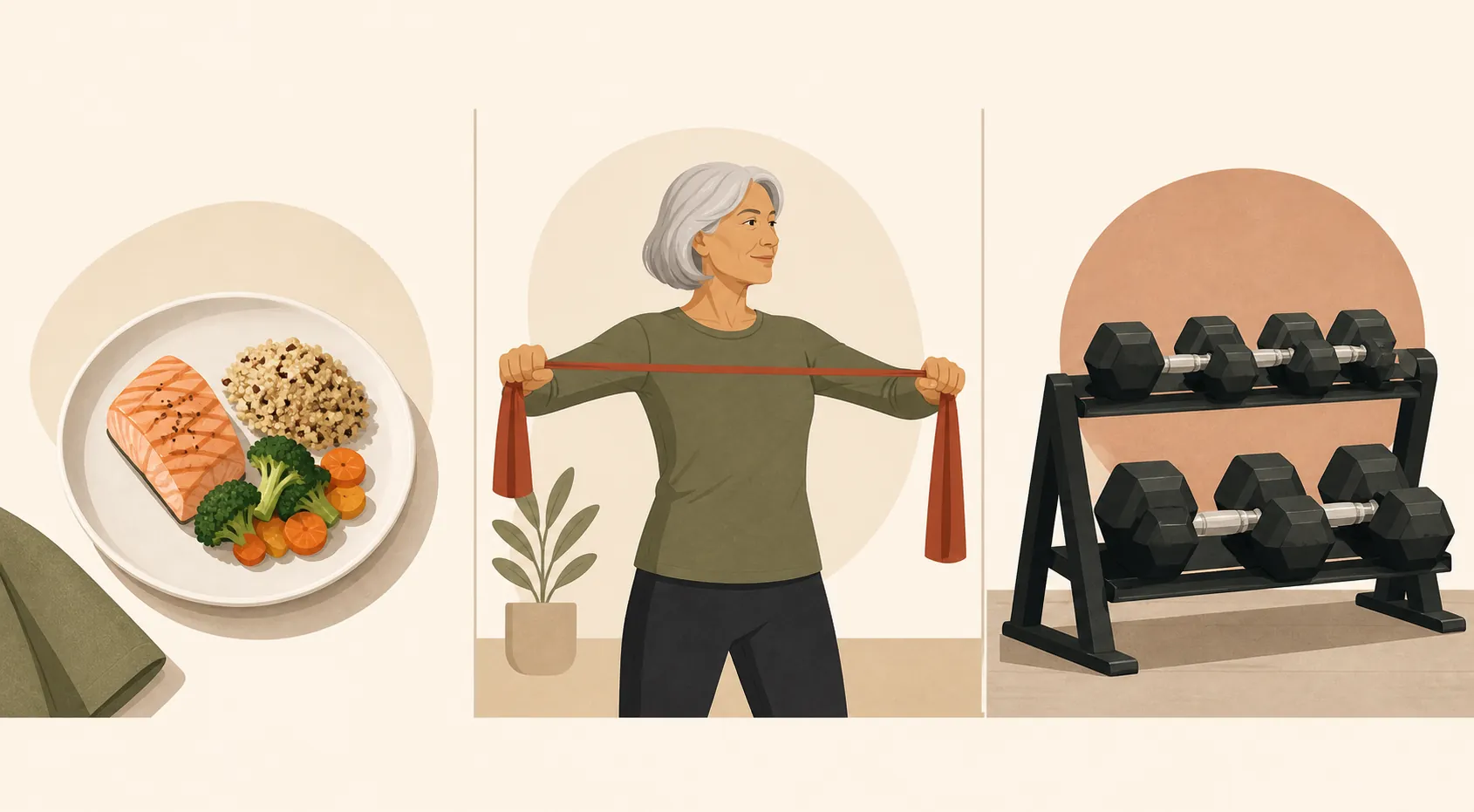
Older adults do not get a recovery discount
With age, muscle tends to become less responsive to the same anabolic signals. That does not mean home training stops working. It means the total setup — hard-enough resistance training, adequate protein, enough food, and recovery — deserves less guesswork.
For readers over 50, the answer shifts slightly. Training is still the main signal, but protein adequacy becomes less optional to monitor. FitAtHome’s home training protein after 50 and protein for aging home workouts go deeper on that boundary without turning every younger person’s routine into a medicalized macro project.
Advanced trainees have fewer easy gains left
A new trainee can often gain strength and some muscle from fairly simple home training because the body is adapting to a new demand. An advanced trainee has already collected the easy adaptations. Their margin is narrower, their training needs to be more precise, and nutrition mistakes become more visible.
That does not mean advanced lifters need to obsess over every gram. It means they are less likely to get away with vague training and vague recovery at the same time. If load progression is slow, sleep is poor, calories are low, and protein is inconsistent, it becomes difficult to know which constraint is actually holding progress back.
Plant-based or budget protein does not have to become a supplement project
If you are eating less protein because you eat mostly plants or because groceries are expensive, the practical move is not to copy a bodybuilding meal plan. It is to make protein show up reliably in normal meals: beans, lentils, tofu, tempeh, soy milk, Greek yogurt if you eat dairy, eggs if you eat them, canned fish if that fits your diet, or whatever affordable staples you can repeat without making food miserable.
Plant-based eating may require a little more attention to total protein and food variety, but that is not the same as needing a counter full of powders. If your recovery meal is more oat milk latte than full meal, FitAtHome’s plant-based protein recovery reference is a more practical detour than debating supplements in the abstract.
A useful order of operations
When muscle gain stalls at home, do not start by assuming your protein is too low. Start by checking the thing most likely to be underdosed: the training stimulus.
| Question | What it tells you |
|---|---|
| Are the main exercises progressing over weeks? | If nothing is getting harder, the muscle-building signal may be weak. |
| Are working sets close enough to failure? | If every set stops far from fatigue, light equipment may not be creating enough tension. |
| Are you training each target muscle consistently? | Random hard workouts do not replace repeatable exposure. |
| Are you recovering well enough to repeat good sessions? | Poor sleep, low calories, and inadequate protein can show up as flat performance. |
| Are you in a calorie deficit, over 50, or already advanced? | These are the cases where protein adequacy deserves a closer look. |
A beginner doing three consistent strength sessions a week, adding reps to push-ups, progressing split squats, and eating protein-containing meals is in a very different position from someone dieting aggressively, sleeping badly, and training with no progression. Both may say they are “eating less protein,” but only one has made protein the obvious suspect.
If you want a routine where overload is built into the plan instead of guessed at, a structured bodyweight progression such as FitAtHome’s 8-week wrestling strength program is closer to the center of the problem than another macro calculator.
The practical answer
Eating less protein than fitness-media norms does not automatically stall muscle growth at home. Resistance training is the stronger driver, and the best evidence shows protein supplementation adds a smaller increment on top of the gains produced by training.
Protein still matters. It matters more during calorie deficits, with older age, and when training is advanced enough that small recovery gaps become meaningful. It also matters if “less protein” really means too little protein, too little total food, or inconsistent meals that leave workouts under-recovered.
But if you are training progressively at home, recovering reasonably, and eating enough protein to be adequate, put most of your effort into overload, consistency, exercise execution, and repeatable meals before you let gram-counting take over the room.
References
- A systematic review, meta-analysis and meta-regression of the effect of protein supplementation on resistance training-induced gains in muscle mass and strength in healthy adults — PMC
- Systematic review and meta-analysis of protein intake to support muscle mass and function in healthy adults — PMC
- Extra protein does not build more muscle — Harvard Health
- Exercise Prevents Muscle Loss From Low-Protein Diets — USDA Agricultural Research Service, 2002
- Protein intake and muscle mass changes during weight loss — PubMed, 2024
This is general fitness education, not medical advice. For diagnosis or treatment of pain or injury, consult a qualified clinician.
Pick your next session
What Happened to Ultrarunner Jeff Browning at TDS?
Veteran ultrarunner Jeff Browning suffered a heart attack about 129 km into the 2026 TDS, was treated on course and airlifted to hospital, where he remains under medical care. This recap separates what's confirmed about his condition from the unverified coma and injury claims circulating online.
A Beginner Breakdance Workout You Can Do at Home
A complete beginner breakdance workout for small apartments: one zero-equipment session built from toprock, the 6-step, basic freezes, and conditioning, sequenced in an injury-aware order with floor and noise notes. Includes a first-month progression and frequency guidance tied to CDC adult activity targets.
GLP-1 Home Workouts in Extreme Heat: A Real Dehydration Risk?
GLP-1 medications suppress thirst, increase GI fluid loss, and cut the water you normally get from food, so "drink when thirsty" stops working as a hydration guide. This article lays out a concrete scheduled-hydration and session-redesign protocol for home workouts in extreme heat, plus the warning signs that mean stop — not a single generic water tip.
Spot something off?
This content sits adjacent to health guidance — tell us if a citation or figure needs a correction.