
Budget Home Gym Equipment: A Phased Buying Guide from $100 to $1,500
A quality home gym doesn't require spending thousands of dollars. This guide walks through each price tier from $100 to $1,500, explaining what to buy first, where the trade-offs are, and how to sequence purchases to avoid costly upgrades.
- Budget tier
- $100–$1,500
Items included: —
What a workable budget home gym actually looks like
A budget home-gym equipment setup is less about the size of the first checkout than what that checkout commits you to later. If the opening purchase leaves you with no way to add load, no room to grow, or no path to a better setup six months from now, the cheap item becomes the expensive one. A quality home gym can start well below $1,500, but the sequence matters more than the individual price tag.
If you are still deciding from constraints rather than product names, the first-time home gym buyer's decision framework and the home gym equipment decision framework are better starting points than a normal shopping list. For a more beginner-friendly route, the home fitness decision guide and the beginner machine guide cover the same problem from a smaller first step.
| Budget tier | What it can realistically do | What usually enters the cart | What it still cannot do |
|---|---|---|---|
| Under $200 | Keep workouts alive with conditioning, mobility, and simple resistance work. | Bands, jump rope, mat. | It does not become a true strength foundation. |
| $200–$500 | Create the first durable strength base and decide between a rack-and-barbell path or a dumbbell-first path. | REP PR-1100 rack, Synergee barbell, or CAP dumbbells [1]. | It is still a budget foundation, not a finished room. |
| $500–$1,000 | Add variety without replacing the base. | Bench plus cable tower, often alongside the original foundation [1]. | It still requires compromises in finish, footprint, or total system breadth. |
| $1,000–$1,500 | Compress more training into one footprint. | An all-in-one setup such as the Bells of Steel option [1]. | It is more complete, but not automatically premium or infinitely expandable. |
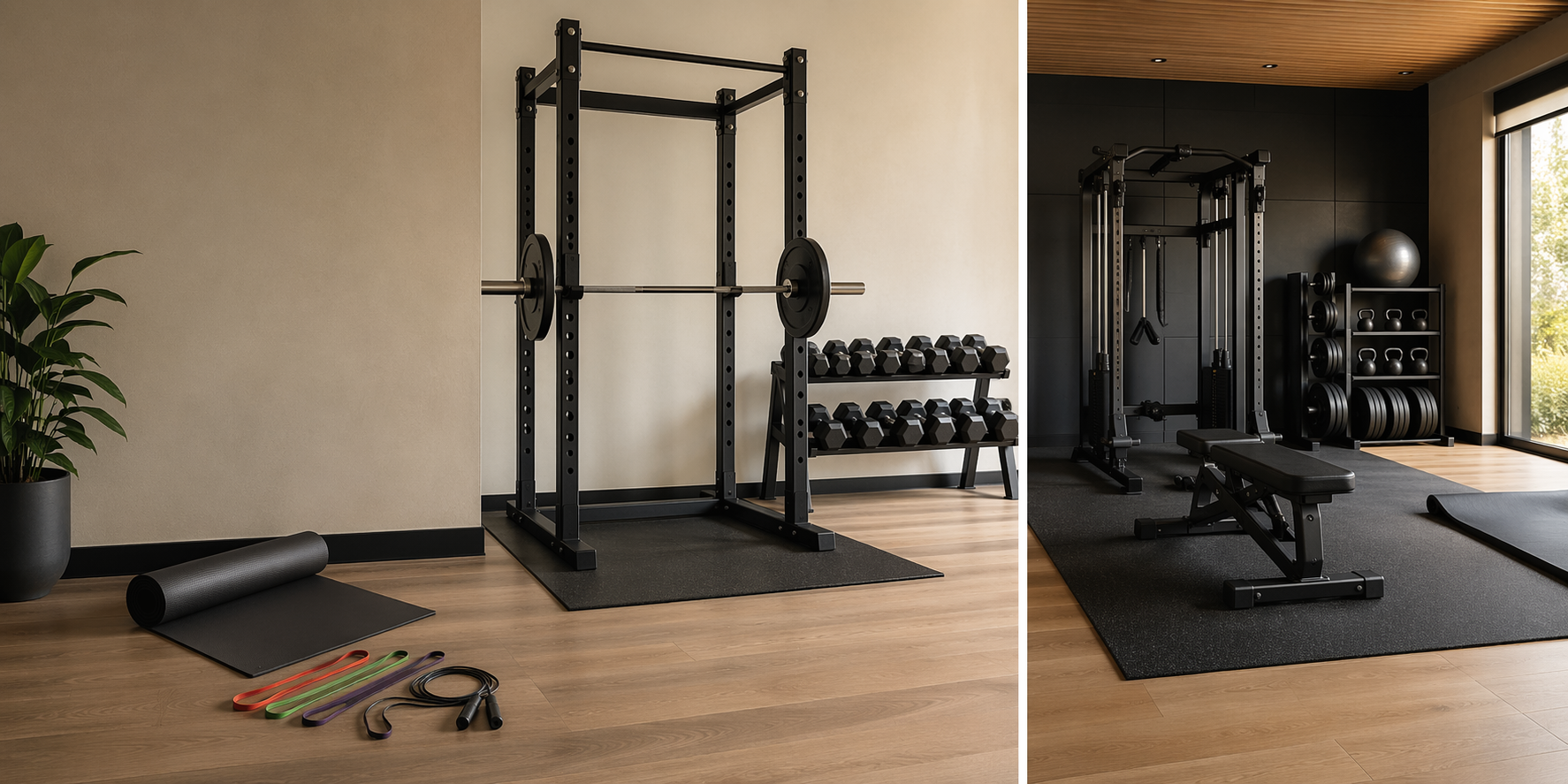
That sequencing logic is also why the broader market numbers matter only in the background. PTPioneer cites Statista data showing that 38.6% of U.S. home-fitness equipment buyers spent under $500 on a single piece in April 2022, and it also cites a home fitness app market projected to grow from $2.24 billion in 2023 to $34.97 billion by 2030 [2]. The first number is directional rather than a fresh 2026 rule; the second helps explain why many budget buyers pair a few durable pieces with digital programming instead of buying a full machine package immediately [2].
Under $200: start the habit, not the system
Under $200 is enough to begin moving, but not enough to pretend the setup solves strength training. Bands, a jump rope, and a mat cover warm-ups, mobility, conditioning, and simple resistance work. That is useful when the real goal is to build the habit and keep the floor clear. It is not a substitute for progressive loading.
- Resistance bands for warm-ups and assistance work
- A jump rope for conditioning
- A mat for floor work and basic stability
$200 to $500: the first fork between rack and dumbbells
This is the tier where the buying order starts to matter more than the brand name. A buyer has to decide whether the room will revolve around a rack-and-barbell base or around a compact dumbbell setup. Budget gear can still be credible here, but the compromise usually shows up in finish, steel, or total system breadth rather than in whether the workout is worthwhile. Garage Gym Reviews is useful here because it reports hands-on testing, including drop-testing, but its guide is affiliate-linked and prices should be checked before purchase.
| Item | Approx. price | Capacity or load spec | Steel gauge / warranty / footprint | Buyer read |
|---|---|---|---|---|
| REP PR-1100 Power Rack | $380 [1] | 700-lb capacity and attachment compatibility; Garage Gym Reviews rated it 4.3/5 after drop-testing [1]. | Steel gauge, warranty, and footprint were not specified in the cited guide. | A credible budget foundation if the room can spare a rack. |
| Synergee Games Cerakote Barbell | ~$180 [1] | 190,000 PSI tensile strength, which the cited guide says is comparable to bars costing 2–3 times more [1]. | Steel gauge, warranty, and footprint were not specified in the cited guide. | A strong low-cost bar, but verify current pricing before buying. |
| CAP Cast Iron Hex Dumbbells | About $1/lb [1] | Low cost per pound is the main value [1]. | Steel gauge is not applicable; warranty and footprint were not specified in the cited guide. | Good value if you accept inconsistent knurling and possible enamel flaking [1]. |
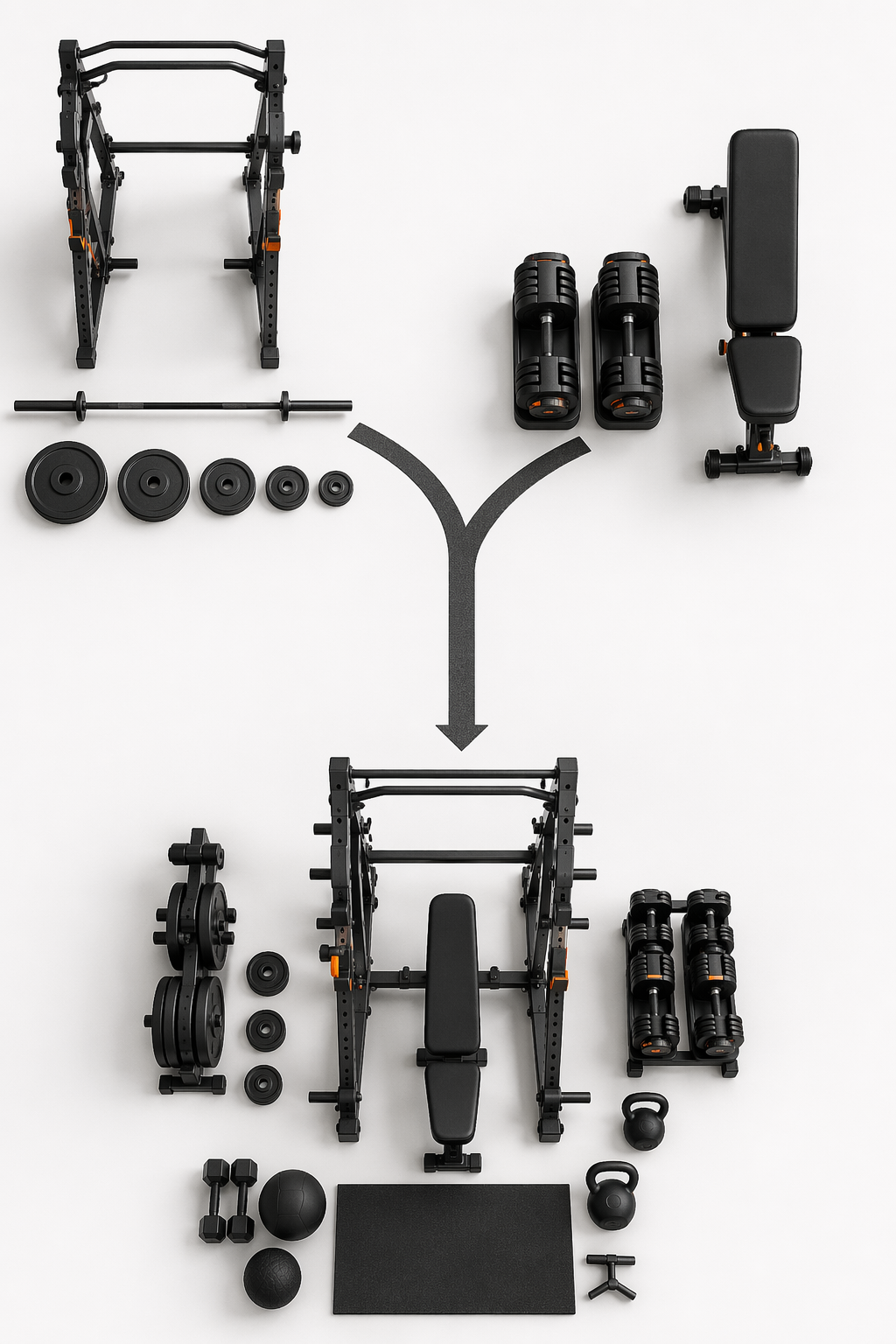
The REP rack is the clearest example of why budget does not have to mean disposable. A 700-lb capacity and attachment compatibility make it easier to grow into than a pile of cheap accessories that solve one session and block the next one [1]. The Synergee barbell shows the same point from another angle: 190,000 PSI tensile strength is the kind of spec that usually gets attention in bars costing much more [1].
CAP dumbbells are the opposite kind of lesson. At about $1 per pound, they are the cheapest clearly identified cost-per-pound option in the cited guide, which makes them easy to justify on paper [1]. The catch is not that they are useless; it is that the finish and feel can be uneven, with inconsistent knurling and enamel flaking [1]. That is a perfectly rational trade-off when the budget is tight, but it should be understood as a trade-off rather than sold as a hidden gem.
$500 to $1,000: add the pieces that change the menu
Once the foundation is in place, the next dollar should buy variety, not repetition. A bench and a cable tower change what the room can do without asking you to replace the base that already works. Pressing angles, flyes, pulldowns, supported rows, and accessory work become easier to program because the space now supports more than one kind of lift.
- Bells of Steel Cable Tower at $435 [1]
- Major Fitness bench at $220 [1]
This tier works best when it follows a real foundation. A cable tower without a stable base becomes an accessory in search of a purpose. A bench without the rest of the system can still be useful, but it is most valuable when it opens up movements the earlier tier could not support. The point is not to make the cart look fuller; it is to make the training menu wider.
$1,000 to $1,500: when an all-in-one stops being overkill
This is the tier where a compact all-in-one starts to make sense if the room is already committed to lifting. Bells of Steel's All-in-One lands around $1,300 [1], which is not cheap, but it can be cheaper than buying several separate pieces that later need replacing. The question is not whether it looks impressive; it is whether it covers the lifts you will actually repeat often enough to justify the footprint.
A buyer who already knows the space will stay dedicated to strength training can treat this tier as consolidation. A buyer who is still guessing may be better served by staying with the simpler foundation and saving the rest for the next constraint that shows up.
How to avoid the six-month upgrade bill
The safest sequence is simple: buy the piece that unlocks the most training you can actually repeat, then add the next piece that removes the biggest constraint. If you are still choosing from constraints rather than product names, the first-time buyer's framework and the home gym equipment decision framework are better route maps than a product list. If your budget later moves beyond $1,500, the broader best home exercise equipment guide is the better next stop.
Digital programming can help a sparse setup feel more complete, but it does not fix a bad first purchase. The useful checkpoint is simpler: if the first durable foundation still makes sense after the novelty wears off, the money was spent in the right order.
References
- The Best Budget Home Gym Equipment of 2026 — Garage Gym Reviews
- Home Fitness Industry Statistics and Trends for 2026 — PTPioneer
Some links on this page are affiliate links — they may earn us a commission at no extra cost to you. Our tier and tests are decided before we ever check which links pay; see our full affiliate disclosure.
Spot something off?
Noise and floor-damage claims carry real deposit-risk consequences if we get them wrong — tell us if your experience with this build didn't match what's above.