

If you only have 30 minutes for cardio at home, the best use of that time is usually not 30 minutes of pure cardio. It is also not abandoning cardio so you can lift instead. A stronger default is to split your weekly workout time roughly evenly between aerobic work and resistance training.
That does not mean every session has to be neatly cut in half. It can mean three mixed workouts, alternating cardio and strength days, or a few shorter sessions that add up to a balanced week. The useful shift is this: strength training is not a side quest you tack on after the “real” heart-health work. In the best current evidence we have for this question, combined training matched aerobic-only training for cardiovascular risk reduction while adding strength gains.

The study that makes the 50/50 split worth taking seriously
The CardioRACE trial followed 406 adults for one year. Participants were ages 35 to 70, had a BMI between 25 and 40, and had elevated blood pressure at baseline. They were assigned to one of four groups: no exercise control, aerobic-only training, resistance-only training, or combined aerobic plus resistance training. The exercise groups completed supervised one-hour sessions three times per week for the year.[1]
The main outcome was not whether one workout felt harder or burned more calories on a watch. Researchers looked at a composite cardiovascular disease risk score built from systolic blood pressure, LDL cholesterol, fasting glucose, and body fat percentage. That matters because home exercisers often get trapped comparing workouts by sweat alone, when the body is responding across several systems at once.[1]
The key result: the combined group and the aerobic-only group had statistically equivalent reductions in the composite cardiovascular disease risk score. The combined group also improved both VO2max and muscular strength, while the aerobic-only group improved VO2max but not strength. The resistance-only group improved strength but not VO2max.[1]
In practical terms, the combined group did not appear to “lose” the cardiovascular risk improvement by giving about half of its training time to resistance work. It got the heart-health risk-score reduction associated with aerobic training and added strength benefits that aerobic-only training did not deliver in the trial.
That is the part worth carrying into a living room workout plan. Not “cardio is overrated.” Not “lifting replaces aerobic exercise.” The cleaner conclusion is that when time is limited, splitting the work can be more efficient than putting every available minute into one mode.
What “statistically equivalent” means when you are choosing tonight’s workout
A statistically equivalent reduction does not mean the two workouts were identical. It means the combined and aerobic-only groups reduced the trial’s cardiovascular risk score to a comparable degree. For someone deciding between jump rope and dumbbells after work, the takeaway is simple enough: choosing a balanced week does not have to feel like you are stealing minutes from your heart.
The body-fat finding adds another useful layer, as long as it is not treated like a personal guarantee. In the CardioRACE reporting, every 1% reduction in body fat was associated with 3%, 4%, and 8% lower risks of developing hypertension, hypercholesterolemia, and metabolic syndrome, respectively.[1] That is an association from the study, not a promise that one person’s risk will drop by a precise amount after a certain number of workouts.
The trial also has boundaries. These were supervised sessions, not improvised workouts between laundry and dinner. The participants were middle-aged to older adults with elevated blood pressure and BMI in the overweight-to-obesity range. A younger, leaner, already-trained person may not respond in exactly the same way. Someone with diagnosed cardiovascular disease or symptoms needs medical guidance, not a generic template from the internet.
Still, the study answers a common home-training question better than preference-based advice does. If you have been doing only cardio because you assumed strength work would dilute the heart-health benefit, the evidence does not support that worry.
How to turn 50/50 into a home workout week
A 50/50 plan is easiest to follow when you count weekly minutes instead of trying to make every workout perfectly symmetrical. If you have 150 total workout minutes available, aim for about 75 minutes of aerobic work and about 75 minutes of resistance training. If you only have 90 minutes, split it close to 45 and 45. The point is the balance, not a spreadsheet.
| If your week allows | One workable 50/50 structure | What it looks like at home |
|---|---|---|
| 3 workouts | 3 mixed sessions | 15 minutes cardio + 15 minutes strength each session |
| 4 workouts | 2 cardio days + 2 strength days | Two 30-minute cardio sessions and two 30-minute strength sessions |
| 5 workouts | Shorter alternating sessions | Cardio and strength split across the week with total minutes kept roughly even |
| 6 short sessions | Micro-sessions | 10 to 15 minutes at a time, alternating emphasis so the week balances out |
For the aerobic half, use movements that keep large muscle groups working continuously: jumping jacks, mountain climbers, jump rope, high knees, or equipment-based cardio. If you have access to a treadmill, bike, rower, or no machine at all, the choice matters less than whether the option is repeatable in your space; this cardio equipment guide for home workouts can help narrow that decision.
For the resistance half, build around push-ups, squats, lunges, and rows. Johns Hopkins Medicine lists aerobic exercise and resistance training as different kinds of exercise that support heart health, with examples including jumping jacks, mountain climbers, push-ups, squats, lunges, and rows.[2] Those movements are also realistic in a spare bedroom: they do not require a full rack, a garage gym, or a floor plan designed by someone who has never lived with furniture.
When squats and lunges show up several times a week, the lower body can get cranky before your motivation does. If you are unsure how often to train legs without turning every staircase into a negotiation, use this guide to leg workout frequency at home to adjust the spacing.
Option 1: Three mixed 30-minute sessions
This is the simplest plan if your calendar regularly eats workouts. Do it Monday, Wednesday, and Friday, or on any three nonconsecutive days.
- Minutes 0–15: cardio using jumping jacks, mountain climbers, jump rope, high knees, or an equipment-based option.
- Minutes 15–30: resistance training using push-ups, squats, lunges, and rows.
- Keep the transition boring: water, reset the timer, start the next block. Do not spend five minutes deciding which version of a lunge counts.
The cardio block should feel sustainable rather than frantic. The strength block should leave you with clean reps still available, especially early on. If form breaks down, the set is over even if the timer is still running.
Option 2: Alternating cardio and strength days
If you dislike switching modes mid-workout, keep the sessions separate and balance the week instead.
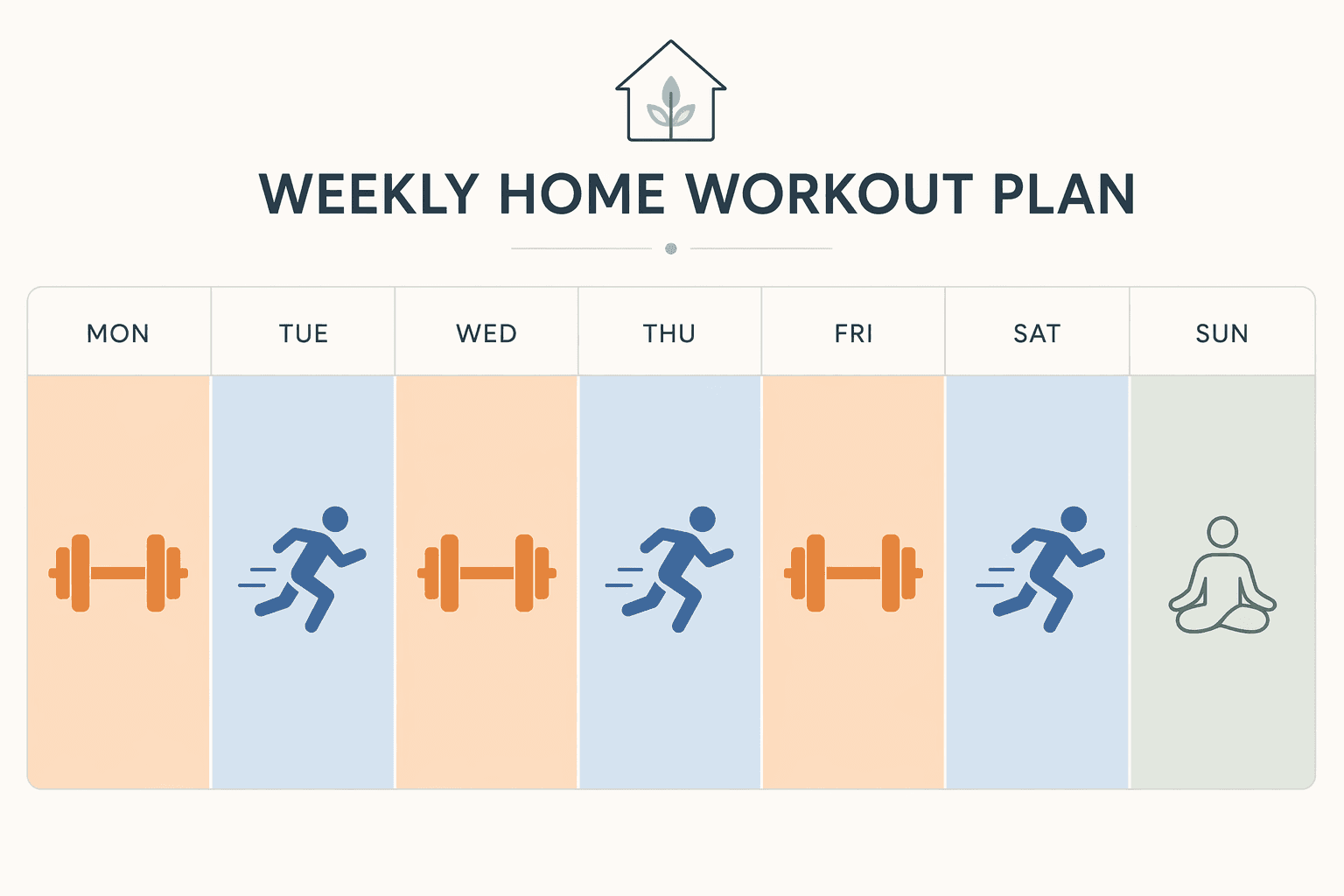
| Day | Session |
|---|---|
| Monday | Cardio |
| Tuesday | Strength |
| Wednesday | Rest or easy movement |
| Thursday | Cardio |
| Friday | Strength |
| Saturday | Optional short cardio or strength session to balance minutes |
| Sunday | Rest |
This layout works well for people who can focus better when the workout has one job. A cardio day can be jump rope or high knees intervals. A strength day can rotate through push-ups, squats, lunges, and rows. If Saturday happens, choose the mode that is behind for the week.
Option 3: Short sessions when life will not hand over 30 minutes
A home plan has to survive interruptions. Ten or 15 minutes still count if you know what they are for. One short session might be all cardio: jump rope, jumping jacks, mountain climbers, or high knees. The next might be all strength: push-ups, squats, lunges, and rows. Over the week, keep the totals close.
This is also where tracking helps. A basic note on your phone is enough, but if you like app-based logging, this iPhone fitness app guide can help if you want to track mixed cardio and strength sessions without rebuilding your entire routine around an app.
Where this fits with standard heart-health guidelines
The American Heart Association recommends at least 150 minutes per week of moderate-intensity aerobic activity, or 75 minutes per week of vigorous aerobic activity, plus moderate- to high-intensity muscle-strengthening activity at least two days per week.[3] That guidance is still the broader public-health checkpoint.
A 50/50 home plan does not erase that recommendation. It gives you a practical structure when you are trying to build a week you can actually repeat. If you are currently doing no structured exercise, three 30-minute mixed sessions may be a more realistic start than trying to hit every guideline perfectly on week one. If you are already active and tolerating more volume, you can build toward the AHA target while keeping resistance training in the plan.
Moderate aerobic work should feel purposeful but controlled. Vigorous work is harder and requires more recovery. The AHA’s target heart rate chart and Cleveland Clinic’s heart-rate-zone guidance can help people who use heart rate to gauge intensity, but you do not need to turn every home workout into a lab test.[4][5]
A sample 50/50 week for cardio at home
Here is a straightforward week for someone with about two and a half hours available. Adjust the session length down if you are starting from less; the split matters more than forcing a jump in volume your knees, shoulders, or schedule cannot handle.
| Day | Workout | Focus |
|---|---|---|
| Monday | 30 minutes cardio | Jump rope, high knees, jumping jacks, mountain climbers, or equipment-based cardio |
| Tuesday | 30 minutes strength | Push-ups, squats, lunges, rows |
| Wednesday | Rest or easy movement | Let soreness settle; keep the habit light |
| Thursday | 30 minutes cardio | Repeat Monday’s format or use another cardio option you can control |
| Friday | 30 minutes strength | Push-ups, squats, lunges, rows, with good form taking priority |
| Saturday | 30 minutes mixed | 15 minutes cardio + 15 minutes strength |
| Sunday | Rest | No make-up punishment required |
That sample gives you 75 minutes of cardio and 75 minutes of resistance training. It is not the only valid arrangement. A person with unpredictable weekdays might do mixed sessions on Tuesday, Thursday, and Saturday. Someone who enjoys equipment might use a bike or rower for the cardio half. Someone without equipment can stay with jumping jacks, mountain climbers, jump rope, and high knees.
The strength side should not become a race. Push-ups can be modified. Squats and lunges can be shortened or slowed. Rows need enough control that the back and arms are doing the work rather than momentum. The home version of the CardioRACE idea depends on repeatable training, not on turning every session into a test of toughness.
How hard should the cardio portion be?
For most home exercisers, the right intensity is the one you can repeat without needing three days to recover. If you are doing jumping jacks, mountain climbers, jump rope, or high knees, you can adjust intensity by changing speed, range of motion, or work-to-rest timing. Equipment-based cardio lets you adjust pace, resistance, or incline.
Heart-rate zones can be useful, especially for people who tend to make every workout either too easy or too punishing. But a home cardio plan should also respect joint feedback, breath control, and coordination. If high knees make your knees complain, choose a different aerobic option. If mountain climbers turn into a collapsing plank, slow down or shorten the interval.
Who should be more cautious with this plan
The CardioRACE findings are useful, but they are not a medical clearance. If you have cardiovascular disease, chest pain, unexplained shortness of breath, dizziness, fainting, unusual heart symptoms, or major medical concerns, talk with a healthcare provider before starting or intensifying exercise. The same goes if you have been inactive and plan to jump into vigorous intervals.
Supervision is another difference between a trial and a living room. In the study, sessions were supervised. At home, you are responsible for pacing, form, warm-up decisions, and whether you stop when something feels wrong. That does not make home training ineffective. It just means the plan has to be honest about what you can perform well without someone watching every rep.
If your available workout time is limited, a roughly even split between aerobic and resistance training is a strong evidence-backed default. It preserves the cardiovascular risk reduction seen with aerobic-only training in CardioRACE while adding muscular strength. Start with a weekly split you can repeat, keep the cardio intensity appropriate, treat strength form as nonnegotiable, and adjust from there.
References
- New research finds half cardio, half strength training reduces cardiovascular disease risks, Iowa State University
- 3 Kinds of Exercise That Boost Heart Health, Johns Hopkins Medicine
- American Heart Association Recommendations for Physical Activity in Adults and Kids, American Heart Association
- Target Heart Rates Chart, American Heart Association
- Exercise Heart Rate Zones Explained, Cleveland Clinic
Comments
Join the discussion with an anonymous comment.