The most useful version of a Dallas Cowboys Cheerleader workout routine does not start with a costume, a stage, or a vague promise to “train like a dancer.” It starts with a timer. In a 2017 description of Jay Johnson’s DCC boot camp format, the structure was blunt: 10 basic exercises, 30 seconds each, as many reps as possible with perfect form, followed by 24 flights of stairs.[1]
That is the engine worth borrowing at home. Short rounds. Simple movements. No hiding bad reps behind speed. The stairs are the one piece most living rooms cannot copy cleanly, so the home version needs a smart finisher: step-ups, stair repeats if you have access, or high-knee intervals if you do not.
Before the workout, the sourcing deserves one clean boundary. Johnson’s 2017 boot camp format gives the structure. Sydney Durso’s published routine on the Dallas Cowboys site gives the richest exercise bank, including glute and leg work, obliques, lats, and core moves.[2] Charly Barby’s later comments about glute bridges and relevés add useful member-level emphasis, especially for kick work and ankle stability in boots.[3] The older Power Squad Bod DVDs show that DCC-branded fitness has also used boot camp, abs, arms, yoga, and dance-cardio formats, but they are historical context rather than a current purchasing path.[4]
So this is not a certified replica of a team practice. It is a practical, DCC-inspired home blueprint built from documented pieces: timed boot camp conditioning, glute-heavy leg work, core training, and a conditioning finish.
The At-Home DCC-Inspired Workout
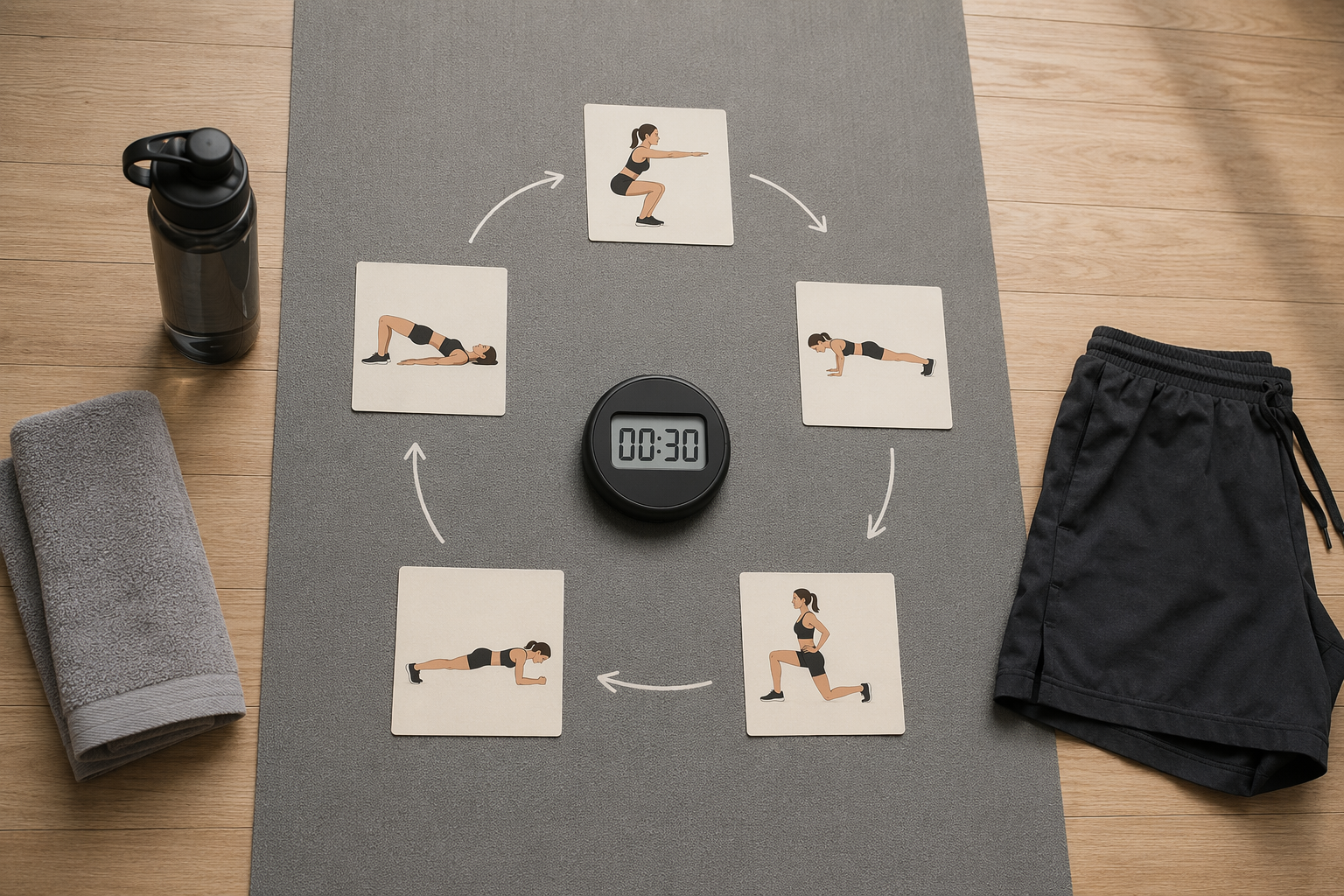
Set a timer before you start. The main circuit uses 30-second work intervals because that is the clearest part of Johnson’s format.[1] Move fast only while your form stays clean. If your push-ups collapse, your lunges shorten, or your back starts doing the work your abs should be doing, the round is over even if the timer is not.
| Block | What You Do | Time |
|---|---|---|
| Warm-up | Mobility, light cardio, activation | 5 minutes |
| Timed boot camp circuit | 10 basic bodyweight exercises, 30 seconds each | 5 minutes per round |
| Glute and leg block | Bridge work, lunges, side kicks, squat walks | 8-12 minutes |
| Core and oblique block | Twists, air bike, leg-raise variation, back-extension variation | 6-8 minutes |
| Conditioning finisher | Home substitute for the 24-flight stair finish | 4-8 minutes |
If you are new to training, do one round of each block and stop while you still have control. If you already train consistently, do two rounds of the boot camp circuit and two rounds of the glute and core blocks.
Warm Up Like You Plan To Kick, Lunge, And Brace
The warm-up should prepare your hips, ankles, core, and shoulders without draining the legs before the timed work begins. Five minutes is enough if you stay focused.
- March or jog in place for 60 seconds.
- Do 10 bodyweight good mornings, keeping your ribs down and hips moving back.
- Do 10 alternating reverse lunges, stepping back far enough that the front heel stays planted.
- Do 10 slow glute bridges, squeezing at the top instead of arching your lower back.
- Do 20 calf raises, rising through the big toe and lowering with control.
- Do 20 seconds of plank shoulder taps, widening your feet if your hips rock.
The calf raises are not decorative. Barby has described doing 32 relevés per session for ankle stability in heeled boots, and that detail makes sense for anyone who has ever tried to move sharply while the ankle is doing extra balance work.[3]
Block 1: The 30-Second Perfect-Form Boot Camp Circuit
This is the part that should feel closest to Johnson’s boot camp philosophy: basic exercises, 30 seconds each, max reps with perfect form.[1] “Max reps” does not mean frantic reps. It means the highest number you can complete without shortening the range of motion, twisting to compensate, or letting the landing get noisy.
| Exercise | 30-Second Goal | Home Form Cue |
|---|---|---|
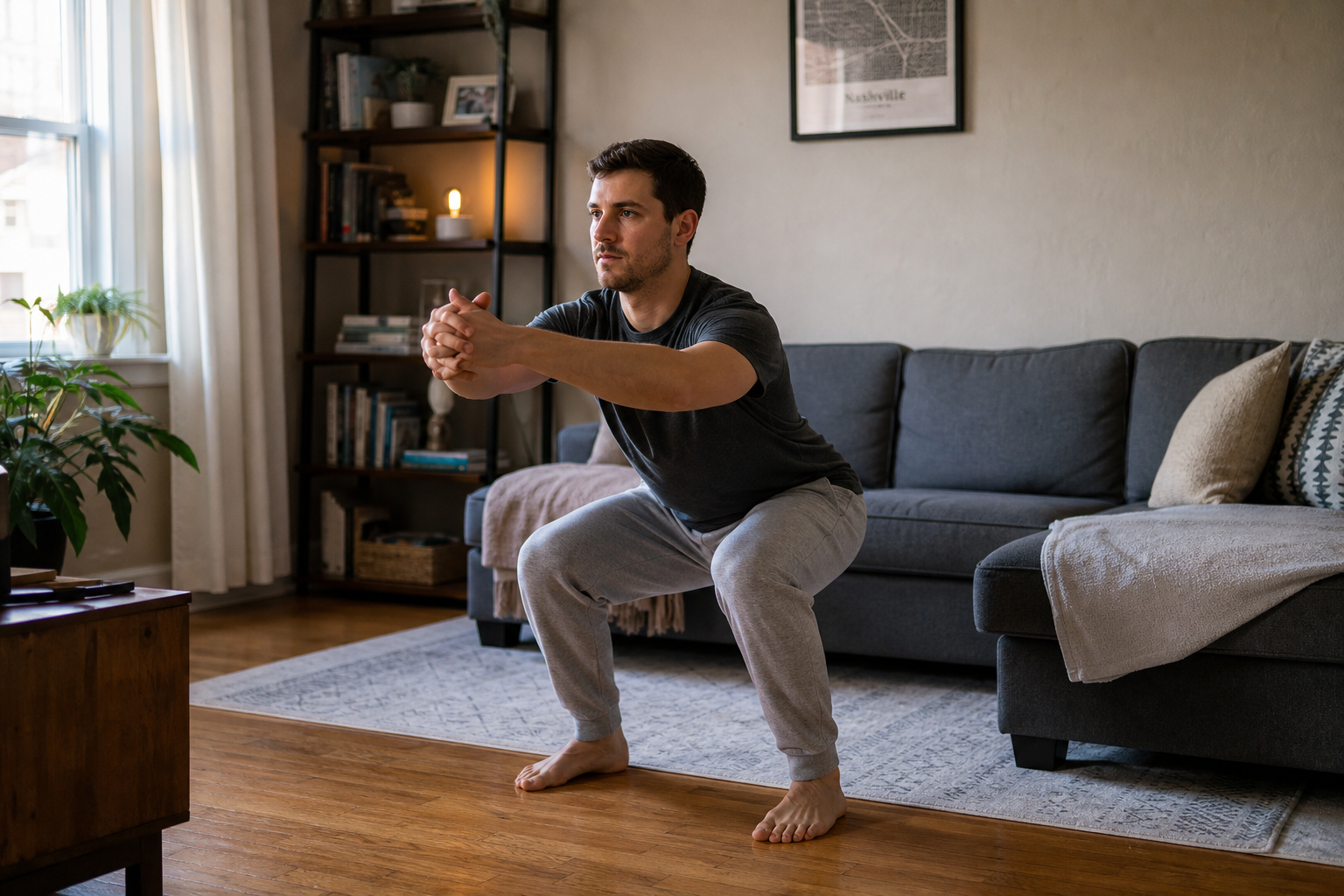
| Bodyweight squats | Steady reps | Sit the hips back, keep the chest lifted, and drive through the full foot. |
| Push-ups | Full-body or knees-down | Lower as one piece; do not let the hips sag first. |
| Alternating reverse lunges | Controlled alternating reps | Step back softly and keep the front knee tracking over the toes. |
| Mountain climbers | Quick but braced | Pull the knee forward without bouncing the shoulders. |
| Plank shoulder taps | Slow enough to stay square | Widen the feet if the hips swing. |
| Jumping jacks | Light cardio pace | Land quietly; step out instead of jumping if needed. |
| Glute bridge marches | Alternate legs | Keep the hips level as each foot lifts. |
| Air squats to calf raise | Squat, stand, rise | Finish tall through the ankle without rolling outward. |
| Bicycle crunches | Smooth rotation | Rotate the ribs; do not yank the neck. |
| High knees | Fast finish | Stay tall and pump the arms; march if impact is too much. |
Rest 60 to 90 seconds after the 10th exercise. Beginners can stop after one round. Intermediate exercisers can repeat the circuit once more. Advanced exercisers can do a third round, but only if the third round still looks like training and not survival.
How To Count The Round
Pick two exercises to track, not all 10. For example, count squats and push-ups in round one, then try to match clean reps in round two. That keeps the workout measurable without turning the whole thing into a spreadsheet.
A clean second round with the same number of squats is a better result than a messy second round with five more. That standard matters in this style of workout because fatigue arrives quickly when every exercise is timed.
Block 2: Glutes And Legs, Adapted From Member-Shared Exercises
Durso’s published gym routine is especially useful because it names actual exercises instead of staying at the level of “tone your legs.” Her glute and leg list includes glute raises, single-leg bridge-ups, resistance band walking squats, standing side kicks, jump lunges, double lunges, and walking lunges with a twist.[2]
At home, you can keep the intent without owning the exact equipment. A missing resistance band is not a crisis. Slow tempo, longer ranges, and cleaner pauses can create plenty of work.
| Move | Reps Or Time | Home Adaptation |
|---|---|---|
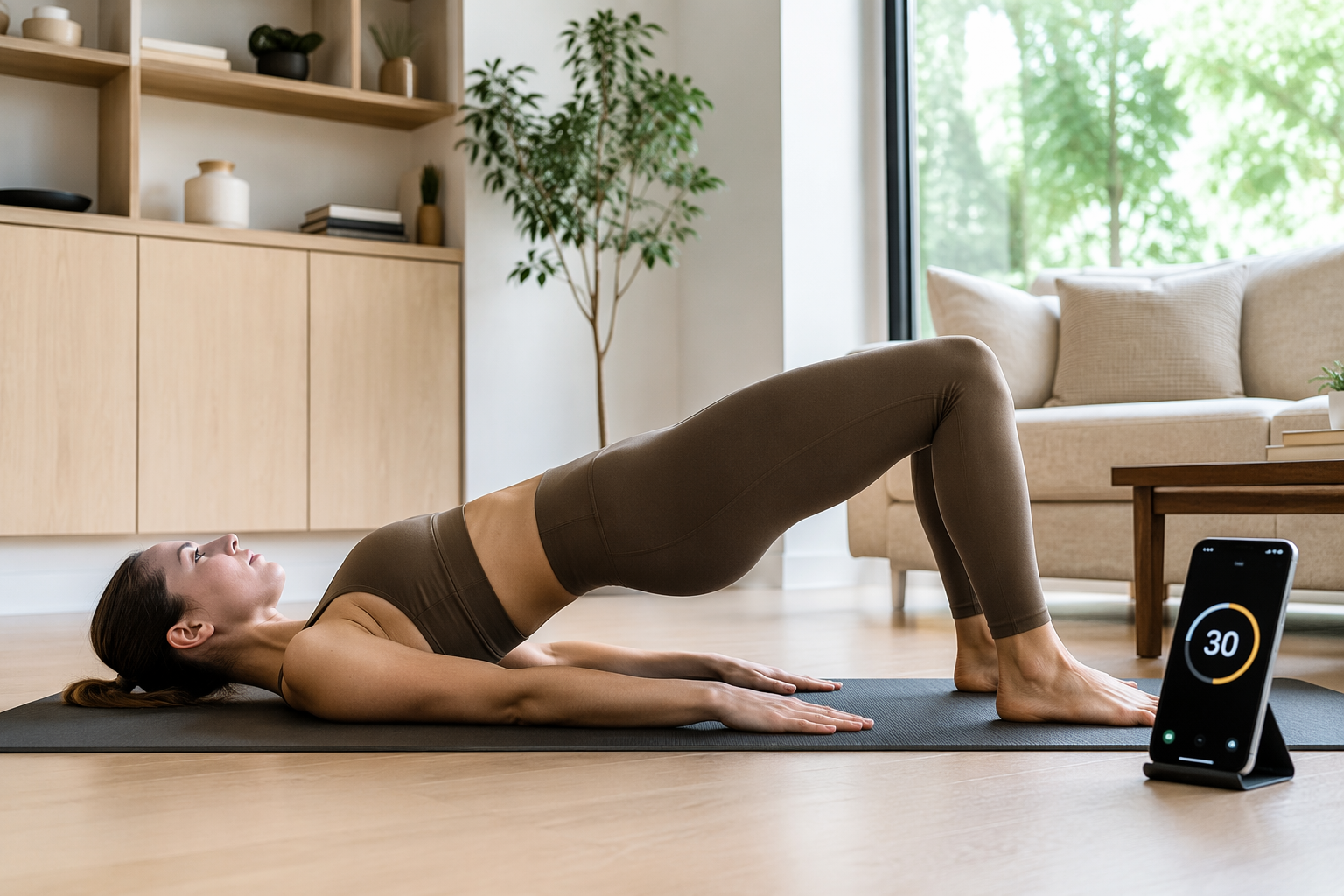
| Glute bridges | 15 reps | Pause for two seconds at the top and keep the ribs stacked over the pelvis. |
| Single-leg bridge-ups | 8-10 each side | Keep both hip bones level; switch to staggered-stance bridges if the pelvis drops. |
| Walking squat steps | 30 seconds | No band needed; stay low and step side to side with controlled knees. |
| Standing side kicks | 12 each side | Hold a wall or chair lightly; move from the hip, not the lower back. |
| Jump lunges | 20 seconds | Use reverse lunges if jumping changes your landing or knee position. |
| Double lunges | 6 each side | Do two small pulses at the bottom, then stand fully before switching. |
| Walking lunges with twist | 8 each side | Use a bodyweight torso rotation instead of a medicine ball. |
The bridge work deserves priority, not because it is trendy, but because it solves a real movement problem. Barby has said she emphasizes glute bridges to keep pressure off the hip flexors during kick training.[3] For a home workout, that translates into a simple rule: make the glutes do their job before you ask the legs to lunge, kick, or jump.
On the side kicks, height is not the first target. A lower kick with a level pelvis is more useful than a high kick that folds through the waist. If your standing hip grips or your lower back tightens, reduce the range and reset.
If you want to build this block into a fuller lower-body day later, pair it with more bodyweight leg options from no-equipment leg workouts or use it as a short finisher after a broader leg workout at home.
Block 3: Core, Obliques, And Back Without Gym Machines
Durso’s routine separates obliques and lats from core work. Her listed movements include medicine ball twists, decline oblique sit-ups, hyperextensions, hanging leg raises, assisted pull-ups, lat pull-downs, ab roller, and air bike.[2] That is a gym routine, so the home version needs substitutions that preserve the movement pattern without pretending your living room has a pull-up station.
| Gym Exercise From The Source | At-Home Version | Do This |
|---|---|---|
| Medicine ball twists | Bodyweight seated twists | 30 seconds, heels down if your hip flexors take over |
| Decline oblique sit-ups | Side-lying oblique crunches | 10-12 each side |
| Hyperextensions | Prone swimmers or superman lifts | 10 slow reps |
| Hanging leg raises | Reverse crunches | 10-15 reps with the lower back controlled |
| Assisted pull-ups | Prone W pulls | 12 reps, squeezing shoulder blades down and back |
| Lat pull-downs | Towel lat press-downs | 12 reps, pulling a towel tight while lowering the arms |
| Ab roller | Bodyweight plank walkouts | 6-8 reps, shorter range if the back arches |
| Air bike | Bicycle crunches | 30 seconds |
Run this as one controlled circuit. Rest when your neck starts helping your abs, when your lower back arches during the walkout, or when the twisting stops coming from the ribs. Core work should make the next block safer, not leave you too tired to brace.
The Stairs Finisher, Without Needing 24 Flights
Johnson’s boot camp description ends with 24 flights of stairs.[1] That is a serious conditioning demand, and it is also the least home-friendly part of the format. Do not turn it into a reckless apartment-stairwell sprint if the stairs are narrow, shared, slippery, or poorly lit.
Choose one finisher based on what you actually have:
- If you have safe stairs: climb one flight briskly, walk down, and repeat for 4-8 minutes.
- If you have a sturdy step or low bench: do 30 seconds of alternating step-ups, rest 30 seconds, and repeat 6-8 times.
- If you have no step: do 20 seconds of high knees, rest 40 seconds, and repeat 6-8 times.
- If impact bothers your joints: march hard in place for 40 seconds, rest 20 seconds, and repeat 6-8 times.
The step-up version is usually the cleanest home substitute because it keeps the climbing pattern without requiring a building full of stairs. Use a surface that does not wobble. A chair only belongs here if it is heavy, stable, and placed where it cannot slide.
Where The DVD History Fits
The Power Squad Bod programs are useful mainly because they show that DCC-branded home fitness has leaned into structure before. A review of Hard Body Boot Camp described a 60-minute DVD with Total Ab Assault, Total Arm Assault, a yoga intro, and beginner, intermediate, and expert tracking tracks; Calorie Blasting Dance was described as a 36-minute beginner-intermediate cardio-dance option with no equipment.[4]
That history supports the shape of this workout: boot camp, abs, arms, mobility, and dance-cardio can all live under the same training umbrella. It does not mean an older DVD is the current team program, and it does not need to become the center of your routine. The cleaner move is to use the same kind of structure: clear tracks, repeatable sessions, and a level you can actually complete.
If you like that guided-track feeling, a simple beginner plan such as a 20-minute home workout for beginners or a first-month workout structure can be a better next step than trying to make every session longer.
How Often To Do This Routine
Use this routine two or three times per week, leaving at least one easier day between hard sessions. The lunge, bridge, kick, and stair patterns all ask a lot from the hips, calves, and ankles. More is not automatically better if the next session starts with tight hip flexors and sore knees.
| Level | Best Starting Version | Progress When |
|---|---|---|
| Beginner | One boot camp round, one glute block, short core block, low-impact finisher | You finish with steady breathing and clean lunges |
| Intermediate | Two boot camp rounds, full glute block, full core block, step-up finisher | Your second round matches your first-round form |
| Advanced | Two or three boot camp rounds, full glute and core blocks, stair or high-knee finisher | You can add work without losing landing control |
For beginners, the first progression should be cleaner reps, not harder variations. Keep push-ups elevated on a couch or counter. Replace jump lunges with reverse lunges. Keep the finisher low impact until your calves and feet tolerate the repeated work.
For variety, rotate this with a different structured session such as a beginner kettlebell workout at home if you want loaded training, or keep it equipment-free and build the lower-body work gradually.
The documented pieces do not reveal a secret body-making formula, and they do not need to. They give something more usable: a timed circuit standard, a strong glute and leg exercise bank, core work that can be adapted without machines, and a conditioning finish that can be scaled to a living room.
References
- Jay Johnson's Boot Camp Format, D Magazine, 2017
- DCC Sydney Durso's Gym Routine, dallascowboys.com
- Charly Barby's Glute Bridge Emphasis, Women's Health, 2025
- Power Squad Bod Hard Body Boot Camp, GameVortex
Comments
Join the discussion with an anonymous comment.